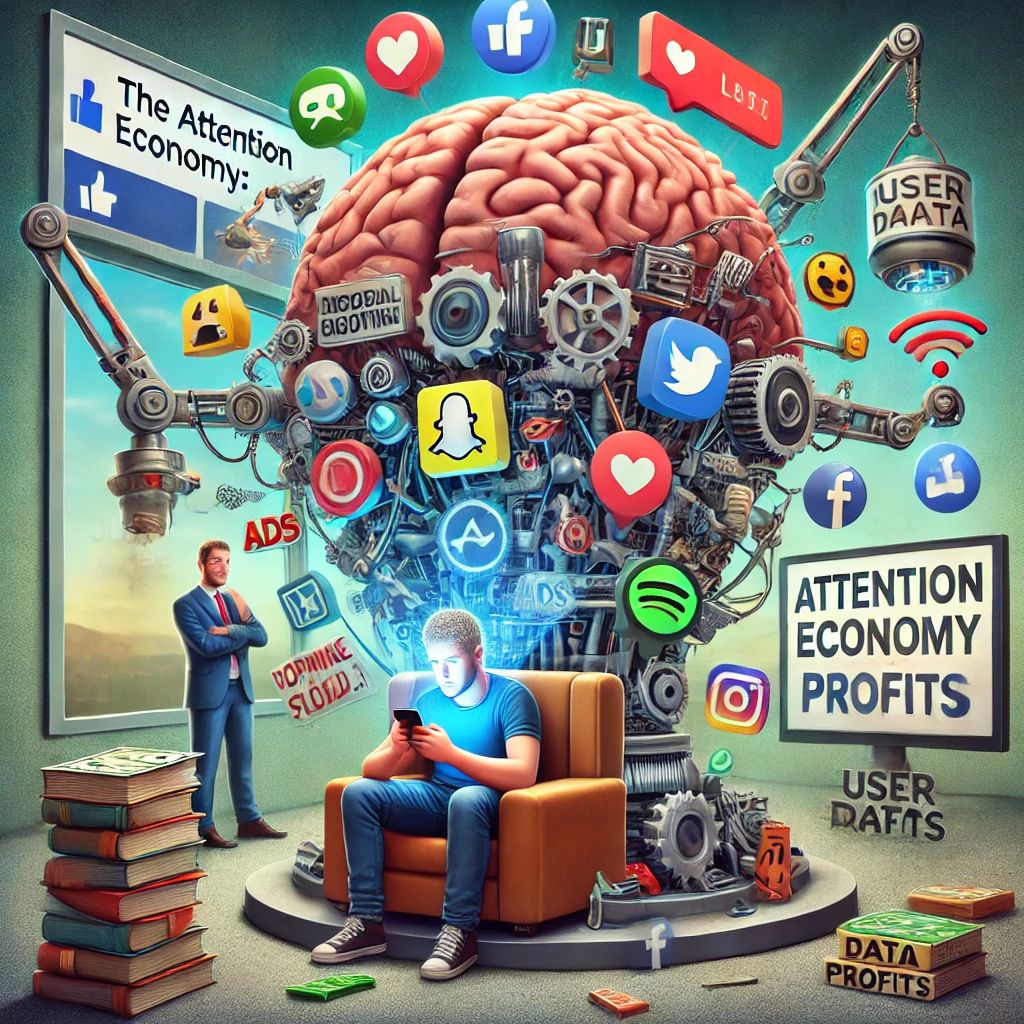
🚀 “The Attention Economy: Are We Paying or Being Played?” 🧠📱💰
In a world where notifications never stop and algorithms know us better than we do, attention has become the most valuable commodity. But are we truly in control, or just products in the digital marketplace?
📊 The Business of Attention
✅ The average person spends 7 hours a day on screens. (Statista, 2024)
✅ Digital ad spending hit $700B globally in 2023. (eMarketer, 2024)
✅ Social media engagement is worth $1.5T to tech giants. (Forbes, 2024)
❌ But attention spans have dropped from 12 seconds (2000) to 8 seconds (2024). (Microsoft Study)
🚨 Reality Check: Are we consuming content, or is content consuming us?
🔴 How the Attention Economy Manipulates Us
🧠 Dopamine Loops: Infinite scrolling & notifications keep us addicted.
📱 Algorithm Traps: AI-driven feeds push extreme content to maximize engagement.
💰 Monetized Distraction: Platforms profit from every second of our attention.
🚨 Reality Check: If it’s free, you’re the product.
🔎 Who’s Winning in the Attention Economy?
🔹 🇺🇸 TikTok & Instagram: Hooking Gen Z with ultra-short content.
🔹 🇺🇸 YouTube & Netflix: Using AI to predict and control viewing habits.
🔹 🇨🇳 Tencent & Bytedance: Monetizing micro-engagement with gamification.
🔹 🇮🇳 Jio & ShareChat: Expanding India’s digital consumption at record speed.
🚨 Reality Check: Are we really choosing what we watch, or is it choosing us?
🏆 KeyTakeaway
The Attention Economy could be a tool for learning and connection, should be designed for well-being, but would be a dystopian trap if we let tech control our focus.
👉 Are you in charge of your attention, or is someone else profiting from it?
AttentionEconomy DigitalAddiction BigTech AI SocialMedia
Originally published on LinkedIn on 2025-02-04 12:25:19: https://www.linkedin.com/feed/update/urn%3Ali%3AgroupPost%3A9270968-7292518584398893056
NamateIndia
Close Collaboration Between Sustainability and Tax Teams: A Winning Strategy
When it comes to implementing the Corporate Sustainability Reporting Directive (CSRD), involving tax teams from the outset is crucial. Here’s why:
1. Holistic Risk Assessment: By working together, sustainability and tax teams can conduct a holistic risk assessment. Sustainability risks often intersect with tax implications, and addressing them collectively ensures comprehensive risk management.
2. Materiality Alignment: Tax considerations can significantly impact materiality assessments. Involving tax experts from the start ensures alignment between financial materiality and sustainability materiality.
3. Value Creation: Close collaboration fosters innovation. Tax professionals can identify opportunities for value creation through sustainable practices, tax incentives, and efficient resource utilization.
Remember, it’s not just about compliance; it’s about creating a sustainable and resilient business.
Corporate Sustainability Reporting Directive (CSRD) aims to enhance transparency and comparability of sustainability information across the EU. It expands reporting requirements for large companies and introduces digital reporting standards.
As per European Commission, “Corporate Sustainability Reporting” Directive,” https://lnkd.in/gNmGnygY
Originally published on LinkedIn on 2024-07-23 14:54:53: https://www.linkedin.com/feed/update/urn%3Ali%3Ashare%3A7221528203062910977

