WHEN_SHIT_STARTS_FLYING, FOLLOW THE CARBON.
Dr. Anju Sharma MrsSustainability
Village gobar gas was a near-perfect local loop:
Dung → Digester → Cookstove → Digestate → Soil
Waste became energy. Nutrients stayed local. Almost nothing moved.
IndustrialCBG changes the equation.
The moment a local manure loop becomes a centralised energy business, it acquires:
Aggregation → Trucks → Upgrading → Compression → Storage → Distribution → Digestate logistics
The chemistry is the same.
The carbon system is not.
TheHiddenCarbon
Take a 100 t/day plant sourcing wet biomass over an average 50 km.
100 t × 50 km = 5,000 tonne-km/day
At ~0.12 kg CO₂e/tonne-km:
→ ~220 t CO₂e/year
from loaded inbound freight alone.
Not counted:
Empty backhaul
Digestate return
Compression power
CBG distribution
Steel + concrete + plant equipment
And then comes methane.
Biogas/biomethane systems can lose around 2–5.5% of methane output across digestion, upgrading, storage & handling.
That can mean roughly:
1 t CH₄ produced → ~0.5–1.5 t additional CO₂e on a 100-year basis.
That is not an operational footnote.
It can materially erode the climate advantage before logistics, electricity & infrastructure even enter the ledger.
TheStrategicBlindSpot
The atmosphere does not distinguish between methane from a gas field & methane from a cowshed.
It responds to the molecule.
That is why the global biomethane debate is already moving from:
Renewable origin → Verified lifecycle performance
EU, UK, US, Denmark & Brazil increasingly focus on some combination of:
Feedstock eligibility | lifecycle GHG thresholds | methane leakage | chain-of-custody | actual emissions avoided
India should be asking the same question.
Capturing manure that would otherwise decay anaerobically & emit methane can create real climate value.
But:
Long feedstock radius + wet-biomass trucking + residue removal + methane slip + compression energy ≠ automatically green
PolicyInversion
If policy rewards:
Installed capacity + tonnes of CBG
the system optimises for volume.
If policy rewards:
Verified net CO₂e avoided
the system optimises for:
↓ Methane leakage
↓ Feedstock radius
↓ Fossil logistics
↑ Genuine waste diversion
↑ Digestate return
↑ Lifecycle carbon integrity
That is the difference between a bioenergy programme & a decarbonisation programme.
The real KPI should therefore be:
Net CO₂e avoided / unit of useful energy
Not merely tonnes of gas produced.
The full CarbonLedger must include:
Feedstock km | methane slip | transport fuel | compression power | digestate fate | soil-carbon impact | infrastructure footprint | counterfactual emissions
As once policy rewards capacity before carbon performance, the pattern becomes predictable:
Build first → Certify green → Audit later.
So when shit starts flying across districts:
Follow the carbon not the certificate.
Originally published on LinkedIn on 2026-08-09 16:10:45: https://www.linkedin.com/feed/update/urn%3Ali%3Ashare%3A7492251033277100032
Pound Powering Grids:
UK’s Shift Toward Net Zero
When politics meets power, and trade meets turbines—September 2025 proved that the UK is no longer flirting with Net Zero. It is writing cheques, signing pacts, and wiring grids. From billion-pound nuclear bets to global trade deals, the country is putting money where its climate mouth is.
1. Big Moves
A. £38B for Sizewell C → 3.2 GW nuclear, ~6M homes powered, ~9 MtCO₂ saved per year.
B. £10B Centrica/X-Energy AMR plan → 12 small reactors, path to 6 GW by 2045.
C. UK–US Nuclear Pact → aims to cut reactor approval time by 30–40%.
D. £1.1B for greenports & shipping upgrades.
E. £1.25B US investment in UK jobs + UK–India FTA adding £6B exports.
2. Net Zero Impact
A. UK target: 100% clean power by 2035 (Labour aims for 2030).
B. Grid investment: £24.2B approved (2026–2031), ~£80B needed in total.
C. Renewables gap: need 190 GW by 2035, pipeline ~130 GW.
D. Storage shortfall: need 30 GW, <10 GW in place.
E. Costs: Sizewell levies to add ~£221K/year for large firms from 2026.
3. Watchpoints
A. Renewables must accelerate (planning, auctions, storage).
B. Investors_split: BP cut renewables by $5B, Centrica goes nuclear.
C. October 2025’s Carbon Budget Plan update will test credibility.
Takeaway: The UK is betting big—billions in nuclear, bold grid spending, and global trade deals. But Net Zero depends on renewables and storage catching up.
Would you put more pounds into nuclear or into renewable speed?
📌 Abbreviation Explainer
GW – Gigawatt (1,000 megawatts of power capacity)
MtCO₂ – Million tonnes of carbon dioxide
AMR – Advanced Modular Reactor
SMR – Small Modular Reactor
FTA – Free Trade Agreement
RIIO – Revenue = Incentives + Innovation + Outputs (UK grid regulation model)
CfD – Contracts for Difference (UK renewable auction scheme)
CCC – Climate Change Committee (UK advisory body)
NESO – National Energy System Operator (UK system planner)
ONR – Office for Nuclear Regulation (UK)
DOE – Department of Energy (US)
KtalystInsights | MrsSustainability | NamasteIndia
Originally published on LinkedIn on 2025-09-15 16:28:12: https://www.linkedin.com/feed/update/urn%3Ali%3Ashare%3A7373392204171579392
🔐💸NetZero NoHomeLoans? Rethinking Home loans Escrow Escapades: Who’s Holding the Money Bag?
💡 KtalystInsight:
Home loans isn’t just about locking funds—it’s about unlocking trust. The real estate handshake is only as strong as the hand that holds the money.” — Dr. Anju Sharma
In the global real estate relay race, escrow is the referee holding the baton of trust. But who plays it best?
🏢 NamasteIndia locks 70% of project funds in a RERA vault. No milestone? No money.
🏠 USA prefers “You buy, I hold” with third-party escrow—till you get the keys.
🔑 UK politely lets the developer keep the deposit—and hopes they behave.
🌆 UAE and Singapore? Tough love. Escrow’s like a tiger mom—milestone-first, money-later.
🇩🇪 Germany trusts its notaries like grandmas trust recipes—strict, reliable, no tampering.
BBV Forum (Bharat Bhagya Vidhata Forum)
Sustainability Infographics 📊
Originally published on LinkedIn on 2025-07-15 16:22:01: https://www.linkedin.com/feed/update/urn%3Ali%3AgroupPost%3A82951-7350922599842873345
🔐💸NetZero NoHomeLoans? Rethinking Home loans Escrow Escapades: Who’s Holding the Money Bag?
💡 KtalystInsight:
Home loans isn’t just about locking funds—it’s about unlocking trust. The real estate handshake is only as strong as the hand that holds the money.” — Dr. Anju Sharma
In the global real estate relay race, escrow is the referee holding the baton of trust. But who plays it best?
🏢 NamasteIndia locks 70% of project funds in a RERA vault. No milestone? No money.
🏠 USA prefers “You buy, I hold” with third-party escrow—till you get the keys.
🔑 UK politely lets the developer keep the deposit—and hopes they behave.
🌆 UAE and Singapore? Tough love. Escrow’s like a tiger mom—milestone-first, money-later.
🇩🇪 Germany trusts its notaries like grandmas trust recipes—strict, reliable, no tampering.
Rajnish Jayaswal
Originally published on LinkedIn on 2025-07-15 16:13:00: https://www.linkedin.com/feed/update/urn%3Ali%3AgroupPost%3A2474261-7350920331458498560
📉 🧾 Headlines That Shouldn’t Be Greened Over – With Dates:
🇩🇪 3 April 2025 | DWS (Germany) fined €25 million by BaFin & German prosecutors for exaggerating ESG credentials in fund marketing.
🇦🇺 19 March 2025 | ActiveSuper fined A$10.5 million (US$6.7M) by ASIC for falsely claiming fossil fuel divestment while investing in coal and gambling.
🇫🇷 June 2025 (Trial opened) | TotalEnergies faces a landmark greenwashing civil trial for promoting natural gas as a “clean transition fuel.” Verdict due in October 2025.
🇬🇧 5 April 2025 | The UK CMA gains new power to fine up to 10% of global turnover for misleading green claims under the Digital Markets, Competition and Consumers Bill.
🇺🇸 March–May 2025 | The US FTC rolls out draft updates to its Green Guides, while California mandates independent third-party verification for environmental claims starting May 1, 2025.
🌎 TheGlobalPicture:
🔢 95% of green-labelled products globally show signs of greenwashing (Greenly, June 2025).
📊 40% of green claims in the EU lack evidence, per EU Commission (2024 report cited in April 2025 updates).
⚖️ 140+ lawsuits filed since 2016, with 30+ new cases in 2024–2025, notes the London School of Economics (25 June 2025 report).
🧼 Even trusted certifications like B Corp (criticized in BBC exposé, 22 June 2025) are under fire for greenlighting questionable companies.
📢 Brands called out in YR2025:
VirginAtlantic (UK, 30 May 2025 – ASA complaint)
Renault (France, 17 June 2025 – legal probe over emission reduction ads)
AquaPura (UK, June 2025 – misleading “carbon neutral” water claims)
🧭 KtalystInsights Takeaway:
> “Green talk without green proof is now a liability—financial, legal, and moral. The age of green theatre is over. Welcome to the ESG audit era.
Originally published on LinkedIn on 2025-07-03 00:36:24: https://www.linkedin.com/feed/update/urn%3Ali%3AgroupPost%3A2474261-7346335972080373762
💡 KtalystInsights – GreenHydrogenExports?
Projects till date 250announced
Operation less than 10percent or revenue-generating.
India is promising but small-scale.
Australia & UK have paused projects due to infra issues.
MiddleEast is building—but for exports, not domestic decarbonisation.
China is overproducing electrolyzers, not hydrogen.
GreenHydrogen: Big Bets, Blunt Realities & Billions at Stake
🔍 “When decarbonisation dreams meet deployment delays.” — KtalystInsights
📊 H1_2025 Global Snapshot – What’s Hot, What’s Not
🌍 Region 💡 Progress 💸 Investment (USD) ❌ Reality Check with Timeline
🇮🇳 India GST proposed: 18% ➡️ 5% on green H₂ Policy incentive ⏳ Draft policy under review – rollout expected Q3 2025
🇮🇳 India Adani’s 5 MW off-grid plant live (Gujarat) ~$6.5M ⏳ Commissioned, but commercial offtake undefined till mid-2026
🇮🇳 India Greenzo wins ₹320 Cr (~$38.5M) EPC order Private project with Oswal ⏳ Project groundwork begins late 2025; output expected mid-2027
🇮🇳 India Toyota + Ohmium microgrid pilot Strategic collaboration ⏳ Pilot in Q2 2025, scalability assessment due early 2026
🇦🇺 Australia Fortescue’s Gladstone H₂ plant paused $650M on hold ⏳ Paused indefinitely; next review Q4 2025
🇦🇺 Australia NSW Hydrogen Hubs get AUD 100M (~$67M) federal grant Policy grant ⏳ Infra permits delayed; construction pushed to 2026
🇪🇺 EU €1B Hydrogen Bank funds 15 projects ~$1.08B ⏳ First rollouts begin late 2025, full ramp by 2027
🇨🇳 China Electrolyzer orders 2025 > 2024 total >$500M ⏳ Plants built; idle capacity reported in Q1 2025
🇺🇸 USA Trump’s 45V subsidy shortened ~$40B investment risk ⏳ Credits expire sooner (by 2027); FIDs slowing Q2 2025
🇬🇧 UK SSE & Equinor pause Keadby H₂ project $100M project paused ⏳ Review delayed till 2026, pending cost benefit clarity
🇮🇹 Italy Edison-Italgas blend 20% green H₂ in Sardinia <$5M pilot ⏳ Testing ends Q3 2025; national scale-up unclear
🇨🇦 Canada HyVera launches mobile Indigenous green H₂ <$2M seed ⏳ Deployed in BC, Alberta rollout planned Q1 2026
🇸🇦 SaudiArabia NEOM’s 4 GW green H₂ under construction $8.4B total CAPEX ⏳ Phase-1 exports via ammonia from late 2026 onward
🇦🇪 UAE ADNOC signs green ammonia deals with Japan, Germany ~$3B MoUs signed ⏳ Exports planned 2027; domestic use still in infancy
📉 Green H₂ Economics – The Hard Math (2025)
💰 Green H₂ cost: $3–$6/kg vs Grey H₂: ~$1/kg
⚙️ Electrolyzer CAPEX: $1.2–1.5M per MW
🎯 Global parity goal: $1.5/kg by 2030 → Needs $300B+ investment
⏳ Timeline truth: The real hydrogen economy won’t arrive before late 2026–2028. Until then, it’s pilot mode + policy prep.
💬 Your take:
Is green hydrogen a sunrise sector—or a sunrise stuck in traffic?
GreenHydrogen KtalystInsights Hydrogen2025 EnergyTransition India2030 MiddleEastEnergy PolicyToProfit CleanTechWatch GlobalHydrogenWatch NamasteIndia
Originally published on LinkedIn on 2025-06-27 04:57:49: https://www.linkedin.com/feed/update/urn%3Ali%3Ashare%3A7344227431928553474
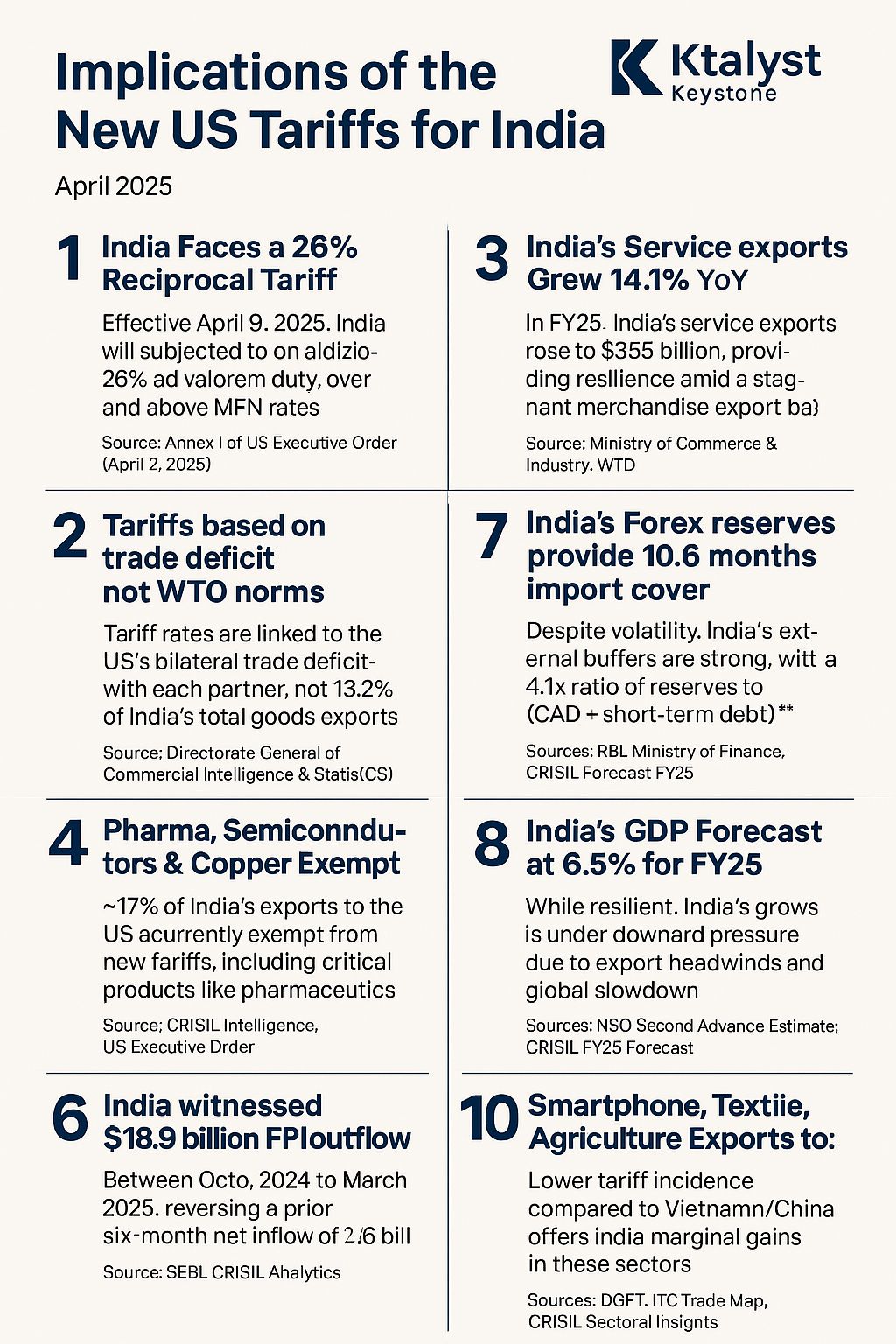
Protectionism is temporary. Strategy is forever.” – KtalystKeystone
Insights from the April 2025 CRISIL Report on US Tariffs & India:
The 26% tariff isn’t just a tax — it’s a test. A test of India Inc.’s resilience, agility, and strategic depth.
India’s export engines may sputter, but its services superpower and domestic strength are the new fuel.
StrategicViewpoint | What IndianBusinesses Must Do Now
🔍 RethinkExportDependency
High-risk sectors like GemsAndJewellery (with 37% exports to US) must unlock new geographies — EU, GCC, ASEAN.
📦 LeverageServicesBoom
With service exports clocking 14.1%YoY growth, the pivot to digital, consulting, and R&D is more than necessary — it’s non-negotiable.
⚙️ LocalizeValueChains
Auto and Electronics firms must evaluate USMCA partnerships and nearshoring to maintain tariff competitiveness.
📈 HedgeWisely
$18.9B of FPI outflows signal clear volatility. CFOs, it’s time to sharpen your forex strategy and revisit pricing models.
🛡️ UseIndiaPolicyCushion
The PLI schemes, ongoing capex push, and FTA progress (esp. with UK & EU) can soften the blow.
🌱 StayResilientStayStrategic
India’s #$355B service exports, 10.6 months import cover, and low CAD are not just stats — they’re shock absorbers.
KtalystKeystone | CatalysingStrategy in Disruptive Times
TradePolicy GlobalMarkets IndiaUS TariffWatch Exports Geopolitics MakeInIndia KtalystPerspective LinkedInPulse

Originally published on LinkedIn on 2025-04-08 17:38:16: https://www.linkedin.com/feed/update/urn%3Ali%3AgroupPost%3A2153908-7315427778760183808
TheSustainabilityReckoning: Data, Dollars & DueDiligence
📊💡 Sustainability is no longer a choice—it’s a business imperative backed by hard data. In 2025, companies face a stark reality: greenwashing lawsuits, evolving regulations, and shifting investor priorities are reshaping the LicenseToOperate. The cost of inaction? Fines, lostmarketaccess, and reputationaldamage.
Here’s what the numbers reveal:
3_Billion_USD_Lawsuit: Apple’s “CarbonNeutral” Claims Under Fire
Apple faces a classactionlawsuit challenging its carbonneutralityclaims, highlighting the #$20Billion+ global fines for greenwashing in 2024 alone. The lesson? Transparency and tangibleaction matter more than marketing.
🔹 EUSlashesSustainabilityReporting by 80%—But Not for BigPlayers
The EU’s CorporateSustainabilityReportingDirective (CSRD) has been relaxed, reducing compliance for smaller firms. However, largecorporations must still navigate stringentESGrequirements, ensuring verifiablesustainability efforts.
🔹 #$2Trillion in ClimateInvestments Defies ESGBacklash
Despite politicalheadwinds, globalclimateinvestments hit #$2trillion in 2024, with renewables and infrastructure leading. Resilientcompanies are attracting capital, proving that climatepositivebusinessmodels aren’t just ethical—they’re profitable.
🔹 WellsFargoDropsNetZeroTargets—A Sign of ESGRealignment?
One of the largestUSbanks has walked back its financedemissionsgoals, citing technological and policygaps. This shift signals a movefromoverambitious targets to pragmaticESGstrategies that align with businessrealities.
🔹 BCorpBoom: 2,400+ Certified Companies in the UK Alone
With consumerdemand for ethicalbusinesspractices soaring, over 2,400UKcompanies, including DanoneUK and GoodEnergy, have achieved BCorpstatus, proving that sustainability isn’t just compliance—it’s a competitiveadvantage.
🔹 #$1BillionCircularEconomyFund Eyes WasteToWealthGrowth
With globalwastecosts projected to exceed #$400billion by 2035, PlanetArk and BostonGlobal are launching a #$1billionfund to support circulareconomyinnovations. The future belongs to businesses that turn wasteintovalue.
📉🔍 TheVerdict?
✅ Sustainability isn’t a cost—it’s an investment in resilience.
✅ Regulatoryshifts are redefining corporateaccountability.
✅ Greenwashinglawsuits are a wake-up call—datadriventransparency is key.
IsYourBusinessFutureProofed for this SustainabilityReckoning? Let’s discuss how compliance, strategy, and innovation can secure your LicenseToOperate in this evolving landscape. Drop your thoughts below! 👇

Originally published on LinkedIn on 2025-03-01 07:39:37: https://www.linkedin.com/feed/update/urn%3Ali%3AgroupPost%3A2474261-7301506382598430720
The Decarbonization Dilemma: How CBAM Gaps Are Stalling Industry’s Green Revolution
As industries strive for sustainability, regulatory uncertainty, particularly around the EU’s Carbon Border Adjustment Mechanism (CBAM), is hindering green investments, decarbonization, and global competitiveness.
1. ArcelorMittal’s €1.7 Billion Investment Delay
ArcelorMittal has paused its €1.7 billion plan to replace Dunkirk’s blast furnaces with hydrogen-powered facilities. CBAM uncertainties, slow green hydrogen development, and limited customer demand for low-carbon steel are the primary reasons.
2. Thyssenkrupp’s €3 Billion Reassessment
Germany’s Thyssenkrupp is reconsidering its €3 billion green steel initiative due to unclear CBAM policies and the challenge of balancing emissions reductions with competitiveness.
3. UK Cement Industry’s Struggles
The UK cement sector, battling cheap, high-carbon imports that make up 40% of the market, lacks CBAM-equivalent protections. This discourages investments in decarbonization and carbon capture technologies.
4. The Global Green Subsidy Race
Conflicting subsidy strategies in the EU, US, and China create uncertainty, stalling global green investments. Misaligned policies heighten reliance on Chinese renewable technologies, threatening decarbonization efforts.
5. Asian Industry’s CBAM Challenges
Compliance Costs: Carbon accounting and verification impose high costs, especially on SMEs.
ExportCompetitiveness: Energy-intensive sectors like India’s steel industry (27% EU export share) face reduced demand due to CBAM fees.
SupplyChains: Adjusting to lower-carbon suppliers increases costs.
TradeTensions: Nations like India criticize CBAM as a trade barrier hindering net-zero transitions.
CarbonPricing Pressure: CBAM pushes Asian countries toward domestic carbon taxes, requiring significant adjustments.
6. Shared Challenges Across Industries
Policy Uncertainty: Industries are delaying investments while awaiting clarity on CBAM’s impact.
Competitive Disparities: EU companies compete against lower-cost imports with fewer regulations.
Market Gaps: Limited green energy infrastructure and low consumer demand slow decarbonization efforts.
The Way Forward
A globally aligned and robust CBAM is vital for restoring corporate confidence and fostering sustainable investments. Governments must collaborate to balance trade fairness with climate goals, ensuring that the green revolution accelerates instead of faltering.
Originally published on LinkedIn on 2024-12-09 17:47:41: https://www.linkedin.com/feed/update/urn%3Ali%3AgroupPost%3A131340-7271943602677633025
Global Leaders in Ethanol Blending in Fuel: India’s Role and Achievements
NamasteIndia ranks among the top ethanol producers globally, alongside the US and Brazil. Tops Countries
1. US: The largest producer and consumer of ethanol, Production: 876K barrels Consumption 838K barrels per day.
2. Brazil: Produces 403K barrels per day and consumes 359K barrels per day.
3. China: Produces and consumes 43K barrels per day.
4. Canada: Produces 33K barrels per day; consumes 41K barrels per day.
5. France: Produces 17K barrels per day & consumes 13 thousand barrels per day.
6. Germany: Produces 13K barrels per day and consumes 27K barrels per day.
7. Colombia: 8.5K barrels/day (produces), 6.1K barrels/day (consumes).
8. Thailand: 8.1K barrels/day (produces), 9.1K barrels/day (consumes).
9. Guatemala: 8K barrels/day (produces).
10. Spain: 7.9K barrels/day (produces), 8K barrels/day (consumes).
11. Belgium: 6.8K barrels/day (produces), 1.8K barrels/day (consumes).
12. India: 5.3K barrels/day (produces & consumes).
13. Australia: 5.3K barrels/day (produces), 5.1K barrels/day (consumes).
14. UK: Produces 4.3 thousand barrels per day and consumes 17 thousand barrels per day.
India’s Ethanol Blending in Gasoline Industry
Key_Facts_&_Figures
Ethanol Blending Target: India aims to achieve 20% ethanol blending in gasoline by 2025, a goal accelerated from the original target of 2030.
Current Blending Level: As of May 2024, India has achieved a 15% ethanol blending rate.
Economic Impact: A successful ethanol blending program can save India approximately $4 billion (₹30K crore) annually by reducing oil imports.
Production Volume: India plans to produce around 10 billion liters (1,000 crore liters) of ethanol to meet the 20% blending target.
Role of Key Stakeholders
Government:
Policy Framework: The government has implemented policies like the National Policy on Biofuels.
Pricing and Incentives: The government administers ethanol prices and provides incentives to encourage production and blending.
Oil Marketing Companies (OMCs):
Procurement: OMCs issue annual tenders to procure ethanol from producers.
Blending and Distribution: OMCs blend ethanol with gasoline at designated depots and distribute the blended fuel to retail stations.
Sugar Industry:
Production: The sugar industry is a major producer of ethanol, utilizing by-products like molasses. Leading companies include Bajaj Hindusthan Sugar Ltd., Balrampur Chini Mills Ltd., Shree Renuka Sugars Ltd., and Dhampur Sugar Mills Ltd., contributing significantly to the total ethanol production.
Environmental impact: supports bioenergy production and waste utilization but also faces challenges like high water usage and pollution.
Originally published on LinkedIn on 2024-09-25 05:31:06: https://www.linkedin.com/feed/update/urn%3Ali%3AgroupPost%3A60128-7244579146016641026

