🌟 NamasteGreenIndia YR2025: India’s ESG Era Expands – Incorporating Packaging, Logistics, and More 🚀
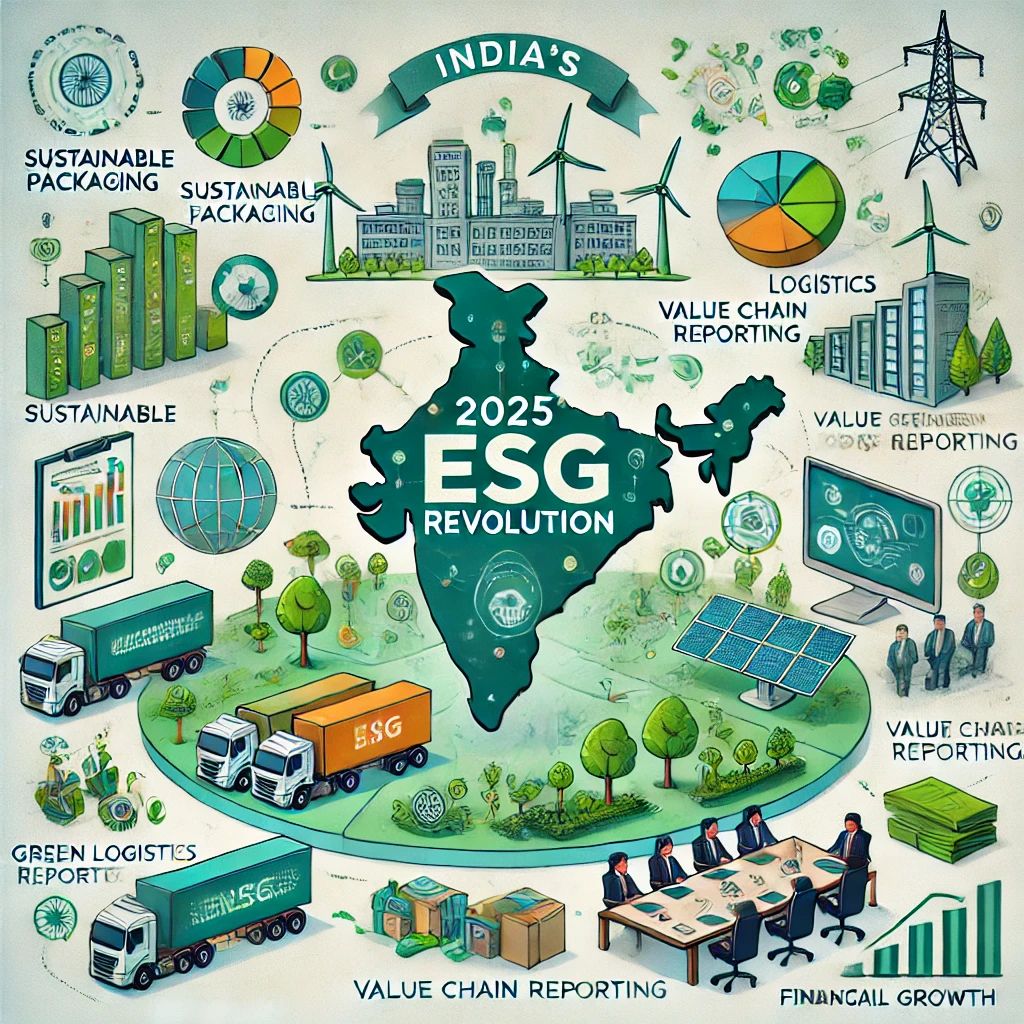
The year YR2025 marks a transformative step in India’s corporate sustainability, with Environmental, Social, and Governance (ESG) regulations now including packaging, logistics, and operational efficiency. These changes align with global sustainability goals and drive innovation across industries.
📌 What’s New in 2025?
🌐 Value Chain Reporting:
Top 250 companies must disclose ESG metrics under SEBI’s “comply or explain” framework.
By 2026, expands to 500 companies, with mandatory assurance.
📜 BRSR Core Metrics:
Focus on 9 ESG KPIs like carbon emissions, water usage, and workforce diversity.
80% of top 500 companies are aligning operations with these standards.
📦 Sustainable Packaging:
New regulations target 50% reduction in single-use plastics by 2030.
Companies aim for 100% reusable packaging, with $3 billion invested in R&D.
🚚 Green Logistics:
Incentives for electric and hydrogen-powered fleets aim to cut emissions by 30% by 2030.
✅ Independent Verification:
ESG disclosures, including packaging and logistics, must undergo third-party assurance.
By 2025, 65% of listed entities will have verified ESG data.
📊 ESG Growth Impact
📦 Packaging Overhaul:
40% of FMCG and e-commerce companies have adopted eco-friendly packaging solutions.
🚛 Logistics Transformation:
Emissions reduced by 20% (2023–2025); green logistics market to hit $12 billion by 2030.
📈 Corporate Participation:
ESG disclosures grew 40%, with 70% of Nifty 50 companies including logistics and packaging metrics.
🌟 Why YR2025 is a Game_Changer
1️⃣ Global Leadership:
India leads in integrating packaging and logistics into ESG frameworks, aligning with global practices.
2️⃣ Investor Appeal:
Companies adopting eco-friendly practices attract funds managing $50 trillion+ in ESG assets.
3️⃣ Business Resilience:
Over 60% of companies report improved efficiency and reduced costs through ESG initiatives.
4️⃣ 🚨 Non_Compliance Risks:
Fines, loss of market share, and reputational damage await companies ignoring these standards.
📌 The Road Ahead
India’s 2025 ESG initiatives integrate packaging, logistics, and operational efficiency into corporate goals. These steps set Indian businesses on a path to lead the global sustainability revolution.
💬 How is your organization adapting to this challenge? Let’s discuss below! 👇

Originally published on LinkedIn on 2025-01-11 10:02:10: https://www.linkedin.com/feed/update/urn%3Ali%3AgroupPost%3A3880479-7283785251959529472
NamasteIndia compares the use of Cow_Dung for Green_Energy in India and China.
Chinese project to use green_hydrogen and thousands of tonnes of cow dung a day to produce methanol
China’s Green_Methanol Project:
China is taking a bold leap into renewable energy by utilizing a mix of green hydrogen and 2,000 tonnes of cow manure daily to produce 200,000 tonnes of green methanol annually. With a significant investment of $203 million, this ambitious project will begin construction in September 2025 and aims to be operational by 2027. Methanol, a versatile fuel with applications in energy, transportation, and chemicals, positions this initiative at the cutting edge of industrial-scale sustainability. By leveraging hydrogen and biowaste, China is not just reducing emissions—it’s revolutionizing how the world approaches clean fuel production on a massive scale.
India’s Gobar Gas (Biogas) Revolution:
India, with its deep_rooted connection to agricultural practices, is harnessing its organic waste through biogas, turning cow dung into sustainable energy. Programs like GOBARdhan are transforming rural economies by promoting the use of biogas for cooking, heating, and electricity generation, directly addressing the energy needs of millions of households. The Indian biogas_market, already valued at $1.47 billion in 2022, is on track to grow to $2.25 billion by 2029, underlining the scalability and potential of this homegrown solution. Not only does it reduce greenhouse gas emissions, but it also fosters a circular economy, supporting livelihoods while promoting environmental stewardship.
Comparative Impact:
Both projects spotlight the power of waste-to-energy conversion, yet their focuses diverge dramatically. China’s high-tech approach aims at industrial fuel transformation with green methanol, a crucial player in decarbonizing heavy_industries and transportation. In contrast, India’s biogas initiatives prioritize rural_energy needs, emphasizing self-reliance, sustainability, and the empowerment of local communities. While China’s project carries the potential to disrupt global_fuel_markets, India’s biogas program drives grassroots_level change, cutting emissions and reducing reliance on traditional fuels in a way that resonates deeply with rural and semi-urban populations.
https://lnkd.in/d5nzY8rP
Originally published on LinkedIn on 2024-10-14 08:27:11: https://www.linkedin.com/feed/update/urn%3Ali%3Ashare%3A7251508830692405249

