NamasteIndia 🚀
Framework_to_Future: India’s CCTS – A Data-Driven Power Play
YR2023–YR2025) 📊
India’s Carbon Credit Trading Scheme (CCTS) has rapidly transformed from a policy blueprint to a dynamic market. Here’s a concise, data-rich overview of its evolution:
YR2023: 🏗️ Foundation Laid
June2023: 📜 Government notifies CCTS, establishing a Compliance Mechanism.
* 🎯 Objective: Reduce GHG intensity in key sectors.
* 🏭 Sectors: Cement, Steel, Aluminium, Refineries, etc.
* ⚖️ Legal: Energy Conservation (Amendment) Act, 2022.
* 🏛️ Regulators: BEE, CERC.
YR2024: 📐 Architecture Built
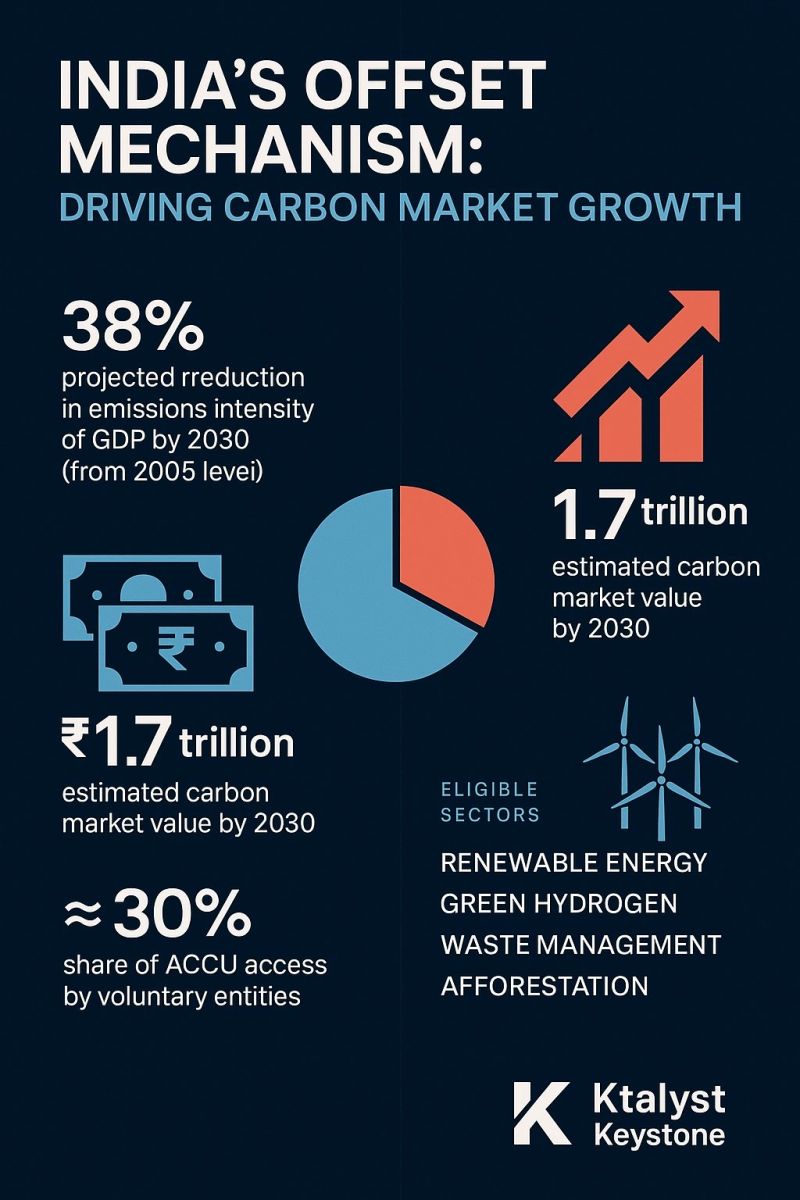
* Dec2023: 🔄 Offset Mechanism integrated.
* 🌱 Key: Non-obligated entities can develop projects.
* 💳 CCCs: Tradable Carbon Credit Certificates.
* 🌍 Alignment: Paris Agreement’s Article 6.
* ✅ ACVAs: Validation & Verification agencies established.
* 🖥️ ICM: Indian Carbon Market registry conceptualized.
YR2025: 📈 Market Activated
* March2025: 8️⃣ Methodologies approved:
* ⚡ Renewable Energy
* 💧 Green Hydrogen
* 🏭 Industrial Efficiency
* 🗑️ Landfill Methane
* 🌳 Mangrove Afforestation
* 💰 Market Potential: USD 300 billion by 2030.
* 🌐 Global Projection: IETA: USD 1-1.5 trillion by 2050.
* 🤝 Transition: PAT scheme integration; full compliance by mid-2026.
Quote:
India’s carbon market is not just compliance—it’s climate economics in motion.” — Anju Sharma, MD, Ktalyst Keystone.
Future: 🔮 Innovation & Integration
* 💻 Digital Infrastructure: For Carbon Credits.
* 🤝 Global Links: International Carbon Market integration.
* 📊 Scope 3 & MRV: Standards inclusion.
* 💡 Private Sector: Tech & Nature-Based solutions.
Call_to_Action:
Let’s discuss how your organization can leverage India’s evolving carbon market. Connect with me!
Question:
How will CCTS reshape your industry? Share your insights!
Hashtags:
CarbonCredits IndiaCarbonMarket CCTS ClimateAction Sustainability EnergyTransition GreenEconomy EnvironmentalPolicy ParisAgreement ESG CleanEnergy Innovation DataDriven MarketInsights


Originally published on LinkedIn on 2025-04-07 17:18:44: https://www.linkedin.com/feed/update/urn%3Ali%3AugcPost%3A7315060472787955712
NamasteCarbonPricingIndia:
The_State_of_Carbon_Pricing_2024: Progress, Disparities, and Where India Fits
The YR2024 State and Trends of Carbon Pricing Report highlights both progress and challenges in global carbon pricing as governments strive to meet the Paris Agreement’s goals. With 75 carbon pricing instruments now operational—39 carbon taxes and 36 emissions trading systems (ETSs)—the landscape is evolving, yet significant gaps in pricing levels and emissions coverage remain.
Global Carbon Pricing: The Leaders
Countries exceeding the $80-$100/ton threshold, recommended to limit global warming, are setting the benchmark:
Uruguay: $167/ton – The world leader, powered by its renewable energy dominance.
Switzerland: $132/ton – Among Europe’s most ambitious nations.
Sweden: $127/ton – Achieved a 33% emissions reduction since 1991.
Norway: $108/ton – Balances oil exports with green innovation.
These leaders leverage carbon pricing to fund renewables, incentivize green practices, and drive significant emissions reductions.
Falling_Short: Countries Below $40/ton
Despite the expanding reach of carbon pricing, many nations are still underpricing emissions, limiting their impact:
California (USA): $39/ton – Gradual cap-and-trade implementation.
Japan (Tokyo): $37/ton – Focused on innovation but still below target.
India: $5/ton – A coal cess aimed at balancing affordability and emissions reductions.
Currently, only 23% of global emissions are covered by these instruments, leaving significant gaps in global climate action.
Where India Stands
As the third-largest emitter globally, India represents a critical player in the future of carbon pricing:
$5/ton Carbon Price: Through its coal cess, generating $3 billion annually for renewable energy initiatives.
National Carbon Market: Launched in 2023 to facilitate voluntary carbon trading, with potential for scaling.
500 GW Renewable Energy Target: India is undergoing one of the world’s fastest energy transitions, underscoring its commitment to sustainability.
Carbon Credit Leader: Indian projects dominate voluntary markets, showcasing the country’s capacity to innovate in carbon offsets.
India’s current pricing is modest but represents a foundation for growth. By gradually scaling its carbon price and expanding the carbon market, India can harmonize economic growth with climate goals.
The Way Forward
Carbon pricing is a powerful tool, but the global average remains far below the $80-$100/ton threshold needed to limit warming to 1.5°C. For nations like India, leveraging mechanisms such as renewable energy investments, carbon markets, and circular economy practices can drive impactful change while balancing affordability and growth.
Originally published on LinkedIn on 2024-12-19 20:26:43: https://www.linkedin.com/feed/update/urn%3Ali%3AgroupPost%3A59930-7275607502493278209
NamasteGreenIndia Advances Climate Action: Setting Up Carbon Trading and Green Bond Regulator
Key Developments:
1. Establishment of a Regulatory Body:
India plans to set up a dedicated regulator for carbon trading and green bonds.
The body will oversee activities related to domestic carbon markets and sustainable financing.
2. Legislative Framework:
The Energy Conservation (Amendment) Bill 2022 laid the foundation for a regulated carbon market.
Carbon_Credit_Trading_Scheme 2023 has been approved, which involves forming a National Steering Committee for market governance.
3. Integration with Global Frameworks:
Aligns with the global carbon market rules finalized under Article 6.4 of the Paris_Agreement at COP29 in Baku, Azerbaijan.
Focused on achieving India’s commitment to reducing greenhouse gas emissions by 2030.
4. Securities Market Expansion:
The Securities and Exchange Board of India (SEBI) proposed including green securitization and sustainable debt instruments under its sustainable finance framework.
Key Actions to be Taken:
1. Formation of the Regulatory Body:
Establish an agency similar to NAFED to regulate carbon trading and green bonds.
2. Operationalizing Carbon Trading:
Develop clear rules for carbon credit issuance, trading, and compliance.
Ensure alignment with international standards for credibility and market participation.
3. Promoting Green Bonds:
Create incentives for businesses to issue and invest in green bonds.
Strengthen frameworks for transparency and accountability in green bond utilization.
4. Stakeholder Engagement:
Collaborate with industries, investors, and global climate bodies to ensure successful implementation.
Promote public and private sector participation in carbon markets and sustainable finance.
5. Monitoring and Reporting Mechanisms:
Implement robust systems for tracking carbon emissions reductions and reporting.
Enhance capacity-building efforts to ensure compliance with regulatory norms.
6. Market Integration:
Foster a domestic carbon market and facilitate integration with international carbon trading systems.
Leverage global best practices to establish India as a leader in green finance and carbon trading.
Strategic Objectives:
Drive India’s transition to a low-carbon economy.
Mobilize green investments to meet climate goals.
Achieve a balance between economic growth and environmental sustainability.
This initiative positions India as a key player in global climate action, aligning national economic policies with environmental priorities.
Originally published on LinkedIn on 2024-12-02 16:46:50: https://www.linkedin.com/feed/update/urn%3Ali%3AgroupPost%3A60128-7269391576076800000
NamasteIndia to get its own refined carbon market
India’s Carbon_Credit Trading Scheme 2.0(CCTS) is a significant initiative aimed at reducing greenhouse gas emissions through a market-based approach. Here’s a summary of what’s currently happening and the implications of the recent announcement:
Regulatory_Framework: The Ministry of Power has notified the Carbon Credit Trading Scheme, 2023, which outlines the roles of various stakeholders, including the Bureau of Energy Efficiency (BEE), the Grid Controller of India Limited, and the Central Electricity Regulatory Commission (CERC).
Emission_Targets: The scheme sets greenhouse gas (GHG) emission intensity reduction targets for obligated entities, aligning with India’s Nationally Determined Contributions (NDCs) under the Paris Agreement.
Monitoring and Reporting: A robust monitoring, reporting, and verification (MRV) system is being implemented to ensure accurate tracking of emissions and carbon credits.
Incentives: Entities that exceed their emission reduction targets will be issued carbon credit certificates, which can be traded in the market. This creates a financial incentive for companies to reduce their emissions.
Market Creation: The announcement marks the establishment of India’s first domestic regulated carbon market. This market will facilitate the trading of carbon credits, encouraging industries to adopt cleaner technologies and reduce their carbon footprint.
Compliance and Voluntary Elements: The scheme includes both compliance-based and voluntary elements. Compliance-based trading requires entities to meet specific emission targets, while voluntary trading allows entities to purchase carbon credits to offset their emissions out of choice.
International Collaboration: The scheme aims to align with international carbon markets, allowing India to learn from global best practices and enhance the effectiveness of its carbon market.
Economic and Environmental Benefits**: By incentivizing emission reductions, the scheme is expected to drive economic growth through green technologies and contribute significantly to India’s sustainability goals.
https://lnkd.in/dnbdVUSX
Originally published on LinkedIn on 2024-09-17 09:39:25: https://www.linkedin.com/feed/update/urn%3Ali%3AgroupPost%3A2474261-7241742536401178625
NamasteIndia Carbon Pricing the Future: India’s Quest for an Economical Climate Change
To address India’s sector-specific challenges in carbon pricing, a multi-faceted approach is necessary. For sectors like heavy industry and agriculture, which are difficult to decarbonize, targeted subsidies, technological innovation, and capacity-building initiatives could ease the transition. Additionally, the private sector’s proactive role and policy coherence are crucial for adapting the carbon pricing model to India’s unique context.
Alternatives to a comprehensive carbon pricing system include regulatory measures, subsidies for low-carbon technologies, and voluntary carbon markets. These can complement carbon pricing by addressing market failures and incentivizing green investments.
Globally, there are successful examples of carbon pricing systems. Sweden, for instance, has a robust carbon tax that has led to significant emissions reductions while the economy grew. The EU’s Emissions Trading System (ETS) is another example, demonstrating how cap-and-trade can effectively lower emissions across member states.
India can learn from these models, tailoring them to its own economic and environmental contexts to ensure a just and equitable transition towards a sustainable future.
Charting Pathways for India’s Carbon Market https://lnkd.in/drtHNkEf
Originally published on LinkedIn on 2024-06-12 11:48:04: https://www.linkedin.com/feed/update/urn%3Ali%3Ashare%3A7206623286598807554

