ASIA_DOES_NOT_HAVE_ONE_ESG_PROBLEM. IT HAS SIX.
Dr. Anju Sharma MrsSustainability
ESG in Asia is not one report card.
It is six stress tests.
✓Carbon is an uninvited auditor.
✓Governance is no longer etiquette.
✓Disclosure is becoming evidence.
NamasteIndia’s paradox is the sharpest.
INDIA → LAST-MILE ESG ECONOMY
India has BRSR, climate targets, renewable ambition, listed sophistication.
BRSR covers top 1,000 companies.
But ESG lives below boardrooms:
Suppliers → MSMEs → Transporters → Processors → Informal actors
A Tier-1 firm tracks emissions precisely.
A Tier-4 supplier estimates from electricity bills.
Same footprint. Different reality.
Ambition + fragmented plumbing = execution friction
Dashboard ↑
Paper challan ↓
Ambition – Traceability = ESG loss
Signal is strong. Voltage drops in the supply chain.
CHINA → CARBON AS INDUSTRIAL DISCIPLINE
3,378 emitters under carbon market.
Carbon now asks:
What did this tonne cost the atmosphere?
Lesson: make ESG operational.
JAPAN → CARBON AS CAPITAL
SSBJ standards (2025), mandatory from 2027 for largest firms.
ESG + CAPEX = transition capital
Lesson: make carbon a valuation input.
SOUTHKOREA → EXPORTS GET CARBON-HEAVY
ESG disclosure from 2028 (291 firms first).
Exports now carry:
Tonnes + CO₂e intensity.
Lesson: future trade = price + carbon.
SINGAPORE → GOVERNANCE = VERIFICATION
Scope 1–2 mandatory FY2025, Scope 3 from FY2026.
If unverified, data is decoration.
Lesson: ESG must be auditable.
INDONESIA → INCLUSION-FIRST TRANSITION
2026 taxonomy expands access for smaller firms.
Not just “how green are you?
But “can you enter the system?
MALAYSIA → FINANCE-FIRST TRANSITION
Malaysia is not missing. It is different.
With its National Sustainability Reporting Framework (NSRF) and gradual ISSB-aligned rollout, Malaysia is positioning ESG through financial system alignment rather than only disclosure expansion.
Islamic finance depth + strong banking regulation means ESG is increasingly embedded through capital allocation, not just compliance reporting.
Lesson: ESG enters through finance architecture, not only corporate reporting.
ASIA SCORECARD
India → Scale
China → Execution
Japan → Capital
Korea → Competitiveness
Singapore → Credibility
Indonesia → Inclusion
Malaysia → Financial alignment
Asia has six ESG problems.
India’s is hardest:
How to carry ESG data across millions of hand-offs without losing signal?
KtalystInsights | INDIA FIX
1. Supplier-first ESG
Standardise core ESG data across suppliers.
2. Procurement-linked ESG
ESG → vendor status → orders → payments.
No commercial impact = no adoption.
3. Product-level proof
Raw material → factory → logistics → customer
Future question:
Can you prove what happened inside this product?
Originally published on LinkedIn on 2026-08-10 05:05:29: https://www.linkedin.com/feed/update/urn%3Ali%3AgroupPost%3A82951-7492446000419143680
ASIA_DOES_NOT_HAVE_ONE_ESG_PROBLEM. IT HAS SIX.
ESG in Asia is not one report card.
It is six stress tests.
✓Carbon is an uninvited auditor.
✓Governance is no longer etiquette.
✓Disclosure is becoming evidence.
NamasteIndia’s paradox is the sharpest.
INDIA → LAST-MILE ESG ECONOMY
India has BRSR, climate targets, renewable ambition, listed sophistication.
BRSR covers top 1,000 companies.
But ESG lives below boardrooms:
Suppliers → MSMEs → Transporters → Processors → Informal actors
A Tier-1 firm tracks emissions precisely.
A Tier-4 supplier estimates from electricity bills.
Same footprint. Different reality.
Ambition + fragmented plumbing = execution friction
Dashboard ↑
Paper challan ↓
Ambition – Traceability = ESG loss
Signal is strong. Voltage drops in the supply chain.
CHINA → CARBON AS INDUSTRIAL DISCIPLINE
3,378 emitters under carbon market.
Carbon now asks:
What did this tonne cost the atmosphere?
Lesson: make ESG operational.
JAPAN → CARBON AS CAPITAL
SSBJ standards (2025), mandatory from 2027 for largest firms.
ESG + CAPEX = transition capital
Lesson: make carbon a valuation input.
SOUTHKOREA → EXPORTS GET CARBON-HEAVY
ESG disclosure from 2028 (291 firms first).
Exports now carry:
Tonnes + CO₂e intensity.
Lesson: future trade = price + carbon.
SINGAPORE → GOVERNANCE = VERIFICATION
Scope 1–2 mandatory FY2025, Scope 3 from FY2026.
If unverified, data is decoration.
Lesson: ESG must be auditable.
INDONESIA → INCLUSION-FIRST TRANSITION
2026 taxonomy expands access for smaller firms.
Not just “how green are you?
But “can you enter the system?
MALAYSIA → FINANCE-FIRST TRANSITION
Malaysia is not missing. It is different.
With its National Sustainability Reporting Framework (NSRF) and gradual ISSB-aligned rollout, Malaysia is positioning ESG through financial system alignment rather than only disclosure expansion.
Islamic finance depth + strong banking regulation means ESG is increasingly embedded through capital allocation, not just compliance reporting.
Lesson: ESG enters through finance architecture, not only corporate reporting.
ASIA SCORECARD
India → Scale
China → Execution
Japan → Capital
Korea → Competitiveness
Singapore → Credibility
Indonesia → Inclusion
Malaysia → Financial alignment
Asia has six ESG problems.
India’s is hardest:
How to carry ESG data across millions of hand-offs without losing signal?
KtalystInsights | INDIA FIX
1. Supplier-first ESG
Standardise core ESG data across suppliers.
2. Procurement-linked ESG
ESG → vendor status → orders → payments.
No commercial impact = no adoption.
3. Product-level proof
Raw material → factory → logistics → customer
Future question:
Can you prove what happened inside this product?
Originally published on LinkedIn on 2026-08-10 05:04:13: https://www.linkedin.com/feed/update/urn%3Ali%3Ashare%3A7492445678179303424
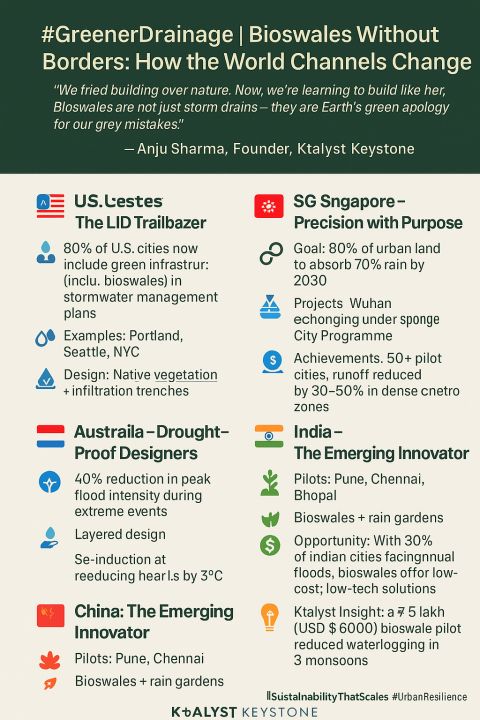
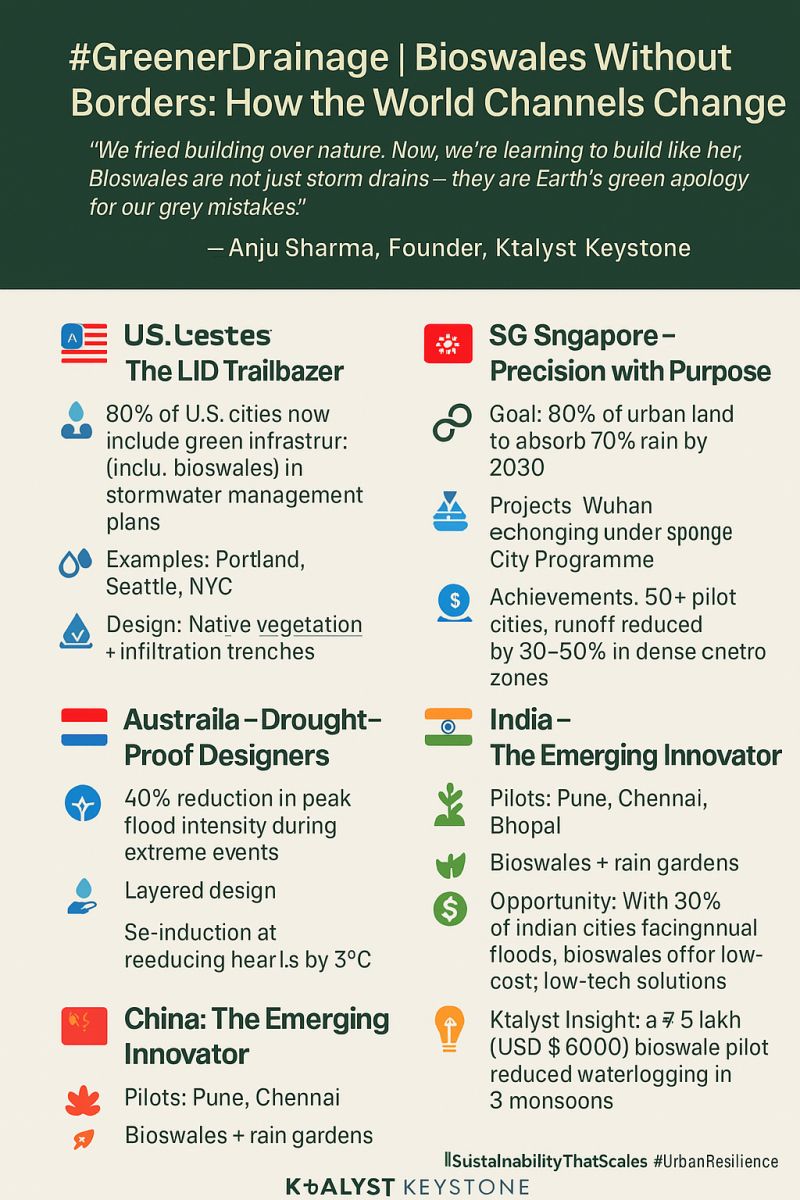
KnowledgeKtalyst GreenerDrainage | Bioswales Without Borders: How the World Channels Change
We tried building over nature. Now, we’re learning to build like her. Bioswales are not just storm drains – they are Earth’s green apology for our grey mistakes.
Anju Sharma | Founder, Ktalyst Keystone
What if stormwater could clean itself before reaching our rivers?
Around the world, bioswales are turning this idea into a reality—naturally filtering water, reducing floods, and beautifying cities while addressing climate resilience.
🌍 Six Countries. Six Styles. One Green Purpose.
🇺🇸 UnitedStates – The LID Trailblazer
🌧️ 80% of U.S. cities now include green infrastructure (incl. bioswales) in stormwater management plans.
🏙️ Examples: Portland, Seattle, NYC
🌿 Design: Native vegetation + infiltration trenches
⚡ Outcome: Up to 90% runoff volume reduction in key pilot zones
🇩🇪🇳🇱 Germany & Netherlands – Bicycle Bioretentionists
🚲 65% of urban roads in Dutch cities use SuDS layouts
🌼 Famous For: Stormwater swales alongside bike highways
📸 Bonus: Used for placemaking and urban branding
🇦🇺 Australia – Drought_Proof Designers
☀️ 40% reduction in peak flood intensity during extreme events (source: Melbourne WSUD case study)
🦘 Cities: Melbourne, Brisbane
🌳 Layered Design: For dry spells and cloudbursts
🔥 Impact: Bioswales integrated into parks, reducing heat islands by 3–5°C
🇸🇬 Singapore – Precision_with_Purpose
💧 ABC Waters Programme launched in 2006
🏝️ Projects: Bishan-AMK Park, Punggol Waterway
🌿 Result: Cleaner waterways + real estate uplift near bioswale zones (up to 12% premium)
🪷 Quote from PUB: “Every drain is now a destination.
🇨🇳 China – The UrbanSponge Model
🏙️ Goal: 80% of urban land to absorb 70% of rain by 2030
🌾 Projects: Wuhan, Chongqing under Sponge City Programme
📉 Achievements: 50+ pilot cities, runoff reduced by 30–50% in dense metro zones
🇮🇳 India – The EmergingInnovator
🇮🇳 Pilots: Pune, Chennai, Bhopal
🌱 Design: Bioswales + rain gardens
💡 Opportunity: With 30% of Indian cities facing annual floods, bioswales offer low-cost, low-tech solutions
🌟 Ktalyst Insight: A ₹5 lakh (USD ~$6,000) bioswale pilot reduced waterlogging in 3 monsoons


Originally published on LinkedIn on 2025-04-09 06:51:09: https://www.linkedin.com/feed/update/urn%3Ali%3AgroupPost%3A82951-7315627313553981440
NamasteIndia UltraTech Cement’s achievement:
UltraTech Cement raised $500 million through a sustainability-linked loan.
This financing aligns with their sustainability and ESG (Environmental, Social, and Governance) goals.
The transaction was supported by six Banks.
It marks UltraTech’s second sustainability-linked initiative, following their pioneering bond issuance in 2021.
Their scope1 and scope2 combined emissions intensity remained unchanged at 618.17 kg CO2e/tonne according to their FY24 sustainability report.
other companies in India are embracing sustainable financing strategies.
TheSixBanks:
SumitomoMitsui Banking Corporation (SMBC)
StateBank of India (SBI)
BNPParibas
DBS Bank
MUFG (Mitsubishi UFJ Financial Group)
Mizuho Bank
Other note worthy companies
NamdevFinvest: A rapidly growing NBFC, Namdev Finvest focuses on providing accessible and tailored financing solutions for solar energy projects. Their commitment to financial inclusion and sustainable development positions them as a critical player in driving the adoption of clean energy solutions across India1.
VivritiCapital: Based in Chennai, Vivriti Capital offers innovative debt financing solutions to the renewable energy sector, particularly solar energy projects. By catering to small and medium enterprises (SMEs), they play a crucial role in advancing India’s clean energy goals.
ElectronicaFinance Ltd.: This specialized NBFC primarily provides financing for industrial equipment, including solar power installations. Their customized financial products make solar energy accessible and affordable for small and mid-sized enterprises, promoting sustainable energy solutions
Source / shared link: https://m.economictimes.com/markets/stocks/news/ultratech-raises-500-million-through-sustainability-linked-financing/articleshow/112810621.cms
Originally published on LinkedIn on 2024-08-26 13:09:24: https://www.linkedin.com/feed/update/urn%3Ali%3Ashare%3A7233822846232256512

