KtalystInsights™: The SEC May Delete the ClimateRule. It Cannot Delete the Climate Bill.
Dr. Anju Sharma MrsSustainability
The SEC may step back from climate disclosure.
The climate bill will not.
So is climate-disclosure investment now a waste for business?
No — not if it was built as business intelligence.
Yes — if it was built only as compliance paperwork.
That is the real boardroom distinction.
Treat the proposed rollback of the 2024 SEC climate-disclosure rule as a corporate victory, and boards may commit a serious diagnostic error.
Removing a reporting line does not remove the risk.
It only switches off one smoke detector while the fire keeps rewriting the balance sheet.
The real climate bill will not arrive only through regulators.
It will arrive through the market:
Insurance repricing → premiums rewriting asset economics
Asset impairment → climate exposure entering valuation
Supply-chain disruption → resilience becoming operating cost
Transition capex → delayed action becoming expensive action
Capital scrutiny → lenders, customers & investors asking harder questions
The SEC argument is legally important:
Securities regulator ≠ climate regulator.
The pushback is not just one finance lobby. It is a broad anti-burden coalition: business chambers, energy incumbents, large issuers & multi-sector companies worried about cost, liability, complexity & regulatory overreach.
Their legal argument may be fair.
Their risk assumption is not.
Less disclosure ≠ less risk.
It may simply convert structured risk into a darker information vacuum.
For global enterprises, the paradox is sharper:
US federal softening
+ EU CSRD pressure
+ California SB 253/SB 261
+ ISSB-aligned markets
+ investor due diligence
= higher demand for credible proof
So the boardroom question has changed.
Not:
What must we disclose?
Rather:
Can we prove asset resilience, cash-flow durability & capital readiness under climate stress?
The next advantage will not belong to the company with the thickest sustainability report.
It will belong to the company with the strongest evidence architecture.
When reporting becomes lighter, credibility becomes heavier.
Strong companies will use climate data as a trust premium.
Weak companies may use deregulation as a hiding place.
A hiding place is not a strategy.
Markets may tolerate opacity during political transitions.
They do not tolerate blind risk forever.
KtalystKlues™
Climate reporting as compliance = possible sunk cost.
Climate intelligence as strategy = business infrastructure.
Reporting relief ≠ risk relief.
Deregulation ≠ de-risking.
Lower disclosure ≠ lower liability.
No rule ≠ no bill.
The SEC may delete the rule.
The market will still present the invoice.
Source / shared link: https://www.reuters.com/legal/government/wall-st-regulator-proposes-scrap-biden-era-climate-rule-2026-05-29/?utm_source=chatgpt.com
Originally published on LinkedIn on 2026-05-30 15:32:40: https://www.linkedin.com/feed/update/urn%3Ali%3AgroupPost%3A82951-7466511909744427009
KtalystInsight
Scope3 is Silent, But Deadly
Madam Sustainability just dropped sensors across your value chain. You might want to sit down.
You’ve installed motion sensors in your factory, but forgot to install CommonSenseInSustainability.
Here’s what her sensors picked up:
SensorReading1: The Out_of_Scope_Problem
71% of emissions are from Scope 3 (CDP, 2024)
But <25% of companies even track them fully
60% of corporate “NetZero” claims ignore downstream emissions (Oxford Tracker, 2023)
MagneticHook: CarbonClueless while claiming climate glory.
SensorReading2: The SupplyChainGaps
That “green” packaging? Shipped 3000 km via diesel
That product life-cycle? Emits 3.8x more than the factory
That Tier3 supplier? Still burns coal… under your ESG umbrella
MagneticHook: SustainableFacade, FossilReality
SensorReading3: The MoneyPit
BlackRock now demands full Scope 3 clarity
CSRD and SEC? No room for vague metrics
Companies with deep Scope 3 tracking see 1.5x more green capital inflow ESGWithoutScope3IsASelfie
MadamSustainability’s Verdict?
You’re watching kilowatts in the conference room,
while carbon leaks from every container, commute, and consumer.
She prescribes:
LowGHGMaterials & circular logistics
SupplierTraceability that goes beyond Tier 1
DownstreamDashboards, not just boardroom dashboards
VirtualTravel, not virtue travel
RealTimeLCA, not last-minute reports
FinalReading:
If your ESGtracker ends at your gate, your climate strategy is a gated community — exclusive, and dangerously outdated.
Because in MadamSustainability’s world:
If it isn’t sensed, it isn’t saved.
MagneticHook: InvisibleEmissions = Visible Risk
MagneticHook: NetZeroOrNetFiction
MagneticHook: AuditReadyOrOutAlready
KtalystInsight | MadamSustainability | Scope3Sensors | ClimateCracks | NoScopeNoHope | SustainabilityWithSubstance | CarbonIsEverywhere
Originally published on LinkedIn on 2025-05-16 05:58:49: https://www.linkedin.com/feed/update/urn%3Ali%3AgroupPost%3A2368335-7329022495468994561
KnowledgeSeries: GreenFinance – The $80 Trillion Opportunity Reshaping Global Capital Markets
🌍 Sustainability = Economics.
💰 GreenFinance is now mainstream, with ESG assets surpassing $50T in 2023, projected to hit $80T by 2030.
🚀 CapitalShiftAlert: Banks, VCs, and InstitutionalInvestors are prioritizing low-carbon businesses. Those who ignore GreenFinance risk obsolescence.
📊 WhyGreenFinance is Taking Over?
✔️ ESGOutperforms: Since 2015, ESG-aligned companies have outperformed markets by 30% (HarvardBusinessReview).
✔️ InvestorShift: ESGFunds saw #$650B inflows in 2023, while traditional funds saw outflows (Morningstar).
✔️ RegulationsTighten: EU & SEC climate disclosure rules mandate carbon reporting, forcing companies to prove sustainability.
✔️ GreenBondsSurge: #$1.5T issued in 2023, funding renewables, transport, and smartcities.
✔️ RiskAndProfitability: Banks raise borrowing costs for polluters, offering low rates to green firms.
🏦 Who’sLeading the GreenFinanceMovement?
✔️ Banks & AssetManagers: BlackRock, GoldmanSachs, JPMorgan—trillions in climate portfolios.
✔️ VentureCapital & PrivateEquity: ClimateTech funding up 210% in 3 years—battery storage, carbon capture.
✔️ SovereignGreenFunds: Norway, Singapore, UAE shifting billions from oil to renewables.
✔️ CorporateGiants: Apple, Microsoft, Tesla issue multi-billion-dollar GreenBonds.
✔️ CarbonMarketsExploding: VoluntaryCarbonMarket set to grow 15X by 2030.
💡 HowBusinessesCanLeverage GreenFinance?
✔️ IssueGreenBonds → Secure low-cost funding for sustainability projects.
✔️ AlignWithESGCriteria → Attract institutional investors & capital.
✔️ TradeCarbonCredits → Monetize emission reductions.
✔️ LeverageImpactInvesting → Tap into VCs, sovereign funds & ESG-focused investors.
✔️ AdoptSmartFinanceTools → Use AI & blockchain for transparent sustainability tracking.
🔍 ComingUpNext: “The Rise of ClimateUnicorns – Where VCs Are Betting in 2025
💬 IsYourBusinessReady for the ClimateEconomy? Let’s discuss!

Originally published on LinkedIn on 2025-03-09 17:24:23: https://www.linkedin.com/feed/update/urn%3Ali%3AgroupPost%3A9500072-7304552646428823552
📚 KnowledgeSeries: Sustainability Taxonomy – The Rulebook for Green Investments 🌱💰
As #$5T in ESG investments grows, defining what is truly sustainable is critical. Enter Sustainability Taxonomy—a classification system ensuring green capital flows into real climate solutions, not greenwashing.
📊 EU Taxonomy – Setting the Global Standard
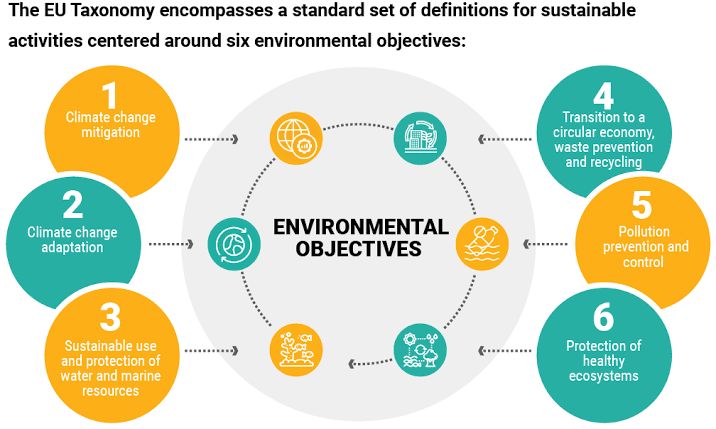
🟢 6 Environmental Objectives → Activities must significantly contribute to at least one while causing no harm to others:
Climate Change Mitigation
Climate Change Adaptation
Water & Marine Resource Protection
Circular Economy Transition
Pollution Prevention & Control
Biodiversity & Ecosystem Restoration
🟢 Impact → Covers 50K+ companies, shaping 80% of EU capital markets. (Source)
🟢 Challenges → Simplification Omnibus (2025 Proposal) could reduce company reporting, raising concerns about greenwashing risks. (Source)
🌍 Global Adoption: Who’s Following the EU Model?
🟢 Australia → Developing Sustainable Finance Taxonomy to attract #$200B+ in green capital. (Source)
🟢 China → Green Bond Principles aligned with EU Taxonomy in 2023, covering #$150B+ in issuances.
🟢 ASEAN → Launched ASEAN Taxonomy 2024, targeting climate finance growth in 10 nations.
🟢 US & UK → No official taxonomy, relying on SEC climate rules & UK Green Finance Strategy instead.
🔥 The Takeaway: Green Finance Needs Clear Rules
📌 #$5T+ ESG investments need clarity—taxonomy prevents greenwashing.
📌 EU model sets the benchmark, but simplification risks loosening standards.
📌 More countries adopting taxonomies → Will we see a global standard soon?
📢 Do we need a worldwide taxonomy for sustainability? Let’s discuss! 👇
Originally published on LinkedIn on 2025-03-04 03:47:30: https://www.linkedin.com/feed/update/urn%3Ali%3AgroupPost%3A2474261-7302535131989164034
🚀 “CorporateGovernance: Can India Match the US?” 🇮🇳⚖️🇺🇸
India’s corporate governance is evolving, but enforcement gaps remain. How does it compare to the US? Here’s a data-driven reality check.
✅ Where India & US Align
🔹 Mandatory ESG Disclosures
✔️ India: Top 1,000 listed firms follow BRSR. (SEBI, 2024)
✔️ US: SEC mandates climate disclosures. (SEC, 2024)
🔹 Board Diversity
✔️ India: 35% of Nifty500 firms have women directors. (NSE, 2024)
✔️ US: Women hold 32% of S&P500 board seats. (Harvard Law, 2024)
🔹 Whistleblower Protections
✔️ India: SEBI enforces audit committees & whistleblower policies. (SEBI, 2024)
✔️ US: SOX Act ensures strict penalties for corporate fraud. (SEC, 2025)
📌 RealityCheck: Laws exist, but enforcement is the game-changer.
⚖️ Where India Lags
🔻 Board Independence
✔️ US: 90% of S&P500 firms separate CEO & Chair roles. (Spencer Stuart, 2024)
✔️ India: Only 33% of Nifty500 firms do the same. (ICSI, 2025)
🔻 Investor Protection
✔️ US: SEC enforces shareholder voting rights. (SEC, 2025)
✔️ India: Promoter-led firms limit investor influence. (SEBI, 2025)
🔻 Legal Delays
✔️ US: Corporate cases resolve in 6-12 months. (Bloomberg, 2025)
✔️ India: Takes 5-7 years. (Economic Times, 2025)
🔻 ESG Penalties
✔️ US: $1.5B in greenwashing fines. (SEC, 2025)
✔️ India: ₹500 Cr ($60M) in fines. (SEBI, 2025)
📌 RealityCheck: India needs stricter oversight & faster dispute resolution.
🏆 KeyTakeaway
📌 India has strong policies but weak enforcement.
📌 US leads in investor rights & legal efficiency.
📌 India must act fast to boost global trust.
💬 Will India bridge the governance gap? Drop your thoughts! 👇


Originally published on LinkedIn on 2025-02-21 17:50:23: https://www.linkedin.com/feed/update/urn%3Ali%3AgroupPost%3A95089-7298760984062488577

