Catchup TheGreenMuteButton:
10Powerful Sustainability Moves They Didn’t Shout About
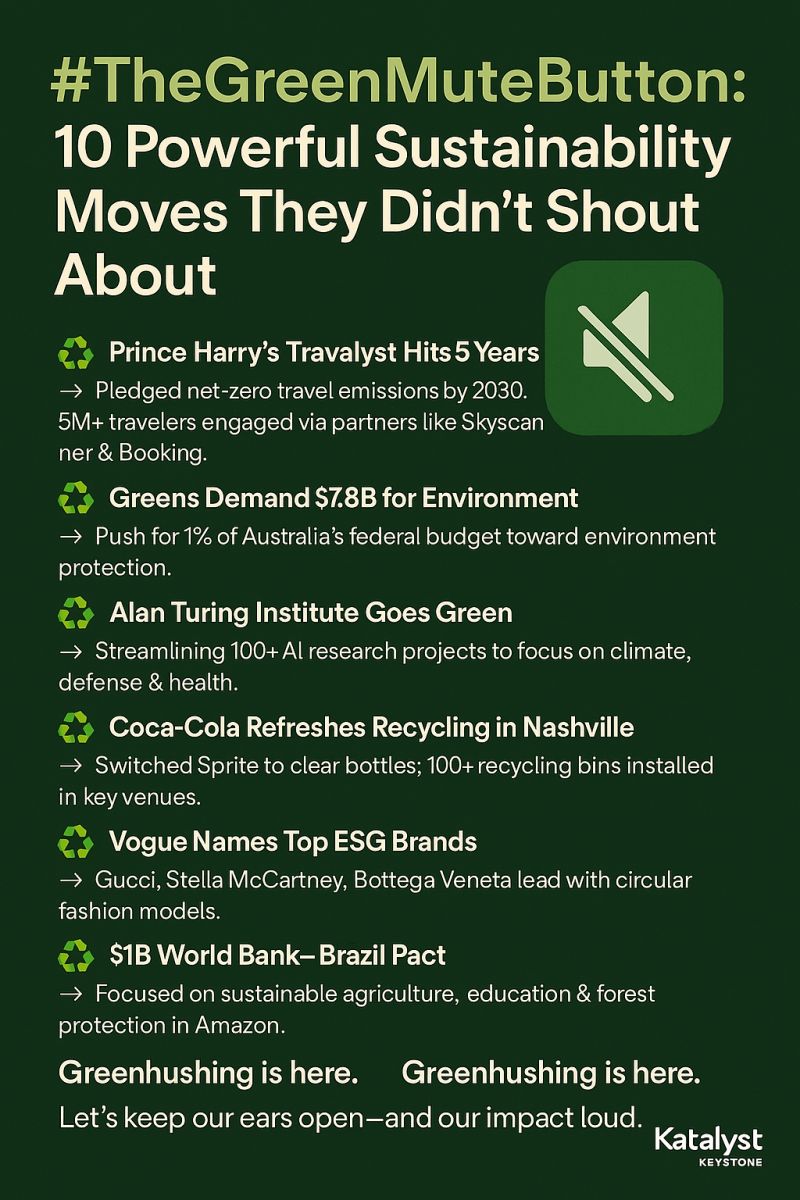
While some brands greenwash, others greenhush—acting boldly, speaking softly. Here are 10 recent under-the-radar sustainability shifts from March 2025:
♻️ Prince Harry’s Travalyst Hits 5 Years
→ Pledged net-zero travel emissions by 2030. 5M+ travelers engaged via partners like Skyscanner & Booking.
♻️ Greens Demand $7.8B for Environment
→ Push for 1% of Australia’s federal budget toward environmental protection.
♻️ Alan Turing Institute Goes Green
→ Streamlining 100+ AI research projects to focus on climate, defense & health.
♻️ Coca-Cola Refreshes Recycling in Nashville
→ Switched Sprite to clear bottles; 100+ recycling bins installed in key venues.
♻️ Vogue Names Top ESG Brands
→ Gucci, Stella McCartney, Bottega Veneta lead with circular fashion models.
♻️ Saudi Digital Push for Green Goals
→ AI tools rolled out to track emissions & land degradation across 13 regions.
♻️ $1B WorldBank–Brazil Pact
→ Focused on sustainable agriculture, education & forest protection in Amazon.
♻️ Tasmania Salmon Rule Sparks Backlash
→ Legal shield for salmon farms in Macquarie Harbour raises ecosystem alarms.
♻️ Akastor’s 2024 ESG Report Out
→ Scope 1 & 2 emissions cut by 16%; 34% board gender diversity.
♻️ Wildlife Orgs Warn of UK Deregulation
→ Streamlining may weaken protections for 500+ endangered species.
Greenhushing is here.
Let’s keep our ears open—and our impact loud.
Greenhushing Sustainability ESG EcoAction SilentRevolution ClimateLeadership LinkedInImpact


Originally published on LinkedIn on 2025-04-02 06:33:17: https://www.linkedin.com/feed/update/urn%3Ali%3AgroupPost%3A7041748-7313086103484358656
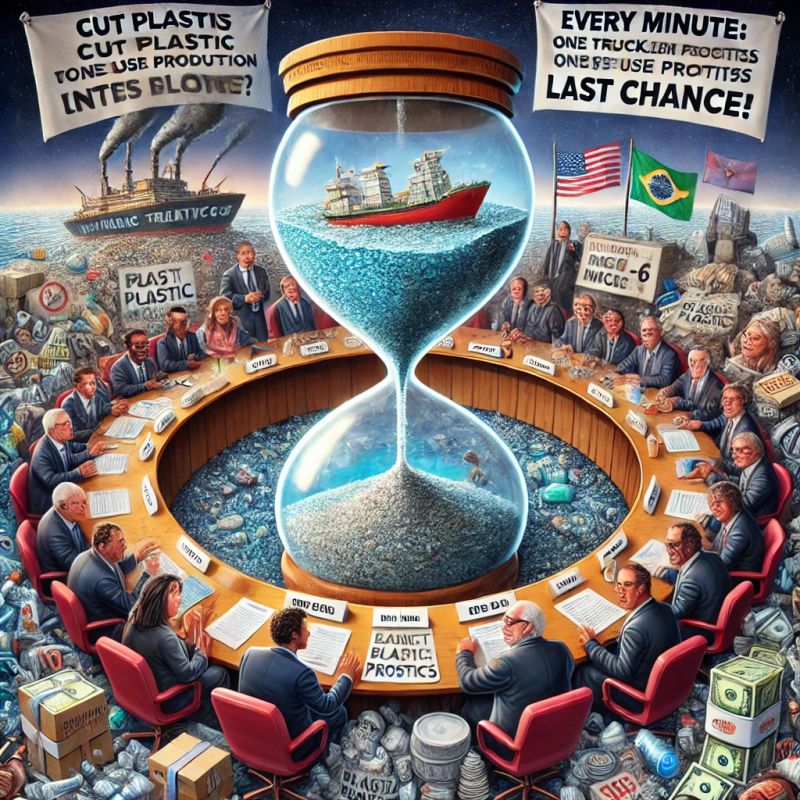
🚨 “Plastic Treaty Deadlock: Is INC-5 Fighting Pollution or Protecting Profits?” ♻️🌍💰
The Intergovernmental Negotiating Committee (INC-5) just wrapped up in Busan, South Korea, aiming to finalize a legally binding treaty on plastic pollution. Instead, the world got another delay. Why? A battle between cutting plastic production and protecting corporate interests.
🔴 1. The Big Divide: Who Wants Action vs. Who Wants Delay?
✅ 85 countries, including the EU and small island nations, pushed for binding plastic production cuts. (Source: UNEP, 2024)
❌ Saudi Arabia, Iran, and Russia led opposition, arguing waste management—not production—is the issue. (Source: The Guardian, 2024)
✅ Plastic waste is projected to triple by 2060 without drastic cuts. (OECD, 2024)
❌ Fossil fuel lobbyists outnumbered environmental groups 3:1 at INC-5, weakening proposals. (Source: WSJ, 2024)
🚨 Reality Check: Plastic production is expected to double by 2040, worsening the crisis. (Source: OECD, 2024)
🟡 2. The Stalemate: Key Proposals vs. Pushback
✅ Caps on virgin plastic production – would target the 450M tons of plastic produced annually. (Source: UNEP, 2024)
✅ Phase-out of toxic chemicals – over 16,000 chemicals are used in plastic, many unregulated. (IPEN, 2024)
✅ Stronger Extended Producer Responsibility (EPR) – shifts waste costs from consumers to corporations.
❌ Plastic production is still expected to grow by 80% by 2050 under current policies. (IEA, 2024)
❌ Half of all plastic ever made has been produced since 2000. (National Geographic, 2024)
🚨 Reality Check: Without cuts, plastic pollution will double in the ocean by 2040. (Source: Pew Charitable Trusts, 2024)
⚠️ 3. The Hard Truth: INC-5 is Running Out of Time
❌ Every minute, the equivalent of a garbage truck of plastic enters the ocean. (WWF, 2024)
❌ Only 9% of all plastic ever made has been recycled. (UNEP, 2024)
❌ Microplastics have been found in 80% of human blood samples tested. (Science Advances, 2024)
🚨 Reality Check: If INC-6 doesn’t enforce production cuts in 2025, this treaty risks becoming another empty climate agreement.
🏆 KeyTakeaway
The INC-5 negotiations ended in deadlock, as plastic-producing nations prioritize profits over pollution cuts. Without stronger global action in INC-6, this treaty could turn into just another greenwashed agreement.
👉 Will the world get a real plastic treaty—or just more delays?
PlasticCrisis NetZero Greenwashing ClimateAction INC5
Originally published on LinkedIn on 2025-02-03 08:51:04: https://www.linkedin.com/feed/update/urn%3Ali%3AgroupPost%3A9270968-7292102277627105281
China is going all in for GreenHydrogen production:
640MW Green Hydrogen Project in Songyuan, Jilin Province
Operator: China Energy Engineering Corporation (CEEC)
Capacity: 640MW
Significance: Largest green hydrogen project in China
Other Major Green Hydrogen Plants in China
1. Sinopec’s Kuqa Plant
Location: Kuqa, Xinjiang
Capacity: 20,000 tons of green hydrogen annually
2. Baofeng Energy’s Ningxia Plant
Location: Ningxia
Capacity: 160MW
Integrates solar power for hydrogen production
3. China Huaneng’s Qinghai Plant
Location: Qinghai
Capacity: 100MW
4. SPIC’s Inner Mongolia Plant
Location: Inner Mongolia
Capacity: 200MW
5. China Datang’s Hebei Plant
Location: Hebei
Capacity: 150MW
Significance: Supports local green energy goals and industrial decarbonization
China’s Investments in Hydrogen Projects Outside of China
1. Saudi Arabia’s NEOM Project
2. Australia’s Asian Renewable Energy Hub
3. Norway’s Green Hydrogen Projects
4. Chile’s Green Hydrogen Initiatives
5. UnitedArab Emirates’ Hydrogen Project
The European Union is taking steps to limit the involvement of Chinese firms in its hydrogen project subsidies.
https://lnkd.in/dhhXCXx4
Originally published on LinkedIn on 2024-09-03 20:25:57: https://www.linkedin.com/feed/update/urn%3Ali%3AgroupPost%3A60128-7236831808686829569
NamasteIndia high population and being Tropical matters!
India:
Per Capita Energy Consumption (2021-22): 24,453 megajoules.
Per Capita Electricity Consumption (March 2023): 1,331 kWh.
1. Qatar: Leads with 817 GJ per person, mainly due to abundant natural gas.
2. Iceland: Relies on geothermal energy, consuming 603 GJ per person.
3. Singapore: Consumes 577 GJ per person, driven by economic activities.
4. UAE United Arab Emirates : Uses 539 GJ per person for infrastructure and development.
5. Trinidad & Tobago: Consumes 384 GJ per person.
6. Kuwait: Energy usage stands at 366 GJ per person.
7. Norway: Benefits from oil and hydropower, with 364 GJ per person.
8. Canada: Consumes 360 GJ per person.
9. Oman: Energy consumption is 333 GJ per person.
10. Saudi Arabia: Uses 314 GJ per person.
11. US United States: Reflects its large population and industrial base (277 GJ per person).
12. Turkmenistan: Consumes 246 GJ per person.
13. South Korea: Major player in Asia Pacific (240 GJ per person).
14. Australia: Energy consumption is 228 GJ per person.
15. Russian Federation: Consumes 217 GJ per person.
Charted: The Countries Using the Most Energy per Capita https://lnkd.in/d8xPJzhZ
Originally published on LinkedIn on 2024-08-03 11:55:13: https://www.linkedin.com/feed/update/urn%3Ali%3Ashare%3A7225469254517571584

