Why ESG Isn’t a Global Roadmap—It’s a Country_by_Country_Compass
ESG Isn’t One-Size-Fits-All—It’s One-Strategy-Fits-Nation
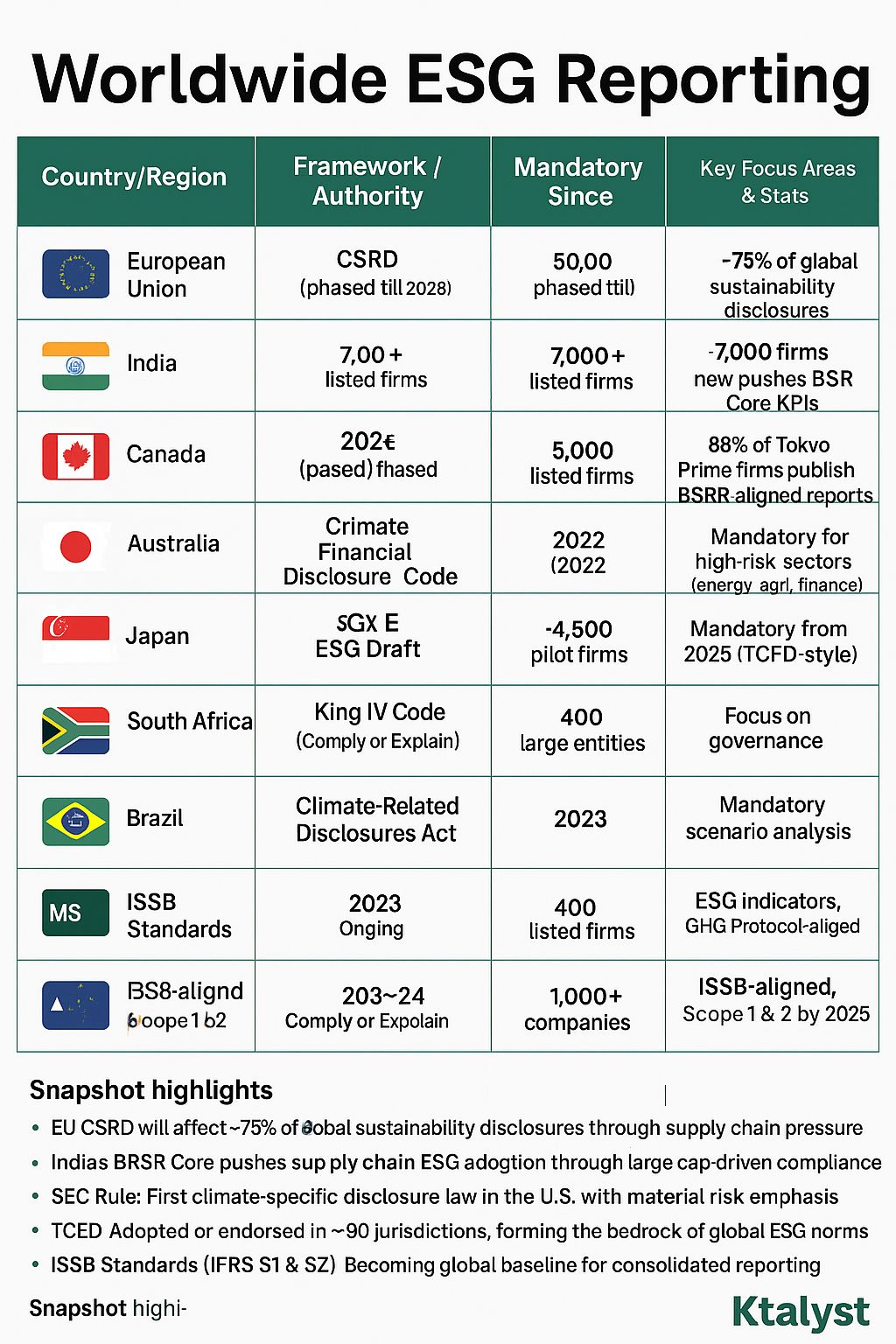
ESG reporting takes different roads because nations prioritize differently—economic maturity, regulatory style, investor pressure, and trade exposure all shape the path. The EU leads with CSRD—affecting 50,000+ firms through double materiality, taxonomy alignment, and mandatory assurance. The US sticks to financial materiality and climate risk, sidestepping Scope 3 and S&G. India’s BRSR ties ESG to development goals, starting with the top 1,000 and easing into assurance. Export-driven China, Malaysia, and Singapore accelerate ESG to meet global buyer expectations and bypass EU CBAM fallout. Japan prefers voluntary codes; South Africa excels in governance (King IV), but lacks integrated data.
Bottom line? ESG mirrors what each country values—growth, governance, global edge, or green capital. It’s not just compliance—it’s strategy, sovereignty, and survival.
🇪🇺 European Union
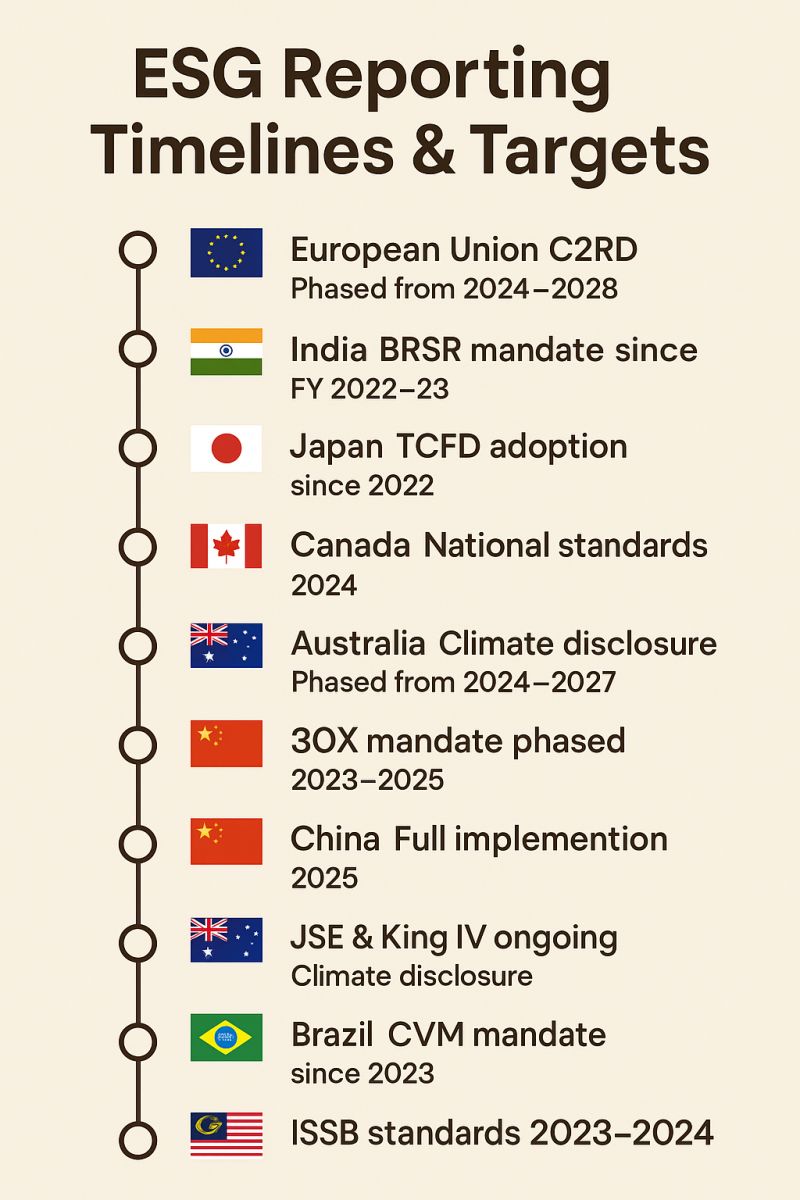
Timeline: CSRD phased from 2024 to 2028
Mandatory from:
2024: Large public-interest companies
2025: All large companies
2026–28: SMEs (limited scope)
FunFact: Will impact 75%+ of global ESG reporting indirectly via supply chains
🇺🇸 United States
Timeline: SEC Rule effective 2024–2025
Mandatory from:
FY2024: Large Accelerated Filers
FY2025: Accelerated Filers
Scope 3? Only if material (and still debated)
🇮🇳 India
Timeline:
BRSR mandatory since FY 2022–23
BRSR Core with limited assurance from FY 2023–24
Next up: Potential rollout for mid-size unlisted companies by 2026
🇯🇵 Japan
Timeline:
TCFD adoption by Prime listed firms since 2022
No fixed law, but >80% of large firms are already onboard voluntarily
🇨🇦 Canada
Timeline:
CSA rule aligned with TCFD from 2024
Mandated for:
Publicly listed entities, expanding coverage gradually
🇦🇺 Australia
Timeline:
Climate Disclosure Framework phased from July 2024
Rollout:
2024: Large companies
2026–27: Mid and small entities
🇸🇬 Singapore
Timeline:
SGX ESG reporting mandatory since 2023
Sector phased:
Energy, Agri, Finance by 2024
All others by 2025
🇨🇳 China
Timeline:
Draft ESG rules under CSRC in 2024
Target:
Full mandatory rollout by 2025
Pilots ongoing in green finance and energy sectors
🇿🇦 SouthAfrica
Timeline:
JSE & King IV apply ongoing since 2016
Mandate:
Comply or explain” model, no fixed year — but tightening expected by 2025
🇳🇿 NewZealand
Timeline:
Climate-Related Disclosure Act enforced from 2023
Applies to:
Financial institutions & large corporates (>NZ$1B AUM or turnover)
🇧🇷 Brazil
Timeline:
CVM ESG disclosure mandatory since 2023
Focus:
Annual reporting, with increasing pressure for Scope 3 inclusion by 2026
🇲🇾 Malaysia
Timeline:
ISSB-aligned standards adopted in 2023–2024
Mandated by:
Bursa Malaysia, full Scope 1–2 by 2025, Scope 3 optional till 2026


Originally published on LinkedIn on 2025-04-21 21:59:46: https://www.linkedin.com/feed/update/urn%3Ali%3AugcPost%3A7320204627323289601
NamasteIndia summary of the roadmap for decarbonization of the steel sector in India:
Background: India’s steel sector contributes approximately 12% of total greenhouse gas emissions.
Emission Intensity: The emission intensity of Indian steel production is 2.55 tonnes of CO2 per tonne of crude steel (higher than the global average).
Roadmap Development: The Ministry of Steel has developed a roadmap for decarbonization.
TaskForces: 14 task forces explored mechanisms for advancing decarbonization.
Integration: Findings from the task forces have been integrated into the roadmap.
Public Consultation: The roadmap will soon be open for public consultation.
Transition Goals: India aims to shift ‘hard-to-abate’ industries from energy efficiency targets to emission targets.
Indian Carbon Market**: Appropriate regulations will be established for the Indian Carbon Market.
This development aligns with sustainability goals and environmental efforts.
Originally published on LinkedIn on 2024-07-28 12:51:40: https://www.linkedin.com/feed/update/urn%3Ali%3AgroupPost%3A2635374-7223309134945804290
NamasteIndia summary of the roadmap for decarbonization of the steel sector in India:
Background: India’s steel sector contributes approximately 12% of total greenhouse gas emissions.
Emission Intensity: The emission intensity of Indian steel production is 2.55 tonnes of CO2 per tonne of crude steel (higher than the global average).
Roadmap Development: The Ministry of Steel has developed a roadmap for decarbonization.
TaskForces: 14 task forces explored mechanisms for advancing decarbonization.
Integration: Findings from the task forces have been integrated into the roadmap.
Public Consultation: The roadmap will soon be open for public consultation.
Transition Goals: India aims to shift ‘hard-to-abate’ industries from energy efficiency targets to emission targets.
Indian Carbon Market**: Appropriate regulations will be established for the Indian Carbon Market.
This development aligns with sustainability goals and environmental efforts.
Originally published on LinkedIn on 2024-07-28 12:51:29: https://www.linkedin.com/feed/update/urn%3Ali%3Ashare%3A7223309090192556032

