DEVIL’S ADVOCATE KPI REPORT
Dr. Anju Sharma
MrsSustainability | KtalystInsights
✓Topic: New Energy World | ✓Sustainability | Logistics
✓Reporting Period: Current Reality
✓Data Status: Green
✓Outcome Status: Questionable
🔴 MACRO KPI SNAPSHOT
KPI Dashboard Status Ground Reality
Markets
🔴 Weak Capital risk-off, patience low
SecuritySpend
🟢 Rising Defence prioritised over disruption
EnergyCost
🔴 High Reliability priced above transition
LogisticsCost
🟠 Volatile Forecast accuracy breaking
SustainabilityScore
🟢 On Track Execution under stress
KPI Note:
AI reads the dashboard.
It doesn’t read the room.
INVESTOR KPI
Metric tracked: IRR, ESG score, pipeline size
Metric missed: Cash survivability under volatility
Variance:
Projects dependent on long logistics chains and subsidy oxygen underperform in down markets.
Devil’s Comment:
📉 Green narrative ≠ bankable resilience.
🏛️ POLICY KPI
Metric tracked: Emission targets, transition timelines
Metric missed: Grid failure tolerance
Variance:
Security and affordability override ideology during stress cycles.
Devil’s Comment:
Blackouts cost elections faster than carbon.
OPERATOR KPI
Metric tracked: Decarbonisation roadmap
Metric missed: Operational shock absorption
Variance:
Assets are extended, hybridised, delayed — not retired.
Devil’s Comment:
Sustainability is sequenced, not abandoned.
Metric tracked: Emissions per shipment
Metric missed: Cost volatility, route fragility
Variance:
Ports, fuel hedging, near-shoring dictate sustainability outcomes more than strategy decks.
Devil’s Comment:
You can’t decarbonise what you can’t deliver.
AI KPI GAP ANALYSIS
AI is strong at:
✔ Optimisation
✔ Forecasting stable systems
✔ Reporting compliance
AI fails at:
❌ Panic cycles
❌ Political trade-offs
❌ Price shocks
❌ Human survival behaviour
KtalystInsights
1) Sustainability KPIs are passing.
2) Resilience KPIs are not even defined.
What isn’t measured gets ignored.
What gets ignored becomes the risk.
If you want next, I can:
Convert this into a one-slide KPI dashboard visual
Add numeric proxy indicators (dummy but realistic)
Create a “Green KPI vs Red Reality” carousel
Say the next move 📊🔥
Originally published on LinkedIn on 2025-12-16 05:10:29: https://www.linkedin.com/feed/update/urn%3Ali%3Ashare%3A7406561329924403200
SustainabilityUnfolded –Episode1 TRIGGERS: Protests to Protocols: What Triggered the Global Focus on Sustainability?
🌍 1970 | Earth Day
20 Million people marched in the U.S.
Environmentalism got its birthday.
Pollution was political.
🏛️ 1972 | Stockholm Conference (UNCHE)
113 Nations, 2 Goals:
✔️ Human development
✔️ Environmental protection
The UN goes green – officially.
📘 1987 |Brundtland Report
Birthed the term “Sustainable Development
Defined as: “Meeting today’s needs without compromising tomorrow.
Future got a seat at the table.
🌿 1992 | Rio Earth Summit (UNCED)
178 Countries | 3 Big Wins:
Agenda 21
UNFCCC (Climate)
CBD (Biodiversity)
Planet got a policy makeover.
🔥 1995 | COP1 – Berlin
The first Conference of Parties to the climate treaty.
Annual climate negotiations begin.
Welcome to the longest meeting ever held… every year.
📜 1997 | Kyoto Protocol (COP3)
37 Developed Nations | Legally binding targets.
First real climate contract.
Promises got power.
🌱 2000 | Millennium Development Goals (MDGs)
Goal 7: Environmental Sustainability
Development meets ecology.
SDG seeds planted.
🧴 2010 | INC5 Plastic Talks Begin
270 Million tonnes/year plastic waste
UN starts formal treaty talks.
Too much plastic? INC5 says “cut it out.
📉 2015 | ParisAgreement (COP21)
196 Countries | Limit warming to <2°C, aim for 1.5°C
Not just goals – commitments.
The climate got a contract. Humanity got hope.
🎯 2015 | UN SDGs Launched
17 Goals | 169 Targets | 193 Nations
Blueprint for People, Planet & Prosperity
Finally, everyone got the memo.
📈 2016 | ESG Goes Big
$23 Trillion+ in ESG assets
Investors ask: “What’s your carbon, not just your cash?
Doing good = Doing well.
⛔ 2020 | COVID Wake-Up Call
7% Drop in global emissions (temporary)
Fragile supply chains, stronger case for sustainability.
Resilience enters the chat.
📢 2022 | Davos: The Great Reset
80% of CEOs: Climate is a business risk
New mantra: Stakeholder Capitalism > Shareholder Greed
Profit with purpose is trending.
♻️ 2023 | INC5 Treaty in Progress
175 Nations drafting a treaty
Goal: End plastic pollution by 2040
Waste not, want a future.
Takeaway?
The world didn’t flip green overnight.
It marched, met, measured, and mobilized.
Coming Up Next – Episode 2: How Sustainability Became Strategy
Follow the footprints from eco-guilt to ESG gold.



Originally published on LinkedIn on 2025-03-26 14:51:14: https://www.linkedin.com/feed/update/urn%3Ali%3AgroupPost%3A82951-7310674700249018368
ForbesFrontlines – Episode 1
VisionariesOfValue – The Quiet Power of Choosing Tomorrow
There are moments in business where numbers don’t speak loud enough.
Where charts and KPIs pale before a single, haunting question:
Will we leave behind a world worth inheriting?
Forbes has long been the mirror for ambition, achievement, and acumen.
But today, it is also becoming a beacon—
Illuminating those who choose value not just for shareholders, but for the shared Earth beneath our feet.
In its 2024 State of Sustainability Report, Forbes didn’t just list trends.
It whispered a truth we can no longer ignore:
🌱 87% of CEOs now believe sustainability is the compass, not just the course.
⏳ 53% of Fortune 500 have tied leadership rewards to ESG—because integrity must be incentivized.
📊 Companies that embraced sustainability didn’t fall behind.
They surged ahead—28% stronger in market performance.
Their secret? They bet on forever.
And the stories Forbes tells?
They aren’t just about power.
They are about promise.
A CEO at Microsoft pledging carbon negativity,
A founder at Patagonia giving away his empire to the Earth,
A teenager in India—Garvita—saving 10 million litres of water,
Not with money, but with belief.
These aren’t headlines.
They are heartlines.
Why does Forbes care?
Because business is no longer about just what we can take.
It’s about what we choose to give back.
Because strategy today must not only forecast quarters—
It must forecast generations.
Because we’re not just building companies anymore—
We’re building consequences.
So, as we begin this Knowledge Series, let me ask you:
What kind of legacy are we funding?
What kind of silence will our success leave behind?
We begin here.
With the VisionariesOfValue.
Who plant trees under whose shade they may never sit.
Up next:
CLevelShift – Leadership at the Helm of Green Transformation
Originally published on LinkedIn on 2025-03-24 04:53:27: https://www.linkedin.com/feed/update/urn%3Ali%3Ashare%3A7309799484979372032
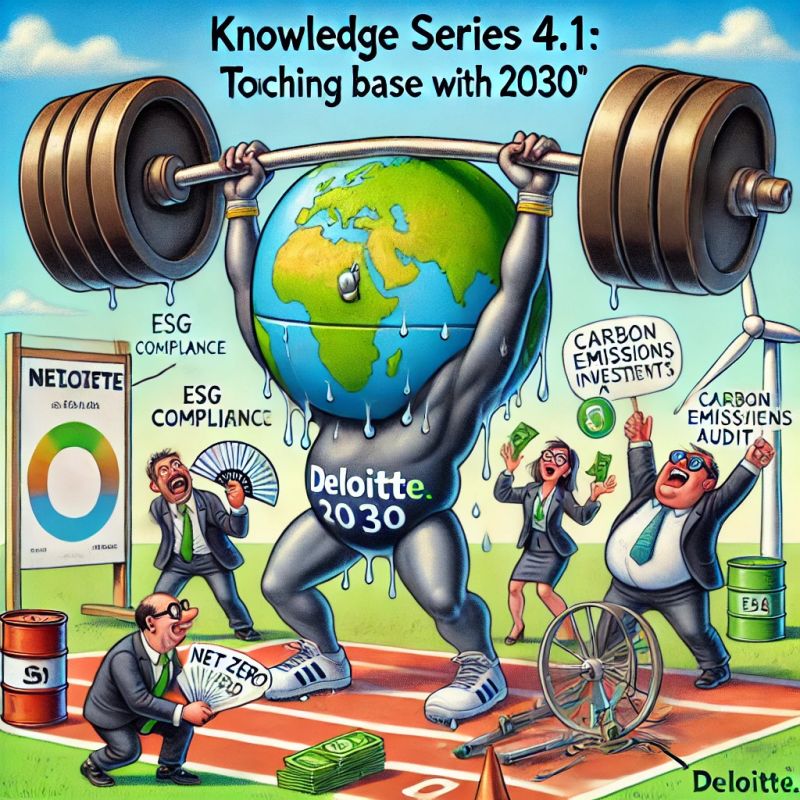
KnowledgeSeries 4.1: Deloitte – Touching Base with Sustainability 🌍♻️
🚀 Deloitte’s Green Footprint
One of the Big Four, Deloitte is at the forefront of ESG and sustainability with bold goals, smart strategies, and data-driven outcomes.
🌱 Vision for a Sustainable Future
> “Sustainability is no longer an option—it’s an imperative.” – Deloitte Insights
Operating in 150+ countries, Deloitte offers consulting, strategy, and finance services to help businesses navigate climate risks and ESG challenges.
Core_Focus_Areas:
✅ Net Zero & Decarbonization
✅ ESG Strategy & Governance
✅ Sustainable Finance
✅ Reporting & Impact Metrics
📊 Key Numbers That Matter
Net_Zero by YR2030
82% drop in travel emissions since 2019
47% cut in energy use across offices
100% renewable energy goal by 2025
$1B for Sustainability Services
Advising 1000+ global firms
Co_developed WEF ESG Metrics
People & Purpose
50% carbon footprint reduction by 2030
40+ CSR hours/employee annually
50% women in leadership target
📑 Insights from Deloitte Reports
2024 Sustainability_Action_Report
98% of companies progressing on ESG goals
56% formed ESG taskforces
2022 CxO Report
89% execs see climate as an emergency
67% increased ESG investments
FTSE 100 ESG Recalibration
46% companies revised their ESG scores
SDG Impact
Aligned with 12 of 17 SDGs, focusing on climate, consumption & governance
🔧 Deloitte’s 4-Step ESG Playbook
1️⃣ Measure carbon & ESG impact
2️⃣ Optimize operations for sustainability
3️⃣ Decarbonize with tech & renewables
4️⃣ Report to global standards (GRI, TCFD, WEF)
The Sustainability Reporting Catalyst helps companies comply across 60+ countries
🔭 What’s Next?
Green Finance innovation
AI for ESG data
Circular economy solutions
Renewable energy scaling
🌱 Deloitte isn’t just consulting on sustainability—it’s living it.
Next in KnowledgeSeries 4.1: Deloitte’s Green Power Play! ♻️
Which Big Four firm is leading the ESG charge? Let us know!
Originally published on LinkedIn on 2025-03-21 08:55:37: https://www.linkedin.com/feed/update/urn%3Ali%3AgroupPost%3A7041748-7308773265890566146
NamasteCarbonPricingIndia:
The_State_of_Carbon_Pricing_2024: Progress, Disparities, and Where India Fits
The YR2024 State and Trends of Carbon Pricing Report highlights both progress and challenges in global carbon pricing as governments strive to meet the Paris Agreement’s goals. With 75 carbon pricing instruments now operational—39 carbon taxes and 36 emissions trading systems (ETSs)—the landscape is evolving, yet significant gaps in pricing levels and emissions coverage remain.
Global Carbon Pricing: The Leaders
Countries exceeding the $80-$100/ton threshold, recommended to limit global warming, are setting the benchmark:
Uruguay: $167/ton – The world leader, powered by its renewable energy dominance.
Switzerland: $132/ton – Among Europe’s most ambitious nations.
Sweden: $127/ton – Achieved a 33% emissions reduction since 1991.
Norway: $108/ton – Balances oil exports with green innovation.
These leaders leverage carbon pricing to fund renewables, incentivize green practices, and drive significant emissions reductions.
Falling_Short: Countries Below $40/ton
Despite the expanding reach of carbon pricing, many nations are still underpricing emissions, limiting their impact:
California (USA): $39/ton – Gradual cap-and-trade implementation.
Japan (Tokyo): $37/ton – Focused on innovation but still below target.
India: $5/ton – A coal cess aimed at balancing affordability and emissions reductions.
Currently, only 23% of global emissions are covered by these instruments, leaving significant gaps in global climate action.
Where India Stands
As the third-largest emitter globally, India represents a critical player in the future of carbon pricing:
$5/ton Carbon Price: Through its coal cess, generating $3 billion annually for renewable energy initiatives.
National Carbon Market: Launched in 2023 to facilitate voluntary carbon trading, with potential for scaling.
500 GW Renewable Energy Target: India is undergoing one of the world’s fastest energy transitions, underscoring its commitment to sustainability.
Carbon Credit Leader: Indian projects dominate voluntary markets, showcasing the country’s capacity to innovate in carbon offsets.
India’s current pricing is modest but represents a foundation for growth. By gradually scaling its carbon price and expanding the carbon market, India can harmonize economic growth with climate goals.
The Way Forward
Carbon pricing is a powerful tool, but the global average remains far below the $80-$100/ton threshold needed to limit warming to 1.5°C. For nations like India, leveraging mechanisms such as renewable energy investments, carbon markets, and circular economy practices can drive impactful change while balancing affordability and growth.
Originally published on LinkedIn on 2024-12-19 20:26:43: https://www.linkedin.com/feed/update/urn%3Ali%3AgroupPost%3A59930-7275607502493278209

