PlasticWaste Lost Its Passport?
Dr. Anju Sharma MrsSustainability
21 May 2026, EU plastic-waste exports move under stricter prior notification & consent controls.
From 21_November_2026, EU plastic-waste exports to non_OECD countries will be banned.
This is where plastic waste shifts from being a tradeable burden to an accountable material flow.
The data spine is uncomfortable:
The EU exported 32 million tonnes of waste in 2022.
Türkiye alone received 12.4 million tonnes, nearly 39% of EU waste exports.
In 2023, the EU generated 35.3 kg plastic packaging waste per person, but recycled only 14.8 kg per person.
Extra-EU recyclable-material exports rose to 8.5 million tonnes in 2023, up 34% from 2022.
Top extra-EU recyclable plastic destinations included Türkiye 22%, Malaysia 21%, and Indonesia 19%.
The message is simple:
Europe has a plastic-waste management gap.
Earlier, part of that gap travelled.
Now, it must be sorted, washed, recycled, traced, audited, priced, and accounted for closer to home.
For EU exporters, this means more pressure on domestic recycling capacity, waste traceability, digital shipment systems, and circular infrastructure.
For non-OECD importers, it means reduced access to EU plastic scrap. Countries across South Asia, Southeast Asia, Africa, Latin America, and parts of the Middle East will feel the shift.
For OECD destinations such as Türkiye, the UK, Japan, South Korea, and Mexico, the concern is diversion. Regulators will watch whether waste is genuinely recovered or merely rerouted.
For India, the signal is strategic.
India is non-OECD. The ban applies from 21 November 2026.
The India equation is clear:
Less EU scrap
→ stronger domestic collection
→ better sorting & washing
→ recycling scale-up
→ pyrolysis oil opportunity
→ EPR-linked traceability
→ circular feedstock security
This should not be read as an import loss.
It should be read as an infrastructure trigger.
The old model was:
Collect → Export → Forget
The new model must be:
Collect → Trace → Sort → Recycle → Reuse → Account
The next circular-economy advantage will not belong to the country that imports the cheapest scrap.
It will belong to the country that can organise the dirtiest material stream into the cleanest business system.
Circularity begins when waste stops travelling and responsibility starts staying home.” Dr. Anju Sharma
Originally published on LinkedIn on 2026-06-04 07:14:45: https://www.linkedin.com/feed/update/urn%3Ali%3Ashare%3A7468198543825219584
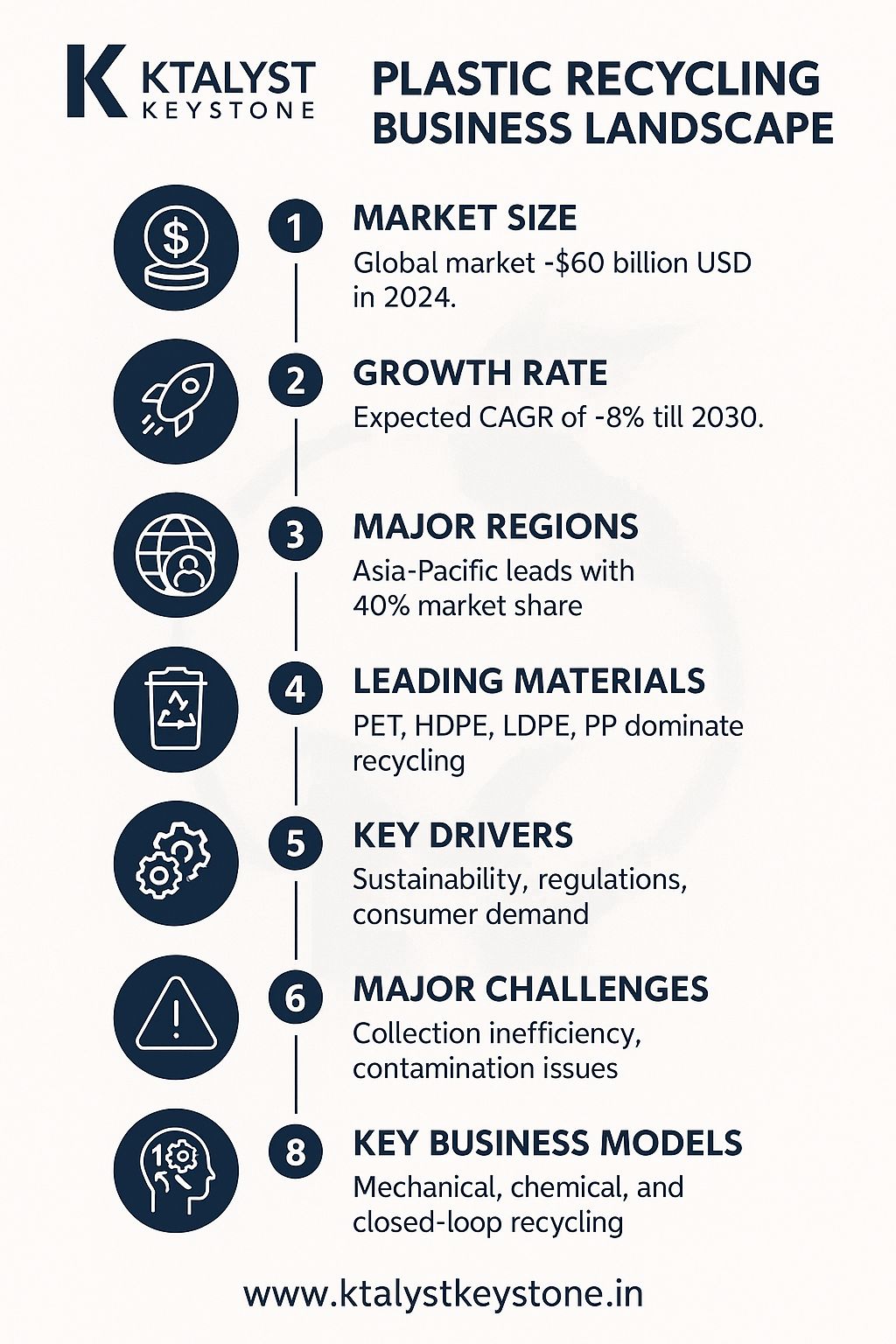
♻️ PlasticRecycling: TheSilentBillionDollarRevolution
isn’t just saving waste — it’s reshaping economies.
Discover the real market movers with KtalystInsights.
#♻️ “Recycling isn’t just renewal; it’s reinvention. Every plastic reimagined is a future reclaimed.” — KtalystKeystone
GlobalLandscape
🌎 MarketSize (2024): ~$60 billion USD
📈 ExpectedCAGR (2024–2030): ~8%
🗺️ TopRegions:
AsiaPacific (~40% share)
Europe (~25%)
NorthAmerica (~20%)
KtalystInsight:
Asia’s dominance is fueled by aggressive policyshifts (China’s Green Fence, India’s EPR regulations) — local recycling startups and global joint ventures are booming.
KtalystRecyclingRating
⭐ AsiaPacific: 8.5/10 — Rapid growth, moderate tech.
⭐ Europe: 9.2/10 — High regulation, tech leadership.
⭐ NorthAmerica: 8.0/10 — Innovation-led recycling but slower mass adoption.
⭐ LATAM & Africa: 5.5/10 — Emerging opportunity zones with infra gaps.
KtalystInsight:
Europe sets the goldstandard with circulareconomy laws, while Asia leads in volume but needs advanced tech and traceability upgrades.
5KeyApplications
🛍️ Packaging – Bottles, containers, films (PET, HDPE).
👕 Textiles – Recycled polyester for apparel and furnishings.
🚗 Automotive – Lightweight components from recycled PP and composites.
🏗️ Construction – Pipes, panels, roofing from recycled plastics.
🎮 ConsumerGoods – Toys, gadgets, daily-use products.
KtalystInsight:
Packaging & Textiles together consume over 60% of all recycled plastics — brands chasing ESG targets are pivoting toward 100% recycled content.
FuturePotential
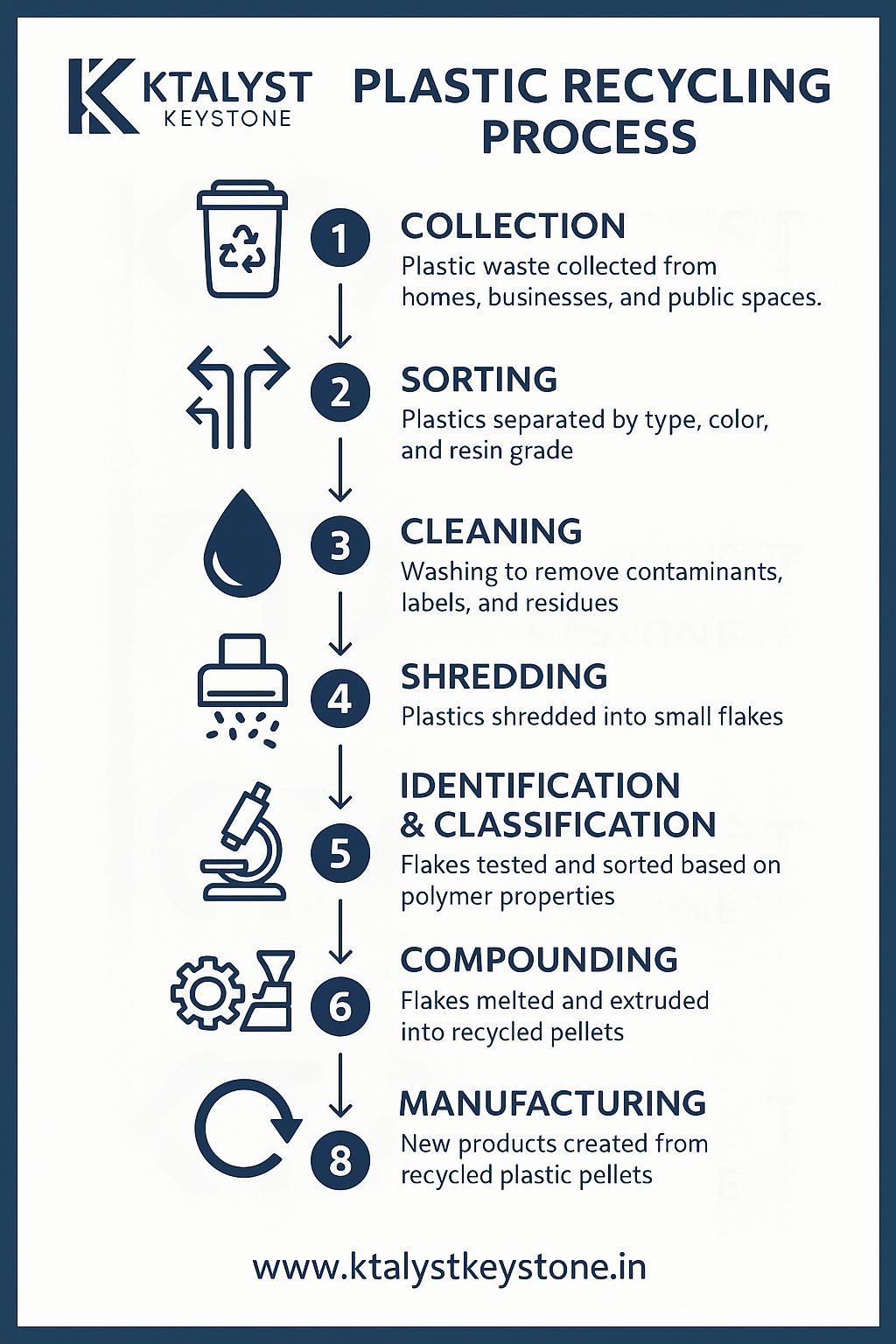
⚙️ AdvancedRecyclingTech (ChemicalRecycling): Unlocking hard-to-recycle plastics.
🤖 AIandRobotics: Smart sorting tech increasing plant yields by 25–30%.
🌿 BioplasticsHybridization: Next-gen materials mixing recycled polymers with bio-based resins.
KtalystInsight:
MechanicalRecycling dominates today, but ChemicalRecycling will be the investmentmagnet for the next decade, especially in Asia and the US, driven by stricter EPR mandates.
FinalThought
The PlasticRecycling economy is no longer a side act.
It’s the next trilliondollaropportunity, the ESGcredibility anchor, and a critical climatestrategy.
At KtalystKeystone, we believe recycling is no longer optional; it’s industrialevolution.
Originally published on LinkedIn on 2025-04-27 11:21:36: https://www.linkedin.com/feed/update/urn%3Ali%3AugcPost%3A7322218357754081280
KnowledgeKtalyst TrashTalk: What’s Really Filling Landfills in the US, EU, India & China?
Every landfill is a business ledger in disguise. What you trash today could have been your margin tomorrow.
Anju Sharma
UnitedStates
LandfillWhat?
[Food Waste] 24Percent
[Plastics] 18Percent
[Paper/Cardboard] 12Percent
[Textiles & Rubber] 11Percent
[Metals] 9Percent
[Wood] 8Percent
[Glass] 5Percent
[Other] 13Percent
50Percent of all MSW still goes to landfill!
ManagingItHow?
32Percent recycled or composted
12Percent through energy recovery
Rest? Buried beneath profit margins.
EuropeanUnion
LandfillWhat?
[Organic Waste] – Big share, varies by country
[Paper/Cardboard] – Still a chunk
[Plastics, Glass, Metals] – Widespread
ManagingItHow?
24Percent landfilled
48Percent recycled/composted
28Percent incinerated with energy gain
EU = Policy Muscle + Producer Pressure = Less Waste
India
LandfillWhat?
[Organic Waste] – 50Percent
[Plastics] – 8Percent
[Paper] – 7Percent
[Rest] – Metals, glass, biomedical mix
ManagingItHow?
Mostly OpenDumping
InformalRecycling = backbone
Composting + WTE = Emerging, not scaled
India = Waste goldmine, but needs formal systems
China
LandfillWhat?
[Food Waste] – Top chunk
[Plastics & Paper] – Considerable
[Textiles, Metals, Others] – Add-on clutter
ManagingItHow?
Historically high landfilling
Big leap in Recycling and WTE
Smart cities with AI-sorting + NoWaste policies
China = From pile-up to policy playbook
KtalystTakeaways
LandfillAddiction: US & India still digging deep
OrganicWaste: Common culprit, compost it!
PlasticAttack: Needs cross-border innovation
EUPlaybook: Regulation works, so do taxes
NextMove?: Monetize waste + tie it to CarbonCredits
Originally published on LinkedIn on 2025-04-10 19:09:07: https://www.linkedin.com/feed/update/urn%3Ali%3AgroupPost%3A100646-7316175417202163713
MistWashed Priorities in Sustainability: When Data Exposes the Gaps
Sustainability often looks good but lacks real impact. Here’s where well-intended efforts get lost in the fog of MistWash:
1. Eco-Friendly Illusions
✅ Recycled & biodegradable products
❌ High carbon footprints from transport & packaging
🔢 A bamboo toothbrush shipped globally > Higher CO₂ than local plastic one
Plastic Bans vs. Bigger Pollutants
✅ Straws & cutlery banned
❌ Ignored: Industrial plastic waste, fishing nets
🔢 Straws = 0.03% of ocean waste | Fishing gear = 46%
3. Carbon Offsets: License to Pollute?
✅ Tree planting & carbon credits
❌ Excuse to keep emitting CO₂
🔢 NY–London flight emits more CO₂ than 12 trees absorb in a year
4. “Sustainable” Fashion = Overproduction
✅ Eco-friendly clothing lines
❌ Still polluting & microplastics in water
🔢 Fashion = 10% of global CO₂ & 35% of ocean microplastics
5. GreenBuildings ≠ Energy Efficient
✅ LEED-certified skyscrapers
❌ Glass-heavy designs need more cooling
🔢 30% more energy use vs. traditional buildings
6. RenewableEnergy: Unseen Costs
✅ Solar & wind farms
❌ Deforestation, wildlife displacement
🔢 15% of solar farms replace forests & wetlands
7. The Recycling Illusion
✅ More recycling efforts
❌ Mass production keeps growing
🔢 9% of plastic is recycled | 380M+ tons produced yearly
8. EVs: The Clean Energy Myth
✅ EVs reduce tailpipe emissions
❌ Coal-powered grids, lithium mining
🔢 EV battery production = 74% more CO₂ than gas car lifecycle
9. Greenwashing > Real Impact
✅ “Carbon Neutral” claims
❌ Offsets instead of real cuts
🔢 70% of corporate claims lack verified reductions
10. Aesthetics Over Impact
✅ Green walls & rooftop gardens
❌ Costly but negligible climate impact
🔢 Vertical gardens cost 10X more than planting trees
🚀 RealSustainability means: Less hype, more impact. Systemic change > Symbolic bans. Accountability > Optics.
ESG Sustainability ClimateAction ImpactOverImage
Originally published on LinkedIn on 2025-03-10 18:45:32: https://www.linkedin.com/feed/update/urn%3Ali%3AgroupPost%3A4385073-7304935456536715264
KnowledgeSeries The_Circular_Economy4Illusion: Why It’s Not Working ♻️
The CircularEconomy is often seen as a sustainability silver bullet, but the data tells a different story. While “reduce, reuse, recycle” sounds promising, the reality is riddled with inefficiencies, high costs, and greenwashing.
🖼️ Recycling is Failing
🔹 91% of plastic waste has never been recycled (UNEP).
🔹 Only 8.6% of global materials are reused annually (Circularity Gap Report 2023).
🖼️ It’s Expensive & Inefficient
🔹 A fully circular transition requires $4.5 trillion (World Economic Forum).
🔹 Reverse logistics costs 5x more than traditional waste disposal (McKinsey).
🖼️ Fast Fashion & E-Waste Contradictions
🔹 92M tons of textile waste is generated yearly (Ellen MacArthur Foundation).
🔹 Only 20% of smartphones are properly recycled, despite valuable metals (UNEP).
🖼️ Greenwashing is Rampant
🔹 60% of sustainability claims are misleading (Changing Markets Foundation).
🔹 Many brands label products “recyclable” but offer no actual recycling infrastructure.
🖼️ The Root Problem: Overproduction
🔹 The world extracts 100B tons of raw materials annually—yet only 8.6% is cycled back (Circularity Gap Report 2023).
🔹 Recycling can’t keep up with rising consumption—we need reduction, not just circularity.
⚡ FinalThought
The CircularEconomy isn’t a solution unless businesses redesign production, reduce overconsumption, and move beyond greenwashing.
💬 What’s your take—Is circularity a real fix, or just a sustainability myth? ⬇️
Originally published on LinkedIn on 2025-03-08 18:31:06: https://www.linkedin.com/feed/update/urn%3Ali%3AgroupPost%3A82951-7304207047842054145
🚨 BigBrands, BIGGERFines: The Recycling Greenwashing Scandal Exposed! ♻💰
We’ve been told recycling is the answer to plastic waste. But what if the system itself is built on fraud and deception? BigBrands are now facing BIGFINES for misleading consumers about recyclability. Here’s how the deception unfolded over the years:
📅 TIMELINE OF GREENWASHING IN RECYCLING
🔹 YR1990s – The Recycling Illusion Begins
📌 Plastic industry documents reveal that producers knew recycling wouldn’t work on a large scale—but they marketed it as the solution to keep plastic production high. (Source)
🔹 YR2000s – Growth of the ‘Recyclable’ Label
📌 Brands like CocaCola, Nestlé, and Unilever start aggressively using recyclable labels, despite knowing that most plastic isn’t actually recycled due to contamination and lack of facilities. (Source)
🔹 YR2018 – China Bans Plastic Waste Imports
📌 China’s NationalSword policy ends global reliance on cheap recycling, exposing the broken system. The US and EU struggle to process their own plastic waste.
🔹 YR2022 – Keurig Faces Greenwashing Lawsuit
📌 KeurigDrPepper pays #$3M in Canada and $1.5M in the US for falsely claiming its K-Cups were recyclable, despite most recycling centers rejecting them. (Source)
🔹 YR2023 – EU Cracks Down on Greenwashing
📌 The EU introduces legislation requiring brands to prove their sustainability claims or face heavy fines.
🔹 YR2024 – ExxonMobil Sued for Recycling Lies
📌 California sues ExxonMobil, accusing them of knowingly misleading the public about plastic recycling.
🔹 YR2025 & Beyond – The Future of Greenwashing Accountability?
📌 Global brands will face stricter regulations and fines in the billions for misleading sustainability claims. Will it be enough to stop greenwashing?
🚨 THE REALITY CHECK: Only 5% of Plastic is Actually Recycled
📌 Despite all the marketing, 95% of plastic waste still ends up in landfills, oceans, or incinerators. We’re not recycling our way out of this crisis. (Source)
💡 The Takeaway: It’s time for big brands to face bigger consequences for deceptive sustainability claims. Recycling is NOT the solution—reducing plastic production is.
📢 What’s Next? Should governments ban false recycling claims? Should companies pay for end-to-end plastic responsibility? Let’s talk below! 👇
Originally published on LinkedIn on 2025-02-26 16:11:56: https://www.linkedin.com/feed/update/urn%3Ali%3AgroupPost%3A82951-7300548149285117954
📢 KnowledgeSeries: “Sustainable Resolutions—Are You Making Real Impact?” 🌍📉
Not all green choices are equal. Are you focusing on what truly matters?
As we commit to SustainableResolutions for 2025, it’s crucial to distinguish between low-impact actions vs. game-changing decisions that can truly reduce our carbon footprint.
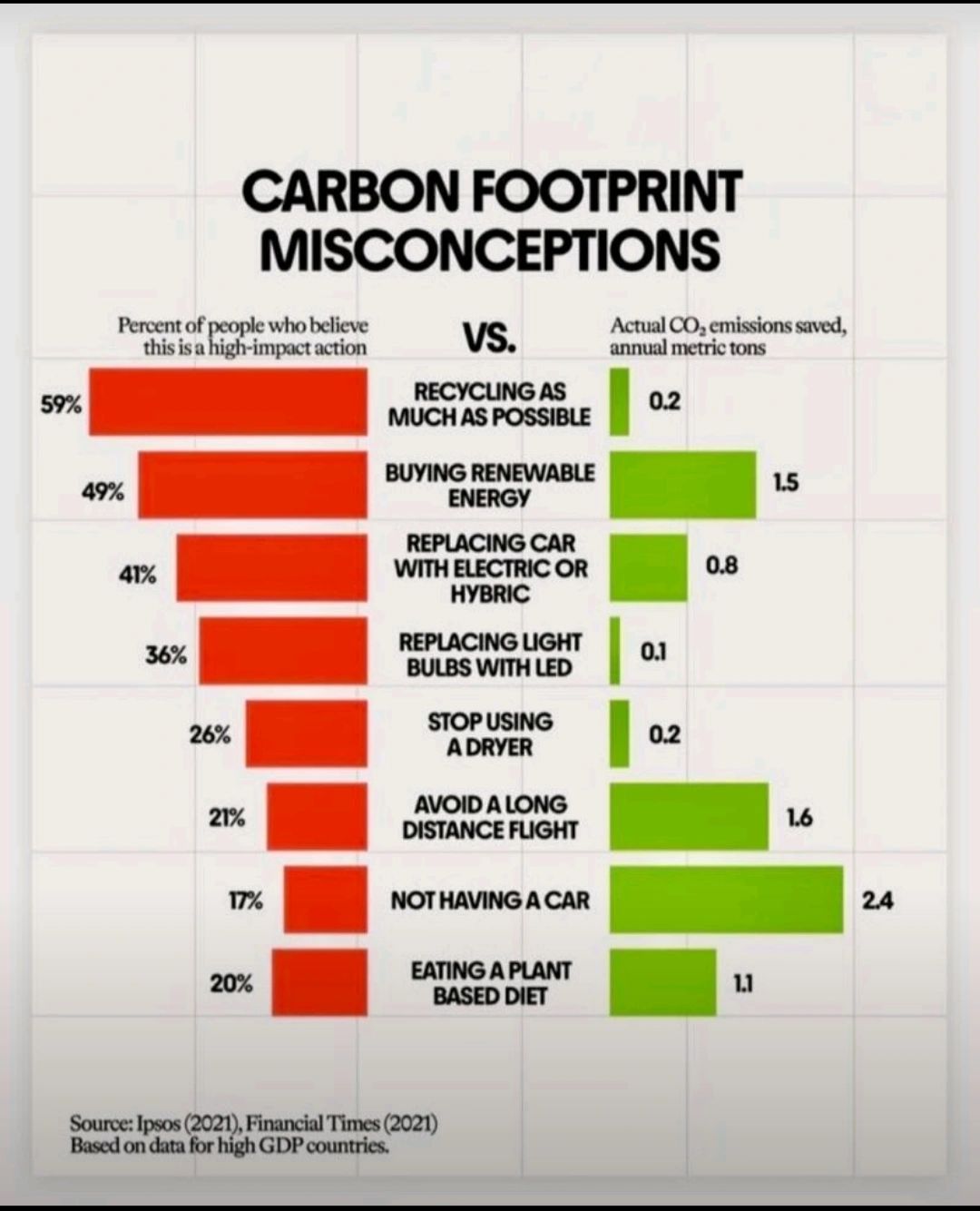
📊 CarbonMisconceptions vs. RealImpact: Where Should You Focus?
🔴 The Green Illusions We Fall For:
🚨 Recycling – 59% of people believe it’s a major climate solution, yet it only saves 0.2 metric tons of CO₂ annually per person. (Ipsos, 2021)
🚨 LED Bulbs – Swapping old bulbs for LED reduces emissions by just 0.1 metric tons annually. (Financial Times, 2021)
🚨 EV Swaps – Switching to an electric vehicle cuts 0.8 metric tons of CO₂, but only if powered by clean electricity. (IEA, 2024)
🚨 Avoiding Dryers – Only saves 0.2 metric tons per year—far less than other choices. (EPA, 2023)
🚨 Short-Term Offsets – Many carbon offset programs focus on short-term tree planting, which takes decades to absorb emissions but provides immediate corporate greenwashing benefits. (UNEP, 2024)
✅ Resolutions That Actually Move the Needle:
🌍 Not owning a car – The single biggest change, saving 2.4 metric tons annually in emissions. (IEA, 2024)
✈️ Skipping a long-haul flight – Avoiding just one international flight saves 1.6 metric tons of CO₂. (UNEP, 2023)
⚡ Switching to renewable energy – A household using renewables can cut emissions by 1.5 metric tons per year. (IPCC, 2024)
🥗 Adopting a plant-based diet – Reduces CO₂ impact by 1.1 metric tons annually. (Nature Food, 2024)
🏠 Energy-efficient homes – Retrofitting homes with insulation, heat pumps, and solar panels can cut energy-related emissions by 40%. (IEA, 2025)
🚀 Your 2025 Sustainable Resolutions: Choose Wisely!
🌱 Could be minor eco-friendly habits—important, but not enough alone.
🌎 Should be actions that target major carbon sources—transport, energy, and food choices.
🔥 Would be transformational if individuals + businesses prioritize high-impact change.
📌 RealityCheck: Corporate sustainability efforts alone won’t fix the crisis—real impact comes from systemic choices.
👉 What’s your sustainability resolution for 2025? Drop your thoughts below! 👇
Originally published on LinkedIn on 2025-02-20 16:00:26: https://www.linkedin.com/feed/update/urn%3Ali%3Ashare%3A7298370925727494144
🚀 NamasteIndia IISc’s Breakthrough in PlasticRecycling: Transforming Waste into Sustainable Innovation ♻️
♻️ The Indian Institute of Science (IISc), Bengaluru has achieved a game-changing breakthrough in plastic recycling! A team led by Prof. Suryasarathi Bose and Prof. Subodh Kumar has developed a bio-based aqueous solution to effectively recycle Carbon Fiber Reinforced Polymers (CFRPs)—a material widely used in aerospace, automotive, and high-performance industries.
🔥 KeyHighlights:
🟢 CFRPs are tough to recycle due to their complex structure—this innovation makes it possible!
🟢 Eco-friendly process breaks down the epoxy resin matrix, allowing for carbon fiber recovery.
🟢 Recovered carbon fiber retains its strength and can be reused in composites.
🟢 Recycled epoxy resin can serve as a hardener in new materials.
🟢 Supports the circular economy, reducing plastic waste and promoting sustainability.
💡 Why does this matter?
This pioneering method can revolutionize sustainable manufacturing by reducing dependency on virgin materials and cutting down industrial waste.
👏 Kudos to IISc for pushing the boundaries of science, sustainability, and innovation!
🔗 Read more: Deccan Herald
Originally published on LinkedIn on 2025-02-14 07:29:55: https://www.linkedin.com/feed/update/urn%3Ali%3Ashare%3A7296068126381608964
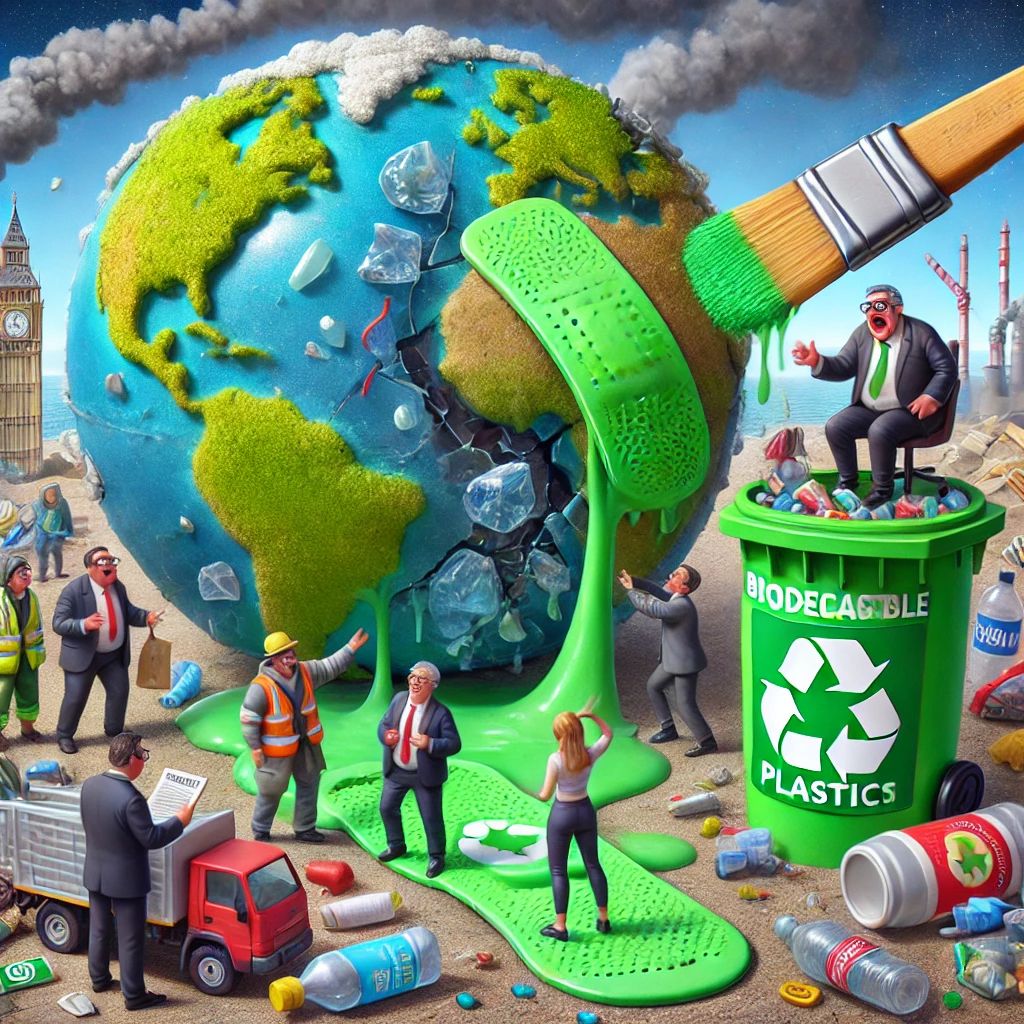
🚨 “Green Plastics: A Band_Aid on a Bullet_Wound?” ♻️🌍💭
The world produces 400 million tons of plastic annually, and now, the industry wants you to believe Green Plastics are the solution. But are they truly a revolution—or just a rebranded problem? Let’s go beyond the buzzwords and into the hard facts.
📊 1. The Green Plastic Illusion
✅ Bioplastics – Made from plants like corn & sugarcane instead of oil.
✅ Recycled Plastics – Reduces virgin plastic demand but still degrades over time.
✅ Biodegradable Plastics – Marketed as compostable but often require industrial processing.
🚨 Reality Check: Only 5% of global plastic is actually recycled, and ‘bioplastics’ often don’t degrade in real-world conditions. (OECD, 2024)
🔴 2. The Unseen Costs: What They Don’t Tell You
❌ Bioplastics require vast amounts of water, land, and energy—competing with food production. (FAO, 2024)
❌ Most ‘biodegradable’ plastics don’t break down in oceans or landfills—just like regular plastic. (WWF, 2024)
❌ Recycling green plastics is costly and inefficient—leading to waste incineration instead. (Greenpeace, 2024)
🚨 Reality Check: Green plastics shift the burden, but don’t eliminate the pollution crisis.
🌍 3. Who’s Leading the Green Plastic Race?
✅ 🇪🇺 EU: Strict bans on single-use plastics, pushing for a true circular economy. (EU Commission, 2024)
✅ 🇯🇵 Japan: Seaweed-based plastics as a real alternative to petroleum-based materials. (JETRO, 2024)
✅ 🇮🇳 India: Mandatory Extended Producer Responsibility (EPR) forcing plastic accountability. (CPCB, 2024)
🚨 Reality Check: Even the best policies fail without proper waste infrastructure & enforcement.
🏆 KeyTakeaway
Green Plastics aren’t a solution—they’re a distraction. Unless we reduce plastic dependency, scale up true alternatives, and overhaul waste systems, we’re just putting a green label on the same crisis.
👉 Are Green Plastics saving the planet or just buying time?
GreenPlastics PlasticParadox CircularEconomy Sustainability NetZero ESG
Originally published on LinkedIn on 2025-02-03 04:26:04: https://www.linkedin.com/feed/update/urn%3Ali%3AgroupPost%3A2474261-7292035591980945408
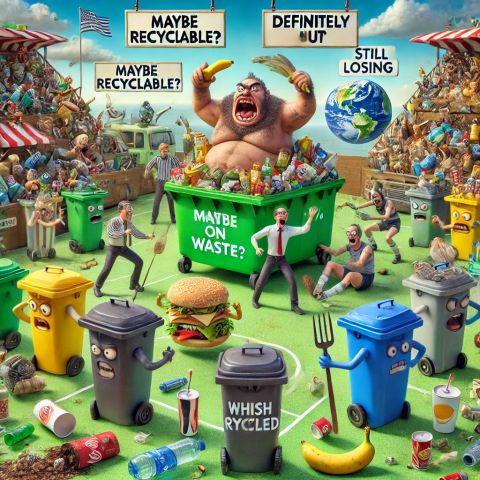
♻️ “The_War_on_Waste: Who’s Leading & Who’s Losing?” 🌍🚨
Governments ban plastics, promote recycling, and push circular economies, but is waste truly being reduced or just shifting elsewhere? Here’s the country-wise reality based on hard data.
🌎 Plastic_Waste: The Biggest Polluters
✅ Top Plastic Waste Generators (Million Tons Annually):
🇺🇸 USA – 42M tons (World Bank, 2023)
🇨🇳 China – 21M tons (Statista, 2024)
🇮🇳 India – 10M tons (CPCB, 2024)
🚨 Reality Check: 94 countries banned plastics, but only 9% is actually recycled. (UNEP, 2024)
🏆 Winners: 🇪🇺 EU Nations (strict bans & recycling laws)
❌ Losers: 🇺🇸 🇮🇳 🇨🇳 (high waste, low recycling rates)
👗 Fast_Fashion & E_Waste: The Hidden Trash Crisis
✅ Top Fast Fashion Waste Producers:
🇨🇳 China – 26M tons annually (Greenpeace, 2024)
🇺🇸 USA – 11.3M tons landfilled yearly (EPA, 2023)
🇪🇺 EU – 5.8M tons discarded (EU Commission, 2024)
🚨 Reality Check: Only 17% of global e-waste is properly recycled.
🏆 Winners: 🇯🇵 🇩🇪 🇰🇷 (advanced e-waste policies)
❌ Losers: 🇺🇸 🇮🇳 🇨🇳 (high waste, poor recycling infrastructure)
♻️ Recycling: Who’s Actually Doing It?
✅ Top Recycling Countries (% Recycled Waste):
🇩🇪 Germany – 67% (Highest global rate, Statista, 2024)
🇰🇷 South Korea – 59% (Strict sorting laws)
🇸🇪 Sweden – *50% recycling + 50% waste-to-energy
🚨 Worst Recycling Rates:
🇮🇳 India – 30% recycling rate (CPCB, 2024)
🇺🇸 USA – 32%, most plastic exported (EPA, 2023)
🇨🇳 China – 28% (Statista, 2024)
🏆 Winners: 🇩🇪 🇰🇷 🇸🇪 (high recycling & circular economy initiatives)
❌ Losers: 🇺🇸 🇮🇳 🇨🇳 (high waste, low recycling rates)
🌍 Circular Economy: Real Shift or Just Talk?
✅ EU Circular Economy Package: 65% recycling target by 2035 (EU Commission, 2024)
✅ China’s ‘Zero Waste Cities’: Pilot in 16 cities to cut landfill waste (China’s Environment Ministry, 2024)
✅ India’s EPR Policy: Firms must recover plastic waste they produce (CPCB, 2024)
🚨 Reality Check: Less than 10% of companies comply with waste responsibility laws. (Greenpeace, 2023)
🏆 Winners: 🇪🇺 EU Nations, 🇨🇳 China (pushing policy enforcement)
❌ Losers: 🇺🇸 USA (low producer responsibility laws)
🏆 KeyTakeaway
The War on Waste isn’t just about bans—it’s about holding corporations accountable, enforcing policies, and cutting overproduction.
🌍 Some nations lead, others drown in trash. Where does your country stand?
👉 Are we winning or just moving waste elsewhere?
WasteCrisis CircularEconomy PlasticPollution RecyclingMyths Sustainability NetZero


Originally published on LinkedIn on 2025-01-31 03:03:19: https://www.linkedin.com/feed/update/urn%3Ali%3AgroupPost%3A131340-7290927601190100992

