NamasteIndia Energy Buffet: Gas_for_Stability, Renewables_for_Velocity.
Dr. Anju Sharma | MrsSustainability
WhatHappensInGoa won’t stay in Goa…..what’s cooking & what’s getting plated? Think of Goa as India’s “Blue_Green” pilot plate because this could shape the national palate of energy till YR2050.
TLDR: Price + Policy + Scale are the real “influencers” here.
1) Gas = the “stability dish” (not a temporary snack) 🔥
✅ Gas is being pushed as the grid’s grown-up friend when renewables fluctuate.
✅ The “works-for-India” LNG zone being discussed: $6–$7/MMBtu
❌ If prices stay high, adoption slows (CGD/transport/power hate expensive vibes).
KtalystInsights: Goal = stabilise the grid without subsidy addiction.
KtalystKlues: By YR2050, the winners won’t “choose” gas or renewables they’ll design the hybrid system that makes both investable under volatility.
2) India’s Transition Priorities (in order, no filter) 🇮🇳
✅ Availability (first)
✅ Affordability (second)
✅ Sustainability (third)
KtalystInsights: Goal = keep growth reliable while decarbonising at India-speed.
KtalystKlues: By YR2050, the global transition won’t be led by the loudest climate slogans— it’ll be led by the economies that can scale clean energy without breaking household budgets.
3) Policy got a makeover: “less paperwork, more progress
✅ SingleLease = fewer approvals, less licensing maze
✅ LongStability signals = “we won’t change rules mid-game” energy
KtalystInsights: Goal = convert policy into a capital magnet, not a capital scare.
KtalystKlues: By YR2050, policy stability becomes a competitive advantage—like credit rating, but for energy.
4) Receipts matter: Infra+outcomes
✅ Gas pipelines: ~66% expansion to 25,923 km
✅ Ethanol blending: forex saving claim of ₹1.59 lakh crore (~$17.3B)
KtalystInsights: Goal = build the plumbing that lets transition scale.
KtalystKlues: By YR2050, energy leadership won’t be measured by targets—it’ll be measured by infrastructure throughput and import risk reduction.
5) Goa wasn’t just a venue it’s a Prototype 🌊🌿
✅ 100percent renewable by 2050 vision
✅ Blue + Green economy framing (coastal energy = big future arc)
KtalystInsights: Goal = prove the “blue-green” model before scaling it nationally.
KtalystKlues: By YR2050, coastlines become “energy coastlines”—offshore power, clean fuels, ports, shipping corridors… the new industrial geography.
The BIG signal behind the buffet 💰
✅ India flagged a $500B energy investment opportunity.
KtalystInsights: Goal = make India a preferred destination for long-cycle energy capital.
KtalystKlues: By YR2050, India’s edge won’t be cheap demand—it’ll be rule-setting demand (pricing, standards, contracts, and scale).
The energy transition isn’t a moral debate. It’s a price signal + policy signal + execution signal. IEW 2026 just turned up the volume on all three.” Dr. Anju Sharma
IndiaEnergyWeek EnergyTransition PolicyRisk DataComa
Source / shared link: https://ddnews.gov.in/en/india-energy-week-2026-opens-with-call-for-investment-partnerships-and-decisive-action-in-global-energy-transition/?utm_source=perplexity
Originally published on LinkedIn on 2026-01-29 05:05:30: https://www.linkedin.com/feed/update/urn%3Ali%3AgroupPost%3A150544-7422505143813726208
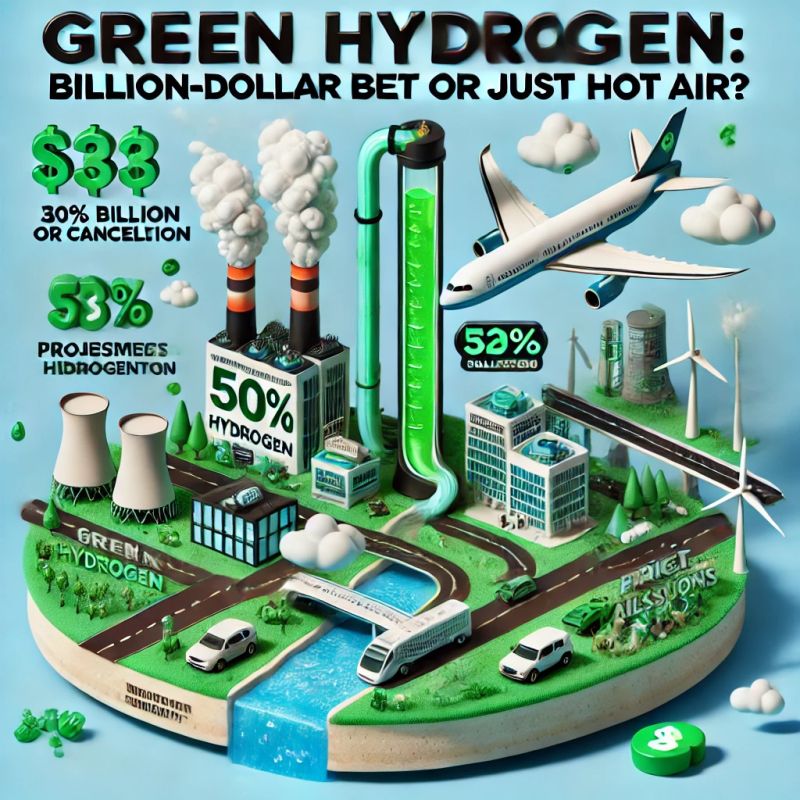
⚡🌍 Green_Hydrogen: Billion_Dollar_Bet or Just Hot Air?
💰 USD320 Billion. That’s how much global green hydrogen investments are expected to hit by 2030. (IEA, 2024)
💨 80 Million Tons. That’s the world’s hydrogen demand—yet only 0.5% comes from green sources. (Hydrogen Council, 2024)
🚀 #$1.50/kg. That’s the break-even cost for green hydrogen to compete with fossil fuels, but only 10% of projects are hitting this target. (BloombergNEF, 2024)
📌 Reality Check: Is green hydrogen scaling fast enough or suffocating under its own hype?
🌍 Game-Changers: Who’s Leading the Hydrogen Race?
🇳🇴 Norway & 🇩🇪 Germany: Floating Hydrogen Terminal
✅ #$3 Billion Project – First floating hydrogen hub to supply 1.3 million tons of green hydrogen annually. (Reuters, 2024)
✅ Price Target: $3-$3.5/kg—50% cheaper than current European hydrogen costs. (IEA, 2024)
✅ Operational By: 2027.
🇪🇸 Spain: Cepsa’s €3B Hydrogen Hub
✅ 2 GW of green hydrogen capacity planned by 2030. (Reuters, 2024)
✅ Phase 1: 400 MW by 2027, reducing 6 million tons of CO₂ annually.
📌 Reality Check: Green hydrogen is growing—but is it growing fast enough?
❌ Setbacks: Why Are Big Projects Failing?
🇦🇺 Australia: $12.5B Hydrogen Project Canceled
❌ Queensland pulled funding for its largest hydrogen project due to skyrocketing costs. (CourierMail, 2024)
❌ Kansai Electric withdrew, citing lack of commercial viability.
🇦🇺 BP’s $600M Hydrogen Hub Shelved
❌ BP paused its green hydrogen project in Western Australia, raising doubts over economic feasibility. (Hydrogen Insight, 2024)
📌 Reality Check: Over 50% of hydrogen projects risk delay or cancellation due to high costs & supply chain challenges. (Hydrogen Council, 2024)
✈️ Hydrogen-Powered Flight: The Next Big Bet?
🚀 ZeroAvia’s Hydrogen Aircraft Takes Off
✅ First 19-seat plane powered by hydrogen-electric engines. (Time, 2024)
✅ Raised #$150M from Airbus, Amazon, & Bill Gates’ Breakthrough Energy Fund.
✅ Commercial hydrogen flights targeted for 2025.
📌 Reality Check: Hydrogen aviation could cut emissions by 90%, but cost & infrastructure remain barriers.
🏆 KeyTakeaway
💡 Green Hydrogen could be the game-changer for clean energy, should be scaled urgently, but would be another overhyped tech if costs don’t fall fast.
👉 Are we heading for a green hydrogen boom or bust?
HydrogenEconomy NetZero CleanEnergy Sustainability GreenHydrogen EnergyTransition
Originally published on LinkedIn on 2025-02-06 18:33:57: https://www.linkedin.com/feed/update/urn%3Ali%3Ashare%3A7293336130429546496
NamasteIndia checking the impact of the EU’s Carbon Border Adjustment Mechanism (CBAM) on Indian firms:
India faces challenges in balancing environmental goals with economic realities, and the EU’s CBAM poses complexities for Indian exporters.
1. CBAM Impact: The EU’s CBAM will result in a 20-35% import tax on Indian firms. Large companies may need to run two production lines—one greener for EU exports and another for the rest of the world.
2. Economic Situation Matters: Carbon prices are typically based on a country’s economic context. Simply adding a local tax won’t significantly reduce the overall tax burden for Indian firms exporting to the EU.
3. Sustainability Challenges: While the EU can afford higher carbon prices, it may not be sustainable for a developing country like India. The global average carbon price is around $6 per tonne of CO2, and India’s expected price would likely be less than $10 per tonne.
4. Disruption to Trade: Even if India establishes its own Emissions Trading System (ETS) or sets a carbon price, Indian firms would still need to pay the EU the difference (approximately $51.3 per tonne of CO2) under CBAM.
5. India’s Response: India has criticized the move and is in dialogue with the EU. The EU delegation proposed India implement its own carbon tax to support greener supply chains while maintaining access to the EU market.
Originally published on LinkedIn on 2024-08-01 10:33:53: https://www.linkedin.com/feed/update/urn%3Ali%3AgroupPost%3A2205762-7224724013695037441
NamasteIndia checking the impact of the EU’s Carbon Border Adjustment Mechanism (CBAM) on Indian firms:
India faces challenges in balancing environmental goals with economic realities, and the EU’s CBAM poses complexities for Indian exporters.
1. CBAM Impact: The EU’s CBAM will result in a 20-35% import tax on Indian firms. Large companies may need to run two production lines—one greener for EU exports and another for the rest of the world.
2. Economic Situation Matters: Carbon prices are typically based on a country’s economic context. Simply adding a local tax won’t significantly reduce the overall tax burden for Indian firms exporting to the EU.
3. Sustainability Challenges: While the EU can afford higher carbon prices, it may not be sustainable for a developing country like India. The global average carbon price is around $6 per tonne of CO2, and India’s expected price would likely be less than $10 per tonne.
4. Disruption to Trade: Even if India establishes its own Emissions Trading System (ETS) or sets a carbon price, Indian firms would still need to pay the EU the difference (approximately $51.3 per tonne of CO2) under CBAM.
5. India’s Response: India has criticized the move and is in dialogue with the EU. The EU delegation proposed India implement its own carbon tax to support greener supply chains while maintaining access to the EU market.
Originally published on LinkedIn on 2024-08-01 10:33:43: https://www.linkedin.com/feed/update/urn%3Ali%3Ashare%3A7224723968493019136

