Protectionism is temporary. Strategy is forever.” – KtalystKeystone
Insights from the April 2025 CRISIL Report on US Tariffs & India:
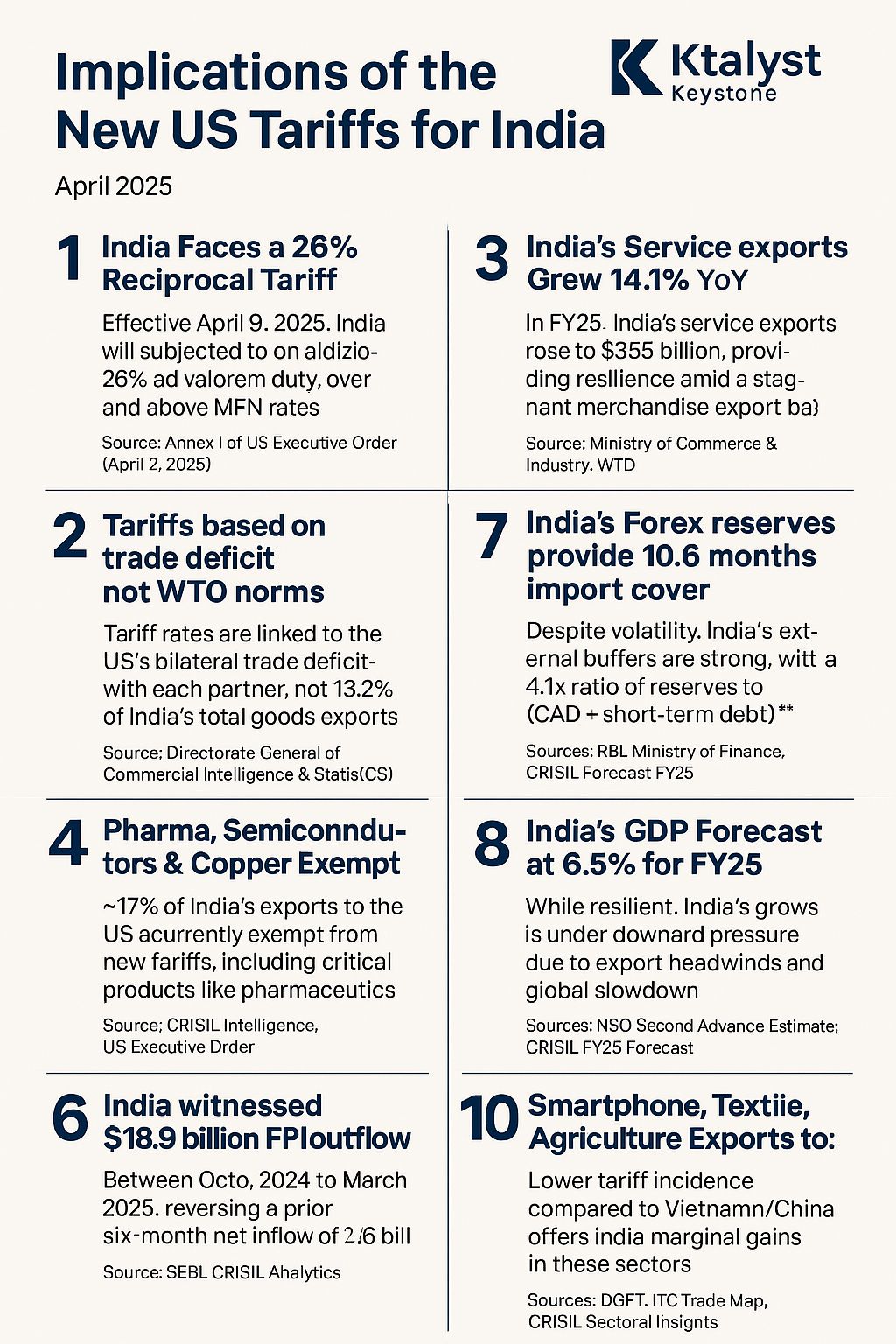
The 26% tariff isn’t just a tax — it’s a test. A test of India Inc.’s resilience, agility, and strategic depth.
India’s export engines may sputter, but its services superpower and domestic strength are the new fuel.
StrategicViewpoint | What IndianBusinesses Must Do Now
🔍 RethinkExportDependency
High-risk sectors like GemsAndJewellery (with 37% exports to US) must unlock new geographies — EU, GCC, ASEAN.
📦 LeverageServicesBoom
With service exports clocking 14.1%YoY growth, the pivot to digital, consulting, and R&D is more than necessary — it’s non-negotiable.
⚙️ LocalizeValueChains
Auto and Electronics firms must evaluate USMCA partnerships and nearshoring to maintain tariff competitiveness.
📈 HedgeWisely
$18.9B of FPI outflows signal clear volatility. CFOs, it’s time to sharpen your forex strategy and revisit pricing models.
🛡️ UseIndiaPolicyCushion
The PLI schemes, ongoing capex push, and FTA progress (esp. with UK & EU) can soften the blow.
🌱 StayResilientStayStrategic
India’s #$355B service exports, 10.6 months import cover, and low CAD are not just stats — they’re shock absorbers.
KtalystKeystone | CatalysingStrategy in Disruptive Times
TradePolicy GlobalMarkets IndiaUS TariffWatch Exports Geopolitics MakeInIndia KtalystPerspective LinkedInPulse

Originally published on LinkedIn on 2025-04-08 17:38:16: https://www.linkedin.com/feed/update/urn%3Ali%3AgroupPost%3A2153908-7315427778760183808
🚨 India’s EVRegulations 2025: What’s New & What It Means for the Industry? ⚡🚗
With EV sales in India growing 49% YoY, new regulatory shifts are shaping the future of the sector. The latest policies focus on local manufacturing, safety standards, & market expansion while setting new rules for charging infrastructure & import incentives. Here’s what’s changing:
📊 Key EV Policy Updates & Their Impact
🔹 Investment Caps on Charging Infrastructure
📌 The Indian Government now limits EV manufacturers to count only 5% of their total investment in charging networks toward the #$500M minimum investment required for lower import tariffs.
📌 Why It Matters? This ensures priority to local EV production, reducing reliance on imports. (Source)
🔹 Tesla’s Entry & Market Implications
📌 Tesla is setting up showrooms in Mumbai & New Delhi and exploring local production. However, high import duties (up to 100%) could push Tesla’s pricing into the luxury segment, making affordability a challenge.
📌 EV Market Reality: The average car price in India is #$10,000-$15,000, while a Tesla Model 3 would cost over #$50,000 without local assembly. (Source)
🔹 Stricter Safety & Battery Standards
📌 BIS (Bureau of Indian Standards) introduces new EV safety rules, requiring all EVs to meet upgraded performance & fire safety benchmarks.
📌 Battery Regulation: EV battery makers must obtain AIS 156 certification from ARAI (Automotive Research Association of India) to ensure safety compliance.
📌 Why It Matters? India aims to reduce EV fire risks, ensuring consumer safety and boosting market confidence. (Source)
🔹 Union Budget 2024-25: EV Industry Boost
📌 Customs duty exemptions on 25 critical minerals used in EV battery production will lower manufacturing costs.
📌 PLI (Production-Linked Incentive) expansion aims to reduce import dependency & boost domestic production.
📌 FAME III (Faster Adoption & Manufacturing of Electric Vehicles) is expected to focus on charging infrastructure expansion. (Source)
⚡ The Takeaway: What’s Next for India’s EV Industry?
🚀 EV penetration in India is at 2% but projected to hit 30% by 2030.
🚀 Government policies favor local EV manufacturing over imports.
🚀 Safety & compliance measures will shape consumer trust & adoption.
📢 Will these new regulations accelerate India’s EV transition or slow global players like Tesla? Let’s discuss! 👇
Source / shared link: https://m.economictimes.com/industry/renewables/govt-set-to-notify-new-ev-policy-with-new-investment-rules-as-tesla-prepares-for-india-entry/articleshow/118415610.cms
Originally published on LinkedIn on 2025-02-27 06:19:45: https://www.linkedin.com/feed/update/urn%3Ali%3AgroupPost%3A82093-7300761508139974656
🌟 India’s Chemical Industry: The Catalyst for Global Leadership (2025–2030) 🌟
The #$4 trillion global chemical industry is evolving rapidly, with trends like green chemistry, digital transformation, and supply chain diversification shaping its future. By 2030, the market is set to grow to #$5.5 trillion, and India has a golden opportunity to lead the charge. 🚀
Why India’s Chemical Industry is a Game-Changer
✅ Economic Engine: Contributes 7% to GDP; projected to hit 9% by 2030.
✅ Export Potential: Current exports at #$30 billion, with a target of #$60 billion.
✅ Job Creation: Can generate 2 million new jobs in specialty and green chemicals.
✅ Sustainability Leadership: Opportunity to capture 10%-15% of the #$150 billion green chemical market.
Global Trends: Challenges & Opportunities
🌍 China’s Dominance:
Controls 35% of the global chemical market.
Investing #$300 billion in green hydrogen and renewable feedstocks.
Pivoting to high-value specialty chemicals.
💡 Opportunity for India:
Reduce 33% import dependency (primarily on China).
Leverage PLI schemes for specialty and bio-based chemicals.
Build world-class chemical hubs and integrated logistics infrastructure.
📊 Global Sustainability Push:
Bio-based materials growing at a CAGR of 12%.
Over 50% of global chemical firms adopting digital supply chains by 2030.
India’s Roadmap for 2030
🔹 Market Expansion: Grow the domestic market to #$400 billion at an 8% CAGR.
🔹 R&D Investments: Increase spending to 1% of industry revenue (vs. current 0.3%-0.5%).
🔹 Skill Development: Train 500,000 professionals in green and digital technologies.
🔹 Sustainability Incentives: Develop bio-refineries and scale carbon-neutral production
The Numbers That Matter
💬 The Takeaway: India’s chemical industry is more than just a sector—it’s the foundation for sustainable growth, global competitiveness, and economic resilience. With the right policies, investments, and innovation, India can lead the global stage by 2030. 🌱
Let’s build a greener, stronger, and more self-reliant future. 💼💡
ChemicalIndustry IndiaGrowth Sustainability MakeInIndia 2030Vision
Source / shared link: https://m.economictimes.com/industry/indl-goods/svs/chem-/-fertilisers/budget-2025-chemical-industry-seeks-tweaking-in-customs-duties-to-boost-manufacturing/articleshow/117429274.cms
Originally published on LinkedIn on 2025-01-22 11:41:38: https://www.linkedin.com/feed/update/urn%3Ali%3AgroupPost%3A3880479-7287796548950745088
NamasteGrowthIndia’s Manufacturing Revolution: Beating China’s Export Curbs with a $24 Billion Strategic Push
The Challenge: Impact of China’s Export Curbs
1. 📉 Electronics: Restrictions on gallium and germanium caused a 25% rise in production costs, delaying projects under India’s $1.2 billion PLI scheme for semiconductors.
2. 🌞 Renewables: SolarPV module prices jumped 30%, leading to an 18% drop in 2024 capacity additions. India imports 80% of solar modules from China.
3. 🚗 EVs: Lithium-ion battery prices increased 25%, slowing EV production by 12%. EV sales growth fell to 34% in 2024 from 58% in 2023.
4. ⚙️ Machinery: A 15% drop in Chinese precision machinery exports raised operational costs. Textile exports fell 8% due to machinery shortages impacting production.
The $24 Billion Strategy to Overcome
1. DiversifyingSupplyChains:
Partnering with Australia, Vietnam, and SouthKorea for critical materials like lithium, cobalt, and rareearths.
Imports from non-China suppliers surged 20% in 2024.
2. BoostingDomesticManufacturing:
$24 billion PLI schemes targeting semiconductors, EVs, and solarpanels.
Vedanta and Tata investing $9.6 billion in chip manufacturing; production starts by 2026.
Expanding solar module capacity to 100 GW by 2030 (currently 40 GW).
3. StrengtheningRenewableEnergy:
Gigafactories for lithium-ion batteries under advanced chemistry PLI schemes.
R&D focus on sodium-ion batteries as an alternative to lithium.
4. StockpilingCriticalMaterials:
Strategic reserves of lithium, cobalt, and rareearths to mitigate supply chain disruptions.
5. SkillDevelopment and Innovation:
Launching national R&D hubs for semiconductors and renewable energy.
Upskilling the workforce for advanced manufacturing.
The Numbers That Matter
🟢 Renewables: India reached 209.44 GW capacity (+15.84% YoY) in 2024.
🔋 Semiconductors: Domestic chip production to reduce $19 billion in annual imports by 2026.
🌞 Solar: Domestic manufacturing grew 35% YoY, reducing dependency on Chinese imports.
🌍 EVGrowth: India’s battery gigafactories will reduce import reliance by 40% by 2028.
Why This Matters
India is turning challenges into opportunities by reshaping its supplychains, investing heavily in localcapabilities, and reducing reliance on China.
With a $24 billion plan, India is not just weathering the storm—it’s leading a ManufacturingRevolution and setting the stage to become a global powerhouse.
Source / shared link: https://mybs.in/2ejuSuZ
Originally published on LinkedIn on 2025-01-14 15:26:11: https://www.linkedin.com/feed/update/urn%3Ali%3AgroupPost%3A3880479-7284953957133602818
NamasteSmartIndia’s Manufacturing Revolution: Beating China’s Export Curbs with a $24 Billion Strategic Push
The Challenge: Impact of China’s Export Curbs
1. 📉 Electronics: Restrictions on gallium and germanium caused a 25% rise in production costs, delaying projects under India’s $1.2 billion PLI scheme for semiconductors.
2. 🌞 Renewables: SolarPV module prices jumped 30%, leading to an 18% drop in 2024 capacity additions. India imports 80% of solar modules from China.
3. 🚗 EVs: Lithium-ion battery prices increased 25%, slowing EV production by 12%. EV sales growth fell to 34% in 2024 from 58% in 2023.
4. ⚙️ Machinery: A 15% drop in Chinese precision machinery exports raised operational costs. Textile exports fell 8% due to machinery shortages impacting production.
The $24 Billion Strategy to Overcome
1. DiversifyingSupplyChains:
Partnering with Australia, Vietnam, and SouthKorea for critical materials like lithium, cobalt, and rareearths.
Imports from non-China suppliers surged 20% in 2024.
2. BoostingDomesticManufacturing:
$24 billion PLI schemes targeting semiconductors, EVs, and solarpanels.
Vedanta and Tata investing $9.6 billion in chip manufacturing; production starts by 2026.
Expanding solar module capacity to 100 GW by 2030 (currently 40 GW).
3. StrengtheningRenewableEnergy:
Gigafactories for lithium-ion batteries under advanced chemistry PLI schemes.
R&D focus on sodium-ion batteries as an alternative to lithium.
4. StockpilingCriticalMaterials:
Strategic reserves of lithium, cobalt, and rareearths to mitigate supply chain disruptions.
5. SkillDevelopment and Innovation:
Launching national R&D hubs for semiconductors and renewable energy.
Upskilling the workforce for advanced manufacturing.
What_happens_in_India
🟢 Renewables: India reached 209.44 GW capacity (+15.84% YoY) in 2024.
🔋 Semiconductors: Domestic chip production to reduce $19 billion in annual imports by 2026.
🌞 Solar: Domestic manufacturing grew 35% YoY, reducing dependency on Chinese imports.
🌍 EVGrowth: India’s battery gigafactories will reduce import reliance by 40% by 2028.
Why This Matters
India is turning challenges into opportunities by reshaping its supplychains, investing heavily in localcapabilities, and reducing reliance on China.
With a $24 billion plan, India is not just weathering the storm—it’s leading a ManufacturingRevolution and setting the stage to become a global powerhouse.
Source / shared link: https://mybs.in/2ejuSuZ
Originally published on LinkedIn on 2025-01-14 15:22:08: https://www.linkedin.com/feed/update/urn%3Ali%3AgroupPost%3A10020629-7284952938307817472

