Why_the_Market_Pays_15x_for_Scope4_but_DiscountsScope3?
Dr. Anju Sharma | KtalystInsights
The ChemicalWorld is not abandoning hydrocarbons.
It is repricing risk, relevance, and return.
Capital doesn’t chase greens browns or greys. It chases systems that remain investable under stress.” Dr. Anju Sharma
This is not a morality play of good versus bad materials.
It is a MacroReallocation of capital driven by carbon math, energy security, and industrial policy.
The MetalEra is not replacing chemistry. It is jumping WALLS
🧱 WALL_01
The ComplianceWall (Fossil-Based Polymers)
Hydrocarbons are not obsolete.
But large parts of the plastics value chain are now structure capped.
❌ Market maturity: Growth tethered to GDP (3–4%)
❌ Carbon exposure: Embedded Scope 3—even at high recycling rates
❌ Valuation gravity: 8–10× EV/EBITDA
KtalystInsight:
This is not a failure of chemistry.
It is a constraint of scale.
Capital doesn’t exit plastics because they are “dirty.” It pauses because compliance caps upside.
🧱 WALL_02
The ScopeWall (Scope 3 vs Scope 4 Reality)
This is where most chemical strategies quietly break.
Not at production.
Not at recycling.
But at system-level carbon relevance.
❌ Scope 3 gravity: Feedstocks and logistics dominate total carbon exposure
❌ Scope 4 invisibility: Avoided emissions (electrification, grid decarbonisation) are real—but often invisible in standard accounting
❌ Metals asymmetry: Mining inflates Scope 3 sharply, yet metals enable massive Scope 4 benefits
What markets are actually pricing:
✓ Who carries unavoidable Scope 3
✓ Who enables outsized Scope 4
✓ Who sits inside the energy system—not adjacent to it
KtalystInsight:
Carbon markets don’t reward clean plants.
They reward system displacement power.
Capital flows where Scope 4 overwhelms Scope 3.
🪜 LADDER_01
The EnergyValueLadder (Critical & Transition Metals)
Metals are
Not clean.
Not cheap.
Not easy.
They are strategically unavoidable.
✓ Demand shock: Lithium & copper demand ~4× by 2030
✓ Valuation premium: 12–15×+ EV/EBITDA
✓ Policy underwriting: IRA · CRMA · PLI
Capital tolerates friction
when assets sit inside energy systems.
DataComa Gap: Where Strategy Goes Wrong
The mistake isn’t choosing the wrong material.
It’s misreading which pain the market will tolerate.
❌ Optimising only plant KPIs
❌ Treating recycling as a growth strategy
❌ Ignoring geopolitical exposure
Where Margins Are Migrating
📉 From volume & formulation complexity
📈 To purity (99.9%+), access, and grid integration
🪜LADDER_02 StratergicPortfolios
The future is not MetalsVsHydrocarbons.
It is static portfolios versus adaptive ones.
Plastics remain essential—but less forgiving
Metals will grow—but harder, dirtier, and more contested
🔄 ThePhaseChange
👉 From MaterialSupremacy
👉 To SystemRelevance
KtalystInsights
ChemicalIndustry EnergyTransition CriticalMinerals
Scope3 Scope4 SustainabilityStrategy
Originally published on LinkedIn on 2026-01-23 05:44:13: https://www.linkedin.com/feed/update/urn%3Ali%3Ashare%3A7420340560558804992
Geneva Plastics Treaty Talks –StatusUpdate
Slow Progress: Negotiations for the first legally binding global plastics treaty are stalling. Plastic production exceeds 400 million tonnes/year (UNEP, 2023) and could triple by 2060 without intervention.
Key Dispute:
Pro-cap countries: 100+ nations want binding caps on virgin polymer production and bans on high-risk single-use plastics, targeting a 40% cut by 2040.
Opposition bloc: Major producers (Saudi Arabia, Russia, U.S., China, India) prefer voluntary measures focused on waste collection and recycling.
Plastics in Focus: Treaty talks are prioritising phase-outs or restrictions on:
Polystyrene foam (EPS/EPS) – used in takeaway containers & insulation.
PVC – especially in food contact materials due to additives like phthalates.
Multi_layer sachets & films – common in snack packs and single-serve goods, difficult to recycle.
Expandedpolyethylene (EPE) – protective packaging.
Plasticmicrobeads – in cosmetics and personal care.
ProblematicAdditives – PFAS (“forever chemicals”), BPA, brominated flame retardants.
Lobbyist Influence: 230+ industry lobbyists (oil, petrochemicals, plastics) present—outnumbering many national delegations—raising fears of watered-down targets.
Finance Talks: Proposals for public–private funds of $10–15 billion/year to improve waste infrastructure in developing nations and compensate economies for transition costs.
High Stakes: Plastics account for 3.4% of global GHG emissions; microplastics are detected in 93% of bottled water and in human placentas. Without bold measures, marineplastic pollution could quadruple by 2050.
PlasticPulpPopulation – The materials that shape our tomorrow, and the choices that decide whether it thrives or withers.” – Dr. Anju Sharma
KtalystInsights | MrsSustainability | KtalystKeystone | PlasticToPulp | PulpOverPlastic | FromWasteToWorth
Originally published on LinkedIn on 2025-08-11 04:25:16: https://www.linkedin.com/feed/update/urn%3Ali%3AgroupPost%3A2474261-7360526696397123585
KtalystKnowledgeSeries
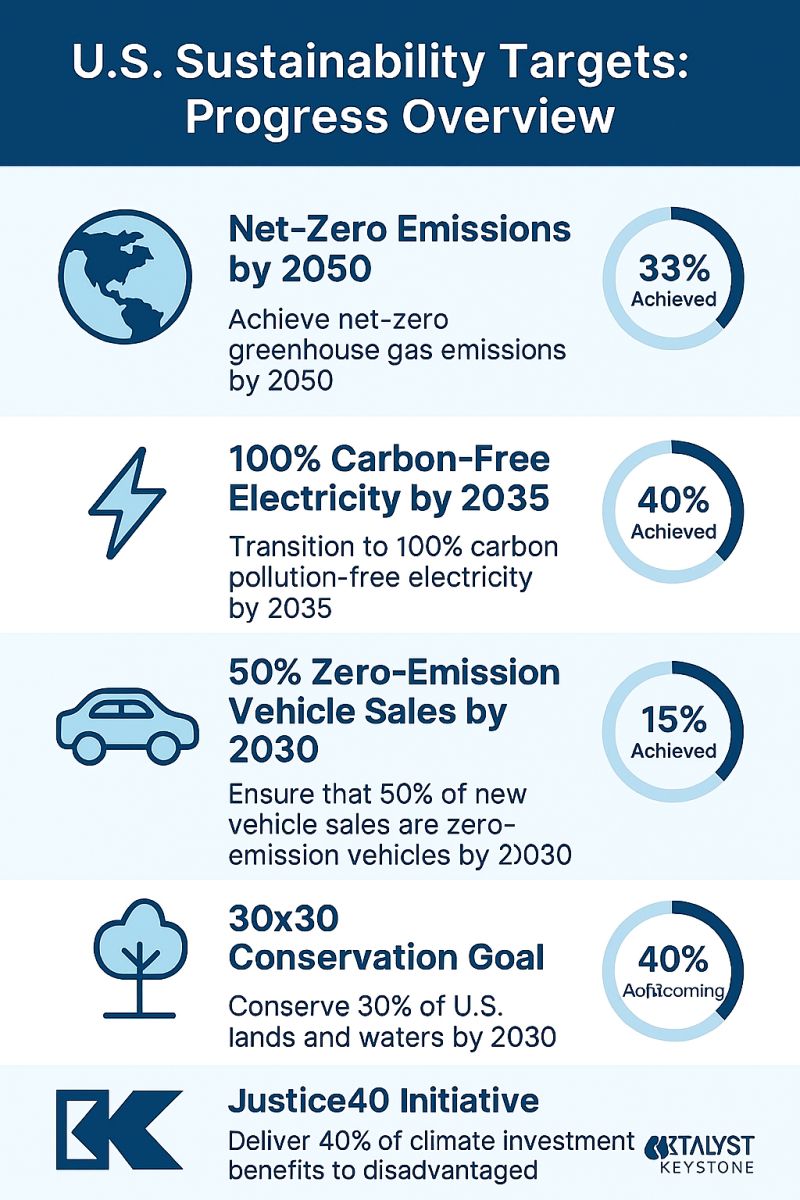
USA SustainabilitySnapshot: Goals, Data & Drive
Targets are timelines. Transformation is the true triumph.” — KtalystKeystone
🌎 Net-Zero Ambition
Goal: Achieve net-zero emissions by 2050
Current Status: U.S. emissions were 17% below 2005 levels by 2023
Key Driver: Clean power shift, IRA incentives
Targets are timelines. Transformation is the true triumph.
⚡ Clean Power by 2035
Goal: 100% carbon-free electricity
Progress:
2023: ~41% from clean sources (solar, wind, nuclear, hydro)
Solar capacity: Quadrupled since 2015
Investment Push: $369B via Inflation Reduction Act
🚗 EV Nation
Goal: 50% new vehicle sales electric by 2030
2023 Stats:
EVs = 7.6% of total new U.S. car sales
500,000 EV chargers planned by 2030
♻️ Circular America
Goal: Cut food waste by 50% by 2030
Current:
30–40% of food still wasted
National Strategy launched in 2023 for plastics reduction & reuse
🌿 Nature Positive (30×30 Goal)
Goal: Conserve 30% of land & water by 2030
Status:
~12% of U.S. land currently protected
New partnerships with Indigenous and rural communities
⚖️ Justice40 Initiative
Goal: 40% of climate investments to disadvantaged communities
Covered Sectors:
Clean transit
Pollution clean-up
Water access
Workforce training
Tracking Tool: CEJST (Climate & Economic Justice Screening Tool)
📊 Climate Data Commitment
Goal: Enhance climate risk transparency
Push:
SEC climate disclosure rules (proposed)
Federal agencies adopting climate risk dashboards

Originally published on LinkedIn on 2025-04-09 06:22:18: https://www.linkedin.com/feed/update/urn%3Ali%3AgroupPost%3A82951-7315620051338825728
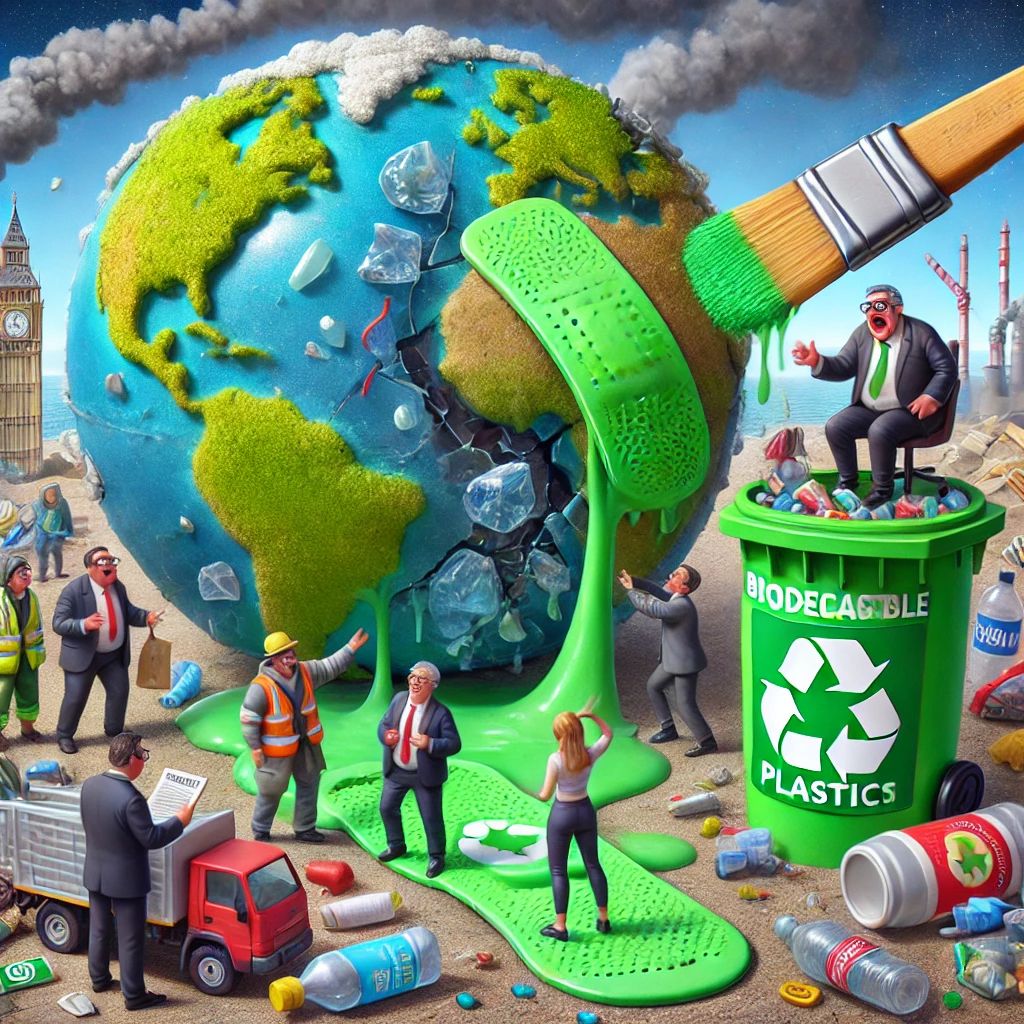
🚨 “Green Plastics: A Band_Aid on a Bullet_Wound?” ♻️🌍💭
The world produces 400 million tons of plastic annually, and now, the industry wants you to believe Green Plastics are the solution. But are they truly a revolution—or just a rebranded problem? Let’s go beyond the buzzwords and into the hard facts.
📊 1. The Green Plastic Illusion
✅ Bioplastics – Made from plants like corn & sugarcane instead of oil.
✅ Recycled Plastics – Reduces virgin plastic demand but still degrades over time.
✅ Biodegradable Plastics – Marketed as compostable but often require industrial processing.
🚨 Reality Check: Only 5% of global plastic is actually recycled, and ‘bioplastics’ often don’t degrade in real-world conditions. (OECD, 2024)
🔴 2. The Unseen Costs: What They Don’t Tell You
❌ Bioplastics require vast amounts of water, land, and energy—competing with food production. (FAO, 2024)
❌ Most ‘biodegradable’ plastics don’t break down in oceans or landfills—just like regular plastic. (WWF, 2024)
❌ Recycling green plastics is costly and inefficient—leading to waste incineration instead. (Greenpeace, 2024)
🚨 Reality Check: Green plastics shift the burden, but don’t eliminate the pollution crisis.
🌍 3. Who’s Leading the Green Plastic Race?
✅ 🇪🇺 EU: Strict bans on single-use plastics, pushing for a true circular economy. (EU Commission, 2024)
✅ 🇯🇵 Japan: Seaweed-based plastics as a real alternative to petroleum-based materials. (JETRO, 2024)
✅ 🇮🇳 India: Mandatory Extended Producer Responsibility (EPR) forcing plastic accountability. (CPCB, 2024)
🚨 Reality Check: Even the best policies fail without proper waste infrastructure & enforcement.
🏆 KeyTakeaway
Green Plastics aren’t a solution—they’re a distraction. Unless we reduce plastic dependency, scale up true alternatives, and overhaul waste systems, we’re just putting a green label on the same crisis.
👉 Are Green Plastics saving the planet or just buying time?
GreenPlastics PlasticParadox CircularEconomy Sustainability NetZero ESG
Originally published on LinkedIn on 2025-02-03 04:26:04: https://www.linkedin.com/feed/update/urn%3Ali%3AgroupPost%3A2474261-7292035591980945408
NamasteIndia Hats off to PowerWomen adding to Sustainability with Fight pollution not plastics
Originally published on LinkedIn on 2024-06-18 13:10:26: https://www.linkedin.com/feed/update/urn%3Ali%3Ashare%3A7208818340369252352

