KtalystInsights™: Whatever May Start Inflation, 7PointPricingPower Decides Who Pays
Dr. Anju Sharma MrsSustainability
Inflation is often introduced to the public like an unavoidable storm.
War erupts. Oil climbs. Freight tightens. Currencies shiver. Supply chains fray.
And then comes the familiar line:
Prices are up. Nothing can be done.
Inflation is not only a storm.
It is also a silent auction of pain.
The spark may come from geopolitics, but the burn is shaped later in contracts, pricing decisions, and balance sheets. Why is it that two seemingly opposite truths can coexist: growth slows, households strain, & yet some corporate profits remain surprisingly resilient? The OECD now projects global growth at 2.9% in 2026, warning that the evolving Middle East conflict is raising energy costs and weakening demand.
Inflation may begin with the visible trigger
✓ war
✓ energy shock
✓ freight disruption
✓ commodity spike
✓ currency weakness
✓ policy delay
These are the flames everyone can see. But the ECB’s March 2026 projections show the deeper transmission clearly: euro area headline inflation is now projected at 2.6% in 2026, revised upward because energy prices are higher owing to the war in the Middle East.
2. InvisibleCorridors The real spread happens
Between the oil field & the invoice, inflation changes costume. It enters freight bills, insurance premia, input costs, and retail pricing. In NamasteIndia, Moody’s warned this week that prolonged energy disruption could widen the trade deficit, strain the fiscal account, & entrench inflation; oil prices had risen 31% since the conflict began on 28 February 2026.
3. Where economics becomes power
Not every firm can absorb a shock.
Not every firm needs to.
Not every price rise is equally innocent.
Some companies face genuine cost pressure. Others operate with enough brand strength, scarcity value, or market power to pass the burden forward. The ECB has noted that unit profits made a visible contribution to domestic price pressures during the recent inflation surge, while later ECB analysis said profits were also partially buffering inflation in some sectors. That is the oxymoron at the heart of modern inflation: profitable pressure.
4. Public experiences inflation one way. The Business experiences it another.
The household:
✓ higher fuel
✓ higher food
✓ higher transport
✓ higher EMIs
✓ thinner savings
The Business:
✓ absorb
✓ defer
✓ pass through
✓ reprice
✓ protect margin
That is why inflation can feel like a public emergency & a private opportunity at the same time.
KtalystBottomLine
Whatever may start inflation, its final shape is decided by who has the power to transfer cost, who is forced to absorb it, and who quietly turns disruption into spread.
Inflation may begin with disruption. Public pain begins when pricing power passes it on.” Dr. Anju Sharma
Originally published on LinkedIn on 2026-04-22 14:06:51: https://www.linkedin.com/feed/update/urn%3Ali%3Ashare%3A7452719571511238656
Sustainability2025: From Voluntary Promises to Regulatory Mandates
For decades, sustainability was about goodwill—voluntary pledges, philanthropy, or brand polish. Companies that cared were seen as pioneers. Governments spoke in pledges, NGOs carried the torch.
YR2025, Sustainability is now law, enforced by regulators, priced by markets, and demanded by societies.
1. EarlyEchoes (1700s–1980s)
Guidance only, no enforcement.
1713: Carlowitz coined Nachhaltigkeit (sustained forestry).
1972: Stockholm Conference raised global awareness.
1987: Brundtland Report defined sustainable development.
2. GlobalFrameworks (1990–2010) By 2005, <20% of Fortune 500 issued sustainability reports.
1992: Rio Earth Summit, Agenda 21.
2000: Millennium Development Goals (8 targets, no penalties).
2005 to 2010 Corporate tools: WBCSD’s Triple Bottom Line, GRI standards.
3. From Reports_to_Risks (2010–2015) OECD warned $90 trillion in climate-exposed infrastructure.
2010: ISO 26000 set out social responsibility.
2015: Paris Agreement—195 nations pledged emission cuts.
2015: UN SDGs—17 goals, 169 targets.
4.RegulatoryMandates(2015–2025)
YR2025, over 80 countries mandate ESG disclosure.
EU CSRD (2024): 50,000+ firms must disclose ESG performance.
IFRS ISSB: Adopted in Canada, UK, Singapore as baseline law.
India: SEBI BRSR (top 1,000 firms), RBI green finance frameworks.
Penalties: Shein fined €1M (Italy), Clorox fined A$8M (Australia).
5. Why the Shift?
Science: Warming already at 1.1°C.
Economics: $300B annual climate disaster costs (World Bank).
Society: 200M climate migrants projected by 2050 (UNHCR).
Markets: 85% of investors use ESG in decisions (PwC).
Trust: Greenwashing eroded credibility, forcing regulation.
6. The WorldToday Concern has turned into compliance
Courts treat greenwashing as fraud.
Net-zero pledges now cover 90% of global GDP.
Cost of capital increasingly tied to ESG ratings.
7. YR2030 Sustainability is shifting from checkbox to operating system.
Integrated accounting: ESG data in audited reports.
CarbonMarkets: Projected $100B+ by 2030.
ESG-linked loans: Already $1.5T market.
Circular economy: $4.5T opportunity by 2030 (Accenture).
What began as promises for posterity are now policies for prosperity.” — Dr. Anju Sharma
Originally published on LinkedIn on 2025-09-08 04:37:28: https://www.linkedin.com/feed/update/urn%3Ali%3AgroupPost%3A82951-7370676626881208322
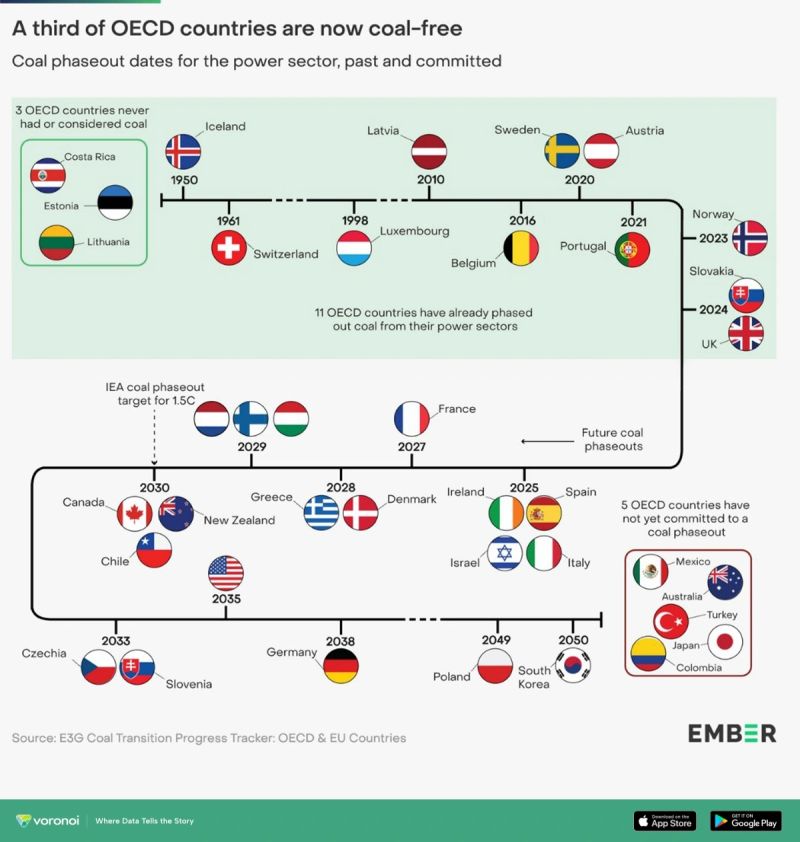
NamasteIndia OECD Countries Phasing Out Coal: Progress and Future Plans
Several OECD countries have successfully transitioned away from coal, significantly reducing their carbon emissions. Notable examples of countries that are now coal-free include:
Belgium: Phased out coal power in YR2016.
Sweden: Achieved a coal-free status in YR2020.
Austria: Eliminated coal from its energy mix in YR2020.
Portugal: Ended coal-fired electricity generation in YR2021.
Several other OECD countries are actively working towards eliminating coal from their energy mixes, with plans and targets set for the near future:
Germany: Plans to phase out coal-fired power generation by YR2038, with discussions ongoing to potentially accelerate this timeline.
France: Aims to shut down its remaining coal-fired power plants; however, as of 2023, some plants remain operational due to energy security concerns.
Italy: Intends to phase out coal by YR2025, focusing on increasing renewable energy capacity to replace coal-fired power.
Netherlands: Has set a target to close all coal-fired power plants by YR2030 as part of its climate policy.
Finland: Plans to ban the use of coal for energy by YR2029, with incentives for earlier phase-out by 2025.
These nations exemplify a broader commitment within the OECD to transition toward cleaner energy sources and meet international climate goals.
Originally published on LinkedIn on 2024-11-19 12:55:49: https://www.linkedin.com/feed/update/urn%3Ali%3AgroupPost%3A5119572-7264622396811169793

