KnowledgeKtalyst GreenerDrainage | Bioswales Without Borders: How the World Channels Change
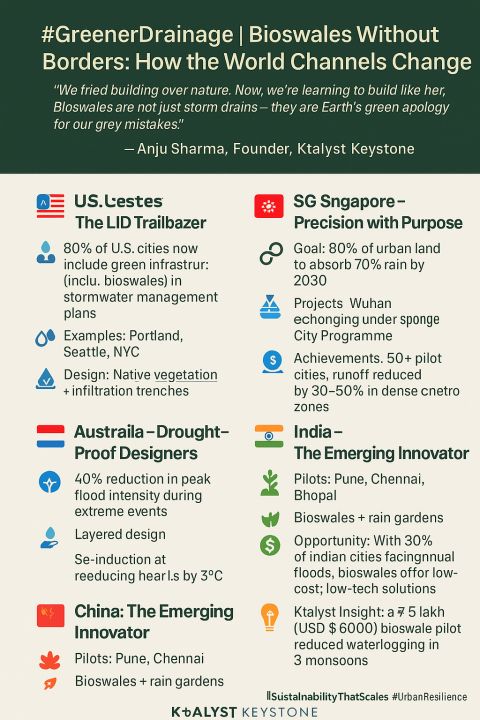
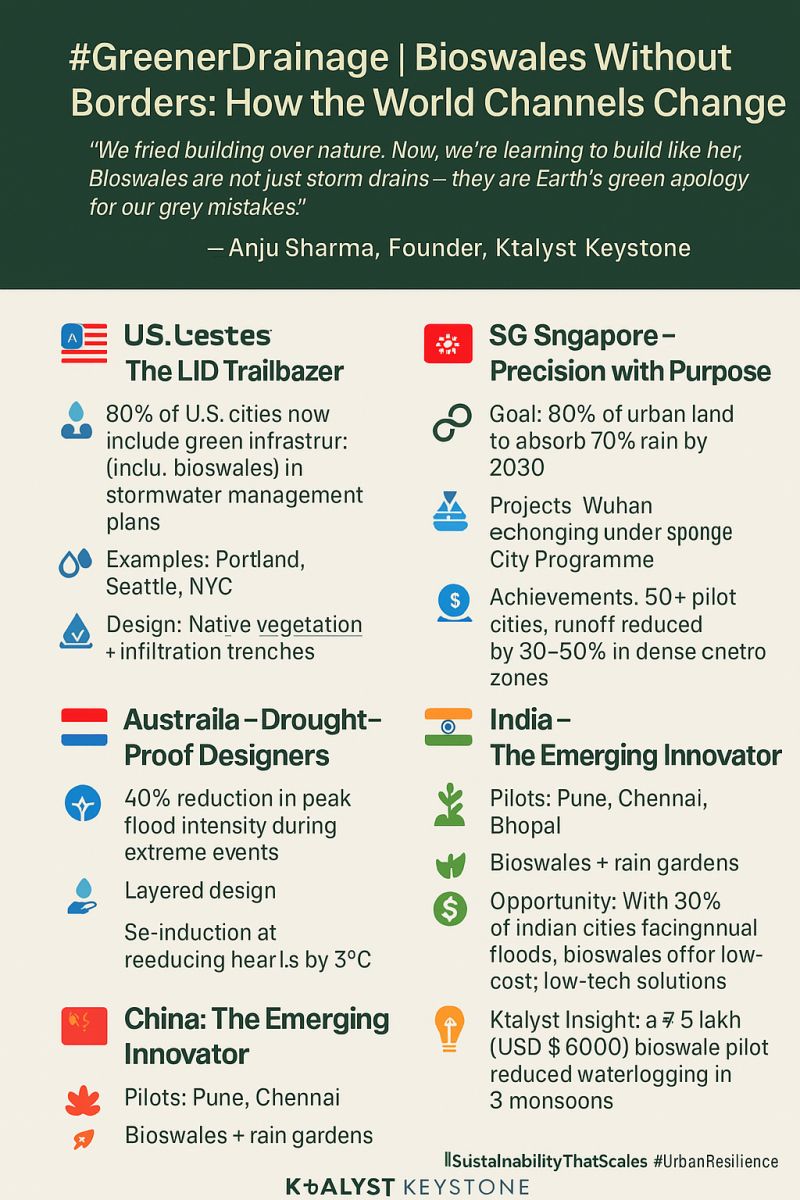
We tried building over nature. Now, we’re learning to build like her. Bioswales are not just storm drains – they are Earth’s green apology for our grey mistakes.
Anju Sharma | Founder, Ktalyst Keystone
What if stormwater could clean itself before reaching our rivers?
Around the world, bioswales are turning this idea into a reality—naturally filtering water, reducing floods, and beautifying cities while addressing climate resilience.
🌍 Six Countries. Six Styles. One Green Purpose.
🇺🇸 UnitedStates – The LID Trailblazer
🌧️ 80% of U.S. cities now include green infrastructure (incl. bioswales) in stormwater management plans.
🏙️ Examples: Portland, Seattle, NYC
🌿 Design: Native vegetation + infiltration trenches
⚡ Outcome: Up to 90% runoff volume reduction in key pilot zones
🇩🇪🇳🇱 Germany & Netherlands – Bicycle Bioretentionists
🚲 65% of urban roads in Dutch cities use SuDS layouts
🌼 Famous For: Stormwater swales alongside bike highways
📸 Bonus: Used for placemaking and urban branding
🇦🇺 Australia – Drought_Proof Designers
☀️ 40% reduction in peak flood intensity during extreme events (source: Melbourne WSUD case study)
🦘 Cities: Melbourne, Brisbane
🌳 Layered Design: For dry spells and cloudbursts
🔥 Impact: Bioswales integrated into parks, reducing heat islands by 3–5°C
🇸🇬 Singapore – Precision_with_Purpose
💧 ABC Waters Programme launched in 2006
🏝️ Projects: Bishan-AMK Park, Punggol Waterway
🌿 Result: Cleaner waterways + real estate uplift near bioswale zones (up to 12% premium)
🪷 Quote from PUB: “Every drain is now a destination.
🇨🇳 China – The UrbanSponge Model
🏙️ Goal: 80% of urban land to absorb 70% of rain by 2030
🌾 Projects: Wuhan, Chongqing under Sponge City Programme
📉 Achievements: 50+ pilot cities, runoff reduced by 30–50% in dense metro zones
🇮🇳 India – The EmergingInnovator
🇮🇳 Pilots: Pune, Chennai, Bhopal
🌱 Design: Bioswales + rain gardens
💡 Opportunity: With 30% of Indian cities facing annual floods, bioswales offer low-cost, low-tech solutions
🌟 Ktalyst Insight: A ₹5 lakh (USD ~$6,000) bioswale pilot reduced waterlogging in 3 monsoons


Originally published on LinkedIn on 2025-04-09 06:51:09: https://www.linkedin.com/feed/update/urn%3Ali%3AgroupPost%3A82951-7315627313553981440
NamasteIndia ranks 6th in the top 14 countries producing wind power as of 2023, along with their percentage increase in wind power capacity over the last 10 years:
1. China: 885 TWh (+190%)
2. United States: 425 TWh (+70%)
3. Germany: 137 TWh (+40%)
4. Brazil: 95 TWh (+210%)
5. United Kingdom: 82 TWh (+60%)
6. India: 71 TWh (+50%)
7. Spain: 60 TWh (+30%)
8. France: 45 TWh (+80%)
9. Canada: 35 TWh (+50%)
10. Italy: 30 TWh (+25%)
11. Sweden: 28 TWh (+90%)
12. Australia: 25 TWh (+120%)
13. Turkey: 22 TWh (+100%)
14. Netherlands: 20 TWh (+150%)
Future_Potential:
China: Exceptional wind resources due to its large land mass and long coastline.
United_States: Vast areas with high wind speeds, especially in the Midwest.
Germany: Consistent wind flow in the North Sea region.
Brazil: Strong wind flow in coastal regions.
United Kingdom: Excellent wind conditions, particularly offshore.
India: Significant potential in coastal areas like Tamil Nadu and Gujarat, and hilly regions such as Himachal Pradesh.
Countries with Untapped Wind_Power_Potential:
Russia: Despite significant wind potential, it generated less than 1% of its electricity from wind in 2023.
Japan: Has strong wind resources but has not fully developed its wind power infrastructure.
South_Korea: Similar to Japan, it has good wind potential but limited development.
These countries have the right wind conditions to further increase their wind power capacity in the future.
Originally published on LinkedIn on 2024-09-19 10:31:36: https://www.linkedin.com/feed/update/urn%3Ali%3Ashare%3A7242480441604161536

