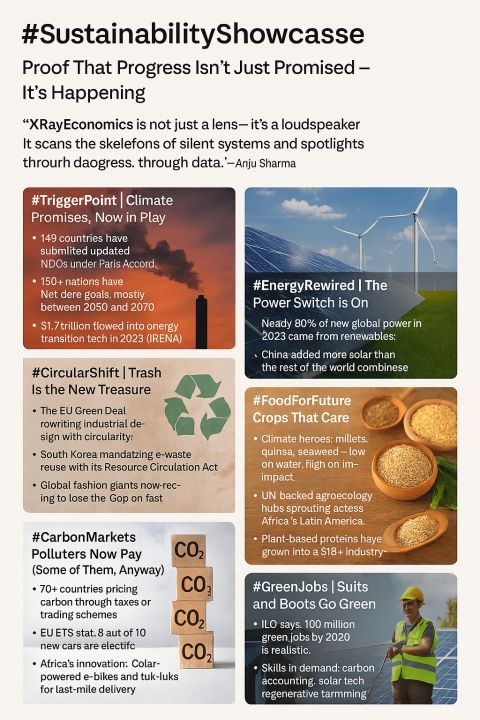
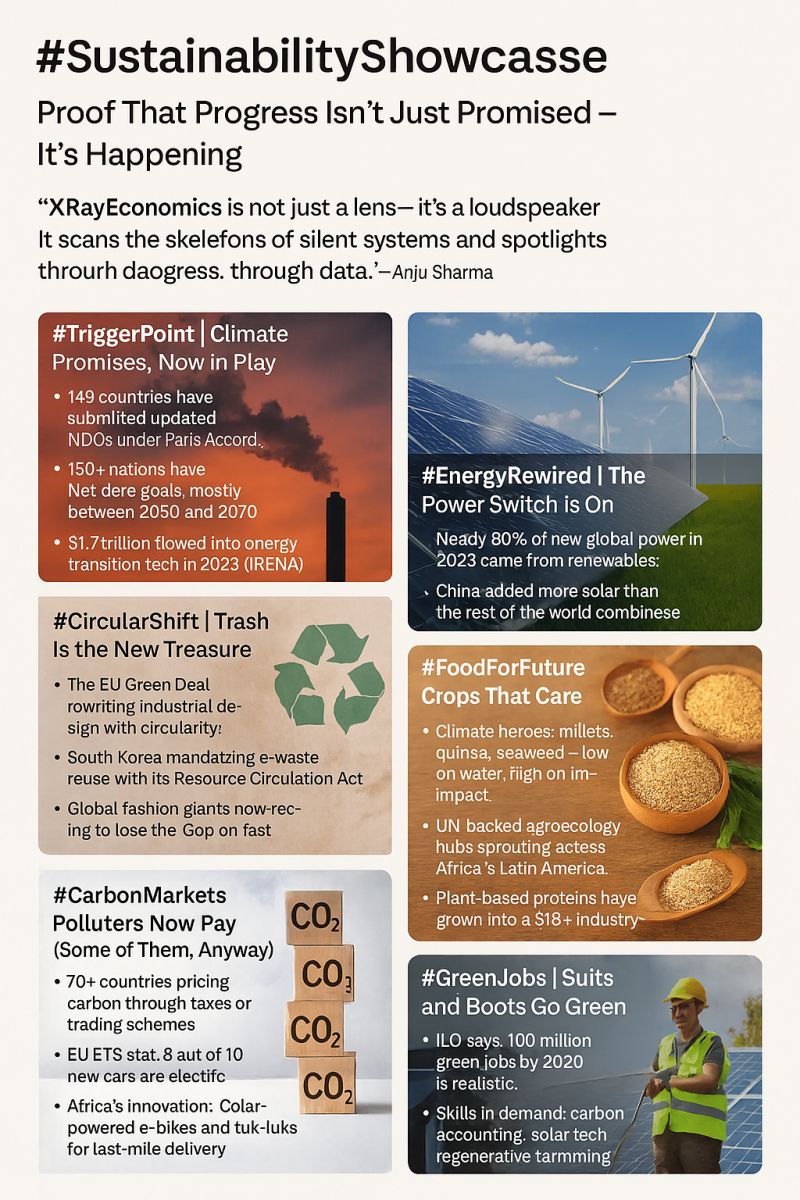
SustainabilityShowcase: Proof That Progress Isn’t Just Promised – It’s Happening
XRayEconomics is not just a lens—it’s a loudspeaker. It scans the skeletons of silent systems and spotlights the nerves of real progress. In the age of noise, sustainability speaks clearest through data.
Anju Sharma
TriggerPoint | Climate Promises, Now in Play
149 countries have submitted updated NDCs under the Paris Accord
130+ nations have Net_Zero goals, most between 2050 and 2070
In 2023, $1.7 trillion flowed into energy transition tech (IRENA)
EnergyRewired | The Power Switch Is On
Nearly 90% of new global power in 2023 came from renewables
China alone added more solar than the rest of the world combined
Europe’s wind energy plans = 10x growth by 2030
CircularShift | Trash Is the New Treasure
The EU Green Deal is rewriting industrial design with circularity
SouthKorea mandates e-waste reuse with its Resource Circulation Act
Global fashion giants now racing to close the loop on fast fashion
FoodForFuture | Crops That Care
Climate_heroes: millets, quinoa, seaweed—low on water, high on impact
UN_backed agroecology hubs sprouting across Africa & Latin America
Plant_based proteins have grown into a $11B+ industry
CarbonMarkets | Polluters Now Pay (Some of Them, Anyway)
70+ countries pricing carbon through taxes or trading schemes
EU ETS = still the world’s largest and most evolved
The Voluntary CarbonMarket has crossed $2B, but needs cleanup
eMobility | Wheels, Meet Conscience
Over 14 million EVs sold worldwide in 2023
Norway’s stat? 8 out of 10 new cars are electric
Africa’s innovation: solar-powered e-bikes and tuk-tuks for last-mile delivery
GreenJobs | Suits and Boots Go Green
ILO says: 100 million green jobs by 2030 is realistic
Skills in demand: carbon accounting, solar tech, regenerative farming
Reskilling is in—EU, Canada, ASEAN are rolling out green upskilling drives
FromLocalToGlobal | Climate Activism Has a Zip Code
Fridays for Future: 7,500+ cities involved, and counting
Kigali to Copenhagen: cities lead the way in urban sustainability
UN’s LiFE Mission and SDG localisation: turning villages into climate role models
Originally published on LinkedIn on 2025-03-28 16:28:24: https://www.linkedin.com/feed/update/urn%3Ali%3Ashare%3A7311423926666977280
SustainabilityTariff2025: The New Trade War – Green or Gone?
💡 “Sustainability is no longer a choice; it’s the cost of doing business.
As the world accelerates toward net_zero, 2025 is shaping up to be a watershed moment for global industries. Sustainability tariffs are no longer just policies on paper—they are reshaping trade, investment, and corporate strategy.
🚀 What’s Changing?
📉 Carbon-based tariffs are being enforced across key trade blocs.
⚡ Green energy mandates are now linked to export competitiveness.
📊 Transparency in ESG reporting is mandatory for global businesses.
🌍 Top5EmittingCountries (2023) & Their Exposure to Tariffs
📌 🇨🇳 China – 12,667 Mt CO₂ | Facing increased U.S. tariffs on EVs & batteries.
📌 🇺🇸 United States – 5,007 Mt CO₂ | Implementing 25% tariffs on steel & aluminum.
📌 🇮🇳 India – 2,654 Mt CO₂ | Under pressure to align with EU’s Carbon Border Tax.
📌 🇷🇺 Russia – 1,711 Mt CO₂ | Facing trade barriers due to high fossil fuel dependency.
📌 🇯🇵 Japan – 1,162 Mt CO₂ | Investing in hydrogen economy to offset future tariff risks.
(Source: Greenmatch UK)
⚖️ KeySustainabilityTariffPolicies in 2025
📌 🇪🇺 European Union – CBAM (Carbon Border Adjustment Mechanism) to tax carbon-heavy imports.
📌 🇺🇸 USA – Higher import duties on non-sustainable steel & aluminum.
📌 🌏 ACCTS (New Zealand, Costa Rica, Iceland, Switzerland) – Eliminating tariffs on green goods.
📌 🇨🇳 China – Facing U.S. import restrictions on EVs & solar panels.
(Source: Reuters, Le Monde)
🔍 IndustriesatRisk
🏗️ Steel & Cement – Carbon-heavy production under scrutiny.
🛢️ Petrochemicals – High emissions & regulatory risks.
👕 Textiles & Apparel – Forced transparency in sustainable sourcing.
📱 Electronics – E-waste accountability & circular economy mandates.
🎯 WhoWillWin?
🏆 Sustainable Leaders – Lower tariffs, premium market positioning, ESG-driven investments.
🚨 Unprepared Companies – Higher operational costs, supply chain disruptions, and lost competitiveness.
📊 What’sNext?
✅ Green energy adoption – Lowering carbon footprints.
✅ Digital ESG tracking – Ensuring compliance.
✅ Circular economy strategies – Turning waste into value.
💬 Is your industry prepared for the 2025 sustainability tariff shift?
Drop your thoughts in the comments! Let’s discuss the road ahead.


Originally published on LinkedIn on 2025-03-12 16:10:09: https://www.linkedin.com/feed/update/urn%3Ali%3AgroupPost%3A82951-7305621129530896385
NamasteIndia Net_Zero developing pathways.
Summary
India is on a robust path to achieving its renewable_energy_targets, with a $386 billion investment plan supported by both the private sector and the government. Top5 corporate investment comes from Reliance, Adani, Mahindra’ Tata & JSW_Group.
Massive_Funding and Corporate Commitments
India has secured a substantial $386 billion in funding to boost its renewable energy capacity, aiming to achieve 500 gigawatts (GW) of clean energy by 2030. This investment will drive innovation, infrastructure development, and job creation in the renewable energy sector
Funding Secured: India secures $386 billion in funding for renewable energy projects.
Reliance’s Battery_Unit: RIL wins the bid to build a 10 gigawatt-hour battery units
2025-2027
Interim Targets: Significant progress towards India’s 175 GW renewable energy target, including 100 GW from solar, 60 GW from wind, and 15 GW from other sourc2028-2030
500 GW Milestone: India targets achieving 500 GW of non-fossil fuel energy capacity by 2030.
50% Renewable Energy: At least half of India’s energy requirements to be met through renewable sources by 2030.
Carbon Intensity Reduction: Reduce carbon intensity by 45% by 2030.
Emission Reduction: Reduce total projected carbon emissions by 1 billion tons by 2030.
#### 2070
Net_ZeroEmissions: India aims to achieve net-zero carbon emissions by 2070.
Investment_Breakdown
India requires approximately $386 billion to achieve its goal of 500 GW of renewable energy capacity by 2030.
1. Reliance Industries Limited (RIL)
Investment: $50 billion
Percentage: 13%
2. Adani Group
Investment: $45 billion
Percentage: 12%
3. Mahindra & Mahindra
Investment: $30 billion
Percentage: 8%
4. Tata Group
Investment: $35 billion
Percentage: 9%
5. JSW Group
Investment: $25 billion
Percentage: 6%
Government of India
Investment: $201 billion
Percentage: 52%
### Sources of Funding
1. **Domestic and International Investments**:
Private Sector Investments: Significant contributions from major corporations like Reliance Industries, Adani Group, Mahindra & Mahindra, Tata Group, and JSW Group.
Foreign_Direct_Investment FDI:
Government Initiatives and Policies:
Green Bonds
Subsidies and Incentives
Multilateral Bilateral Funding:
International_Financial Institutions: Loans and grants from institutions like the World Bank, Asian Development Bank (ADB), and International Monetary Fund (IMF).
Bilateral Agreements: Financial support through agreements with other countries committed to global sustainability goals.
Public_Sector_Undertakings (PSUs).
Tax_Revenues general and income tax.
https://lnkd.in/dy8VwV_g
Download the TOI app now:
https://lnkd.in/dZigKD2s
Originally published on LinkedIn on 2024-09-16 17:01:07: https://www.linkedin.com/feed/update/urn%3Ali%3AgroupPost%3A60128-7241491302687617026
NamasteNetZero
NTPC Limited signed a Memorandum of Understanding (MoU) with the United_States_Agency_for_International_Development (USAID).
The partnership aims to develop a roadmap for transforming NTPC’s townships and offices into Net_Zero Establishments by the fiscal year 2025-26.
Focus is on achieving net zero status in Scope 2 emissions, which includes indirect emissions from purchased electricity, steam, heating, and cooling.
NTPC also aims to make its townships net zero in water and waste.
This collaboration aligns with India’s broader sustainability goals and NTPC’s proactive approach to addressing climate change.
Originally published on LinkedIn on 2024-09-10 13:12:15: https://www.linkedin.com/feed/update/urn%3Ali%3AgroupPost%3A60128-7239259379957432320

