DataComa Alert: When a footnote wipes out a forecast.
By Dr. Anju Sharma | MrsSustainability | KtalystInsights
On 3 Dec 2025, Nature retracted a widely-cited climate-economy paper.
Same day, NGFS warned users to interpret its climate stress-test outputs knowing this paper was used.
What went wrong isn’t “climate.
It’s Model Risk + DataComa.
✓ One high-impact study
✓ One embedded damage function
✓ Many dashboards turned “uncertainty” into “certainty
✓ Then—retraction.
Board rule: If your scenario has one academic spine, it’s not resilience. It’s a narrative.
KtalystInsights:
Climate risk is real. But risk math must be resilient too with ranges, sensitivity, and competing models, not just a headline number.
When certainty is cheap, always ask who paid for the assumptions.” Dr. Anju Sharma
Originally published on LinkedIn on 2025-12-19 11:47:00: https://www.linkedin.com/feed/update/urn%3Ali%3Ashare%3A7407748285416955904
BeyondGreen: The Full Spectrum of Sustainability Has More Colours Than You Think
Sustainability isn’t just greenwashing or a CSR afterthought.
It’s a strategic spectrum—and at KtalystKeystone, we decode it in full colour.
Here’s what each hue really means—with the data to back it:
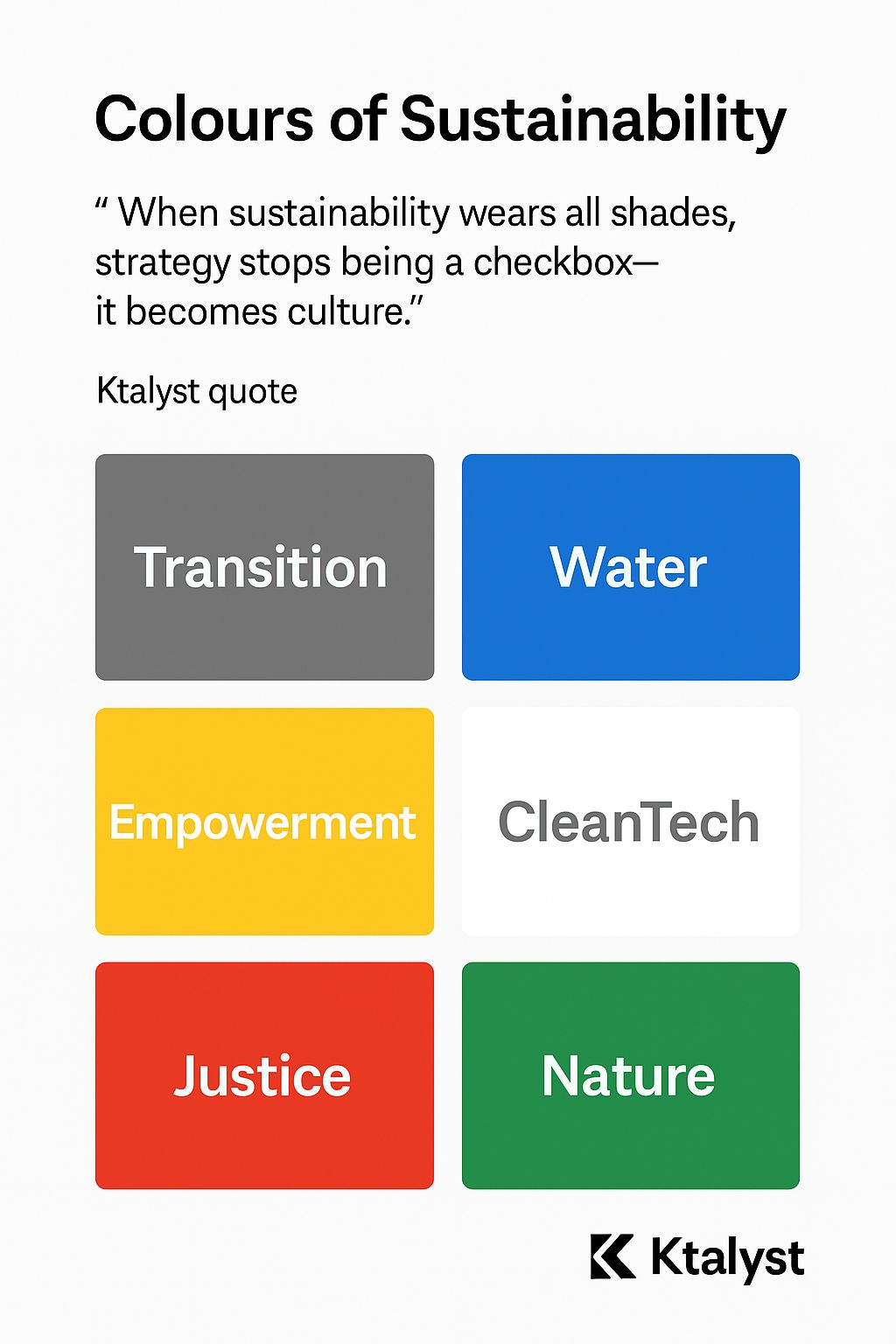
Grey – TransitionTech
Cement & steel = 14% of global CO₂. Innovations like CCUS and low-carbon fuels are critical to reach net-zero by 2050.
Blue – WaterResilience
By 2030, 40% of the world may face water stress. Blue credits, marine protected zones, and circular reuse models are rising fast.
White – CleanEnergyGrid
Green hydrogen market = $90B+ by 2030. EV infrastructure and fuel cells are accelerating decarbonization across sectors.
Yellow – Solar & Skills
India’s solar rooftop capacity grew 4X between 2021–24. Yellow isn’t just energy—it’s empowerment, inclusion, and innovation.
Red – SocialJustice
Over 160 million children still in labour force. Red ensures ESG isn’t just ‘E’—it’s also equity, ethics, and equal opportunity.
Green – Nature-Positive Action
Forests absorb ~2.6B tons of CO₂ annually. Carbon markets, afforestation, and regenerative farming are redefining nature’s ROI.
When we move BeyondGreen, we don’t just see sustainability—we LeadIt.
ColoursOfSustainability | ESGLeadership | TechForClimate | GreenCapital | SustainabilityDecoded | KtalystKeystone | ClimateCanvas
Originally published on LinkedIn on 2025-04-22 20:33:40: https://www.linkedin.com/feed/update/urn%3Ali%3Ashare%3A7320545349763260416
KtalystKnowledgeSeries
USA SustainabilitySnapshot: Goals, Data & Drive
Targets are timelines. Transformation is the true triumph.” — KtalystKeystone
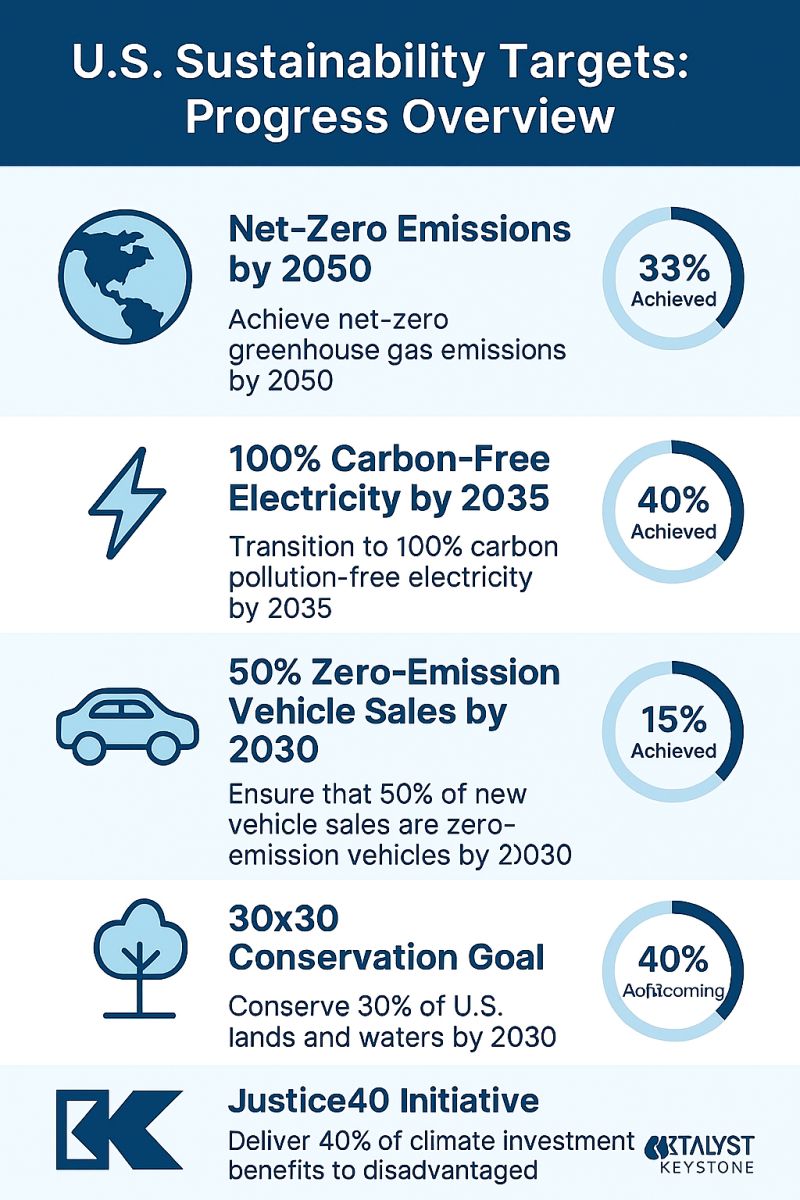
🌎 Net-Zero Ambition
Goal: Achieve net-zero emissions by 2050
Current Status: U.S. emissions were 17% below 2005 levels by 2023
Key Driver: Clean power shift, IRA incentives
Targets are timelines. Transformation is the true triumph.
⚡ Clean Power by 2035
Goal: 100% carbon-free electricity
Progress:
2023: ~41% from clean sources (solar, wind, nuclear, hydro)
Solar capacity: Quadrupled since 2015
Investment Push: $369B via Inflation Reduction Act
🚗 EV Nation
Goal: 50% new vehicle sales electric by 2030
2023 Stats:
EVs = 7.6% of total new U.S. car sales
500,000 EV chargers planned by 2030
♻️ Circular America
Goal: Cut food waste by 50% by 2030
Current:
30–40% of food still wasted
National Strategy launched in 2023 for plastics reduction & reuse
🌿 Nature Positive (30×30 Goal)
Goal: Conserve 30% of land & water by 2030
Status:
~12% of U.S. land currently protected
New partnerships with Indigenous and rural communities
⚖️ Justice40 Initiative
Goal: 40% of climate investments to disadvantaged communities
Covered Sectors:
Clean transit
Pollution clean-up
Water access
Workforce training
Tracking Tool: CEJST (Climate & Economic Justice Screening Tool)
📊 Climate Data Commitment
Goal: Enhance climate risk transparency
Push:
SEC climate disclosure rules (proposed)
Federal agencies adopting climate risk dashboards

Originally published on LinkedIn on 2025-04-09 06:22:18: https://www.linkedin.com/feed/update/urn%3Ali%3AgroupPost%3A82951-7315620051338825728
KnowledgeSeries: The Future of CarbonCredits – A USD250B Market by 2050
The carboncredit market is no longer a side conversation—it’s becoming a mainstream financial instrument. With projections hitting #$250B by 2050, businesses and investors must pay attention.
Why? Because companies that integrate NetZero strategies today will gain a competitive edge, while those that don’t will face higher costs, regulatory risks, and shrinking investor confidence.
🌎 The Carbon Credit Boom: Why It’s a Business Imperative
✔️ The voluntary carbon market is set to grow 15X by 2030, reaching #$10B–$40B. (McKinsey)
✔️ Investments in carbon credits hit #$1.7B in 2023, up 50% YoY. (BloombergNEF)
✔️ 6,000+ global companies have set Science-Based Targets (SBTi), driving demand for verified carbon offsets.
✔️ Indonesia, Brazil, and Kenya are integrating carbon markets into their economies, generating revenue from forests, renewable energy, and carbon capture projects.
✔️ Article 6 of the ParisAgreement is enabling international carbon credit trading, boosting market credibility.
🚀 What does this mean for businesses?
✔️ A carbon credit strategy is no longer optional—it’s a business necessity.
✔️ Companies without a decarbonization plan will face higher compliance costs.
✔️ Investors are prioritizing NetZero leaders, making carbon credits a key ESG performance driver.
📊 Who’s Leading the Carbon Credit Race?
✔️ Big Tech & Carbon Capture:
Meta, Microsoft, and Google are securing multi-million-dollar deals in Direct Air Capture (DAC) to future-proof their carbon strategies.
✔️ Financial Institutions Going Green:
BlackRock, JP Morgan, and Goldman Sachs are launching climate-focused funds, treating carbon credits as an emerging asset class.
✔️ Corporate Adoption Soaring:
40%+ of Fortune500 companies are embedding carbon offsets into their business models.
✔️ Government-Led Action:
The EU, Singapore, and Japan are developing regulated carbon exchanges to ensure transparency & standardization.
🌱 What to Expect in 2025 & Beyond?
✔️ Stricter Regulations → Carbon credit verification will be tighter, reducing low-quality offsets & greenwashing risks.
✔️ Rising Prices → As demand outstrips supply, carbon credit prices could triple by 2030, making early adoption a smart financial move.
✔️ Emerging Markets in Play → Africa, Southeast Asia, and Latin America will dominate nature-based carbon solutions (reforestation, soil carbon, etc.).
✔️ Carbon as a Tradable Asset → Institutional investors are pushing for liquid carbon credit markets, making carbon a financialized commodity.
🔍 ComingUpNext: “The Business Case for Carbon Credits – Risks, Rewards & Strategy
Originally published on LinkedIn on 2025-03-08 07:02:05: https://www.linkedin.com/feed/update/urn%3Ali%3AgroupPost%3A82951-7304033651044839424
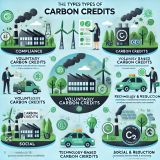
KnowledgeSeries – Decoding Carbon Credits: Which Ones Truly Make an Impact?
Carbon credits are essential tools in the fight against climate change, but not all credits are created equal. Here’s a quick guide to understanding their types and impact.
🌍 Compliance Carbon Credits
✅ Regulated Offsets – Mandatory under government-led carbon markets.
✅ Examples: EU ETS, California Cap-and-Trade, China ETS.
✅ Who Uses Them? Heavy industries, power plants, airlines, and corporations with emission limits.
💡 Voluntary Carbon Credits
✅ Market-Driven Offsets – Purchased by businesses and individuals to meet sustainability goals.
✅ Examples: Renewable Energy Credits (RECs), Forestry & Land Use, Methane Capture.
✅ Who Uses Them? Airlines, event organizers, eco-conscious brands.
🌱 Nature-Based Carbon Credits
✅ Carbon Sequestration – Uses ecosystems to absorb CO₂.
✅ Examples: Reforestation, Blue Carbon (Mangroves & Seagrass), Soil Carbon Farming.
✅ Why It Matters? Restores biodiversity, improves water cycles, and benefits local communities.
🔬 Technology-Based Carbon Credits
✅ Innovative Carbon Removal – Uses advanced tech to pull carbon from the air.
✅ Examples: Direct Air Capture (DAC), Carbon Capture & Storage (CCS), Waste-to-Energy.
✅ Challenges: High cost, scalability, and energy consumption.
⚡ Avoidance & Reduction Credits
✅ Preventing Emissions at the Source – Focuses on eliminating carbon before it’s released.
✅ Examples: Wind & Solar Energy, Energy Efficiency, Clean Cooking Stoves.
✅ Why It’s Crucial? Immediate impact with proven effectiveness.
🤝 Social Carbon Credits
✅ Climate + Community Benefits – Supports sustainability while improving lives.
✅ Examples: Sustainable Farming, Water Purification, Community Reforestation.
✅ Beyond Carbon? Jobs, education, and health improvements.
🔥 Biochar Carbon Credits
✅ Long-Term Carbon Storage – Converts biomass into stable carbon that remains in the soil.
✅ Benefits: Boosts soil health, prevents methane release, locks carbon for centuries.
✅ The Future? High permanence with agricultural benefits.
Which Carbon Credit Makes the Most Impact?
✅ Compliance Credits – Necessary but market-dependent.
✅ Voluntary Credits – Flexible, but risk of greenwashing.
✅ Nature-Based – Cost-effective and high-impact.
✅ Tech-Based – Promising, but expensive.
✅ Avoidance & Social Credits – Immediate reductions with co-benefits.
✅ Biochar – One of the most durable carbon storage solutions.
💬 Which one do you think has the highest potential for a net-zero future? Comment below!
Sustainability CarbonMarkets NetZero ClimateAction
Originally published on LinkedIn on 2025-03-06 08:05:21: https://www.linkedin.com/feed/update/urn%3Ali%3AgroupPost%3A100646-7303324797692747776
Fighting Nature and winning the battle… what will happen when We lose the War
Despairing for Disappearing Hills in NaviMumbai
For fourteen years, my flat balcony has been my special place—a spot where I could relax and enjoy the lush green leaves against the backdrop of rolling hills. But now, as usual the concrete is taking up this serene area into high-rise buildings.
This change threatens to take away my calming view, which has been my friend for so long. Along with it another natural habitat will die due to greedy hunger of Development. These hills are gradually being surrounded by towering structures, and it feels like nature is losing to human development.
The clash of Titans urbanization and nature happens silently but significantly. Rules favoring development often overpower our connection to the natural world. We stand helpless once again!!! No new governments help in this age old destruction 😔

Originally published on LinkedIn on 2024-08-23 15:12:17: https://www.linkedin.com/feed/update/urn%3Ali%3Ashare%3A7232766605183586304

