Green💚 vs GreenInvestment$
Dr. Anju Sharma | MrsSustainability
KtalystInsights™ KtalystKlues
Why climate ambition doesn’t move capital but certainty does:
🌱 Green intention doesn’t attract money.
💵 Green certainty does.
As ESG labels multiply and sustainability debates get louder, global investors are doing something very quiet, they’re reallocating capital to places where transition looks executable, manufacturable, and financeable.
Not the greenest. The clearest.
What global capital is actually responding to
1️⃣ Policy certainty beats policy passion
Too many labels. Too many reversals. Too much confusion.
Even Europe now admits disclosure overload didn’t move money or portfolios.
👉 EU green fund rules failed to boost flows or reduce emissions (FT, Jan 2026):
https://lnkd.in/d4TKmCDW
KtalystKlue™:
Capital hates surprises more than it hates carbon.
2️⃣ Manufacturing scale is the new ESG moat
Factories matter more than frameworks.
Green $ flows to countries that can build batteries, grids, hydrogen, and industrial systems not just report on them.
KtalystKlue™:
Sustainability without factories is just good PowerPoint.
3️⃣ Corporate capex speaks louder than fund labels
Markets don’t follow ESG colours they follow balance sheets.
Governments backing industrial transition vehicles are pulling capital faster than disclosure regimes.
👉 UK National Wealth Fund targets CCUS, batteries & hydrogen (Reuters, Jan 2026):
https://lnkd.in/dVHjb9d8
KtalystKlue™:
If the CFO isn’t spending, the fund flow won’t follow.
4️⃣ Investor clarity is the silent deal-maker
Academics confirmed it: investors struggled to understand sustainability labels so money stayed put.
👉 NBER Working Paper (Jan 2026):
https://lnkd.in/d8cYTyQG
KtalystKlue™:
Confused investors don’t save the planet they sit in cash.
🔮 KtalystKlues™ | Future Forecast (2026–2032)
ESG labels fade; capex-backed transition wins
Manufacturing nations outperform moral nations
Transition finance beats “perfect green” finance
Boring policy beats bold policy
CFOs, not CSOs, decide the climate curve
The next decade won’t ask who is the greenest. It will ask who can transition at scale without breaking cash flow.” Dr. Anju Sharma
🌱💵 Green 💚 needs Green $.
Green $ needs certainty, factories, and CFO comfort.
GreenVsGreen IndustrialSustainability
TransitionEconomics CapitalFlows
DataComa
Originally published on LinkedIn on 2026-02-02 02:19:22: https://www.linkedin.com/feed/update/urn%3Ali%3AgroupPost%3A131340-7423912886571487232
Why ESG Isn’t a Global Roadmap—It’s a Country_by_Country_Compass
ESG Isn’t One-Size-Fits-All—It’s One-Strategy-Fits-Nation
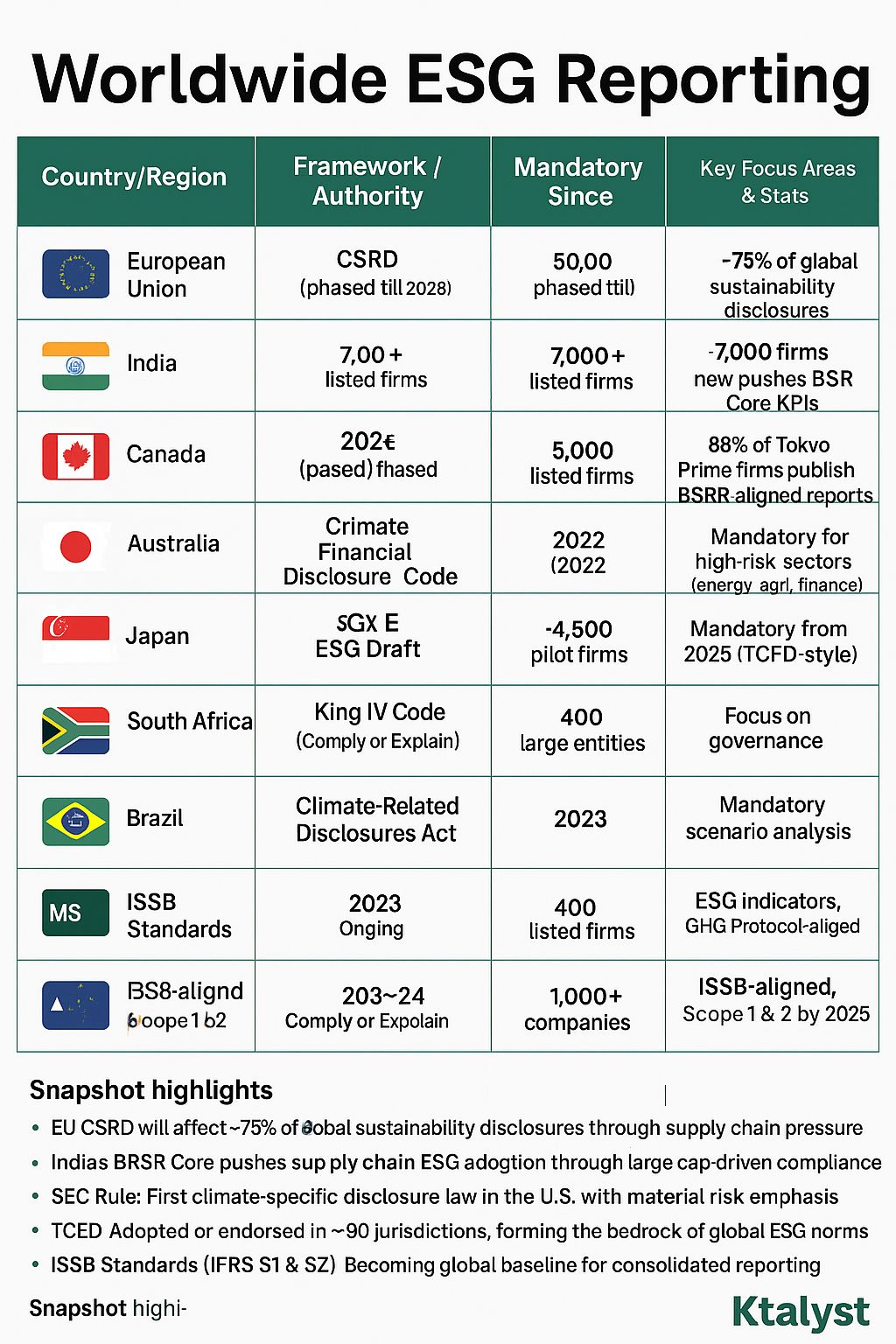
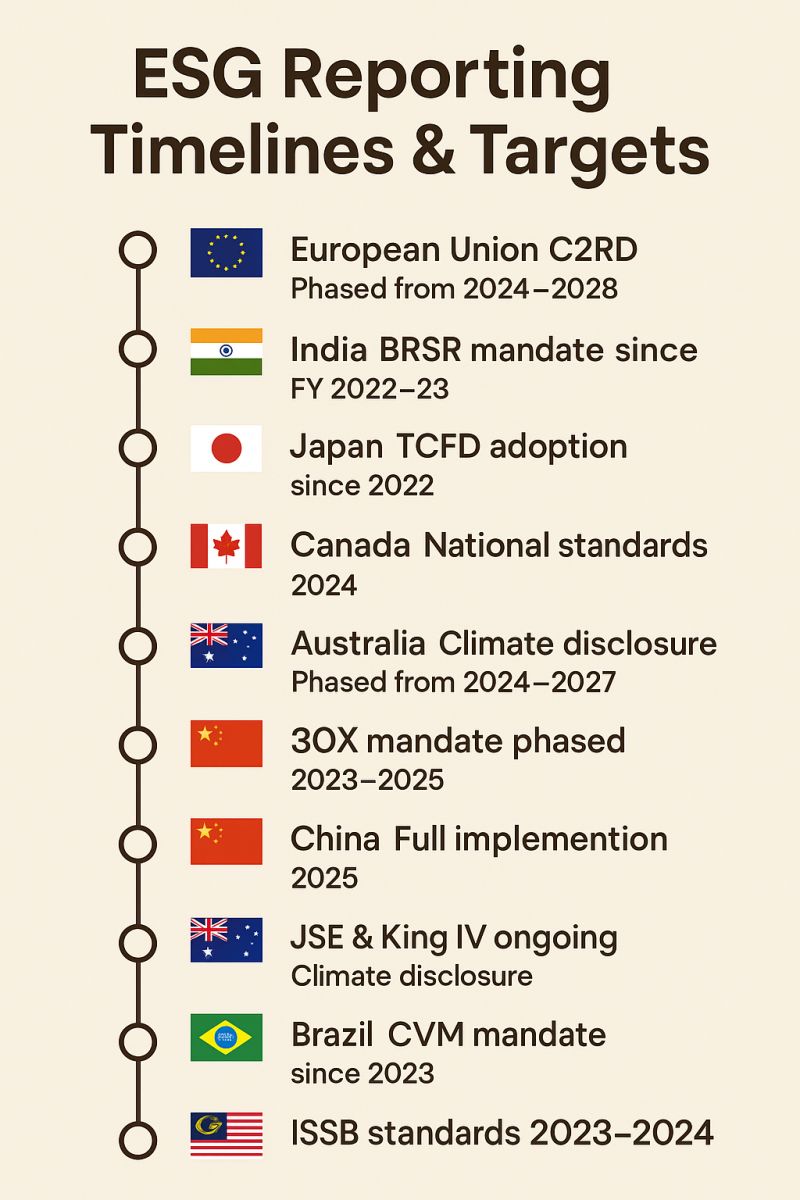
ESG reporting takes different roads because nations prioritize differently—economic maturity, regulatory style, investor pressure, and trade exposure all shape the path. The EU leads with CSRD—affecting 50,000+ firms through double materiality, taxonomy alignment, and mandatory assurance. The US sticks to financial materiality and climate risk, sidestepping Scope 3 and S&G. India’s BRSR ties ESG to development goals, starting with the top 1,000 and easing into assurance. Export-driven China, Malaysia, and Singapore accelerate ESG to meet global buyer expectations and bypass EU CBAM fallout. Japan prefers voluntary codes; South Africa excels in governance (King IV), but lacks integrated data.
Bottom line? ESG mirrors what each country values—growth, governance, global edge, or green capital. It’s not just compliance—it’s strategy, sovereignty, and survival.
🇪🇺 European Union
Timeline: CSRD phased from 2024 to 2028
Mandatory from:
2024: Large public-interest companies
2025: All large companies
2026–28: SMEs (limited scope)
FunFact: Will impact 75%+ of global ESG reporting indirectly via supply chains
🇺🇸 United States
Timeline: SEC Rule effective 2024–2025
Mandatory from:
FY2024: Large Accelerated Filers
FY2025: Accelerated Filers
Scope 3? Only if material (and still debated)
🇮🇳 India
Timeline:
BRSR mandatory since FY 2022–23
BRSR Core with limited assurance from FY 2023–24
Next up: Potential rollout for mid-size unlisted companies by 2026
🇯🇵 Japan
Timeline:
TCFD adoption by Prime listed firms since 2022
No fixed law, but >80% of large firms are already onboard voluntarily
🇨🇦 Canada
Timeline:
CSA rule aligned with TCFD from 2024
Mandated for:
Publicly listed entities, expanding coverage gradually
🇦🇺 Australia
Timeline:
Climate Disclosure Framework phased from July 2024
Rollout:
2024: Large companies
2026–27: Mid and small entities
🇸🇬 Singapore
Timeline:
SGX ESG reporting mandatory since 2023
Sector phased:
Energy, Agri, Finance by 2024
All others by 2025
🇨🇳 China
Timeline:
Draft ESG rules under CSRC in 2024
Target:
Full mandatory rollout by 2025
Pilots ongoing in green finance and energy sectors
🇿🇦 SouthAfrica
Timeline:
JSE & King IV apply ongoing since 2016
Mandate:
Comply or explain” model, no fixed year — but tightening expected by 2025
🇳🇿 NewZealand
Timeline:
Climate-Related Disclosure Act enforced from 2023
Applies to:
Financial institutions & large corporates (>NZ$1B AUM or turnover)
🇧🇷 Brazil
Timeline:
CVM ESG disclosure mandatory since 2023
Focus:
Annual reporting, with increasing pressure for Scope 3 inclusion by 2026
🇲🇾 Malaysia
Timeline:
ISSB-aligned standards adopted in 2023–2024
Mandated by:
Bursa Malaysia, full Scope 1–2 by 2025, Scope 3 optional till 2026


Originally published on LinkedIn on 2025-04-21 21:59:46: https://www.linkedin.com/feed/update/urn%3Ali%3AugcPost%3A7320204627323289601
BoardroomMandate: Sustainability is No Longer Optional—It’s an IndustryImperative
#📌 The Industry Wake-Up Call: Sustainability as a Business Mandate
#📉 $4 Trillion at Risk – Non-compliant companies risk market value erosion, fines, and investor exits.
#📈 68% of Institutional Investors – ESG performance now directly influences capital allocation.
#🔎 Regulatory Overhaul – EU CSRD, SEC Climate Disclosures, India’s BRSR mandate sustainability reporting.
#🌍 Sustainability Metrics by Industry
#🌾 Agriculture
✅ AI-backed precision farming → 15% fuel savings | 30% lower pesticide & water use | 20% higher yield #
#👗 Fashion & Textiles
✅ India targets $350B industry by 2030 while cutting emissions by 50% #
✅ Biomass & renewable energy adoption reducing carbon footprint #
#📢 Advertising & Marketing
✅ 25% rise in consumer trust for brands with authentic sustainability efforts #
❌ Greenwashing crackdown – Firms face legal & reputational damage #
#🛍 Retail & Consumer Goods
✅ 65% of consumers prefer brands with strong sustainability credentials #
✅ Sustainable businesses see higher long-term revenue growth #
#🧪 Biotech & Materials Science
✅ Seaweed-based biomaterials emerging as a sustainable alternative to plastics #
#📊 ESG Data & Risk Analytics
✅ 70% of Fortune 500 firms use ESG risk monitoring tools to ensure compliance & risk mitigation #
#💼 Corporate Sustainability Rankings
✅ Top 10% sustainable companies outperform market peers by 7% TSR #
#📌 What Boards Need to Do—Now
✅ Embed ESG in Growth Plans – Not a side initiative, but a core strategy #
✅ Ensure Regulatory Compliance – Align with global ESG mandates #
✅ Set Industry-Specific KPIs – Track & measure sustainability performance #
✅ Invest in Low-Carbon Innovation – AI, renewables, & circular economy #
✅ Demand Transparent ESG Reporting – Investor & regulatory trust is at stake #
📢 Board Directors: Is your company’s ESG strategy future-ready? Let’s discuss. 👇 #


Originally published on LinkedIn on 2025-03-11 16:22:38: https://www.linkedin.com/feed/update/urn%3Ali%3AgroupPost%3A4385073-7305261883983355904
🚀 “CorporateGovernance: Can India Match the US?” 🇮🇳⚖️🇺🇸
India’s corporate governance is evolving, but enforcement gaps remain. How does it compare to the US? Here’s a data-driven reality check.
✅ Where India & US Align
🔹 Mandatory ESG Disclosures
✔️ India: Top 1,000 listed firms follow BRSR. (SEBI, 2024)
✔️ US: SEC mandates climate disclosures. (SEC, 2024)
🔹 Board Diversity
✔️ India: 35% of Nifty500 firms have women directors. (NSE, 2024)
✔️ US: Women hold 32% of S&P500 board seats. (Harvard Law, 2024)
🔹 Whistleblower Protections
✔️ India: SEBI enforces audit committees & whistleblower policies. (SEBI, 2024)
✔️ US: SOX Act ensures strict penalties for corporate fraud. (SEC, 2025)
📌 RealityCheck: Laws exist, but enforcement is the game-changer.
⚖️ Where India Lags
🔻 Board Independence
✔️ US: 90% of S&P500 firms separate CEO & Chair roles. (Spencer Stuart, 2024)
✔️ India: Only 33% of Nifty500 firms do the same. (ICSI, 2025)
🔻 Investor Protection
✔️ US: SEC enforces shareholder voting rights. (SEC, 2025)
✔️ India: Promoter-led firms limit investor influence. (SEBI, 2025)
🔻 Legal Delays
✔️ US: Corporate cases resolve in 6-12 months. (Bloomberg, 2025)
✔️ India: Takes 5-7 years. (Economic Times, 2025)
🔻 ESG Penalties
✔️ US: $1.5B in greenwashing fines. (SEC, 2025)
✔️ India: ₹500 Cr ($60M) in fines. (SEBI, 2025)
📌 RealityCheck: India needs stricter oversight & faster dispute resolution.
🏆 KeyTakeaway
📌 India has strong policies but weak enforcement.
📌 US leads in investor rights & legal efficiency.
📌 India must act fast to boost global trust.
💬 Will India bridge the governance gap? Drop your thoughts! 👇


Originally published on LinkedIn on 2025-02-21 17:50:23: https://www.linkedin.com/feed/update/urn%3Ali%3AgroupPost%3A95089-7298760984062488577
🚨 CaseStudyAnalysis: “Volkswagen’s $1.4 Billion Tax Clash in India – A Wake-Up Call for MNCs & Policymakers?” 🚗💸
A stable tax system builds investor trust, but unpredictability drives them away.
Volkswagen, one of the world’s largest automakers, is battling a massive $1.4 billion tax dispute with Indian authorities over misclassification of imported car parts. This case is not just about one company—it reflects systemic tax challenges that impact FDI, business confidence, and India’s economic reputation.
🔍 WhatWentWrong?
📌 RegulatoryAmbiguity: India’s tax system lacks clear, consistent classifications. Volkswagen’s import methods were accepted for years before being reclassified.
📌 RetrospectiveTaxation: India has a history of sudden tax demands on MNCs (Vodafone – $2B, CairnEnergy – $1.2B), eroding investor trust. (Source: Reuters, 2025)
📌 LengthyLitigation: Tax disputes in India take an average of 7-10 years to resolve, delaying investments. (Source: EconomicTimes, 2025)
📌 PolicyShiftsWithoutClarity: Frequent rule changes without transition time force companies into costly legal battles.
🚀 HowIndiaCanImprove?
✅ PredictabilityInTaxation: Stable, transparent tax structures can boost FDI inflows beyond $80B/year. (DPIIT, 2025)
✅ Fast-TrackDisputeResolution: A dedicated tax tribunal for MNCs could cut dispute timelines by 60%. (NITIAayog, 2025)
✅ CustomsClarity: Pre-rulings on tax classifications will reduce compliance risks for 1,000+ global firms operating in India.
✅ InvestorConfidenceReforms: Proactive government engagement with MNCs could prevent capital flight (like SEAsia gaining $25B from exiting investors). (IMF, 2025)
✅ EaseOfDoingBusiness: India improved from Rank142 (2014) to Rank63 (2024) but still struggles with tax complexity. (WorldBank, 2025)
⚖️ TheBiggerPicture
Volkswagen’s case isn’t just about one company—it’s a test for India’s tax and regulatory future. Striking the right balance between RevenueMaximization and InvestorTrust is crucial for long-term economic stability.
💬 What’s your take? Are tax disputes a cost of doing business in India, or can better policies fix this? Let’s discuss! 👇
Originally published on LinkedIn on 2025-02-20 11:41:29: https://www.linkedin.com/feed/update/urn%3Ali%3AgroupPost%3A95089-7298305762500501504
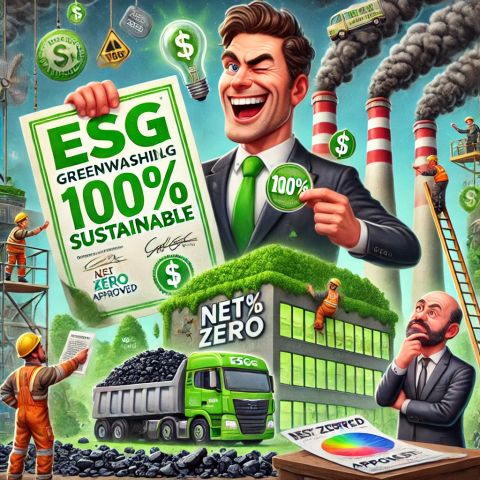
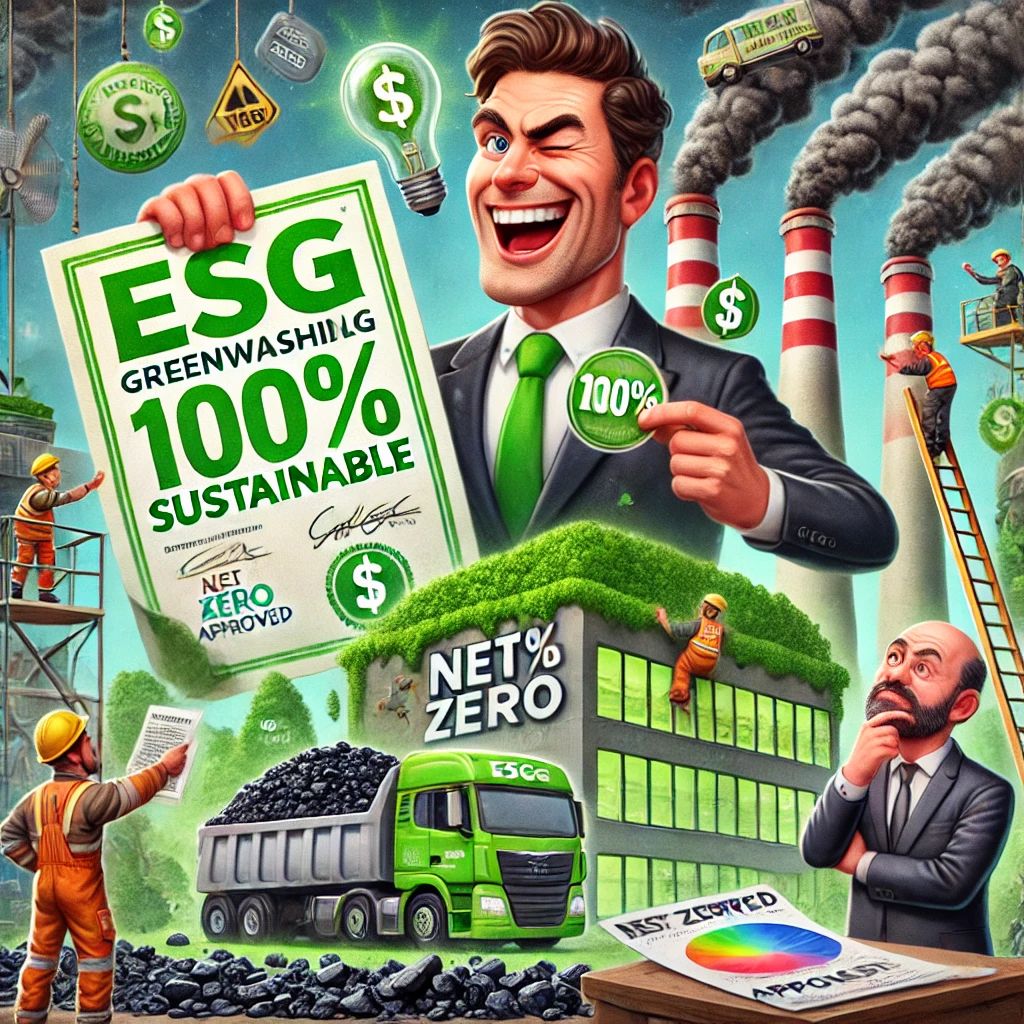
🚨 “The_ESG_Greenwashing Epidemic: Data Exposes the Cracks!” 🌍💰📉
With $40T+ in ESG investments, companies are racing to appear sustainable. But loopholes, weak regulations, and misleading_claims have made ESG a greenwashing goldmine.
📊 Where ESG Frameworks Are Failing
🚨 600+ ESG rating systems cause contradictory scores for the same company. (Bloomberg, 2025)
🚨 Only 30% of ESG funds align with their sustainability claims. (Morningstar, 2025)
🚨 90% of emissions come from supply chains, yet only 14% of companies report Scope 3 emissions. (WEF, 2025)
🚨 Regulatory gaps:
✔️ EU 🇪🇺 (CSRD) – Strict rules, but SMEs struggle.
✔️ USA 🇺🇸 (SEC) – No mandatory Scope 3 reporting.
✔️ China 🇨🇳 – Green finance push, weak transparency.
✔️ India 🇮🇳 (BRSR) – Mandatory for top 1000 firms, but weak enforcement.
📌 RealityCheck: ESG is riddled with self-reported, unchecked claims.
💰 Who’s Leading ESG Greenwashing?
🔻 BlackRock – Lost $4B in ESG funds over greenwashing concerns. (FT, 2025)
🔻 Tesla – Dropped from S&P ESG Index for labor & governance issues. (Reuters, 2025)
🔻 ExxonMobil & Chevron – Invest in carbon offsets but emissions keep rising. (IEA, 2025)
🔻 Fast Fashion (Shein, H&M, Zara) – Only 1% of clothes get recycled, despite sustainability claims. (UNEP, 2025)
📌 RealityCheck: Even ESG ‘leaders’ are failing real sustainability tests.
📉 The ESG Reset: What’s Next?
✅ EU & SEC tightening rules to curb greenwashing.
✅ AI & blockchain-based audits to verify ESG claims.
✅ Investor shift from ESG buzzwords to science-backed decarbonization.
📌 RealityCheck: ESG must move from PR to measurable impact—or risk collapse.
🏆 KeyTakeaway
ESG could be a force for corporate accountability, should be data-driven, but would be a marketing gimmick if greenwashing persists.
👉 Will ESG drive real sustainability or remain a branding exercise? Drop your thoughts below! 👇
Originally published on LinkedIn on 2025-02-16 03:15:11: https://www.linkedin.com/feed/update/urn%3Ali%3AgroupPost%3A100646-7296728792973078528
Family Ties and Corporate Transparency: A $1.3B Governance Challenge
The Issue
A 2009 Deed of Family Settlement (DFS) has sparked a governance conflict within the #$1.3 billion Kirloskar Group. SEBI directed Kirloskar Oil Engines Ltd (KOEL) to disclose the DFS, citing its relevance to shareholders. KOEL resists, claiming it as private, while Kirloskar Brothers Ltd (KBL) supports transparency. The matter is now with the Securities Appellate Tribunal (SAT).
Key Observations
💼 Group Valuation: The Kirloskar Group commands a market capitalization of #$1.3 billion, spanning multiple public entities.
📊 Shareholder Base: Over 2.5 million shareholders are directly impacted across its companies.
⚖️ DFS Dispute Timeline:
2009: DFS created as a private family settlement.
2023: SEBI issues directive for disclosure.
2025: Dispute escalates to SAT.
🚨 Market Reaction: Legacy businesses embroiled in disputes often experience a drop of up to 10-15% in stock performance during prolonged legal battles (source: historical case analysis).
📉 Investor Confidence: Public disputes can lead to:
Reduced institutional investments by 20% over three quarters.
Erosion of market valuation by #$50-$100 million if unresolved.
📘 Governance Trends:
82% of shareholders prioritize transparency over privacy in family-led businesses (survey data from corporate governance reports).
🛡️ Reputational Risk: Such disputes risk not only financial loss but also long-term trust erosion among investors and stakeholders.
The Takeaway
The Kirloskar case highlights the balancing act between legacy-driven confidentiality and the modern demand for corporate transparency. Statistics reveal that adapting governance practices is essential to preserving market confidence and shareholder trust.
In a #$1.3 billion legacy, governance is not just an obligation—it’s the cornerstone of trust.
Originally published on LinkedIn on 2025-01-17 18:03:49: https://www.linkedin.com/feed/update/urn%3Ali%3AgroupPost%3A60128-7286080789396512768
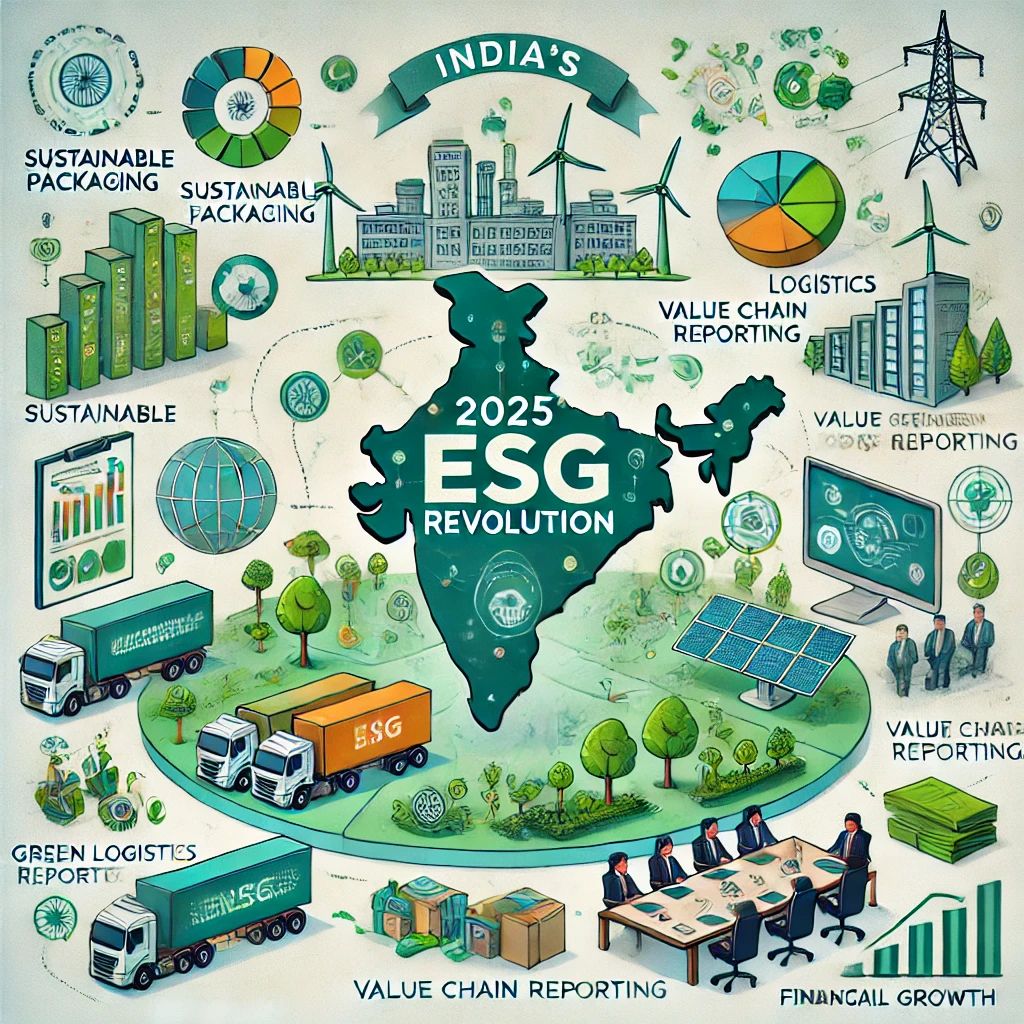
🌟 NamasteGreenIndia YR2025: India’s ESG Era Expands – Incorporating Packaging, Logistics, and More 🚀
The year YR2025 marks a transformative step in India’s corporate sustainability, with Environmental, Social, and Governance (ESG) regulations now including packaging, logistics, and operational efficiency. These changes align with global sustainability goals and drive innovation across industries.
📌 What’s New in 2025?
🌐 Value Chain Reporting:
Top 250 companies must disclose ESG metrics under SEBI’s “comply or explain” framework.
By 2026, expands to 500 companies, with mandatory assurance.
📜 BRSR Core Metrics:
Focus on 9 ESG KPIs like carbon emissions, water usage, and workforce diversity.
80% of top 500 companies are aligning operations with these standards.
📦 Sustainable Packaging:
New regulations target 50% reduction in single-use plastics by 2030.
Companies aim for 100% reusable packaging, with $3 billion invested in R&D.
🚚 Green Logistics:
Incentives for electric and hydrogen-powered fleets aim to cut emissions by 30% by 2030.
✅ Independent Verification:
ESG disclosures, including packaging and logistics, must undergo third-party assurance.
By 2025, 65% of listed entities will have verified ESG data.
📊 ESG Growth Impact
📦 Packaging Overhaul:
40% of FMCG and e-commerce companies have adopted eco-friendly packaging solutions.
🚛 Logistics Transformation:
Emissions reduced by 20% (2023–2025); green logistics market to hit $12 billion by 2030.
📈 Corporate Participation:
ESG disclosures grew 40%, with 70% of Nifty 50 companies including logistics and packaging metrics.
🌟 Why YR2025 is a Game_Changer
1️⃣ Global Leadership:
India leads in integrating packaging and logistics into ESG frameworks, aligning with global practices.
2️⃣ Investor Appeal:
Companies adopting eco-friendly practices attract funds managing $50 trillion+ in ESG assets.
3️⃣ Business Resilience:
Over 60% of companies report improved efficiency and reduced costs through ESG initiatives.
4️⃣ 🚨 Non_Compliance Risks:
Fines, loss of market share, and reputational damage await companies ignoring these standards.
📌 The Road Ahead
India’s 2025 ESG initiatives integrate packaging, logistics, and operational efficiency into corporate goals. These steps set Indian businesses on a path to lead the global sustainability revolution.
💬 How is your organization adapting to this challenge? Let’s discuss below! 👇

Originally published on LinkedIn on 2025-01-11 10:02:10: https://www.linkedin.com/feed/update/urn%3Ali%3AgroupPost%3A3880479-7283785251959529472

