Why ESG Isn’t a Global Roadmap—It’s a Country_by_Country_Compass
ESG Isn’t One-Size-Fits-All—It’s One-Strategy-Fits-Nation
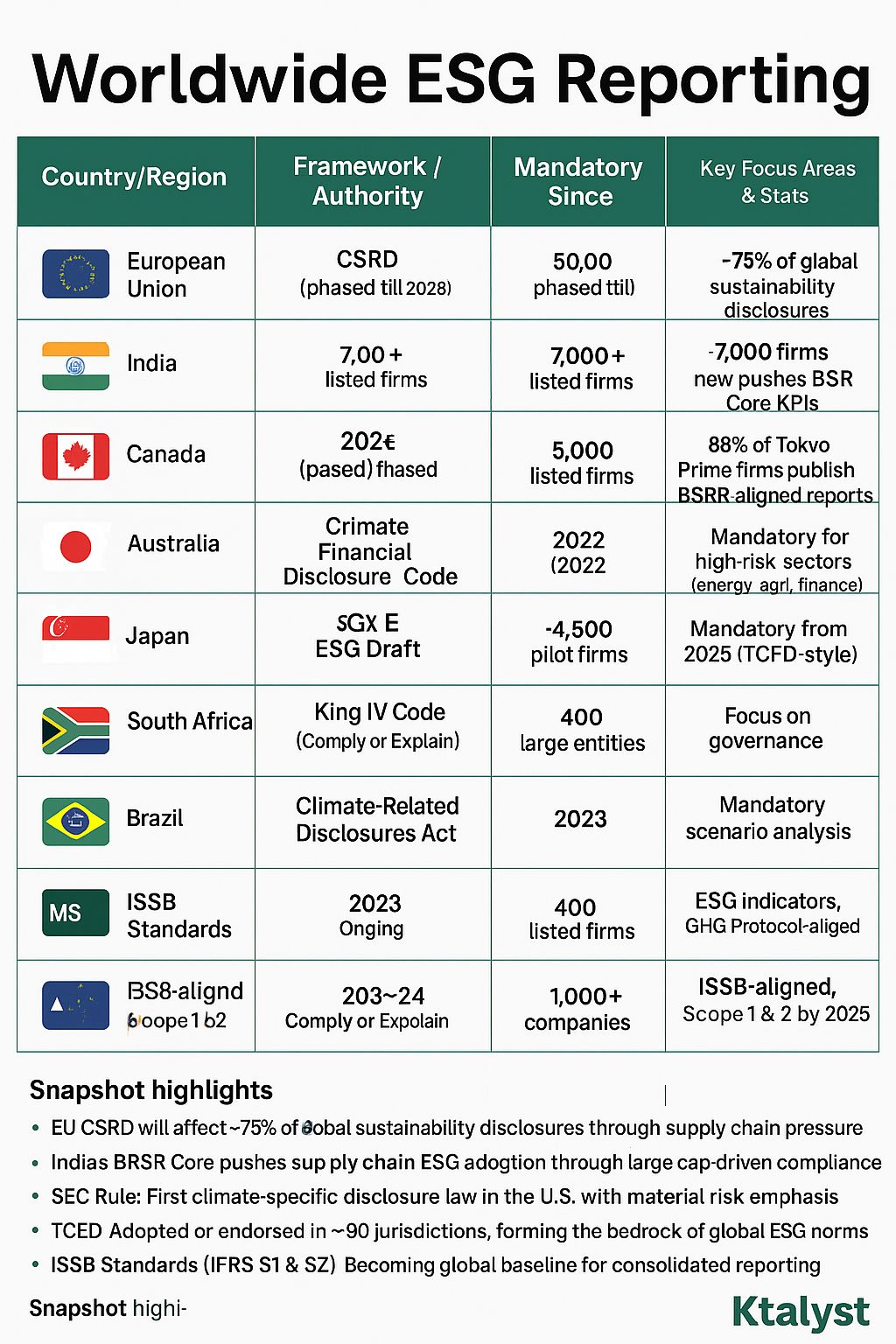
ESG reporting takes different roads because nations prioritize differently—economic maturity, regulatory style, investor pressure, and trade exposure all shape the path. The EU leads with CSRD—affecting 50,000+ firms through double materiality, taxonomy alignment, and mandatory assurance. The US sticks to financial materiality and climate risk, sidestepping Scope 3 and S&G. India’s BRSR ties ESG to development goals, starting with the top 1,000 and easing into assurance. Export-driven China, Malaysia, and Singapore accelerate ESG to meet global buyer expectations and bypass EU CBAM fallout. Japan prefers voluntary codes; South Africa excels in governance (King IV), but lacks integrated data.
Bottom line? ESG mirrors what each country values—growth, governance, global edge, or green capital. It’s not just compliance—it’s strategy, sovereignty, and survival.
🇪🇺 European Union
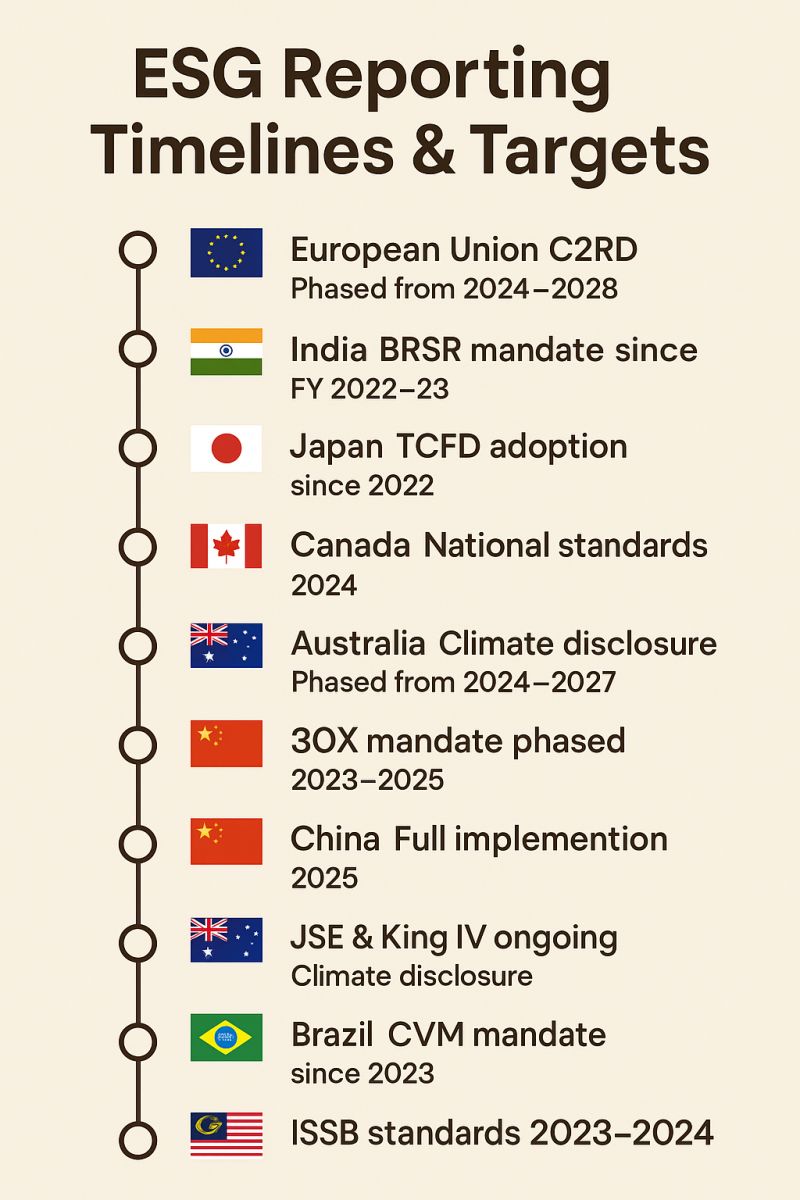
Timeline: CSRD phased from 2024 to 2028
Mandatory from:
2024: Large public-interest companies
2025: All large companies
2026–28: SMEs (limited scope)
FunFact: Will impact 75%+ of global ESG reporting indirectly via supply chains
🇺🇸 United States
Timeline: SEC Rule effective 2024–2025
Mandatory from:
FY2024: Large Accelerated Filers
FY2025: Accelerated Filers
Scope 3? Only if material (and still debated)
🇮🇳 India
Timeline:
BRSR mandatory since FY 2022–23
BRSR Core with limited assurance from FY 2023–24
Next up: Potential rollout for mid-size unlisted companies by 2026
🇯🇵 Japan
Timeline:
TCFD adoption by Prime listed firms since 2022
No fixed law, but >80% of large firms are already onboard voluntarily
🇨🇦 Canada
Timeline:
CSA rule aligned with TCFD from 2024
Mandated for:
Publicly listed entities, expanding coverage gradually
🇦🇺 Australia
Timeline:
Climate Disclosure Framework phased from July 2024
Rollout:
2024: Large companies
2026–27: Mid and small entities
🇸🇬 Singapore
Timeline:
SGX ESG reporting mandatory since 2023
Sector phased:
Energy, Agri, Finance by 2024
All others by 2025
🇨🇳 China
Timeline:
Draft ESG rules under CSRC in 2024
Target:
Full mandatory rollout by 2025
Pilots ongoing in green finance and energy sectors
🇿🇦 SouthAfrica
Timeline:
JSE & King IV apply ongoing since 2016
Mandate:
Comply or explain” model, no fixed year — but tightening expected by 2025
🇳🇿 NewZealand
Timeline:
Climate-Related Disclosure Act enforced from 2023
Applies to:
Financial institutions & large corporates (>NZ$1B AUM or turnover)
🇧🇷 Brazil
Timeline:
CVM ESG disclosure mandatory since 2023
Focus:
Annual reporting, with increasing pressure for Scope 3 inclusion by 2026
🇲🇾 Malaysia
Timeline:
ISSB-aligned standards adopted in 2023–2024
Mandated by:
Bursa Malaysia, full Scope 1–2 by 2025, Scope 3 optional till 2026


Originally published on LinkedIn on 2025-04-21 21:59:46: https://www.linkedin.com/feed/update/urn%3Ali%3AugcPost%3A7320204627323289601
🌟 India’s Chemical Industry: The Catalyst for Global Leadership (2025–2030) 🌟
The #$4 trillion global chemical industry is evolving rapidly, with trends like green chemistry, digital transformation, and supply chain diversification shaping its future. By 2030, the market is set to grow to #$5.5 trillion, and India has a golden opportunity to lead the charge. 🚀
Why India’s Chemical Industry is a Game-Changer
✅ Economic Engine: Contributes 7% to GDP; projected to hit 9% by 2030.
✅ Export Potential: Current exports at #$30 billion, with a target of #$60 billion.
✅ Job Creation: Can generate 2 million new jobs in specialty and green chemicals.
✅ Sustainability Leadership: Opportunity to capture 10%-15% of the #$150 billion green chemical market.
Global Trends: Challenges & Opportunities
🌍 China’s Dominance:
Controls 35% of the global chemical market.
Investing #$300 billion in green hydrogen and renewable feedstocks.
Pivoting to high-value specialty chemicals.
💡 Opportunity for India:
Reduce 33% import dependency (primarily on China).
Leverage PLI schemes for specialty and bio-based chemicals.
Build world-class chemical hubs and integrated logistics infrastructure.
📊 Global Sustainability Push:
Bio-based materials growing at a CAGR of 12%.
Over 50% of global chemical firms adopting digital supply chains by 2030.
India’s Roadmap for 2030
🔹 Market Expansion: Grow the domestic market to #$400 billion at an 8% CAGR.
🔹 R&D Investments: Increase spending to 1% of industry revenue (vs. current 0.3%-0.5%).
🔹 Skill Development: Train 500,000 professionals in green and digital technologies.
🔹 Sustainability Incentives: Develop bio-refineries and scale carbon-neutral production
The Numbers That Matter
💬 The Takeaway: India’s chemical industry is more than just a sector—it’s the foundation for sustainable growth, global competitiveness, and economic resilience. With the right policies, investments, and innovation, India can lead the global stage by 2030. 🌱
Let’s build a greener, stronger, and more self-reliant future. 💼💡
ChemicalIndustry IndiaGrowth Sustainability MakeInIndia 2030Vision
Source / shared link: https://m.economictimes.com/industry/indl-goods/svs/chem-/-fertilisers/budget-2025-chemical-industry-seeks-tweaking-in-customs-duties-to-boost-manufacturing/articleshow/117429274.cms
Originally published on LinkedIn on 2025-01-22 11:41:38: https://www.linkedin.com/feed/update/urn%3Ali%3AgroupPost%3A3880479-7287796548950745088

