🚨 India’s Emission Intensity Targets: A Game_Changer for Industries & Carbon#Markets?
India is set to release EmissionIntensityTargets for nine industrial sectors by the end of February 2025—marking a major milestone in its NetZero commitment. With industries given one year to comply, CarbonCreditTrading is expected to follow, reshaping how businesses approach Decarbonization and Sustainability.
📊 What’s Changing?
🔹 Industries Impacted: Steel, Cement, Petrochemicals, Fertilizers, Textiles, Pulp & Paper, Power, and more.
🔹 Compliance Window: Companies get one year to implement emission-cutting measures.
🔹 Carbon Markets Activation: After compliance, CapAndTrade kicks in—firms exceeding targets can sell credits, while high emitters must buy them.
🔹 India’s Net Zero Push: Aims to cut GHG emissions intensity by 45% by 2030 (vs. 2005 levels). (MoEFCC, 2025)
💡 What’s the Opportunity?
✔️ Green Investment Boom: Expect a surge in Renewables, CCUS (Carbon Capture), and EnergyEfficiency projects.
✔️ Competitive Advantage: Early adopters of clean tech & low-carbon solutions will benefit from carbon credits.
✔️ Global Alignment: Brings India closer to EU CBAM, US IRA, & China’s ETS—making exports competitive.
⚠️ The Challenges Ahead
🚨 Cost of Compliance: Industries must invest in LowCarbonTech, Electrification, and AlternativeFuels.
🚨 Regulatory Uncertainty: Clarity on CarbonPricing, OffsetRules, and international trading needed.
🚨 SMEs at Risk: Large firms may comply, but MSMEs could struggle due to financial constraints.
🏆 KeyTakeaway: Green Mandates & Market Forces Converging
📌 India could be a global leader in carbon markets & industrial sustainability.
📌 India should be providing clear policy incentives & transition funds.
📌 India would be missing out if compliance turns into just another Greenwashing exercise.
👉 Will India’s emission trading system be a breakthrough or just another regulatory hurdle? Let’s discuss! 👇
Originally published on LinkedIn on 2025-02-25 17:55:58: https://www.linkedin.com/feed/update/urn%3Ali%3Ashare%3A7300211941875052544
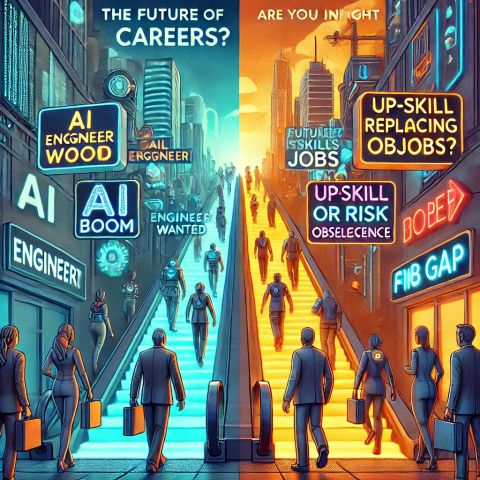
🚀 The Future of Careers: Are You Ready? 💼📊
As AI, automation, and digitalization reshape jobs, the key to survival is choosing the right industry and upskilling. But with employment rates fluctuating, is the job market truly evolving?
📉 Job Market Shifts (Last 5 Years)
🚨 Global employment rate at 56.3% in 2024, still below pre-pandemic levels. (Statista, 2024)
🚨 64.9M young people unemployed worldwide. (ILO, 2024)
🚨 Retail jobs shrinking by 364,800 in the U.S. by 2033 as e-commerce rises. (Statista, 2024)
🚨 Manufacturing jobs rebounding in tech-driven regions, but traditional hubs still struggle. (EIG, 2024)
📌 Reality Check: The real crisis isn’t job loss—it’s the growing skill gap.
📊 Fastest-Growing Career Paths
✅ Tech & AI 💻 – AI engineers, cybersecurity, data scientists. (38% growth by 2030, WEF 2024)
✅ Healthcare & Biotech 🏥 – Telemedicine, bioinformatics. (14% job growth in a decade, BLS 2024)
✅ Sustainability & Green Economy 🌍 – ESG auditors, renewable energy. (Green jobs to outpace fossil fuels 4:1, IEA 2024)
✅ Finance & Fintech 💰 – Blockchain, digital banking. (18% YoY hiring increase, PwC 2024)
✅ Manufacturing & Supply Chain 🏭 – Robotics, AI logistics. (80% of manufacturers lack skilled workers, Deloitte 2024)
🚨 Reality Check: Automation isn’t killing jobs—it’s transforming them.
📉 Careers at Risk
❌ Fossil Fuels – Declining as renewables grow.
❌ Print Media – AI replacing journalism.
❌ Basic Customer Service – AI chatbots taking over.
❌ Traditional Automotive – EVs need fewer parts, reducing jobs.
🚨 Reality Check: Industries aren’t dying—skills are evolving.
🧠 The Skills You Need Now
📌 AI & Data Proficiency – Even non-tech jobs need AI literacy.
📌 Cybersecurity & Digital Skills – The digital economy depends on security.
📌 Sustainability & ESG Knowledge – Businesses need climate-conscious leaders.
📌 Creativity & Adaptability – AI can’t replace problem-solving.
🚨 Reality Check: Lifelong learning isn’t optional—it’s survival.
🏆 KeyTakeaway
Your career could be future-proof with the right skills, should be aligned with growth industries, but would be at risk without adaptation.
👉 Are you ready for the future of work?
FutureOfWork CareerGrowth Upskilling AI GreenJobs Automation

Originally published on LinkedIn on 2025-02-04 13:44:47: https://www.linkedin.com/feed/update/urn%3Ali%3AgroupPost%3A9270968-7292538584681635841
The Decarbonization Dilemma: How CBAM Gaps Are Stalling Industry’s Green Revolution
As industries strive for sustainability, regulatory uncertainty, particularly around the EU’s Carbon Border Adjustment Mechanism (CBAM), is hindering green investments, decarbonization, and global competitiveness.
1. ArcelorMittal’s €1.7 Billion Investment Delay
ArcelorMittal has paused its €1.7 billion plan to replace Dunkirk’s blast furnaces with hydrogen-powered facilities. CBAM uncertainties, slow green hydrogen development, and limited customer demand for low-carbon steel are the primary reasons.
2. Thyssenkrupp’s €3 Billion Reassessment
Germany’s Thyssenkrupp is reconsidering its €3 billion green steel initiative due to unclear CBAM policies and the challenge of balancing emissions reductions with competitiveness.
3. UK Cement Industry’s Struggles
The UK cement sector, battling cheap, high-carbon imports that make up 40% of the market, lacks CBAM-equivalent protections. This discourages investments in decarbonization and carbon capture technologies.
4. The Global Green Subsidy Race
Conflicting subsidy strategies in the EU, US, and China create uncertainty, stalling global green investments. Misaligned policies heighten reliance on Chinese renewable technologies, threatening decarbonization efforts.
5. Asian Industry’s CBAM Challenges
Compliance Costs: Carbon accounting and verification impose high costs, especially on SMEs.
ExportCompetitiveness: Energy-intensive sectors like India’s steel industry (27% EU export share) face reduced demand due to CBAM fees.
SupplyChains: Adjusting to lower-carbon suppliers increases costs.
TradeTensions: Nations like India criticize CBAM as a trade barrier hindering net-zero transitions.
CarbonPricing Pressure: CBAM pushes Asian countries toward domestic carbon taxes, requiring significant adjustments.
6. Shared Challenges Across Industries
Policy Uncertainty: Industries are delaying investments while awaiting clarity on CBAM’s impact.
Competitive Disparities: EU companies compete against lower-cost imports with fewer regulations.
Market Gaps: Limited green energy infrastructure and low consumer demand slow decarbonization efforts.
The Way Forward
A globally aligned and robust CBAM is vital for restoring corporate confidence and fostering sustainable investments. Governments must collaborate to balance trade fairness with climate goals, ensuring that the green revolution accelerates instead of faltering.
Originally published on LinkedIn on 2024-12-09 17:47:41: https://www.linkedin.com/feed/update/urn%3Ali%3AgroupPost%3A131340-7271943602677633025
NamasteBudgetIndia Govt to release energy transition policy document: Solar stocks jump up to 11% led by Borosil Renewables
1. Energy Transition Pathways: Finance Minister Nirmala Sitharaman emphasized the need for a policy document that balances employment, growth, and environmental sustainability. This document will guide India’s transition to cleaner energy sources.
2. Hard-to-Abate Industries: The government aims to move these industries from energy efficiency targets to emission targets. Regulations will facilitate this transition, ensuring a more sustainable approach.
3. PM Surya Ghar Muft Bijli Yojana: A visionary scheme, aiming to equip 1 crore households with rooftop solar installations, offering up to 300 units of free electricity each month.
4. Pumped Storage Policy (PSP): To enhance renewable energy integration, the government plans to introduce a robust PSP. This will facilitate the storage of excess electricity, contributing to a smoother energy mix.
5. Advanced Ultra Super Critical (AUSC) Technology: Public sector giants NTPC Ltd and BHEL will collaborate on an 800 MW commercial power plant based on AUSC technology, with government support³.
India’s commitment to sustainability and efficiency is commendable, and these initiatives will shape the country’s energy landscape.
Download Economic Times App to stay updated with Business News – https://lnkd.in/gvCUBh-r
Originally published on LinkedIn on 2024-07-23 15:54:19: https://www.linkedin.com/feed/update/urn%3Ali%3Ashare%3A7221543160794034176

