PessimistPicasso One Cannot Need Everything Together
Dr. Anju Sharma KtalystKlues™
Today’s market canvas looks like a Pessimist Picasso.
Every system wants five things at once:
✓AI wants more compute.
✓Energy systems want cleaner power.
✓Markets want lower risk.
✓Governments want security.
✓Climate wants adaptation now.
But systems do not scale because everyone wants everything together.
They scale when ambition is sequenced.
The data spine is already visible.
China wants renewables to supply 80% of AI data-centre power by 2030, from only 11% in 2023.
At the same time, China’s datacentre power demand could rise by 300–500 billion kWh between 2026 and 2030, adding around 18% of total electricity-demand growth.
The IEA’s wider AI-energy lens shows the same pressure?
US & China are expected to account for nearly 80% of global data-centre electricity-consumption growth to 2030, with US demand rising by about 240TWh & China by about 175TWh versus 2024 levels.
Meanwhile, markets are doing their own abstract painting:
✓Oil fell more than 1%, with Brent near $76.81/bbl, as investors balanced Hormuz-flow relief, peace-talk optimism and supply uncertainty.
✓Asian markets also slipped, with MSCI Asia-Pacific down 2.9%, Nikkei down 3%, and Kospi down 8.1%, as investors repriced rates, risk and growth at the same time.
Climate is no longer waiting backstage.
Europe’s heatwave is pushing the UK toward possible June records, with forecasts near 39°C, above the old June benchmark of 35.6°C.
So the message is simple:
One cannot need everything together.
Growth without grid discipline becomes fragility.
AI without energy planning becomes load risk.
Climate ambition without infrastructure becomes theatre.
Markets without sequencing become anxiety with a ticker symbol.
The leadership question:
What do we want?
What must come first, so the system does not collapse under the weight of everything?
China’s push for green power use in AI projects faces hurdles, experts say – https://lnkd.in/ejJ7f7HN
Source / shared link: https://www.reuters.com/business/energy/chinas-push-green-power-use-ai-projects-faces-hurdles-experts-say-2026-06-22/?utm_source=chatgpt.com
Originally published on LinkedIn on 2026-06-23 07:22:29: https://www.linkedin.com/feed/update/urn%3Ali%3Ashare%3A7475085859856449536
AI_ProfitPool LeavingScreens
Dr. Anju Sharma MrsSustainability
AI started as a software story, now it’s morphing to an hardware high cycle.
Wave1 was public fascination: models, copilots, agents, apps & chatbots.
Wave2 is less glamorous, more capital-intensive & far more strategic.
It sits behind the screen:
Data centres. Chips. Power systems. Cooling loops. Grid access. Specialty chemicals. Water systems. Transformers. Storage. Carbon accounting.
Ktalyst5Cs™ Lens translates a signal map for tracking where capital, capability, constraint & profit are moving in the AI economy:
Compute → Capex → Chemicals → Climate → Clean Growth
The data spine is already visible.
The IEA projects global data-centre electricity consumption could double to around 945 TWh by 2030, growing nearly 15% annually.
Reuters has reported Big Tech AI spending moving toward the US$600 billion range, shifting investor focus from AI excitement to capex productivity, cash-flow discipline & return visibility.
BloombergNEF estimates data-centre investment could reach US$3.3 trillion through 2029, with global data-centre demand already exceeding 84 GW.
Who captures the industrial profit pool that makes the model scalable?
Compute becomes the first scarcity gate.
GPU makers, advanced memory players, foundries, hyperscalers & AI accelerator suppliers sit closest to the first monetisation layer.
Data centres become the new industrial real estate.
Colocation players, REITs, EPC firms, modular infrastructure builders & hyperscalers gain as digital growth turns into land, shells, racks, cables, cooling & grid connections.
Power becomes the strategic moat.
Utilities, transformer makers, grid-equipment suppliers, storage providers, microgrid developers & backup-power companies move from support layer to core value chain.
Cooling becomes uptime insurance.
Immersion cooling, HVAC, chiller systems, heat-transfer fluids, water-treatment chemistry & recycling technologies become essential as AI servers generate concentrated heat.
Chemicals become the hidden material spine.
This may be the most underpriced profit pool.
AI infrastructure needs semiconductor chemicals, photoresists, etchants, CMP slurries, specialty gases, dielectric cooling fluids, flame-retardant polymers, cable insulation, transformer oils, coatings, adhesives, encapsulants & water-treatment chemistry.
The next petrochemical growth story may not be parked in a showroom.
It may be humming inside a data centre.
Clean energy becomes capacity credibility.
Renewables, storage, clean firm power, heat recovery, microgrids & energy-management systems gain as AI infrastructure faces pressure to prove reliability & climate legitimacy.
KtalystKlues™:
✓Compute captures demand.
✓Capex builds capacity.
✓Chemicals enable reliability.
✓Climate defines permission.
✓Clean Growth protects legitimacy.
Ktalyst5Cs™ KtalystKlues™ KtalystInsights™ KtalystKeystone ChemicalIndustry Petrochemicals
Originally published on LinkedIn on 2026-06-08 11:21:20: https://www.linkedin.com/feed/update/urn%3Ali%3AgroupPost%3A1910576-7469710148266106880
TheSolarParadox: Is Your Roof Unemployed?
Dr. Anju Sharma•MrsSustainability
NamasteIndia, a 124.53 GW clue is hiding in plain sight.
As of 31 March 2026, India’s cumulative solar capacity reached 150.26 GW. Yet only 25.73 GW came from grid-connected rooftop solar, while 114.87 GW came from ground-mounted systems.
The IEA says distributed solar PV will drive 42% of total PV expansion during 2025–2030. Rooftop solar is no longer a side character. It is moving into a lead role.
1. The strategygap is not sunlight. It is placement.
✓ scout hectares
✓ chase approvals
✓ build long transmission links
Meanwhile, roofs, warehouses, factories, malls, schools, hospitals, and parking lots sit in full sunlight like idle capital with no KPI pressure.
x more land conflict
x more transmission burden
x more friction
Fields should grow food. Roofs should grow power.
2. The CFO math gets the roof promoted.
Take a 100 kW rooftop system:
✓ generation: ~4.2 lakh kWh/year
✓ tariff: ₹8 per unit
✓ avoided power cost: ₹33.6 lakh/year (~USD 40,000)
4,20,000 × ₹8 = ₹33,60,000
Suddenly, the roof is no longer overhead.
It is on payroll.
3. Carbon gives the roof a second job.
Using the CEA grid emission factor of 0.716 tCO2/MWh, a 100 kW rooftop system avoiding 420 MWh/year can avoid about 300.7 tCO2 annually.
✓ 420 × 0.716 = 300.7 tCO2/year
So the roof now does two jobs:
✓ cuts the electricity bill
✓ cuts the carbon load
That is better output than half the meetings on most calendars.
4. Policy opened the door. Business must walk in.
The MNRE Grid Connected Rooftop Solar Programme targeted 40,000 MW of cumulative rooftop capacity, with Phase II running till 31 March 2026.
Against that, India’s 25.73 GW rooftop base says one thing clearly:
✓ sunlight exists
✓ surfaces exist
✓ economics increasingly exist
x urgency to use dead concrete intelligently
Execution is the missing panel.
5. Parking lots deserve a promotion too.
A parking lot without a solar canopy is:
x a heat trap
x a tyre toaster
x a wasted surface
Add a canopy and it becomes:
✓ shade
✓ on-site power
✓ EV charging support
✓ lower heat load
✓ better land-use efficiency
Now that is a career upgrade.
KtalystShuttleStrategy
Maximize grey or dormant assets.
Turn idle surfaces into lower power cost, lower carbon load, stronger ESG, and possible carbon-credit upside.
When dead concrete starts delivering live returns, strategy has finally woken up.
Final KtalystKlue™
A bare roof in 2026 is not neutral.
It is a failure of spatial intelligence.
Stop looking at the horizon.
Look up.
Your roof is not waiting for sunlight.
It is waiting for a promotion.
StepUpRoofs
Your roof can pay your electricity bill, cut your carbon load, and finally make concrete earn its keep.
MrsSustainability KtalystInsights™ KtalystKlues™ KtalystKeystone KtalystShuttleStrategy EnergyStrategy FiscalDiscipline Ktalyst5Ts Ktalyst5Ps5Es DataComa KtalystGreenLove
Originally published on LinkedIn on 2026-04-10 05:01:27: https://www.linkedin.com/feed/update/urn%3Ali%3Ashare%3A7448233663873474560
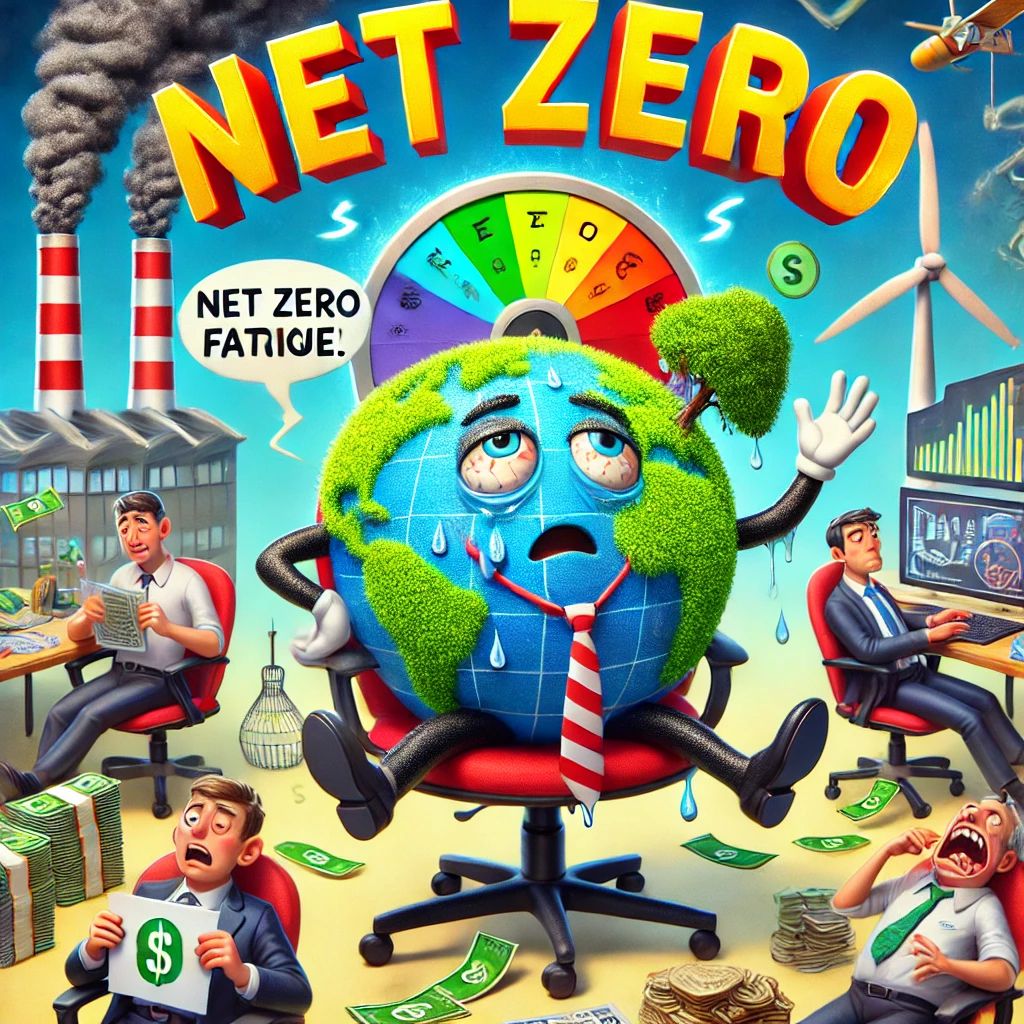
NetZeroFatigue: When GoingGreen Feels Like RunningOnEmpty 🌍
#🟢 Ambiguity Fatigue: “Lost in a maze of green fog!
72% of companies lack clear definitions for Net Zero goals. (Source: CDP, 2023)
Only 39% have science-based targets for Net Zero. (Source: SBTi, 2023)
Impact: Stakeholders are left confused, eroding trust and delaying action.
#🟠 Greenwashing Fatigue: “All talk, no trees!
63% of consumers distrust corporate Net Zero claims. (Source: Edelman Trust Barometer, 2024)
Greenwashing accusations grew 55% in 2023, with $40M+ in fines. (Source: UNEP, 2023)
Impact: Public skepticism grows, putting genuine efforts under scrutiny.
#🔵 Financial Fatigue: “Going green costs more green!
Achieving Net Zero needs #$4 trillion/year in clean energy investment by 2030. (Source: IEA, 2022)
Developing nations face a #$1.3 trillion/year funding gap. (Source: WorldBank, 2023)
Impact: Resource inequity slows global progress.
#🟡 Offset Dependence Fatigue: “Band-aids don’t fix bullet holes!
92% of carbon offset projects fail to deliver promised benefits. (Source: Guardian, 2023)
The global offset market hit #$2 billion in 2023, despite ineffectiveness. (Source: ICAP, 2023)
Impact: Over-reliance on offsets delays meaningful emission cuts.
#🟣 Technological Fatigue: “Waiting for tech miracles that don’t compute!
Carbon capture removes only 0.1% of global emissions today. (Source: IPCC, 2023)
By 2030, tech solutions may account for just 10-20% of required reductions. (Source: IEA, 2023)
Impact: Over-reliance on unproven tech wastes precious time.
#🔴 Public Engagement Fatigue: “Climate posters don’t pay the bills!
51% of citizens feel disconnected from national climate strategies. (Source: Pew Research, 2023)
Only 29% trust their government’s Net Zero plans. (Source: WEF, 2024)
Impact: Reduced public pressure stalls policy implementation.
#🟤 Equity Fatigue: “When the rich pollute, the poor pay!
The richest 10% emit over 50% of global emissions, while the poorest 50% contribute just 12%. (Source: Oxfam, 2022)
Developed nations pledged $100B/year in climate finance but delivered only #$83B in 2022. (Source: UNFCCC, 2023)
Impact: Inequity breeds global mistrust, slowing cooperation.
KeyTakeaway 🌍
NetZeroFatigue is real, driven by ambiguity, inequity, and overpromises. To truly go green, we need clearGoals, verifiedAction, and a whole lot of trust.
👉 Let’s make Sustainability about less spin and more action!
NetZero ClimateLeadership SustainabilityHumor ESG

Originally published on LinkedIn on 2025-01-24 14:13:50: https://www.linkedin.com/feed/update/urn%3Ali%3Ashare%3A7288559629452677121
NamasteIndia WattTransition will happen in 2030?
India’s clean energy transition faces several challenges as it strives to reduce carbon emissions and embrace sustainable practices. Let’s explore these challenges:
1. Affordable Financing
Access to affordable financing remains a hurdle. Scaling up clean energy projects requires substantial investments, and ensuring accessible funding mechanisms is crucial.
2. Institutional Deployment of Financing
India lacks institutions that can effectively deploy financing in new low-carbon growth areas.
Establishing robust financial institutions to support clean energy initiatives is essential.
3. Technology Risks
Transitioning to clean energy involves adopting new technologies. These come with inherent risks, including uncertainties related to performance, reliability, and scalability.
4. Energy Affordability
The recent surge in commodity prices has made energy less affordable for many.
Balancing affordability while transitioning to cleaner sources is a delicate challenge.
5. Energy Security Risks
As the world’s third-largest energy importer, India faces energy security risks due to tight markets and geopolitical factors.
Diversifying energy sources and enhancing domestic production are critical.
6. Investment Gap
To achieve net zero emissions by 2070, India needs substantial investments.
The International Energy Agency IEA estimates that an average annual spending of $160 billion across India’s energy economy is necessary between now and 2030.
Despite these challenges, India has immense potential to lead the way in clean energy. By creating jobs, enhancing energy security, and reducing greenhouse gas emissions, India can set an example for the world. Its abundant resources—such as sunlight, wind, and vacant lands—position it to become a global leader in renewable energy production. NamasteIndia
Originally published on LinkedIn on 2024-05-24 19:18:46: https://www.linkedin.com/feed/update/urn%3Ali%3AugcPost%3A7199851342083874817

