Chameleon_H₂:Grey2Pink,MarginShoes
Dr. Anju Sharma MrsSustainability
Hydrogen is the chameleon of the energy transition.
✓molecule stays the same.
✓colour changes the business case.
For years, H₂ was sold as the “fuel of everything.
Cars. Homes. Steel. Ships. Aviation. Chemicals. Power.
One tiny molecule carrying the weight of every net-zero PowerPoint.
Very ambitious.
Very elegant.
Very expensive.
H₂ is not one market. It is many coloured balance sheets.
✓Grey H₂ = cheap molecule + high carbon bill
✓Blue H₂ = fossil molecule + carbon capture promise
✓Green H₂ = renewable molecule + cost pressure
✓Pink H₂ = nuclear molecule + baseload discipline
✓Turquoise H₂ = methane-split molecule + solid carbon logic
Ammonia / methanol / e-fuels = H₂ dressed for travel
Which colour of hydrogen can survive the spreadsheet, as the capital moves?
Announcement Economy → Engineering Economy → Offtake Economy
MoUs are no longer medals.
FID is the new credibility certificate.
The market now asks:
✓ Is there cheap clean power?
✓ Is the grid available?
✓ Is the electrolyzer actually running?
✓ Is the carbon intensity certifiable?
✓ Is the port ready?
✓ Is the buyer signed?
✓ Is the delivered cost competitive?
KtalystKlue:
H₂ Value = Colour × Cost × Carbon Intensity × Certification × Offtake
No offtake? No project.
No grid? No green.
No certification? No premium.
No logistics? No trade.
Hydrogen will not replace electrons everywhere. It will win where electrons struggle.
Steel needs heat + chemistry
Fertilizer needs ammonia
Shipping needs dense fuels
Aviation needs synthetic pathways
Refining needs H2 Long-duration storage molecules, not just batteries
So the smarter formula is:
Electrons for easy sectors + H₂ for hard sectors = credible decarbonisation
Pure H₂ is still a logistics diva.
Tiny molecule.
Big tantrum.
That is why the real trade routes may be hydrogen in costume:
H₂ + N₂ = Ammonia passport
H₂ + CO₂ = E-fuel pathway
H₂ + carbon route = Methanol trade lane
By 2030, the winners will not be the loudest hydrogen nations.
They will be the countries and companies that convert clean electrons into contracted, certified, shipped molecules.
China = hardware scale
Saudi Arabia = ammonia mega-project logic
India = refinery + fertilizer + green ammonia demand
US = subsidy-backed clusters
EU = regulation-led demand
Japan/Korea = import-backed offtake
Oman/UAE/Morocco/Namibia/Chile/Australia = export promise, if delivered cost behaves
Hydrogen is not the new oil.
It is the industrial passport for nations that can turn clean electrons into tradable molecules.
By 2030, H₂ will not replace everything.
It will dominate only where electrons struggle to reach.
That is the business model.
KtalystBottomLine:
The molecule is not the strategy.
The delivered margin is.
Originally published on LinkedIn on 2026-05-09 15:15:05: https://www.linkedin.com/feed/update/urn%3Ali%3AgroupPost%3A1850284-7458897337730506752
Chameleon_H₂:Grey2Pink,MarginShoes
Dr. Anju Sharma MrsSustainability
Hydrogen is the chameleon of the energy transition.
✓molecule stays the same.
✓colour changes the business case.
For years, H₂ was sold as the “fuel of everything.
Cars. Homes. Steel. Ships. Aviation. Chemicals. Power.
One tiny molecule carrying the weight of every net-zero PowerPoint.
Very ambitious.
Very elegant.
Very expensive.
H₂ is not one market. It is many coloured balance sheets.
✓Grey H₂ = cheap molecule + high carbon bill
✓Blue H₂ = fossil molecule + carbon capture promise
✓Green H₂ = renewable molecule + cost pressure
✓Pink H₂ = nuclear molecule + baseload discipline
✓Turquoise H₂ = methane-split molecule + solid carbon logic
Ammonia / methanol / e-fuels = H₂ dressed for travel
Which colour of hydrogen can survive the spreadsheet, as the capital moves?
Announcement Economy → Engineering Economy → Offtake Economy
MoUs are no longer medals.
FID is the new credibility certificate.
The market now asks:
✓ Is there cheap clean power?
✓ Is the grid available?
✓ Is the electrolyzer actually running?
✓ Is the carbon intensity certifiable?
✓ Is the port ready?
✓ Is the buyer signed?
✓ Is the delivered cost competitive?
KtalystKlue:
H₂ Value = Colour × Cost × Carbon Intensity × Certification × Offtake
No offtake? No project.
No grid? No green.
No certification? No premium.
No logistics? No trade.
Hydrogen will not replace electrons everywhere. It will win where electrons struggle.
Steel needs heat + chemistry
Fertilizer needs ammonia
Shipping needs dense fuels
Aviation needs synthetic pathways
Refining needs H2 Long-duration storage molecules, not just batteries
So the smarter formula is:
Electrons for easy sectors + H₂ for hard sectors = credible decarbonisation
Pure H₂ is still a LogisticsDiva.
Tiny molecule.
Big tantrum.
That is why the real trade routes may be hydrogen in costume:
H₂ + N₂ = Ammonia passport
H₂ + CO₂ = E-fuel pathway
H₂ + carbon route = Methanol trade lane
By 2030, the countries & companies that convert clean electrons into contracted, certified, shipped molecules.
China = hardware scale
Saudi Arabia = NH3 mega-project logic
NamasteIndia = refinery + fertilizer + green NH3 demand
US = subsidy-backed clusters
EU = regulation-led demand
Japan/Korea = import-backed offtake
Oman/UAE/Morocco/Namibia/Chile/Australia = export promise, if delivered cost behaves
Hydrogen is not the new oil.
It is the industrial passport for nations that can turn clean electrons into tradable molecules.
By 2030, H₂ will not replace everything.
It will dominate only where electrons struggle to reach.
That is the business model.
KtalystBottomLine:
The molecule is not the strategy.
The delivered margin is.
Originally published on LinkedIn on 2026-05-09 15:11:49: https://www.linkedin.com/feed/update/urn%3Ali%3Ashare%3A7458896518889226241
♻ Hydrogen & Scope3 — The Emissions You Can’t Ignore
Hydrogen may be the fuel of the future, but if you’re chasing net-zero targets, you can’t skip the Scope 3 math.
Bottomline: In any sourcing, your Scope 3 footprint isn’t in the molecule — it’s in the megawatts behind it.
Where Scope 3 shows up in H₂
Category3 – Upstream Energy Emissions: Lifecycle CO₂ from electricity or fuels used in electrolysis (can be 8–25 kg CO₂/kg H₂ if grid-powered).
Category1 – Purchased Goods & Services: Embedded emissions from catalysts, electrolyzers, and plant equipment.
Categories10_11 – Processing & Use: Downstream CO₂ from ammonia synthesis, methanol conversion, or fuel cell use.
📏 How to Account (GHG Protocol):
Supplier-Specific: Get actual emissions data from your H₂ producers or energy suppliers.
Hybrid/Average: Use industry or grid factors if primary data isn’t available.
✅ Best Practices for Hydrogen Buyers:
Map your value chain — from energy source to end use.
Prioritize high-impact categories — especially upstream electricity.
Use high-quality data — metered, not modelled.
Be transparent — document every assumption.
KtalystInsights | HydrogenEconomy | Scope3 | NetZero | Sustainability | MrsSustainability
Originally published on LinkedIn on 2025-08-11 06:15:43: https://www.linkedin.com/feed/update/urn%3Ali%3AgroupPost%3A82951-7360554490363600904
🔋💨 Green Hydrogen Retreats: BP, Shell, Repsol, Engie
💬 “Green hydrogen is the fuel of the future — but for now, the future is on hold?
MrsSustainability
KtalystInsights | GreenHydrogen | MrsSustainability
📉 26 GW wind + solar. 1.6 million tonnes green H₂. AU$55 billion project.
🛑 BP exits Australia’s AREH in July 2025 — refocuses on oil & gas returns.
⚠️ From $30B planned low-carbon spend, BP slashes to ~$4B by 2030.
🧭 They’re not alone. A global correction is underway.
📌 BP – Exited AREH, Australia (2025)
📌 Shell – Paused Rotterdam H₂ hub (600 MW, 2024)
📌 Repsol – €2.5B Spain projects delayed; seeking new subsidies
📌 Equinor – Norway H₂ plans deferred due to cost overruns
📌 Engie – India JV with NTPC slowed down amid offtake issues
📊 Globally, over 70% of large-scale green H₂ projects are stuck at MoU or concept stage (IEA, 2025).
NetZero | EnergyTransition | HydrogenEconomy | BPExit | ClimateCapital
Originally published on LinkedIn on 2025-07-25 12:05:48: https://www.linkedin.com/feed/update/urn%3Ali%3AgroupPost%3A2474261-7354482000310812672
🌍 NamasteIndia’s Emerging 2025TrendsGreenTechOutlook 🇮🇳
From coastal corridors to global climate leadership, India is positioning itself as a hub for green hydrogen, ammonia, and clean energy exports.
📌 Key Trend: GreenHydrogen is not just a domestic ambition—it’s India’s new global growth story.
🔹 Top India-HQ Players Leading the Shift:
1. AMGreen – Launches the Kakinada green ammonia project (0.5–1 MTPA), with plans to supply 20% of Europe’s green ammonia by YR2030.
2. Reliance – GigaScale hydrogen from Jamnagar.
3. AdaniGreen – Scaling from 13.48 GW to 45 GW of renewables by 2030, driving integrated hydrogen-ammonia systems.
4. BPCL & LarsenToubro – Building electrolyzers, mobility hubs, and infrastructure from Kochi to Mundra.
5. NTPCGreen – Powering public-sector scale, with targets of 100,000 tonnes/year of green hydrogen.
6. Startups – Log 9 Materials and Green Trek are pioneering graphene fuel cells and sustainable steel.
📈 Emerging 2025Trends:
✅ Export-first ammonia & hydrogen corridors to Europe, Japan, and Singapore
✅ Indigenous electrolyzer manufacturing reducing costs by 30%
✅ Sector-wide decarbonization across fertilizers, aviation, and shipping
✅ Startup and public-private collaboration shaping India’s green edge
🔎 What’s Driving It:
📊 India’s green hydrogen market projected at $8B by YR2030!
🏛️ NationalGreenHydrogen Mission ($2.4B) + PLI schemes + global MOUs
🌞 Lowest solar costs globally (~$0.03/kWh), making green fuels viable
💬 India’s GenZ workforce, global investors, and policy leaders are aligning with one goal: Sustainable growth, exported at scale.
📢 What should India prioritize next—electrolyzer R&D, green steel, or global alliances?
Originally published on LinkedIn on 2025-05-28 11:39:24: https://www.linkedin.com/feed/update/urn%3Ali%3Ashare%3A7333456858675867648
🚗⚡ “Why Are Big_Carbon_Companies_Skipping_EVs_for_Hydrogen?” 🌍🔋💨
📊 With EV sales surpassing 14 million in 2024, why are oil & gas giants betting big on hydrogen instead?
✅ Hydrogen investments by major energy firms hit $320B globally. (McKinsey, 2024)
✅ Over 35 countries now have national hydrogen strategies, with policy incentives rising. (IEA, 2024)
❌ Yet, the transition away from fossil fuels is far from straightforward.
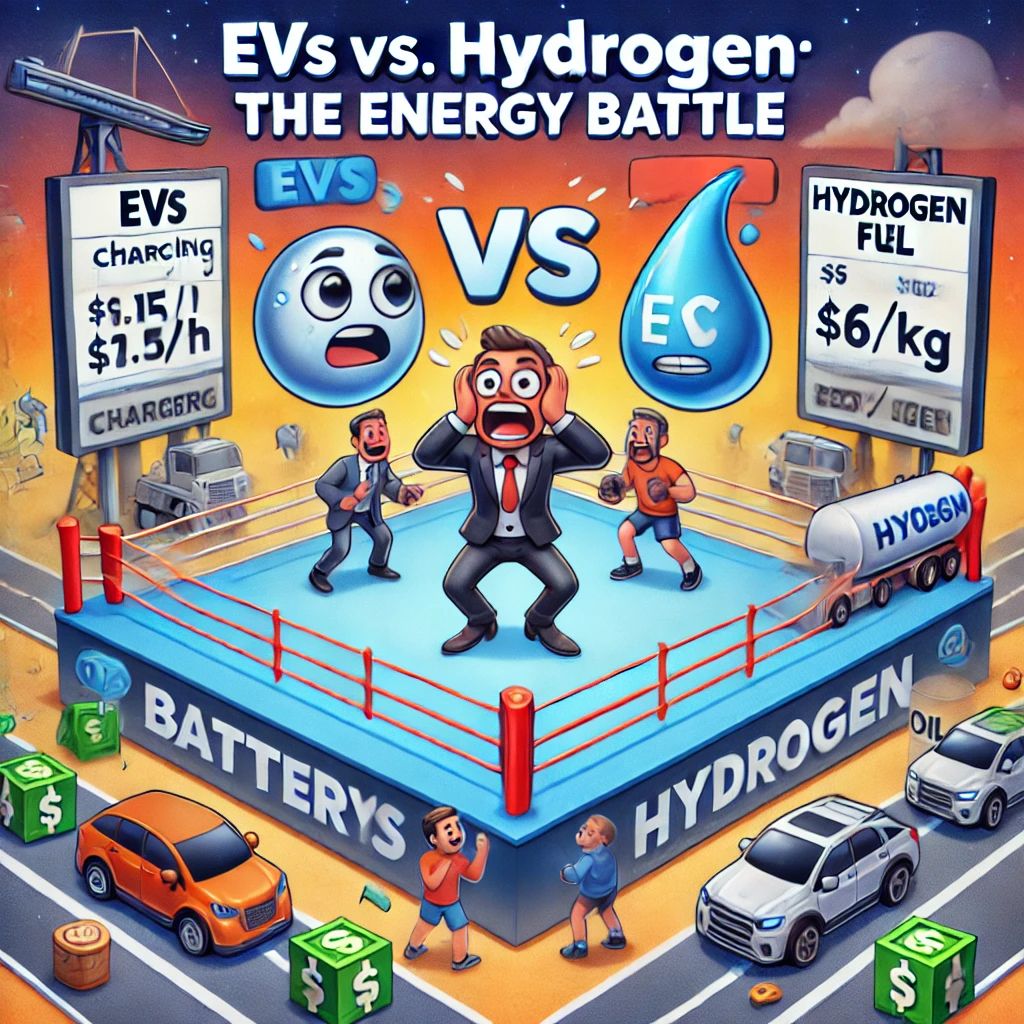
📌 Reality Check: The energy war isn’t EVs vs. fossil fuels—it’s EVs vs. hydrogen.
🔎 Why Are Carbon Giants Favoring Hydrogen Over EVs?
🚨 Hydrogen Leverages Their Existing Infrastructure
🔹 Oil & gas companies already handle gases—hydrogen fits their expertise.
🔹 Refineries & pipelines can be repurposed for hydrogen transport.
🚨 EV Battery Supply Chains Are a Challenge
🔹 70% of the world’s lithium refining is controlled by China. (Bloomberg, 2024)
🔹 Hydrogen avoids reliance on limited mineral resources.
🚨 Hydrogen Works Better for Heavy Transport & Industry
🔹 EV trucks take hours to charge—hydrogen refuels in minutes.
🔹 Steel, shipping & aviation can’t rely on batteries alone. (IEA, 2024)
🚨 Governments Are Pumping Money Into Hydrogen
🔹 EU plans $43B in hydrogen funding by 2030. (EU Hydrogen Strategy, 2024)
🔹 The US Inflation Reduction Act provides $3/kg hydrogen production incentives.
📌 Reality Check: Carbon giants aren’t anti-EV—they’re just betting on what keeps them in business.
⚖️ Is Hydrogen a Real Threat to EVs?
✅ Toyota, BMW, and Hyundai are developing hydrogen fuel cell vehicles.
✅ Over 120 hydrogen fueling stations opened in 2024, but EV chargers still outnumber them 20:1. (Global EV Outlook, 2024)
❌ Green hydrogen is still expensive – costing 4-6x more than fossil fuels today. (IEA, 2024)
📌 Reality Check: EVs dominate now, but hydrogen is creeping up in key sectors.
🏆 KeyTakeaway
💡 EVs could be the dominant player for personal transport, should be complemented by hydrogen for heavy industry, but would be challenged if hydrogen costs drop significantly.
👉 Do you think hydrogen will overtake EVs, or is it just a fossil fuel lifeline? Let’s discuss. 💬
Originally published on LinkedIn on 2025-02-10 04:57:02: https://www.linkedin.com/feed/update/urn%3Ali%3AgroupPost%3A60128-7294580099679490048

