KtalystGreyToGreen:GreenMethanol
Dr. Anju Sharma MrsSustainability
One Molecule. Four Price Curves. A New Chemical Economy.
Methanol isn’t going green overnight.
It’s being repriced in layers.
The industry is not switching fuels.
It’s splitting margins.
Inflection point:
EU ETS now prices maritime carbon, FuelEU Maritime starts enforcing fuel intensity, Scope 3 moves from slideware to contractsand suddenly the same CH₃OH carries different cash flows.
The 4_Curve Market That’s Emerging:
1) Grey Methanol — Volume Engine
✓ Coal / gas-based, deeply integrated into chemicals (formaldehyde, acetic acid, MTO)
✓ Lowest cost, highest carbon exposure
Impact: Remains the backbone, but margins compress as carbon becomes a cost line.
2) Blue Methanol — The Bridge
✓ Natural gas + CCS/CCU retrofits
✓ Faster to scale using existing assets
Impact: Buys time. Converts legacy plants into lower-intensity supply while green scales.
3) Bio-Methanol — Early Green Volume
✓ Biomass, waste, biogas routes
✓ Enters quickly into blending, shipping, compliance markets
Impact: Delivers near-term tonnes.
Constraint: Feedstock logistics, traceability, land-use scrutiny.
4) E-Methanol — Premium Proof
✓ Green H₂ + captured CO₂
✓ Highest credibility for EU-grade compliance and Scope 3
Impact: Sets the top price curve.
Constraint: Hydrogen cost, power intensity, certification.
Why This Matters
1. Pricing is shifting from tonne → carbon-adjusted tonne
✓ Same molecule, different lifecycle emissions
✓ Premium flows to certified, auditable tonnes
Result: Margin divergence across the same product.
2. Demand is becoming contract-led, not spot-led
✓ Shipping fleets are ordered before fuel is abundant
✓ Long-term offtakes are locking supply
Result: Bankability > announcements
3. Ports are becoming profit pools
✓ Bunkering, storage, blending, certification
Result: Value migrates from plant gate to corridor control
4. Carbon is moving from report → revenue
✓ Compliance (EU ETS, FuelEU), Scope 3, product carbon footprints
Result: Molecules become claim carriers with pricing power
5. Certification is the new capacity
✓ LCA, MRV, chain-of-custody decide market access
Result: A “green” tonne without proof = discounted tonne
The New ValueEquation
Methanol Value = Molecule + Carbon Intensity + Certification + Offtake + Port Access + Policy
KtalystBusinessMonitor
✓ Segment your portfolio across Grey / Blue / Bio / E don’t bet on one curve
✓ Lock offtake early, demand is outrunning certified supply
✓ Invest in proof systems , LCA, MRV, chain-of-custody
✓ Build corridor positions ports, storage, bunkering
✓ Design for Scope 3 — sell molecules that reduce your customer’s emissions
KtalystBottomLine
✓ Grey owns the volume.
✓ Green marks the premium.
✓ Transition carbon-adjusted tonne
Originally published on LinkedIn on 2026-04-27 13:18:35: https://www.linkedin.com/feed/update/urn%3Ali%3Ashare%3A7454519366592643073
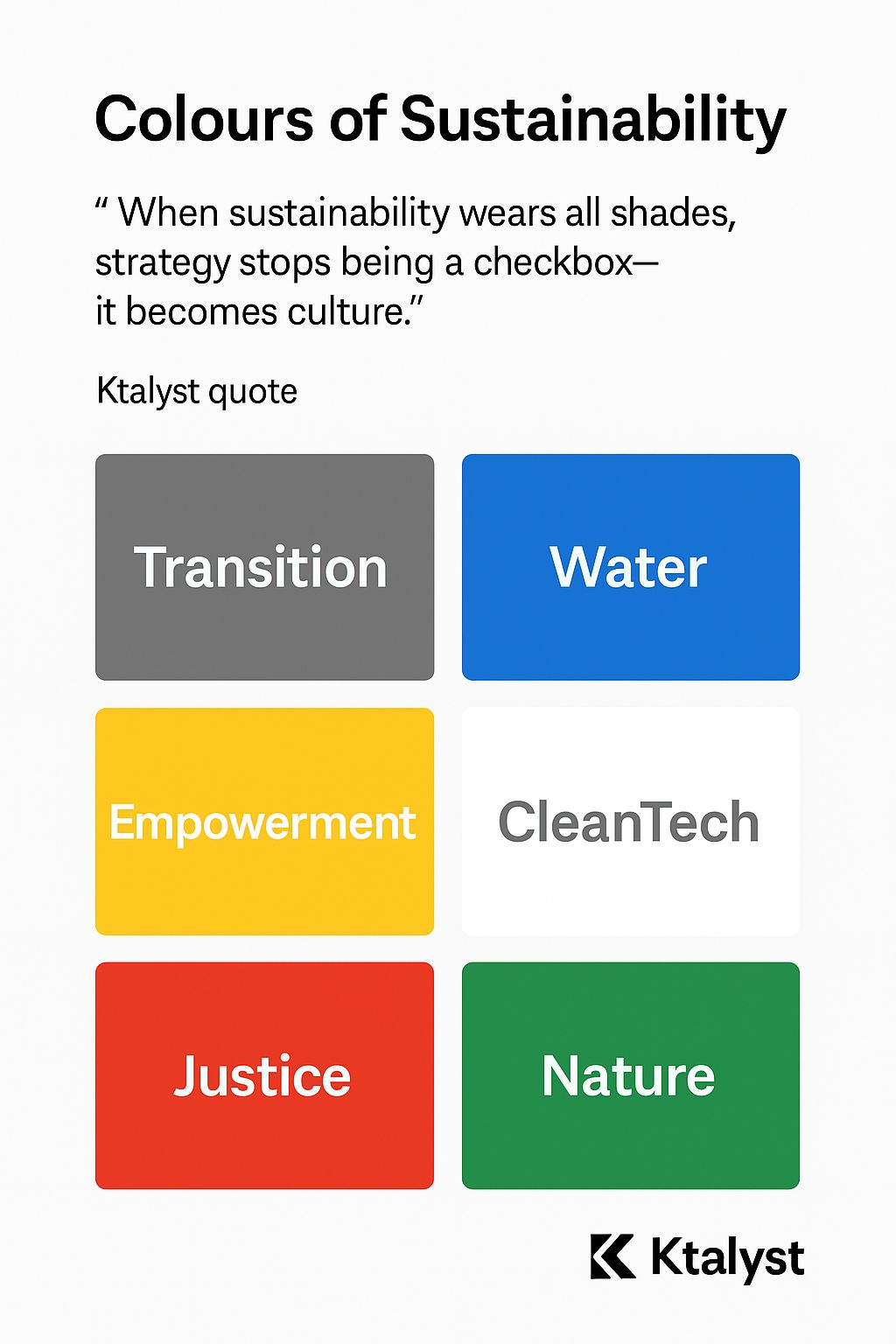
BeyondGreen: The Full Spectrum of Sustainability Has More Colours Than You Think
Sustainability isn’t just greenwashing or a CSR afterthought.
It’s a strategic spectrum—and at KtalystKeystone, we decode it in full colour.
Here’s what each hue really means—with the data to back it:
Grey – TransitionTech
Cement & steel = 14% of global CO₂. Innovations like CCUS and low-carbon fuels are critical to reach net-zero by 2050.
Blue – WaterResilience
By 2030, 40% of the world may face water stress. Blue credits, marine protected zones, and circular reuse models are rising fast.
White – CleanEnergyGrid
Green hydrogen market = $90B+ by 2030. EV infrastructure and fuel cells are accelerating decarbonization across sectors.
Yellow – Solar & Skills
India’s solar rooftop capacity grew 4X between 2021–24. Yellow isn’t just energy—it’s empowerment, inclusion, and innovation.
Red – SocialJustice
Over 160 million children still in labour force. Red ensures ESG isn’t just ‘E’—it’s also equity, ethics, and equal opportunity.
Green – Nature-Positive Action
Forests absorb ~2.6B tons of CO₂ annually. Carbon markets, afforestation, and regenerative farming are redefining nature’s ROI.
When we move BeyondGreen, we don’t just see sustainability—we LeadIt.
ColoursOfSustainability | ESGLeadership | TechForClimate | GreenCapital | SustainabilityDecoded | KtalystKeystone | ClimateCanvas
Originally published on LinkedIn on 2025-04-22 20:33:40: https://www.linkedin.com/feed/update/urn%3Ali%3Ashare%3A7320545349763260416
If It’s Not Green, Is It Blue, Grey, or Black? The Sustainability_Color_Code You Need to Know” 🌍🎨
Greenwashing has made “green” claims more questionable than ever. But if an initiative isn’t truly sustainable, what color does it fall under? Welcome to the new reality of sustainability labeling—where “not green” has shades of its own.
🔹 Blue, Grey, or Black? Understanding The Sustainability Spectrum
🔹 Blue: Sustainable but with a catch.
💧 Used for water-based and ocean-related sustainability projects—but can sometimes be misused, like “Blue Hydrogen” (which still relies on fossil fuels).
📉 Example: Companies investing in “blue carbon” like mangrove restoration while continuing offshore drilling.
🔸 Grey: A transition state—low-carbon but not net-zero.
🏭 Used for industries moving toward green but still dependent on fossil fuels.
📉 Example: Grey Hydrogen, made from natural gas with carbon capture, is cleaner than black coal, but still polluting.
⚫ Black: The dirtiest of them all—zero sustainability efforts.
🔥 Represents industries fully reliant on fossil fuels, heavy pollution, and no green commitments.
📉 Example: Coal-powered energy plants or airlines offsetting emissions with tree-planting, rather than cutting fuel use.
📊 The Reality Check: Who’s Being Misclassified?
✔️ Blue Hydrogen was sold as “clean,” but studies show it still emits up to 20% more CO₂ than burning gas directly! (Cornell University, 2024)
✔️ Grey Finance: Many banks market ESG funds, but 58% still finance fossil fuels. (Rainforest Action Network, 2024)
✔️ Black Energy’s Disguise: 76% of energy companies claiming net-zero still invest in new oil & gas projects. (IEA, 2024)
🏆 KeyTakeaway: The Color You Need is Transparency, Not Just Green
🌍 Sustainability isn’t just about color—it’s about credibility.
💰 Investors and consumers must look beyond green claims to understand what’s truly sustainable.
🚀 Regulators need stricter labeling to ensure companies don’t misuse “clean” colors for marketing.
👉 What do you think? Should companies be forced to use color codes for sustainability claims? Let’s discuss! 👇

Originally published on LinkedIn on 2025-02-17 06:55:36: https://www.linkedin.com/feed/update/urn%3Ali%3AgroupPost%3A9270968-7297146651570311168

