Isobutanol in Diesel: A New Blend A Big Economic Signal
Diesel carries India’s economic pulse.
It moves freight.
It runs farms.
It powers buses, mines, construction equipment, gensets and industrial motion.
India’s next biofuel frontier may therefore not sit only at the petrol pump.
It may sit inside diesel the harder fuel, the heavier fuel, the fuel where chemistry gets audited by engines.
A new molecule is entering that conversation: isobutanol.
India is now examining isobutanol blending with diesel, with a possible mandate signal later in 2026. Reports point to BPCL as the visible OMC front-runner on isobutanol–diesel formulation.
The correction matters:
India is not the first country to use bio-butanol as fuel.
The US has advanced isobutanol mainly through gasoline pathways.
Europe and Asia have tested butanol–diesel blends in engines.
Indonesia has scaled a different diesel route through palm biodiesel B40/B50.
India’s claim is more specific & more interesting:
➡️ a large diesel economy trying to move bio-/iso-butanol diesel blending from research into fuel-policy architecture.
Petrol blending was an ethanol story.
Diesel blending is a specification story.
Diesel does not only ask, “Is it green?
It asks:
⚙️ Will cetane hold?
⚙️ Will flash point stay safe?
⚙️ Will lubricity protect injectors?
⚙️ Will water tolerance work?
⚙️ Will storage remain stable?
⚙️ Will BS VI behaviour remain acceptable?
⚙️ Will OEMs support warranty confidence?
That is why ethanol could scale in petrol, but struggled in diesel.
India’s emerging diesel-isobutanol stack now looks like this:
MoRTH → policy signal
BIS → fuel specification
ARAI → vehicle validation
BPCL → fuel formulation
Early users → tractors, buses, trucks, captive fleets, agri-equipment
Dosage watch:
➡️ up to 10% v/v isobutanol-diesel under evaluation
➡️ final notified percentage awaited
BPCL matters because it is the clearest visible OMC technology runner not a full commercial rollout yet, but a strong formulation signal.
The proof path is clear:
R&D formulation → ARAI validation → BIS specification → OMC blending protocol → fleet trial → mandate percentage
India should not oversell this as a diesel replacement.
India should build it as a controlled, validated, specification-led oxygenated diesel corridor.
A small blend can become a big economic signal when it touches fuel security, rural value chains, import substitution and heavy-duty mobility.
Policy can open the door.
Chemistry decides who enters.
Dr. Anju Sharma | MrsSustainability
NamasteIndia KtalystInsights Biofuels Diesel Isobutanol GreenMobility
Originally published on LinkedIn on 2026-06-13 13:31:36: https://www.linkedin.com/feed/update/urn%3Ali%3Ashare%3A7471554871389839360
EVChariotsToBatteryBays: The Battery Is Becoming a Chemical Power Club
Dr. Anju Sharma MrsSustainability
The EV story is familiar.
The chemical story inside the battery is just getting interesting.
Global EV battery deployment reached around 1.2 TWh in 2025 and is expected to approach 3 TWh by 2030. By 2035, it could reach 4–5 TWh depending on the scenario.
Yet the power is concentrated.
In January 2026, the top five EV battery makers held roughly 75% of global installations:
✓ CATL: 45.2%
✓ BYD: 13.8%
✓ LG Energy Solution: 6.6%
✓ CALB: 5.3%
✓ Panasonic: 4.3%
That means OEMs are not just buying cells.
They are buying into a chemistry-led dependency system.
The old auto chain was:
OEM → Tier 1 → Component Supplier
The EV chain now looks like:
OEM → Cell Maker → Specialty Chemical Platform → Mineral / Refining Base → Recycler
This is where specialty chemicals become strategic.
Lithium gets the headline.
Chemistry decides the behaviour.
✓ Electrolyte additives: fast charging + cell stability
✓ Binders: electrode durability
✓ Conductive additives: power movement
✓ Separator coatings: thermal safety
✓ Cathode coatings + dopants: cycle life
✓ Silicon-anode enablers: higher energy density
✓ Thermal interface materials: heat control
✓ Flame retardants: pack credibility
✓ Adhesives + sealants: structural reliability
✓ Coolants + dielectric fluids: temperature discipline
The OEM problem is no longer only:
Can I source batteries?
It is:
✓ Who controls my charging curve?
✓ Who controls my degradation risk?
✓ Who controls my warranty exposure?
✓ Who controls my carbon footprint?
✓ Who controls my recycling loop?
✓ Who controls my cost of ownership?
S&P Global Mobility has flagged range, charging time and cost as key EV technology pain points for automakers.
That is exactly why the battery conversation is moving from cell capacity to chemical performance.
Commodity chemicals support scale.
Niche specialty chemicals create differentiation.
EV Competitiveness = Battery Chemistry × Charging Confidence × Carbon Credibility ÷ Cost of Ownership
The carbon math is also not automatic.
Better chemistry can mean longer life, fewer replacements, safer fast charging and improved recycling economics.
Poor chemistry can mean oversized packs, faster degradation, higher embedded carbon, fossil-heavy charging dependency and end-of-life waste.
The EV may sell from the showroom.
The strategy sits inside the battery.
Lithium may power the battery. Specialty chemistry decides whether that power becomes performance, profit or problem.
Dr. Anju Sharma
Originally published on LinkedIn on 2026-05-26 16:41:42: https://www.linkedin.com/feed/update/urn%3Ali%3Ashare%3A7465079729059151872
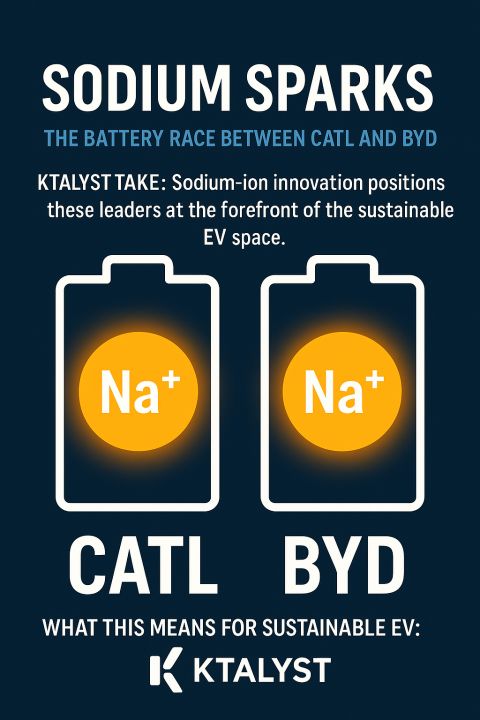
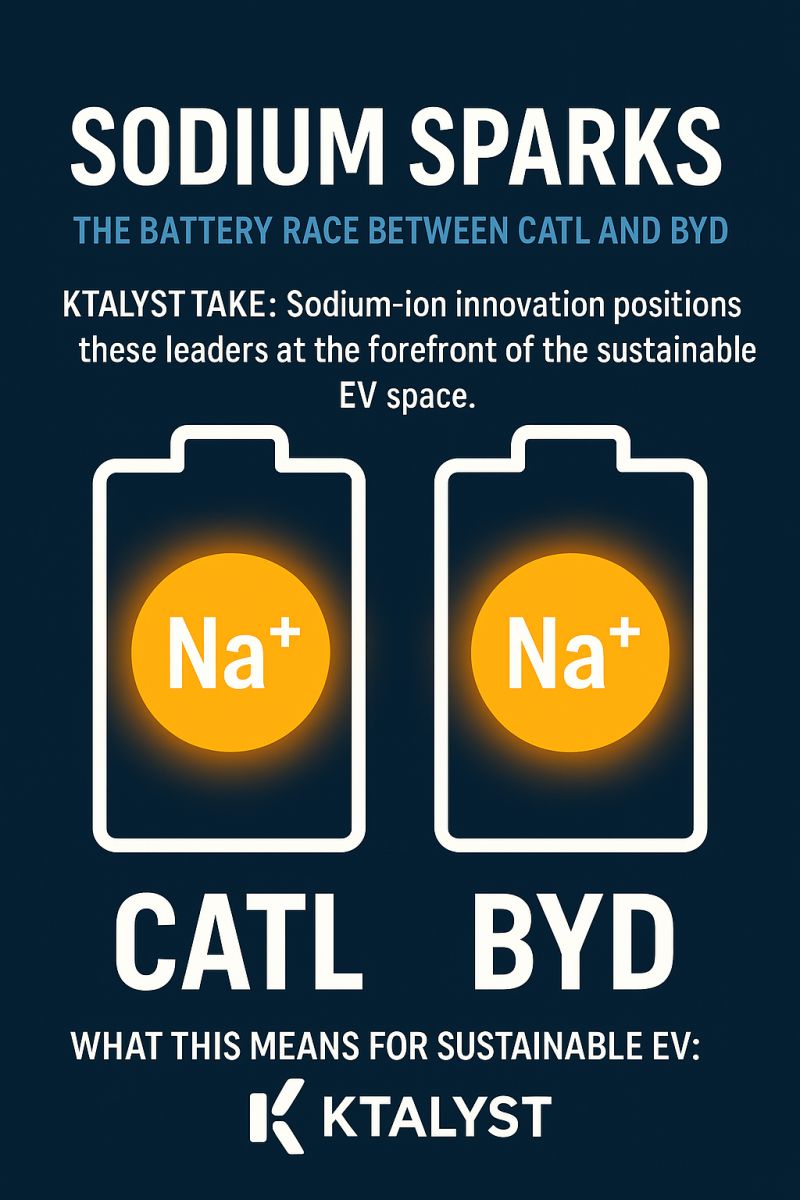
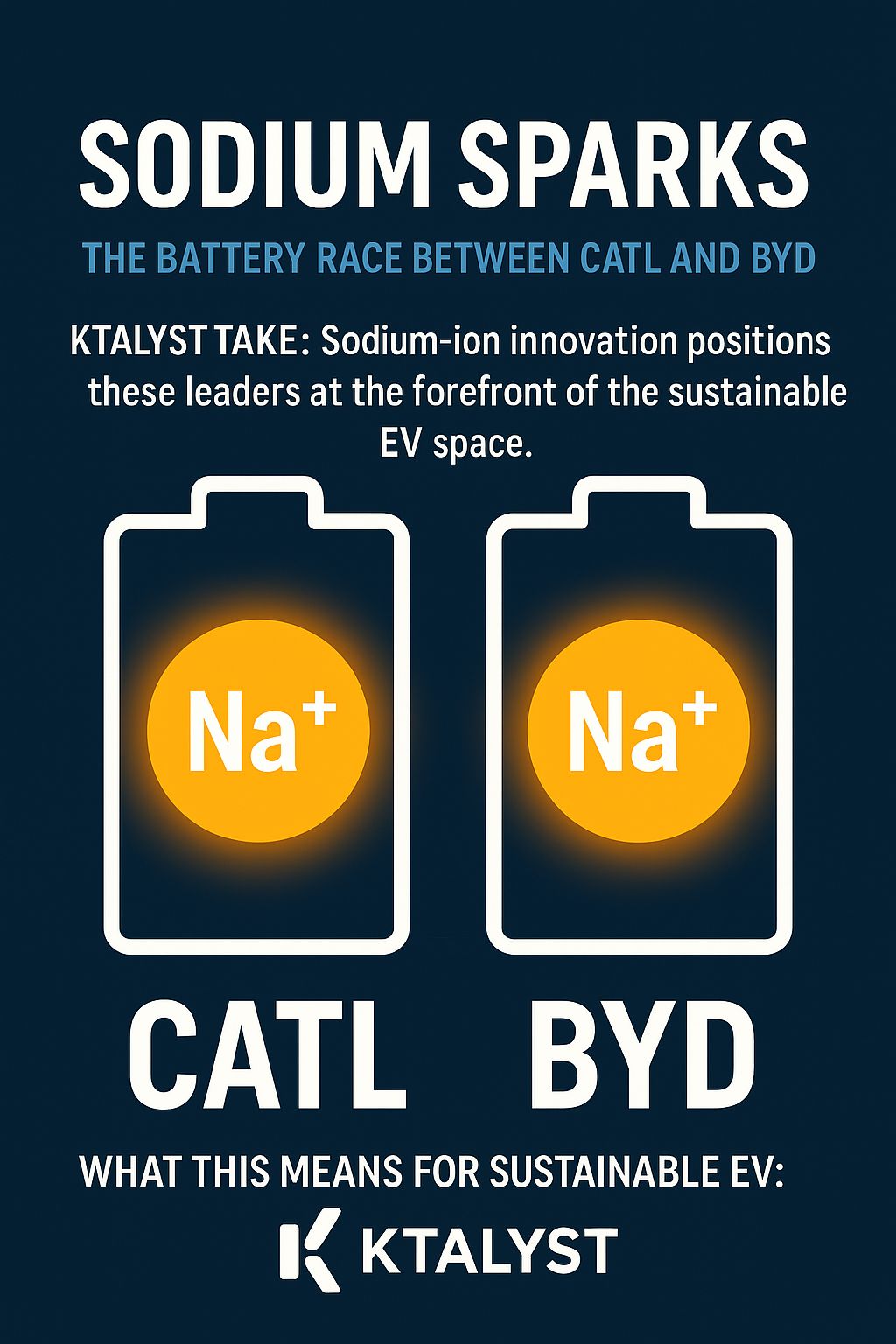
SodiumSparks: CATL vs BYD – Who’s Charging Ahead?
Ktalyst Take:
Sodium-ion innovation positions CATL and BYD as frontrunners in rewriting the rules of sustainable mobility—less lithium, more accessibility.
As the EV world accelerates toward clean energy, sodium-ion batteries are emerging as the cost-effective, resource-resilient alternative to lithium. Unlike lithium—which is geographically concentrated, expensive, and water-intensive—sodium is abundant, cheaper to process, and more stable at lower temperatures, making it ideal for entry-level EVs and grid-scale storage.
And now, the two battery titans—CATL and BYD—are going head-to-head to scale it.
CATL: Chemistry-First Champion
1st to launch Sodium-ion Gen 1 in 2021
Gen 2 (2024–25) targets 200 Wh/kg
Dual chemistry packs (Na+ + Li+) for flexible range
Used in: Chery iCAR, JMEV, grid storage pilots
Cold weather & fast-charging advantage
BYD: Urban Mobility Master
Launched Seagull Sodium variant in 2024
Targets mass-market, affordable EVs
~120–140 Wh/kg density
Fully in-house cell and vehicle integration
Focus: LATAM, ASEAN, and 2W/3W segments
Why This Race Matters for EV Sustainability:
Lithium-ion: Higher energy but costlier, less abundant, and geopolitically volatile
Sodium-ion: Lower cost, scalable for price-sensitive markets, with cleaner resource profile
Enables inclusive EV adoption and decentralized energy storage without over-reliance on rare minerals
KtalystView:
This isn’t just a tech race. It’s the birth of a parallel battery economy—one where sodium shines in powering the planet affordably.
SustainableEV | BatteryDisruption | TechForSustainability | SodiumIon | CATL | BYD | GreenMobility | KtalystKeystone | CleanEnergyShift
Originally published on LinkedIn on 2025-04-22 23:41:08: https://www.linkedin.com/feed/update/urn%3Ali%3AgroupPost%3A4385073-7320592527068225536
KnowledgeSeries: How Startups Drive Sustainability 🌍🚀
Startups are disrupting industries, solving climate challenges, and creating profitable green businesses. The data speaks for itself! 👇
1: Why Startups Matter in Sustainability?
📊 The Numbers Speak:
✅ 75% of global CO₂ emissions come from energy use – startups in renewables are cutting this.
✅ 90% of plastic waste isn’t recycled – circular economy startups are tackling this crisis.
✅ $1.8T in green startup investments needed by 2030 to meet climate goals.
🔍 Key Sectors Startups Are Transforming:
🔋 RenewableEnergy – AI-driven solar, wind & battery storage
🍽 SustainableFood – Alternative proteins & vertical farming
🏭 CleanTech – AI-powered waste & pollution management
🚗 GreenMobility – EVs, ride-sharing & micro-mobility
🏡 EcoLiving – Carbon-neutral shopping & smart homes
🚀 Startups = Faster innovation + Scalable impact!
2: Who’s Leading the Green Startup Revolution?
🔥 Game-Changing Startups You Should Know:
Sun King – Bringing off-grid solar energy to Africa & Asia 🌞
Rivian – Accelerating the future of electric vehicles 🔋
AMP Robotics – AI-powered recycling for zero-waste industries ♻️
Beyond Meat – Redefining food with plant-based proteins 🍔🌱
EcoCart – Making every online purchase carbon-neutral 🛍️🌍
🔹 What do they have in common?
✔️ Tech-driven innovation
✔️ Massive climate impact
✔️ Scalable, profitable models
StartupLeaders ClimateTech
3: The Growth & Funding Challenge 💰
📊 Biggest Roadblocks for Sustainability Startups:
❌ 67% struggle with high initial capital – Green tech isn’t cheap!
❌ 54% face regulatory hurdles – Compliance is complex.
❌ 48% find it hard to change consumer habits – Awareness takes time.
❌ 42% hit scalability issues – Local success ≠ global success.
💡 The Good News?
$60B+ invested in green startups in 2023 – A 35% YoY jump!
ESG investors are doubling down on sustainable businesses.
Govt incentives & carbon credits are fueling the movement.
GreenFunding ImpactInvestment
4: Future Trends – What’s Next for Sustainability Startups?
📈 By 2030, we will see:
✔️ 50%+ of new mobility solutions being electric or green-powered 🚗🔋
✔️ Carbon-neutral startups leading the energy & food industries 🌍🥦
✔️ $10T+ global market size for sustainability-driven businesses 💸
🚀 Biggest Trends to Watch:
🌎 Carbon capture & offset solutions – Net-zero will be the norm.
🔋 Energy storage & decentralized grids – Smart, efficient power.
🌊 Water conservation & desalination startups – Solving global water crises.
FutureOfSustainability GreenTechFuture
💡 Final Thought: The next unicorns 🦄 will be green.
Are you investing, working, or building in the right future? 🌱
👇 Tag a sustainability startup doing amazing work! Let’s amplify impact.
SustainableStartups ESG TheFutureIsNow

Originally published on LinkedIn on 2025-03-20 05:50:24: https://www.linkedin.com/feed/update/urn%3Ali%3AgroupPost%3A82951-7308364268603641859
🚀 “The 3Es of ₹Ethanol: Environment, Economy & Efficiency – Is India Getting It Right?” 🌱💰⚡
Fueling sustainability or fueling a crisis?
India’s EthanolBlending mission is racing toward 20% ethanol-petrol blending (E20) by 2025-26, aiming to slash ₹53,894 crore ($6.5B) in crude oil imports annually while cutting CO₂ emissions by 2.3 million tonnes—equivalent to taking 4.2 lakh cars off the road. (MoPNG, 2024) But does ethanol truly deliver on Environment, Economy, and Efficiency?
🌍 1. Environment: Green or Resource-Heavy?
✔️ CO₂ Reduction: Ethanol blending cut 2.3M tonnes of CO₂ in 2023, but its full lifecycle emissions remain debated. (MoPNG, 2024)
✔️ Water Crisis: Producing 1L of ethanol from sugarcane requires 2,860L of water, straining groundwater. (NITI Aayog, 2024)
✔️ Crop Dependency: 92% of India’s ethanol comes from sugarcane, a crop linked to declining soil fertility. (IEA, 2024)
✔️ Air Quality Gains: E20 reduces particulate matter by 30-50%, improving urban air pollution. (ICCT, 2024)
📌 RealityCheck: Can ethanol be truly sustainable when it risks food & water security?
💰 2. Economy: Cost Savings vs. Inflation?
✔️ Fuel Independence: Ethanol saved India $6.5B in oil imports in 2023. (MoPNG, 2024)
✔️ Investment Boom: The sector is attracting ₹41,000 crore ($4.9B) in new investments by 2025. (NITI Aayog, 2024)
✔️ Job Creation: Ethanol production has generated 4 lakh jobs in rural India. (MoPNG, 2024)
✔️ Food Price Spike: 40L tonnes of sugarcane & 25L tonnes of grain were diverted to ethanol in 2023, contributing to food inflation. (FAO, 2024)
📌 RealityCheck: Are we trading food security for fuel independence?
⚡ 3. Efficiency: Can Ethanol Compete with Petrol?
✔️ Mileage Drop: E20 reduces fuel efficiency by 6-10%, requiring more frequent refueling. (SIAM, 2024)
✔️ Vehicle Readiness: Only 20% of India’s petrol vehicles are E20-ready. (MoRTH, 2024)
✔️ Slow Adoption: Just 6% of fuel stations nationwide are E20-compliant. (BPCL, 2024)
✔️ Flex-Fuel Future: Maruti, Toyota & Honda have launched E85-compatible vehicles, but mass adoption is slow. (AutoCar India, 2024)
📌 RealityCheck: Can ethanol match petrol’s efficiency without major tech breakthroughs?
🇺🇸 US Interest in India’s Ethanol Push
🔹 Corn Exports: The US exported $1.2B worth of ethanol-friendly corn to India in 2023. (USDA, 2024)
🔹 Big Oil & Biofuels: ExxonMobil & Chevron have invested $800M in India’s ethanol supply chain. (Bloomberg, 2024)
🔹 Strategic Partnerships: US firms are eyeing India’s ₹41,000 crore ($4.9B) ethanol market for global expansion. (Reuters, 2024)
Originally published on LinkedIn on 2025-02-21 17:04:12: https://www.linkedin.com/feed/update/urn%3Ali%3AgroupPost%3A82951-7298749364091428865
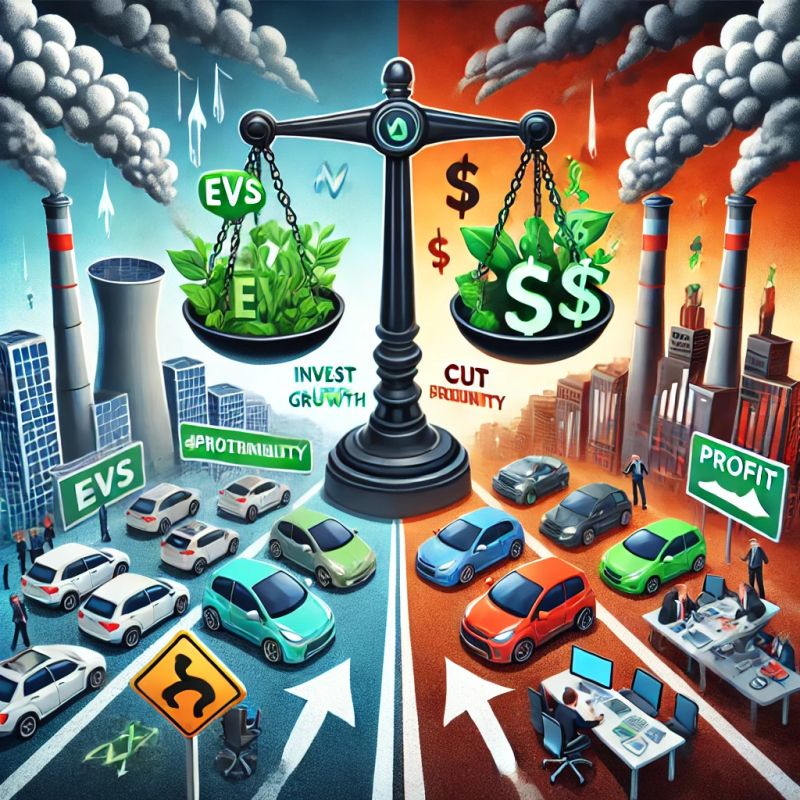
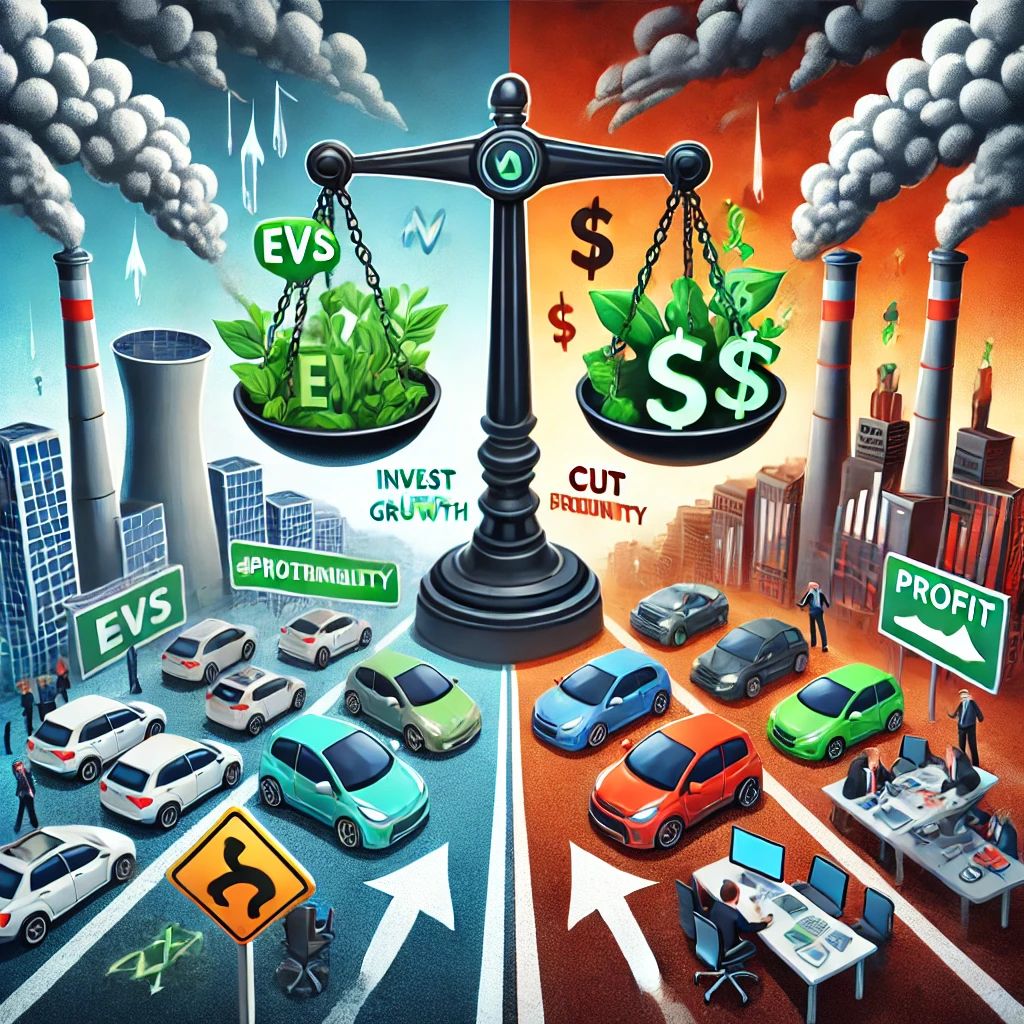
🌍⚡ “Sustainability = Profitability?: Auto Leaders vs. Laggards in Q3 FY25” 🚗💰
The IndianAutoIndustry is witnessing a sustainability shake-up.
✅ Companies prioritizing EVs, GreenManufacturing, and CircularEconomy are outpacing the market.
❌ Those slow to adopt sustainable practices are struggling with shrinking margins & investor skepticism.
📊 Here’s the data-driven Q3 FY25 leaderboard: Who’s accelerating, and who’s stalling?
🚀 TopPerformers: Profits Fueled by Sustainability
✔️ Mahindra & Mahindra (M&M): ₹3,181 Cr PAT (+20% YoY) | 16% volume growth | EV leadership & green factories paying off.
✔️ ActionConstructionEquipment (ACE): ₹873 Cr revenue (+16.6%) | Investing in low-emission tech & energy-efficient equipment.
✔️ NDR Auto Components: 79% stock surge | CircularEconomy approach driving green component sales.
✔️ SundaramClayton: 69% stock rise | LightweightMaterials reducing carbon footprint.
✔️ SJS Enterprises: 65% stock growth | Strengthening SustainableSupplyChains.
✔️ BharatForge: 12% revenue growth | Expanding into EV components & sustainable engineering.
✔️ BoschIndia: +10% revenue | Investing heavily in CleanMobility tech.
✔️ GreavesCotton: ₹423 Cr revenue (+18%) | Dominating the EV three-wheeler market.
✔️ TataElxsi: +15% growth | Digital innovations fueling the EV ecosystem.
✔️ JBM Auto: ₹1,287 Cr revenue (+22%) | Scaling urban MobilitySolutions for net-zero cities.
📌 RealityCheck: Sustainability isn’t just an ESG commitment—it’s a financial win.
⚠️ Underperformers: Cost Pressures & Slow Sustainability Adoption
🔻 TataMotors: ₹5,578 Cr net profit (-22.5%) | EV growth overshadowed by rising costs & margin drops.
🔻 MarutiSuzuki: ₹3,508 Cr PAT (+12%) | Facing price pressures amid rising sustainability investments.
🔻 BajajAuto: 4% revenue growth | Struggling to scale EV production profitably.
🔻 HeroMotoCorp: Flat EBITDA margins | Needs faster transition to green mobility.
🔻 TVSMotor: +14% EBITDA growth | High costs hurting profits despite EV expansion.
📌 RealityCheck: Not prioritizing sustainability is now a business risk, not just an ESG issue.
🏆 KeyTakeaway
💰 Sustainability isn’t a cost—it’s the key to long-term profitability.
🚀 Auto companies investing in green tech are seeing stronger earnings & investor confidence.
⚠️ Laggards must pivot or risk being left behind in a carbon-conscious economy.
👉 Which auto company do you think is leading the SustainabilityRace? Let’s discuss below! 👇
Originally published on LinkedIn on 2025-02-10 16:49:42: https://www.linkedin.com/feed/update/urn%3Ali%3AgroupPost%3A82093-7294759446935670784
🌍 NamasteBharatMobility Global Expo 2025: Driving_India_Towards_a_Greener_Future 🚗⚡
Inaugurated by Prime Minister Narendra Modi, the BharatMobilityExpo 2025 is setting the stage for India to shine as a global leader in sustainablemobility and innovation. This landmark event aligns with the nation’s vision of ‘Viksit Bharat by 2047’, showcasing the latest advancements in electricvehicles, renewableenergyintegration, and cuttingedgeinfrastructure.
🚀 Key Highlights from Day 1
📌 Maruti Suzuki e Vitara
🛻 Electric SUV with 500+ km range
💡 Features: 10-way powered driver’s seat, 7 airbags
📅 Launch: March 2025
📌 Hyundai Creta Electric
💰 Introductory Price: ₹17.99–₹23.50 lakh (approx. $21,700–$28,400 USD)
🔋 Range: 473 km
📱 Advanced Features: Digital key, memory settings for the driver’s seat
📌 Toyota Urban Cruiser BEV Concept
🚗 Futuristic design, built on the Maruti e Vitara platform
🔌 Developed to cater to India’s green mobility goals
📌 Tata Motors: Electrifying the Spotlight
Sierra EV: Near-production model
Harrier EV: Showcasing sustainable luxury
Special Editions: Bandipur and Stealth Editions
📌 BMW iX1 LWB
🚙 Long-wheelbase luxury EV with a 531 km range
🌟 Catering to India’s growing demand for premiumelectricSUVs
🌟 Why Bharat Mobility Global Expo Matters
🔋 Sustainability at its Core:
Reinforcing India’s commitment to reducing carbon emissions and driving green technology adoption.
🌐 Global Collaboration:
Over 1,000 brands from 13 global markets unite to showcase the future of mobility.
🏛️ World-Class Venues:
Bharat Mandapam
Yashobhoomi
India Expo Centre & Mart
🚗 A Glimpse into the Future:
The event is more than a showcase—it’s a movement towards a cleaner, greener, and innovative India.
💡 India: The Mobility Powerhouse
With a focus on electricvehicles, renewableenergy, and futurereadyinfrastructure, this expo isn’t just about unveiling vehicles; it’s about redefining mobility and creating opportunities for businesses and investors to be part of India’s growth story.
👉 Let’s lead the charge together toward a sustainable tomorrow!
Originally published on LinkedIn on 2025-01-17 17:35:18: https://www.linkedin.com/feed/update/urn%3Ali%3AgroupPost%3A82951-7286073612950790145

