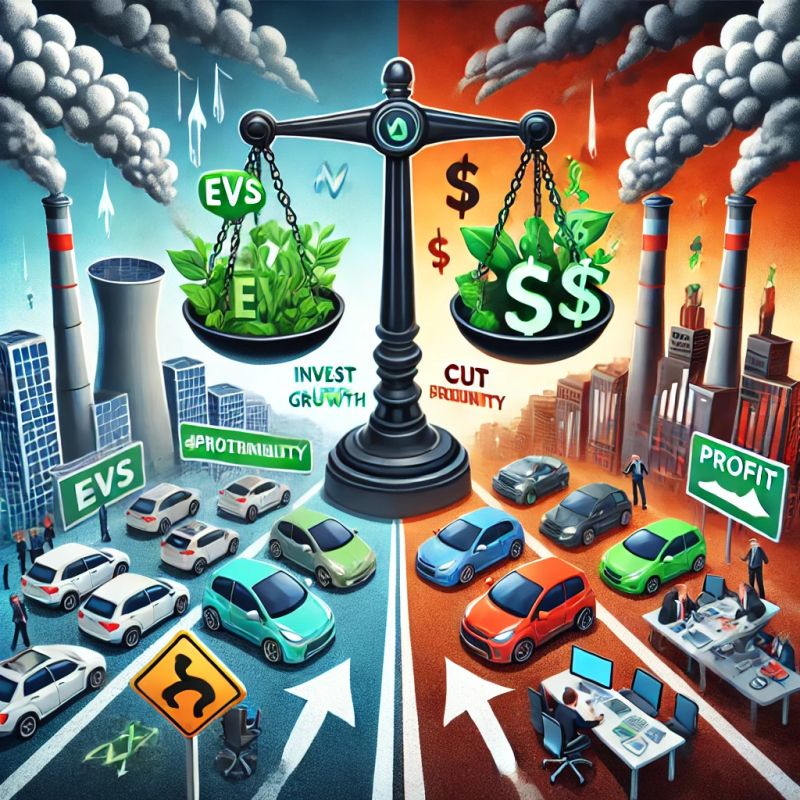
🌍⚡ “Sustainability = Profitability?: Auto Leaders vs. Laggards in Q3 FY25” 🚗💰
The IndianAutoIndustry is witnessing a sustainability shake-up.
✅ Companies prioritizing EVs, GreenManufacturing, and CircularEconomy are outpacing the market.
❌ Those slow to adopt sustainable practices are struggling with shrinking margins & investor skepticism.
📊 Here’s the data-driven Q3 FY25 leaderboard: Who’s accelerating, and who’s stalling?
🚀 TopPerformers: Profits Fueled by Sustainability
✔️ Mahindra & Mahindra (M&M): ₹3,181 Cr PAT (+20% YoY) | 16% volume growth | EV leadership & green factories paying off.
✔️ ActionConstructionEquipment (ACE): ₹873 Cr revenue (+16.6%) | Investing in low-emission tech & energy-efficient equipment.
✔️ NDR Auto Components: 79% stock surge | CircularEconomy approach driving green component sales.
✔️ SundaramClayton: 69% stock rise | LightweightMaterials reducing carbon footprint.
✔️ SJS Enterprises: 65% stock growth | Strengthening SustainableSupplyChains.
✔️ BharatForge: 12% revenue growth | Expanding into EV components & sustainable engineering.
✔️ BoschIndia: +10% revenue | Investing heavily in CleanMobility tech.
✔️ GreavesCotton: ₹423 Cr revenue (+18%) | Dominating the EV three-wheeler market.
✔️ TataElxsi: +15% growth | Digital innovations fueling the EV ecosystem.
✔️ JBM Auto: ₹1,287 Cr revenue (+22%) | Scaling urban MobilitySolutions for net-zero cities.
📌 RealityCheck: Sustainability isn’t just an ESG commitment—it’s a financial win.
⚠️ Underperformers: Cost Pressures & Slow Sustainability Adoption
🔻 TataMotors: ₹5,578 Cr net profit (-22.5%) | EV growth overshadowed by rising costs & margin drops.
🔻 MarutiSuzuki: ₹3,508 Cr PAT (+12%) | Facing price pressures amid rising sustainability investments.
🔻 BajajAuto: 4% revenue growth | Struggling to scale EV production profitably.
🔻 HeroMotoCorp: Flat EBITDA margins | Needs faster transition to green mobility.
🔻 TVSMotor: +14% EBITDA growth | High costs hurting profits despite EV expansion.
📌 RealityCheck: Not prioritizing sustainability is now a business risk, not just an ESG issue.
🏆 KeyTakeaway
💰 Sustainability isn’t a cost—it’s the key to long-term profitability.
🚀 Auto companies investing in green tech are seeing stronger earnings & investor confidence.
⚠️ Laggards must pivot or risk being left behind in a carbon-conscious economy.
👉 Which auto company do you think is leading the SustainabilityRace? Let’s discuss below! 👇
Originally published on LinkedIn on 2025-02-10 16:49:42: https://www.linkedin.com/feed/update/urn%3Ali%3AgroupPost%3A82093-7294759446935670784
Namaste🌞India
Sun Shines Bright on India’s Chemical Industry with Solar Energy
India’s solar energy revolution isn’t just about generating clean energy; it’s also creating a golden opportunity for the chemical industry, which supplies critical materials like polysilicon, silver paste, and encapsulation films. With record-breaking investments, cutting-edge technology partnerships, and government incentives, the chemical sector is positioned to power India’s renewable energy journey.
🏢 Key Industry Players
Tata Chemicals: Focused on high-performance coatings and encapsulation films.
Waaree Energies: Pioneering durable, recyclable solar modules.
Adani Solar: Strengthening in-house chemical production for vertical integration.
Reliance Industries: Partnering with global firms to enter polysilicon manufacturing.
💰 Key Investments in YR2024
🔹 Adani Group: ₹7.5 trillion ($88.53 billion) in Rajasthan, including 100 GW solar projects.
🔹 Tata Power Solar: ₹43 billion invested in a 4.3 GW solar module facility in Tamil Nadu.
🔹 Hero Future Energies: $20 billion to expand renewable capacity to 30 GW by 2030.
🔹 FDI Surge: $3.76 billion in FY 2023-24, a 50% YoY growth in renewable energy.
🤝 Key Technology Partnerships
🔹 Waaree Energies & IIT Bombay: Researching cost-effective perovskite solar cells.
🔹 Reliance Industries & NexWafe (Germany): Developing low-cost polysilicon technologies.
🔹 Tata Chemicals & JohnsonMatthey (UK): Innovating sustainable encapsulation materials.
📍 Geographic & Global Challenges
🔸 Extreme Weather: Heatwaves demand heat-resistant coatings; cyclones call for weatherproof materials.
🔸 Regional Disparities: Solar adoption thrives in western/northern states but lags in the northeast.
🔸 Global Competition:
China dominates polysilicon production.
Southeast Asia offers cost-competitive solar materials.
🔸 Resource Scarcity: Shortages of silver and polysilicon create supply chain challenges.
🔸 Sustainability Demands: Global buyers require eco-friendly and low-carbon solar panels.
🚀 Opportunities for India’s Chemical Industry
🔹 Scale domestic manufacturing of critical materials.
🔹 Develop climate-resilient coatings tailored for diverse Indian geographies.
🔹 Leverage green technology partnerships for innovation.
🔹 Expand into underdeveloped regions with decentralized solar projects.
🌍 Conclusion
The Indian chemical industry has a pivotal role in powering the solar energy boom. By addressing global challenges, leveraging investments, and fostering innovation, it can solidify its position as a global leader in solar-related chemical manufacturing.

Originally published on LinkedIn on 2024-12-13 18:37:46: https://www.linkedin.com/feed/update/urn%3Ali%3AgroupPost%3A3880479-7273405759328038912

