NaviMumbaiMarvels: A Lotus_in_the_Sky & A_Maze_Beneath
Hope the ground stands!!!!
Airports test our wings, tunnels test our ground. Together, they test our resolve.
Mumbai’s skyline just sprouted a new lotus, the Navi Mumbai International Airport (NMIA). A blooming terminal built on reclaimed land & flattened hills, it promises 20 million flyers a year to start, scaling to 90 million.
But airports don’t fly alone. Their arteries are tunnels, expressways, and coastal roads. Without them, wings stall.
SkywardPromise
1) First airport in India with water-taxi integration alongside metro & rail.
2) 47 MW solar, SAF storage, EV fleets, biometric e-gates — a green gateway in the making.
3) For Mumbaikars, relief after decades of congestion at CSMIA.
A lotus blooming from marshland — ambition rising from constraints.
TunnelMatrix
Mumbai to NMIA Tunnel: Feasibility study underway for a Bandra–airport lifeline.
Pune’s Yerawada–Katraj twin tunnel: 14–20 km double-decker dream still in study.
MumbaiPune Expressway “MissingLink”: Nearly complete — twin tunnels + cable-stayed bridge to cut ~30 minutes.
A nervous system beneath western India arteries in stone.
TheGroundBeneath
Ulwe Hill was blasted down to make way for NMIA. Marshes reclaimed, soil compacted. But can the ground hold when monsoons roar?
Bridges sway in high winds. Tunnels seep if drainage falters. Reclaimed ground has memory.
The poetry of a lotus must be matched with the prose of soil mechanics.
What It Means?
Faster cargo flows from NMIA to Pune’s factories = export efficiency.
Time saved = logistics gained.
True infrastructure = public dashboards tracking soil stability & tunnel integrity for the first three monsoons.
Without this, speed could become fragility.
Reflection
Infrastructure wins when commuters forget it exists. When the lotus is just “the airport,” when tunnels are “just the road.
Until then — eyes on the gauges, and on the ground.
We measure progress not only by what we build above, but by what holds below.
Originally published on LinkedIn on 2025-10-09 05:37:39: https://www.linkedin.com/feed/update/urn%3Ali%3Ashare%3A7381925794991861761
The Watt Economy: Where Power, Not Paper, Rules?
In the Watt economy, waste isn’t watts lost — it’s watts the point.
(Pun Intended)
In 2025, the most valuable currency isn’t green paper, it’s green power. Dollars still grease markets, but watts now govern nations. Central banks can print liquidity; only electrons can fuel prosperity.
This shift is everywhere.
1. Finance Follows Watts, Not Wall Street
When the Fed cut rates by 25 bps, Wall Street cheered with a US$1.2 trillion rally. But the milestone was elsewhere: US$1.8 trillion in clean energy, overtaking fossil fuels for the first time. Liquidity can create markets; watts create futures.
2. Asia: From Workshop to Powerhouse
China: 220 GW solar built in a single year, larger than the rest of the planet combined.
India: 18 GW added, sprinting toward 500 GW by 2030.
ASEAN : A US$40 bn project pipeline making Southeast Asia the new energy frontier.
Once, Asia stitched textiles and assembled chips. Now, it manufactures tomorrow’s power.
3. Middle East: Betting Against Itself
Oil is still lifeblood, but Gulf petrodollars are hedging their own extinction.
Saudi Arabia: US$8.4 bn hydrogen gamble at NEOM.
Dubai : 5 GW solar park.
Sovereign funds 15% of assets now in clean tech?
Paradox? No. It’s planetary-scale portfolio hedging.
4. NamasteIndia: Laboratory of Growth vs Green
6.9% GDP forecast colliding with tariff wars.
Gujarat’s first greenhydrogen blending project.
EV sales 35% YoY rise.
SATAT Biogas plants multiplying.
US$120 bn approvals in EVs, AI, semiconductors in a state
5. Waste: The Watt Economy’s Blind Spot
Power generation is only half the story; power waste is the other half.
Transmission losses?
Data centers & AI: projected to consume 10% of global electricity by 2030, yet most waste their cooling energy.
E-waste & batteries: 62 million tonnes of electronic waste globally, with <20% recycled.
Circular fixes: Waste-to-energy plants in Europe now fuel 50M homes; India’s municipal waste-to-energy push (150+ projects) is nascent but growing.
Watts not used wisely are watts lost — and in this economy, waste is the new oil spill.
6. Fragility: The Price of Power
Supply chains stretched thin: polysilicon, lithium, rare earths.
Trade wars re-map grids with tariffs & carbon borders.
Climate shocks wipe hydro capacity in a single flood.
Watts bring resilience, but they also test it.
KtalystInsight
Renewables already supply 32% of global electricity. EV sales hit 17 million units this year. Carbon credit markets are racing toward US$1 trillion. Whoever controls watts will control wealth, sovereignty, and survival.
But whoever controls waste will control efficiency, margins, and trust.
Dr. Anju Sharma
KtalystInsights | MrsSustainability | NamasteIndia | WattEconomy | EnergyTransition | GreenGrowth | NetZero
Originally published on LinkedIn on 2025-09-18 11:09:18: https://www.linkedin.com/feed/update/urn%3Ali%3AgroupPost%3A82951-7374399113762631681
🔋🌞 NamasteIndia Rising: From Watts to Wonders!
KtalystInsights | RenewableIndia | EnergyTransition | Mission500GW | GreenGrowth
Scaling up isn’t about doing more. It’s about doing different, faster, and smarter.
India’s clean energy story isn’t a whisper anymore. It’s a power surge ⚡
According to the Ministry of New & Renewable Energy (MNRE), here’s how we’ve charged ahead from 2014 to 2025:
📊 RE Capacity Growth (MW)
☀️ Solar: 2.8 GW ➜ 110.8 GW
🌬️ Wind: 21 GW ➜ 51.3 GW
♻️ Bio-Energy: 8.2 GW ➜ 11.6 GW
That’s over 173GW by YR2025—a 5X leap from 2014!
But here’s the catch 👉
India’s YR2030 target = 500GW non-fossil fuel power.
We’re barely 35% there. Time to level up.
🎯 What We Still Need by 2030:
🔸 170–190 GW more in Solar ☀️
🔸 89 GW more in Wind 🌬️
🔸 20+ GW in Bio/Hybrid/Small Hydro ♻️
⚠️ The Bottlenecks?
Delayed PPAs & grid bottlenecks
Low investment in storage, offshore, and bioenergy
Land acquisition & infra hurdles
💡 KtalystInsights Takeaway:
We’ve built the panels. Now let’s power the ambition.
The future isn’t just renewable—it’s India-made, digitally managed, and net zero aligned.
Who’s leading the charge?
Tag your RE champions and let’s talk Mission2030 👇
Originally published on LinkedIn on 2025-07-03 01:37:28: https://www.linkedin.com/feed/update/urn%3Ali%3AgroupPost%3A82951-7346351339515305984
Green capital will define the next decade like oil defined the last.
KtalystKeystone
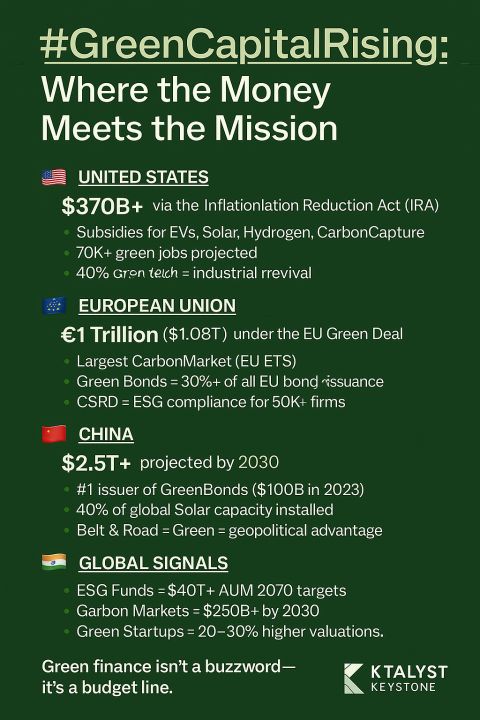
GreenCapitalRising: Where the Money Meets the Mission
The world isn’t just going green—it’s investing green. Here’s how India, US, EU, and China are reshaping global markets with trillions in GreenFinance:
🇺🇸 UNITED STATES
$370B+ via the Inflation Reduction Act (IRA)
Subsidies for EVs, Solar, Hydrogen, CarbonCapture
70K+ green jobs projected
GreenVC deals up 40% YoY
Future: Climate tech = industrial revival
🇪🇺 EUROPEAN UNION
€1 Trillion (~$1.08T) under the EU Green Deal
Largest CarbonMarket (EU ETS)
Green Bonds = 30%+ of all EU bond issuance
CSRD = ESG compliance for 50K+ firms
Future: ESG = license to operate
🇨🇳 CHINA
$2.5T+ projected by 2030
1 issuer of GreenBonds ($100B in 2023)
40% of global Solar capacity installed
Belt & Road = Green Infrastructure
Future: Green = geopolitical advantage
🇮🇳 INDIA
Needs $240B/year to hit 2070 targets
FY23 GreenInvestments: $30B
SovereignGreenBonds launched
Focus: EVs, Hydrogen, AgriWaste, Solar
Future: Green = growth + inclusion
🌍 GLOBAL SIGNALS
ESGFunds = $40T+ AUM globally
CarbonMarkets = $250B+ by 2030
GreenStartups = 20–30% higher valuations
GreenFinance isn’t a buzzword—it’s a budget line.
If you’re not building for this shift, you’re betting against the market.
Originally published on LinkedIn on 2025-04-02 11:55:39: https://www.linkedin.com/feed/update/urn%3Ali%3AgroupPost%3A2474261-7313167229670297602
#️⃣ Sustainability Compliance or Competitive Edge? The Rising Demand for ESG Advisory
🌍 Sustainability is No Longer a Choice—It’s a Business Mandate. With global ESG (Environmental, Social, and Governance) regulations tightening, companies are turning to specialized sustainability consultants to navigate compliance, mitigate risks, and unlock new growth opportunities.
🔍 # Why is ESG Consulting Booming?
📈 6% Growth in Sustainability Consulting (2024-25) – The demand for ESG advisory is projected to rise as companies adjust to new disclosure norms. (Source: FT)
📈 # $2 Trillion in Global Climate Investments – A significant surge in funds directed towards renewable energy, infrastructure, and ESG-driven innovation. (Source: WSJ)
📈 # 50,000+ Companies Impacted by EU CSRD – The Corporate Sustainability Reporting Directive (CSRD) expands compliance requirements beyond financial disclosures, affecting supply chains worldwide.
📈 # 40% Reduction in Scope 3 Emissions – Leading companies like Mastercard are already driving sustainability transformations, proving that ESG is more than a compliance burden—it’s a profitability driver. (Source: TIME)
📉 # The Risk_of_Inaction
🟠 # Fines, Reputation Damage & Investor Backlash – Non-compliance with ESG norms isn’t just a regulatory issue—it can cost businesses millions in penalties and lost investments.
🟠 Greenwashing Scrutiny is Increasing – Governments and watchdogs are cracking down on misleading sustainability claims, making authentic ESG action more critical than ever.
🟠 Banks Are Reducing ESG Roles – While companies are hiring ESG consultants, financial institutions like Barclays and Wells Fargo are scaling back dedicated sustainability teams, signaling shifting priorities in the corporate world.
🏆 Sustainability as a Competitive Advantage
🔵 Companies that move beyond compliance and integrate sustainability into their core strategy are:
✔ Building stronger investor confidence 💰
✔ Enhancing brand reputation & consumer trust 🌱
✔ Driving cost efficiencies through resource optimization ♻️
✔ Attracting & retaining top talent 👥
💡 # What’s Your ESG Strategy? Are you simply meeting compliance requirements, or are you leveraging sustainability to build long-term resilience and profitability? 🚀


Originally published on LinkedIn on 2025-03-02 05:24:18: https://www.linkedin.com/feed/update/urn%3Ali%3AgroupPost%3A2474261-7301834718403084290
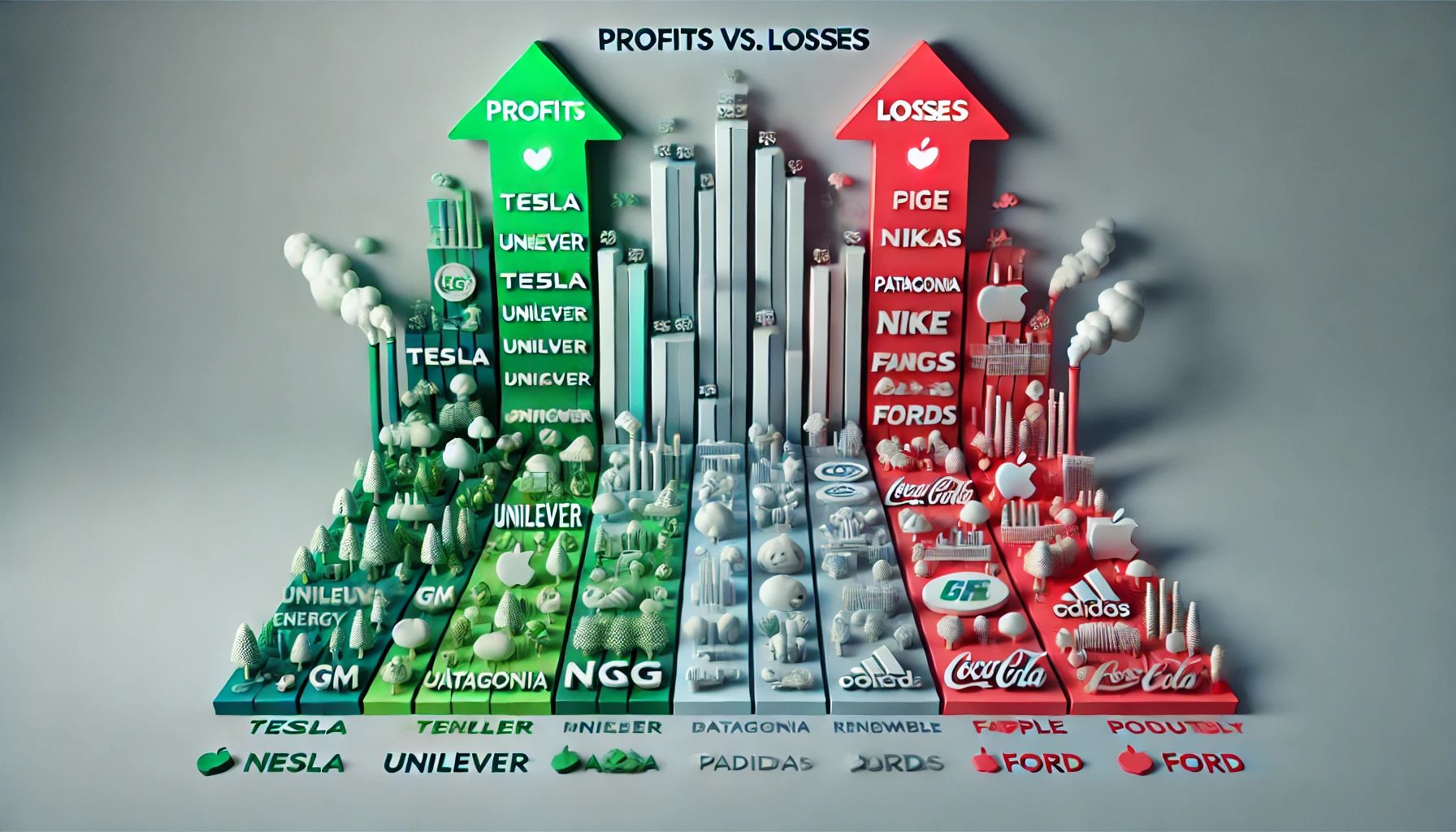
Sustainability Wars: Profits of the Bold, Losses of the Blind
Sustainability isn’t just a buzzword—it’s the defining strategy for profitability in modern business. These 10 examples showcase how companies that embraced sustainability secured financial success, while competitors who hesitated faced staggering losses and shrinking market share.
📊 1. Unilever vs. Procter & Gamble (P&G)
Unilever: Sustainable brands grew 69% faster, saving #€1 billion by 2020.
P&G: Lost #$8 billion in 2023, struggling to appeal to eco-conscious consumers in Europe.
📊 2. Tesla vs. General Motors (GM)
Tesla: EV dominance earned #$12.6 billion net income (2022) and an 800% valuation increase in 5 years.
GM: EVs accounted for just 2% of revenue (2022), causing a 25% market share drop in China.
📊 3. IKEA vs. Wayfair
IKEA: Renewable energy and circular practices saved #€2 billion and grew customer loyalty by 25%.
Wayfair: Suffered #$1.5 billion losses (2022) due to unsustainable operations.
📊 4. Patagonia vs. Columbia Sportswear
Patagonia: Eco-friendly initiatives helped achieve #$1 billion annual revenue and build brand trust.
Columbia: Lost 15% market share between 2020-2023 to Patagonia due to lack of sustainability focus.
📊 5. Walmart vs. Target
Walmart: Energy efficiency saved #$1 billion annually, cutting operational costs significantly.
Target: Reported a #$2 billion profit dip (2022) due to slower sustainability adoption.
📊 6. Nike vs. Adidas
Nike: Flyknit technology saved 60% material costs, generating #$3.5 billion in savings.
Adidas: Faced a #€500 million revenue loss (2023) from delayed sustainable innovations.
📊 7. Apple vs. Samsung
Apple: 100% renewable energy adoption fueled record #$394 billion revenue (2022) and 40% brand equity growth.
Samsung: Lost 15% EU market share, criticized for lagging in renewable energy initiatives.
📊 8. Microsoft vs. Oracle
Microsoft: Sustainability efforts drove 27% Azure growth (2023), securing eco-conscious enterprise clients.
Oracle: Missed #$1.2 billion in contracts, trailing in cloud services for sustainability-focused industries.
📊 9. PepsiCo vs. Coca-Cola
PepsiCo: Water-saving initiatives saved #$80 million annually, stabilizing global supply chains.
Coca-Cola: Lost #$2 billion (2022) due to water mismanagement protests and plant shutdowns in India.
📊 10. Toyota vs. Ford
Toyota: Sold 16 million hybrid vehicles, generating #$70 billion in cumulative profits.
Ford: Lost 10% market share (2020-2023) due to delayed EV and hybrid innovations.
The Bottom Line
Companies that lead with sustainability strategies not only maximize profits but also future-proof their business. Those that delay or ignore the shift face crippling losses in revenue, market share, and reputation.
SustainabilityWins GreenGrowth ProfitWithPurpose CorporateLeadership
Originally published on LinkedIn on 2025-01-24 05:11:11: https://www.linkedin.com/feed/update/urn%3Ali%3AgroupPost%3A82951-7288423065552609280

