🚗⚡ EV KnowledgeSeries – Global_Perspective
🔋 What is an EV?
🔹 Uses electric motors for propulsion, reducing fossil fuel dependency.
🔹 Lowers carbon footprint, improves energy efficiency.
🔌 Types of EVs
🔋 BEVs: Fully electric, no fuel. ⚡ Tesla Model 3, Nissan Leaf
🔋 HEVs: Fuel + electric motor, self-charging. 🚗 Toyota Prius, Honda City e:HEV
🔋 PHEVs: Can be externally charged + fuel engine. 🔌 BMW 330e, Mitsubishi Outlander PHEV
🔋 FCEVs: Hydrogen fuel cell-powered. 💧 Toyota Mirai, Hyundai Nexo
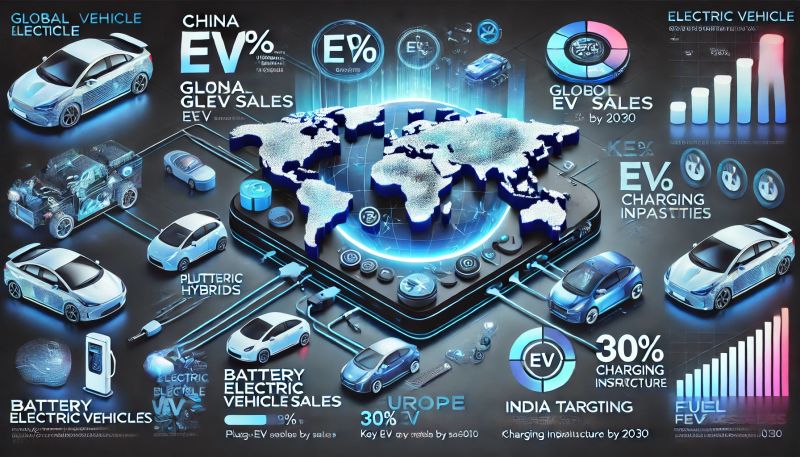
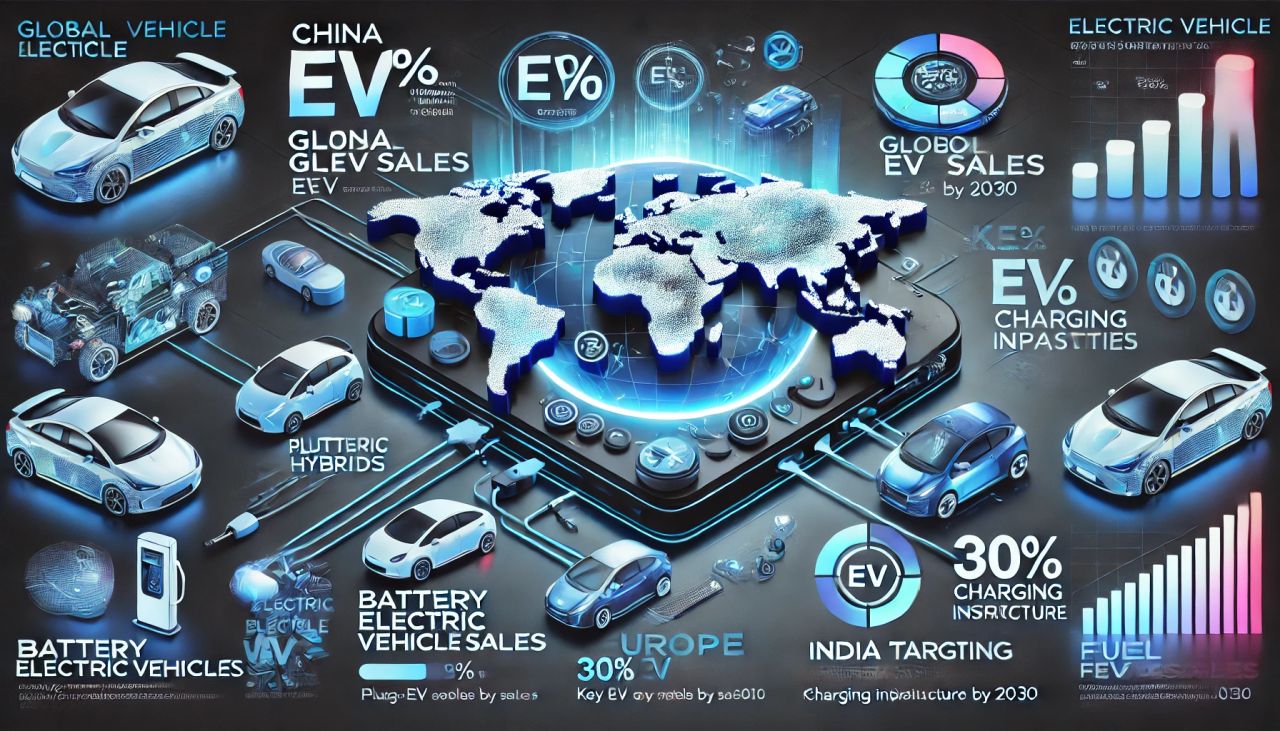
📈 Global EV Market Trends
🔹 #🌍 Market Share (2024)
🔋 China: 🇨🇳 60% global EV sales.
🔋 Europe: 🇪🇺 30%+ EV adoption, Norway 80% EV sales.
🔋 USA: 🇺🇸 Rapid Tesla-led expansion.
🔋 India: 🇮🇳 5% market share, 30% target by 2030.
🔹 #🚘 Top EV Brands (2024)
🔋 #🥇 BYD (China) – 3.0M units.
🔋 #🥈 Tesla (USA) – 2.5M units.
🔋 #🥉 Volkswagen (Germany) – 1.5M units.
🔋 #🏅 Hyundai-Kia (Korea) – 1.2M units.
🔋 #🎖 Tata Motors (India) – 200K units.
⚡ EV Charging Infrastructure
🔹 #🚀 Charging Types
🔋 AC Slow Charging: ⏳ 6-12 hours (home, public).
🔋 DC Fast Charging: ⚡ 30-60 mins (public stations).
🔋 Ultra-Fast Charging: 🚀 <15 mins (Tesla Superchargers).
🔹 #🌍 Global Charging Stats
🔋 China: 🇨🇳 5M+ chargers (largest).
🔋 Europe: 🇪🇺 2.5M+ chargers.
🔋 USA: 🇺🇸 800K+ chargers.
🔋 India: 🇮🇳 10K+ chargers, 1M target by 2030.
🏛 Government Policies & Incentives
🔹 #💰 EV Incentives (2024)
🔋 #🇺🇸 USA: $7,500 tax credit.
🔋 #🇨🇳 China: Subsidies + free EV license plates.
🔋 #🇪🇺 EU: CO₂ limits, ICE ban 2035.
🔋 #🇮🇳 India: FAME-II, 5% GST, state subsidies.
🔹 #🚫 Emission Regulations
🔋 EU: ICE ban by 2035.
🔋 California: 100% ZEVs by 2035.
🔋 China: 40% EV target by 2030.
🚧 EV Challenges & Solutions
🔹 #⚠️ Challenges
🔋 Battery Cost & Supply – Lithium shortage.
🔋 Charging Infra – Insufficient fast chargers.
🔋 Range Anxiety – Fear of running out of charge.
🔋 High Cost – EVs costlier than ICE cars.
🔋 Grid Strain – Rising power demand.
🔹 #💡 Solutions
🔋 #✅ Battery Innovation – Solid-state tech.
🔋 #✅ Faster Charging – Ultra-fast networks.
🔋 #✅ Policy Push – More subsidies & infra funding.
🔮 Future of EVs – What’s Next?
🔹 #📌 2030+ Predictions
🔋 #🔹 EVs = 40-50% of new sales.
🔋 #🔹 50% cheaper batteries.
🔋 #🔹 Hydrogen FCEVs for trucking.
🔋 #🔹 V2G tech: EVs power grids.
🔋 #🔹 Solar-powered EVs.
🚀 TheEVRevolutionIsNow SustainableMobility TheFutureIsElectric
Originally published on LinkedIn on 2025-03-10 13:29:07: https://www.linkedin.com/feed/update/urn%3Ali%3Ashare%3A7304855827301961729
KnowledgeSeries: The Future of CarbonCredits – A USD250B Market by 2050
The carboncredit market is no longer a side conversation—it’s becoming a mainstream financial instrument. With projections hitting #$250B by 2050, businesses and investors must pay attention.
Why? Because companies that integrate NetZero strategies today will gain a competitive edge, while those that don’t will face higher costs, regulatory risks, and shrinking investor confidence.
🌎 The Carbon Credit Boom: Why It’s a Business Imperative
✔️ The voluntary carbon market is set to grow 15X by 2030, reaching #$10B–$40B. (McKinsey)
✔️ Investments in carbon credits hit #$1.7B in 2023, up 50% YoY. (BloombergNEF)
✔️ 6,000+ global companies have set Science-Based Targets (SBTi), driving demand for verified carbon offsets.
✔️ Indonesia, Brazil, and Kenya are integrating carbon markets into their economies, generating revenue from forests, renewable energy, and carbon capture projects.
✔️ Article 6 of the ParisAgreement is enabling international carbon credit trading, boosting market credibility.
🚀 What does this mean for businesses?
✔️ A carbon credit strategy is no longer optional—it’s a business necessity.
✔️ Companies without a decarbonization plan will face higher compliance costs.
✔️ Investors are prioritizing NetZero leaders, making carbon credits a key ESG performance driver.
📊 Who’s Leading the Carbon Credit Race?
✔️ Big Tech & Carbon Capture:
Meta, Microsoft, and Google are securing multi-million-dollar deals in Direct Air Capture (DAC) to future-proof their carbon strategies.
✔️ Financial Institutions Going Green:
BlackRock, JP Morgan, and Goldman Sachs are launching climate-focused funds, treating carbon credits as an emerging asset class.
✔️ Corporate Adoption Soaring:
40%+ of Fortune500 companies are embedding carbon offsets into their business models.
✔️ Government-Led Action:
The EU, Singapore, and Japan are developing regulated carbon exchanges to ensure transparency & standardization.
🌱 What to Expect in 2025 & Beyond?
✔️ Stricter Regulations → Carbon credit verification will be tighter, reducing low-quality offsets & greenwashing risks.
✔️ Rising Prices → As demand outstrips supply, carbon credit prices could triple by 2030, making early adoption a smart financial move.
✔️ Emerging Markets in Play → Africa, Southeast Asia, and Latin America will dominate nature-based carbon solutions (reforestation, soil carbon, etc.).
✔️ Carbon as a Tradable Asset → Institutional investors are pushing for liquid carbon credit markets, making carbon a financialized commodity.
🔍 ComingUpNext: “The Business Case for Carbon Credits – Risks, Rewards & Strategy
Originally published on LinkedIn on 2025-03-08 07:02:05: https://www.linkedin.com/feed/update/urn%3Ali%3AgroupPost%3A82951-7304033651044839424
🚨 India’s EVRegulations 2025: What’s New & What It Means for the Industry? ⚡🚗
With EV sales in India growing 49% YoY, new regulatory shifts are shaping the future of the sector. The latest policies focus on local manufacturing, safety standards, & market expansion while setting new rules for charging infrastructure & import incentives. Here’s what’s changing:
📊 Key EV Policy Updates & Their Impact
🔹 Investment Caps on Charging Infrastructure
📌 The Indian Government now limits EV manufacturers to count only 5% of their total investment in charging networks toward the #$500M minimum investment required for lower import tariffs.
📌 Why It Matters? This ensures priority to local EV production, reducing reliance on imports. (Source)
🔹 Tesla’s Entry & Market Implications
📌 Tesla is setting up showrooms in Mumbai & New Delhi and exploring local production. However, high import duties (up to 100%) could push Tesla’s pricing into the luxury segment, making affordability a challenge.
📌 EV Market Reality: The average car price in India is #$10,000-$15,000, while a Tesla Model 3 would cost over #$50,000 without local assembly. (Source)
🔹 Stricter Safety & Battery Standards
📌 BIS (Bureau of Indian Standards) introduces new EV safety rules, requiring all EVs to meet upgraded performance & fire safety benchmarks.
📌 Battery Regulation: EV battery makers must obtain AIS 156 certification from ARAI (Automotive Research Association of India) to ensure safety compliance.
📌 Why It Matters? India aims to reduce EV fire risks, ensuring consumer safety and boosting market confidence. (Source)
🔹 Union Budget 2024-25: EV Industry Boost
📌 Customs duty exemptions on 25 critical minerals used in EV battery production will lower manufacturing costs.
📌 PLI (Production-Linked Incentive) expansion aims to reduce import dependency & boost domestic production.
📌 FAME III (Faster Adoption & Manufacturing of Electric Vehicles) is expected to focus on charging infrastructure expansion. (Source)
⚡ The Takeaway: What’s Next for India’s EV Industry?
🚀 EV penetration in India is at 2% but projected to hit 30% by 2030.
🚀 Government policies favor local EV manufacturing over imports.
🚀 Safety & compliance measures will shape consumer trust & adoption.
📢 Will these new regulations accelerate India’s EV transition or slow global players like Tesla? Let’s discuss! 👇
Source / shared link: https://m.economictimes.com/industry/renewables/govt-set-to-notify-new-ev-policy-with-new-investment-rules-as-tesla-prepares-for-india-entry/articleshow/118415610.cms
Originally published on LinkedIn on 2025-02-27 06:19:45: https://www.linkedin.com/feed/update/urn%3Ali%3AgroupPost%3A82093-7300761508139974656
🚨 CaseStudyAnalysis: “Volkswagen’s $1.4 Billion Tax Clash in India – A Wake-Up Call for MNCs & Policymakers?” 🚗💸
A stable tax system builds investor trust, but unpredictability drives them away.
Volkswagen, one of the world’s largest automakers, is battling a massive $1.4 billion tax dispute with Indian authorities over misclassification of imported car parts. This case is not just about one company—it reflects systemic tax challenges that impact FDI, business confidence, and India’s economic reputation.
🔍 WhatWentWrong?
📌 RegulatoryAmbiguity: India’s tax system lacks clear, consistent classifications. Volkswagen’s import methods were accepted for years before being reclassified.
📌 RetrospectiveTaxation: India has a history of sudden tax demands on MNCs (Vodafone – $2B, CairnEnergy – $1.2B), eroding investor trust. (Source: Reuters, 2025)
📌 LengthyLitigation: Tax disputes in India take an average of 7-10 years to resolve, delaying investments. (Source: EconomicTimes, 2025)
📌 PolicyShiftsWithoutClarity: Frequent rule changes without transition time force companies into costly legal battles.
🚀 HowIndiaCanImprove?
✅ PredictabilityInTaxation: Stable, transparent tax structures can boost FDI inflows beyond $80B/year. (DPIIT, 2025)
✅ Fast-TrackDisputeResolution: A dedicated tax tribunal for MNCs could cut dispute timelines by 60%. (NITIAayog, 2025)
✅ CustomsClarity: Pre-rulings on tax classifications will reduce compliance risks for 1,000+ global firms operating in India.
✅ InvestorConfidenceReforms: Proactive government engagement with MNCs could prevent capital flight (like SEAsia gaining $25B from exiting investors). (IMF, 2025)
✅ EaseOfDoingBusiness: India improved from Rank142 (2014) to Rank63 (2024) but still struggles with tax complexity. (WorldBank, 2025)
⚖️ TheBiggerPicture
Volkswagen’s case isn’t just about one company—it’s a test for India’s tax and regulatory future. Striking the right balance between RevenueMaximization and InvestorTrust is crucial for long-term economic stability.
💬 What’s your take? Are tax disputes a cost of doing business in India, or can better policies fix this? Let’s discuss! 👇
Originally published on LinkedIn on 2025-02-20 11:41:29: https://www.linkedin.com/feed/update/urn%3Ali%3AgroupPost%3A95089-7298305762500501504
NamasteGreenIndia’s DDGS Export Boom: USD 717 Million Market, But 2025 Holds the Key
The Surge: A 314% Export Boom
India is making waves in the global Distillers Dried Grains with Solubles (DDGS) market, a key ethanol byproduct used as animal feed. Here’s the story behind the numbers:
📦 1,212 shipments of DDGS in the last 12 months (314% growth).
🌏 Major buyers:
🇻🇳 Vietnam: 51% share.
🇳🇵 Nepal: 21% share.
🇺🇸 United States: 7% share.
💰 Market Value:
2023: USD 420.67 million.
2032 (Projected): USD 717.81 million (CAGR: 6.17%).
The Challenge: Falling Prices
Despite the export surge, the industry is battling a steep price drop:
🏷️ Domestic DDGS prices: #₹14–15/kg (~USD 0.17–0.18).
🌍 Global competition and oversupply are hitting margins hard.
1. Expanded Production Capabilities:
With ethanol blending targets set to increase to 20% by 2025, India’s DDGS production will reach record levels.
2. Market Diversification:
New export agreements with Africa, Southeast Asia, and Latin America are expected to reduce over-reliance on existing markets like Vietnam and Nepal.
3. Government Interventions:
Policies promoting minimum price guarantees and export incentives are likely to stabilize DDGS prices.
Focus on value-added DDGS products, such as enriched feed, to attract premium markets.
4. Sustainability Push:
Growing demand for sustainable feed solutions globally aligns perfectly with DDGS as a cost-effective, eco-friendly option.
Indian DDGS could gain significant traction in European markets following stricter feed sustainability regulations.
5. Technological Advancements:
Adoption of advanced processing techniques will improve DDGS quality and reduce production costs, ensuring competitiveness in global markets.
India is turning its ethanol growth into a global export advantage, but to sustain the momentum in 2025 and beyond:
🛠️ Strengthen Domestic Support: Build strategic reserves to manage price fluctuations.
🌍 Capture New Markets: Target countries with rising feed demand like Brazil, Indonesia, and Nigeria.
🚀 Lead the Sustainability Charge: Establish India as a key supplier of sustainable animal feed.
Why It Matters
India’s ethanol-driven DDGS market is poised for exponential growth in 2025. By embracing innovation, diversification, and sustainability, India can become a global powerhouse in the animal feed sector while ensuring long-term industry stability.
💬 Let’s connect to explore how IndiaExports and EthanolEconomy are setting the stage for a transformative 2025. 🚀
Originally published on LinkedIn on 2025-01-15 19:30:29: https://www.linkedin.com/feed/update/urn%3Ali%3Ashare%3A7285377825862283264
NamasteIndia_IOCL venture on compressed_biogas (CBG):
Partnership_Objective: Indian Oil Corporation Ltd. (IOCL) has teamed up with EverEnviro Resource JV focus compressed biogas (CBG). The project aims to utilize agricultural_waste, municipal_solid waste, and other organic_residues for CBG production, contributing to sustainable energy development in India.
Investment and Timeline: The initiative involves an investment of approximately $220 million USD.
YR2024-2025: The initial phase will involve setting up the first few CBG plants and securing feedstock supply agreements.
YR2026-2028: The expansion phase will establish a network of CBG plants across various regions.
YR2029 onwards: The project targets full-scale production, optimizing operations, and expanding distribution to meet growing demand.
Sustainability and Circular_Economy: The venture emphasizes sustainable waste management by turning organic waste into valuable energy. This approach supports a circular economy, reducing landfill use and promoting environmental conservation.
Economic and Job_Creation Impact: Establishing and operating CBG plants is expected to create jobs, especially in rural areas. This will support local economies and boost the agricultural and waste management sectors.
Alignment with National Energy Goals: The project aligns with India’s target to achieve 500 GW of non_fossil fuel-based energy by YR2030. CBG, as a renewable energy source, will play a significant role in reaching this goal while enhancing the country’s energy security.
Reduction in Import Dependence: By promoting indigenous biofuel production, the venture aims to lessen India’s reliance on imported fossil fuels, strengthening the nation’s energy independence.
Incentives and Government Support: The joint venture is part of the government’s Sustainable Alternative Towards Affordable Transportation (SATAT) scheme, which encourages CBG adoption through assured offtake agreements by oil marketing companies like Indian Oil. The scheme offers favorable policies to support biofuel infrastructure development.
Environmental Benefits: Using CBG will help reduce greenhouse gas emissions, improve air quality, and mitigate climate change by providing a cleaner-burning alternative to traditional fossil fuels like petrol and diesel.
This comprehensive strategy not only advances India’s clean energy transition but also brings significant economic, social, and environmental benefits.
Source / shared link: https://m.economictimes.com/industry/energy/oil-gas/indian-oil-partners-with-everenviro-for-joint-compressed-biogas-venture/articleshow/114246133.cms
Originally published on LinkedIn on 2024-10-17 18:26:06: https://www.linkedin.com/feed/update/urn%3Ali%3Ashare%3A7252746712501342208
ElectricVehicles growth anywhere in the world is fascinating. Also taking a look at Growth of EV Market in India
Rapid Growth: India’s EV market is expected to grow at a compound annual growth rate (CAGR) of 90% to reach $150 billion by 2030⁶.
Government Targets: India aims to achieve 30% EV sales in private cars, 70% in commercial vehicles, 40% in buses, and 80% in two-wheelers and three-wheelers by 2030⁶.
Sales Surge: In 2023, EV sales in India increased by 49.25%, reaching 1.52 million units⁶.
Charging Infrastructure: As of February 2024, there are 12,146 operational public EV charging stations nationwide, with Maharashtra having the highest number.
Market Value: The Indian EV market is projected to expand from $3.21 billion in 2022 to $113.99 billion by 2029, with a 66.52% CAGR.
Employment: The EV industry is expected to create around 50 million direct and indirect jobs by 2030.
IncreasedTax for Hybrid and EVs: The Indian government maintains a significant tax difference to promote electric mobility, with electric cars taxed at 5% and hybrid cars at 48%.
Originally published on LinkedIn on 2024-09-05 17:27:41: https://www.linkedin.com/feed/update/urn%3Ali%3AgroupPost%3A60128-7237511723660828673
NamasteIndia Bio-Bitumen Initiative: Step-by-Step savings of $1.2 billion USD by adding 35 % of Bio bitumin from Rice straw (legnin route)
1. Collection of Rice Straw:
After the rice harvest, rice straw is collected using stationary threshers or self-propelled combine harvesters. The straw is then transported to processing facilities.
2. Production of BioBitumen:
Praj Industries and Indian Oil Corporation (IOCL) are leading the way in producing bio-bitumen from biomass, such as paddy straw.
3. Government Promotion:
The Indian government, under Union Road Transport Minister Nitin Gadkari, is actively promoting the use of bio-bitumen to reduce carbon emissions and support the circular economy.
4. Mixing BioBitumen with Petrochemical Bitumen:
Companies like Aggregate Industries and Heidelberg Materials are conducting trials and developing methods to mix up to 35% bio-bitumen with traditional petrochemical bitumen.
5. Economic Benefits:
This initiative aims to save India around ₹10,000 crore annually, which is approximately $1.2 billion USD.
6. Environmental Impact:
By converting agricultural waste into bio-bitumen, this initiative helps reduce air pollution caused by stubble burning and promotes sustainable road construction.
This comprehensive approach not only supports sustainability but also offers significant economic and environmental benefits.
Source / shared link: https://m.economictimes.com/industry/transportation/airlines-/-aviation/indian-aviation-will-use-20-pc-biofuels-made-from-stubble-over-the-next-five-years-nitin-gadkari/articleshow/112345141.cms
Originally published on LinkedIn on 2024-08-08 19:31:29: https://www.linkedin.com/feed/update/urn%3Ali%3AgroupPost%3A2474261-7227396019523657728
NamasteCareerIndia landscape is undergoing a significant transformation, akin to a “factory reset.” Here’s what’s happening:
1. Manufacturing Sector Growth:
Over the past two years, India’s manufacturing sector has experienced robust job growth, surpassing the services sector.
Factors driving this turnaround include government incentives, increased domestic demand, and companies expanding their capacities¹.
The manufacturing industry is projected to create millions of jobs by 2024, contributing to India’s goal of becoming a global manufacturing hub.
2. Job Trends:
Manufacturing job growth has outpaced that of the services sector. From 2022 to 2024:
Manufacturing jobs expanded by 200% (from 29.83 million to 42.2 million).
Services sector jobs dropped by 35% (from 21.75 million to an estimated 46.3 million)¹.
Sectors covered include automobile, electronics, infrastructure, construction, textiles, and engineering.
3. Government Initiatives:
The introduction of production-linked incentive (PLI) schemes has fueled growth in manufacturing jobs.
As India aims to be a global manufacturing hub, the focus on job creation in this sector is crucial¹.
In summary, India’s factory reset on the jobs scene is reshaping employment dynamics, with manufacturing leading the way toward a more robust workforce¹. .
Source / shared link: https://m.economictimes.com/news/economy/policy/india-is-doing-a-factory-reset-on-the-jobs-scene/articleshow/112050761.cms
Originally published on LinkedIn on 2024-07-27 11:14:40: https://www.linkedin.com/feed/update/urn%3Ali%3AgroupPost%3A2635374-7222922334947430400
NamasteCareerIndia landscape is undergoing a significant transformation, akin to a “factory reset.” Here’s what’s happening:
1. Manufacturing Sector Growth:
Over the past two years, India’s manufacturing sector has experienced robust job growth, surpassing the services sector.
Factors driving this turnaround include government incentives, increased domestic demand, and companies expanding their capacities¹.
The manufacturing industry is projected to create millions of jobs by 2024, contributing to India’s goal of becoming a global manufacturing hub.
2. Job Trends:
Manufacturing job growth has outpaced that of the services sector. From 2022 to 2024:
Manufacturing jobs expanded by 200% (from 29.83 million to 42.2 million).
Services sector jobs dropped by 35% (from 21.75 million to an estimated 46.3 million)¹.
Sectors covered include automobile, electronics, infrastructure, construction, textiles, and engineering.
3. Government Initiatives:
The introduction of production-linked incentive (PLI) schemes has fueled growth in manufacturing jobs.
As India aims to be a global manufacturing hub, the focus on job creation in this sector is crucial¹.
In summary, India’s factory reset on the jobs scene is reshaping employment dynamics, with manufacturing leading the way toward a more robust workforce¹. .
Source / shared link: https://m.economictimes.com/news/economy/policy/india-is-doing-a-factory-reset-on-the-jobs-scene/articleshow/112050761.cms
Originally published on LinkedIn on 2024-07-27 11:14:31: https://www.linkedin.com/feed/update/urn%3Ali%3Ashare%3A7222922298507333632

