When Trust Becomes a Governance Question!
A vote can secure a chair. But can it secure credibility?
The unfolding Tata Sons boardroom controversy presents a fascinating paradox. An institution that built generations of credibility on trust now finds itself facing uncomfortable questions about transparency, independence and potential conflicts of interest.
The reported business relationships and voting decisions deserve objective scrutiny, not premature verdicts.
But one argument particularly catches my attention: “Disclosure was not legally required.
Perhaps.
Yet, since when did corporate governance become an exercise in discovering how little one is legally obliged to disclose, rather than how much stakeholders deserve to know?
Compliance is the minimum threshold. Credibility is the standard leadership chooses to uphold.
There is a fundamental distinction between the two.
For boards entrusted with safeguarding iconic institutions, independence cannot merely be a designation printed beside a director’s name. It must be demonstrated when loyalties overlap, interests intersect and decisions become uncomfortable.
And therein lies the corporate irony.
Companies spend billions building brands, millions managing reputations, and occasionally put both at risk over disclosures that would cost a fraction of either.
We measure financial risk, operational risk, market risk and even climate risk. Yet somehow, the risk of eroding institutional trust rarely gets the same rigorous stress test.
Tata’s greatest intangible asset has never been merely its brand. It is the trust behind that brand.
And trust is a peculiar asset.
It takes generations to build, moments to question, and cannot be restored simply by passing a boardroom resolution.
A majority vote can settle a decision. It cannot automatically settle the questions surrounding that decision.
Because ultimately, governance is not about proving that nothing illegal happened. It is about ensuring that nothing essential to trust was overlooked.
And unlike boardroom resolutions, credibility does not come with a proxy vote.
Dr. Anju Sharma
CorporateGovernance BoardIndependence BoardroomInsights KtalystInsights KtalystKlues™
Originally published on LinkedIn on 2026-10-08 08:49:00: https://www.linkedin.com/feed/update/urn%3Ali%3Ashare%3A7513883133524676608
When “G” in ESG detonates, it doesn’t whisper!
Dr. Anju Sharma MrsSustainability
We love talking about the comfortable parts of ESG.
✓Net-zero roadmaps.
✓Renewables.
✓Carbon accounting.
✓100-page sustainability reports.
But companies rarely unravel overnight because someone missed a Scope 3 target.
They unravel when Governance fractures.
Unclear authority → Contested mandates → Regulatory friction → Boardroom paralysis → Market repricing.
That is why G is not the third letter in ESG.
It is the operating system.
Tata is giving us a fascinating live case study.
For more than a century, the Tata model has stood for something unusual:
patient capital + professional management + philanthropic ownership + stakeholder purpose.
Beautiful architecture.
Until the architecture gets stress-tested.
1. Two hats. One board seat.
Tata Trusts owns roughly 66% of Tata Sons.
Its nominees sit on the Tata Sons board.
But here is the governance trap:
Does a nominee director represent the shareholder who appointed them or the company whose board they now sit on?
When Trust nominees take different positions on something as fundamental as chairman succession, that theoretical question suddenly becomes very real.
2. Governance looks simple… until people disagree.
Reserved matters.
Affirmative rights.
Majority of nominee directors.
Casting vote.
Four phrases that sound painfully boring.
Until billions of enterprise value start depending on what they actually mean.
Consensus hides weak governance architecture.
Conflict exposes it.
3. Regulation just entered the boardroom.
The Tata Sons listing issue is not simply:
IPO or no IPO?
It is much bigger.
It asks whether a century-old ownership model can coexist with a modern regulatory classification.
And when restructuring operating businesses becomes part of the answer, regulation is no longer sitting outside the company.
It is redesigning the corporate architecture.
4. Markets don’t wait for governance committees.
Boardrooms debate.
Lawyers interpret.
Shareholders negotiate.
Regulators examine.
Markets?
Markets reprice.
That is the brutal part of Governance risk.
The financial transmission often begins before the governance argument is resolved.
And that takes us to the real ESG question.
For generations, Tata’s philanthropic ownership provided stability, patience and purpose.
But the model now faces a difficult question:
How does a controlling charitable shareholder exercise stewardship without slowly becoming the management layer above the board?
Too little oversight becomes abdication.
Too much involvement becomes interference.
And somewhere between the two sits the most dangerous word in governance:
Ambiguity.
My takeaway?
The biggest governance risk is rarely making the wrong decision.
It is reaching the moment of decision & discovering nobody agrees on who actually has the right to make it.
Dr. Anju Sharma
Originally published on LinkedIn on 2026-10-01 08:41:48: https://www.linkedin.com/feed/update/urn%3Ali%3AgroupPost%3A38770045-7511344605750079488
KtalystFuelFlex Series 101:
The Macroeconomic Reality of Fuel Contamination
Fuel Flex is often misread as petty adulteration or local distributor malpractice.
That framing is no longer sufficient.
Modern fuel fraud operates as a systemic mechanism of fiscal leakage, subsidy capture, market distortion and climate-accounting failure. It weakens sovereign tax bases, diverts public incentives, penalizes legitimate market participants and puts green-transition credibility at risk.
The damage sits across four economic vectors:
1. Fiscal Leakage
Liquid fuels are high-volume, high-tax commodities. When untaxed or lower-taxed products are blended into commercial fuel streams, the state loses core fiscal yield. SARS estimates fuel adulteration drains approximately R3.6 billion annually from South Africa’s national fiscus.
2. Subsidy Capture
In green fuel markets, weak verification can turn policy support into an extraction mechanism. In the Washakie Renewable Energy case, a coordinated conspiracy generated $1.16 billion in fraudulent biofuel tax credits and extracted $511 million in IRS cash payouts.
3. Market Capture
Fraudulent or weakly verified supply creates artificial cost advantage. Under the U.S. Renewable Fuel Standard, the EPA Office of Inspector General identified nearly 339 million fraudulent RINs, linked to $87 million in illicit transactions. Ghost compliance supply dilutes legitimate credit value and undermines genuine producers.
The risk is also visible in global feedstock flows. Reuters reported that Chinese used cooking oil imports into the U.S. surged from under 200 million pounds per year to over 3 billion pounds in 2023, raising concerns around origin fraud, subsidy eligibility and domestic feedstock displacement.
4. Climate Distortion
The deepest risk is not only economic. It is atmospheric.
When fossil or high-emission pathways are misdeclared as renewable, carbon ledgers become unreliable. The European Commission’s 2025 review of Chinese biodiesel fraud allegations did not confirm intent to defraud, but it did identify systemic weaknesses in supply-chain certification audits.
That matters.
Because if the audit system cannot guarantee traceability, climate accounting becomes fragile.
The conclusion is simple:
Fuel fraud is not leakage.
It is economic extraction through weak authentication.
This is why the sector must move beyond asking:
Is the fuel marked?
The better question is:
Can the molecule, feedstock, custody route, carbon claim and money trail be independently authenticated?
Marked is not enough.
Certified is not enough.
Authenticated is the new minimum.
Dr. Anju Sharma
Originally published on LinkedIn on 2026-06-24 16:41:21: https://www.linkedin.com/feed/update/urn%3Ali%3Ashare%3A7475588889861214208
ISSBUpdate: GreenReport as a Growth Passport
Dr. Anju Sharma MrsSustainability
ISSB is turning sustainability data into market access, capital confidence & boardroom strategy.
This is a power shift.
For years, sustainability reporting asked one question:
What do we disclose?
ISSB ₹changes the question.
Can the organisation produce sustainability information that investors can trust, boards can use, lenders can assess, and markets can price?
Very different game.
IFRS_S1 and IFRS_S2 have moved sustainability from the sidelines into the core of enterprise strategy.
This is no longer about pretty ESG narratives, annual report polish, or green language wearing a finance suit.
It is about:
✓ Decision-useful data
✓ Financial materiality
✓ Controls and assurance
✓ Capital allocation
✓ Market confidence
✓ Board accountability
✓ Customer and lender credibility
The signal is impossible to ignore:
✓ 39_jurisdictions are adopting or moving toward ISSB-aligned standards
✓ The UK has issued UK SRS S1 and S2
✓ Brazil is heading into mandatory ISSB-based reporting for listed companies
✓ Australia, Japan, Singapore, and Malaysia are progressing through phased roadmaps
✓ SASB enhancement work is pushing disclosures closer to sector-specific investor relevance
This is bigger than compliance.
It is the shift from:
× ESG storytelling
✓ Sustainability governance
× Climate data collection
✓ Climate-related financial disclosure
× Annual reporting
✓ Year-round control environments
× Departmental ownership
✓ Enterprise accountability
× Regulatory response
✓ Strategic readiness
The organisations that win this transition will not be the ones with the longest sustainability report.
They will be the ones with the strongest data spine:
Jurisdiction → Standard → Metric → Financial Materiality → Controls → Assurance → Market Access
KtalystKlues™ for boards and leadership teams:
✓ Map current disclosures to ISSB, SASB, BRSR, ESRS, and local rules
✓ Fix data ownership before fixing the narrative
✓ Connect sustainability risks to financial outcomes
✓ Build assurance-ready processes now, not later
✓ Treat sustainability information as enterprise intelligence
ISSB is not asking companies to report more.
It is asking them to become more credible.
The green report is becoming a growth passport.
And every passport needs stamped proof.
KtalystInsights™: The next sustainability advantage will not belong to the company with the loudest promise.
It will belong to the company whose proof can travel the farthest.
Two steps back, but three forward for sustainability reporting – https://lnkd.in/dVpqYivn
Originally published on LinkedIn on 2026-05-27 10:20:39: https://www.linkedin.com/feed/update/urn%3Ali%3Ashare%3A7465346222258577408
Greenwashing a Behaviour: What Makes You Choose It?
Dr. Anju Sharma MrsSustainability
(Inspired by the Forbes EZ Lynk write-up)
Greenwashing: Not just in your brochure.
✓ Sometimes it is product design.
✓ Sometimes it is a loophole.
✓ Sometimes it is a customer promise.
✓ Sometimes it is a digital tool that quietly says,
I only enabled the option. I did not choose how people used it.
A recent Forbes report on the DOJ demanding data from Apple, Google, Amazon & Walmart on more than 100K users linked to the EZ Lynk car-tuning app opens a bigger question than one company, one app, or one emissions case.
For me, the deeper sustainability question is:
When does innovation become evasion?
Every company loves the word innovation. It sounds clean, modern & future-ready. Yet innovation without behavioural accountability can become a polished escape route.
A product may be sold as freedom, tuning, diagnostics, flexibility or customer empowerment.
Yet when used differently, the same product may weaken emissions compliance, increase environmental harm & shift responsibility from manufacturer to user.
This is where greenwashing becomes more than false advertising, now it’s behaviour.
✓It begins when a company knows the grey zone & still chooses to live inside it.
✓It begins when ambiguity becomes profitable.
✓It begins when compliance is treated as a legal obstacle, not a design principle.
The EZLynk casestudy for new anatomy of greenwashing.
It’s no longer limited to “eco-friendly” claims on packaging.
It can sit inside software, app stores, aftermarket ecosystems, customer forums, data trails, hardware plugs & coded permissions.
Greenwashing: LabelToLogic
For serious companies, greenwashing risk is not just a reputation threat.
It can become a governance advantage.
The real question is no longer:
Can we market this as green?
It is:
Can we prove it cannot easily become dirty?
A responsible company must ask:
✓ Is misuse foreseeable?
✓ Are guardrails built in?
✓ Are users & distributors aligned?
✓ Is the claim backed by measurable proof?
Greenwashing is a behavioural choice.
It chooses convenience over correction, silence over warning, & clever wording over ethical clarity.
The future ESG question is not only:
What did you emit?
It is also:
What did you enable?
So the shift is clear:
✓From green claims to green controls.
✓From ESG storytelling to ESG engineering.
✓From “we didn’t intend misuse” to “we designed against misuse.
My view is simple:
Greenwashing is not born in marketing.
It is born in behaviour.
The cure is not a slogan.
The cure is cleaner courage”. Dr. Anju Sharma
MrsSustainability KtalystInsights™ KtalystKlues™ KtalystGreenLove Ktalyst5Ps5Es
https://lnkd.in/dbWH7Deb
Source / shared link: https://www.forbes.com/sites/thomasbrewster/2026/05/14/government-demands-apple-and-google-identify-over-100000-users-of-car-app/
Originally published on LinkedIn on 2026-05-16 02:28:42: https://www.linkedin.com/feed/update/urn%3Ali%3Ashare%3A7461241187933241345
NamasteIndia 🇮🇳 AISummitIndia Everyone’s TrainingModels!
Dr. Anju Sharma | MrsSustainability | KtalystInsights™ | KtalystKlues™
The development of full artificial intelligence could spell the end of the human race.” StephenHawking
Is our nation Training_a_CivilizationStack?
AI looks like code. It behaves like capital. It survives on electricity.
And it collapses without governance.
Most nations are India is building AIRain
Let’s walk the clouds. (pun intended)
1️⃣ Governance population-scale
Aadhaar: 1.4B+ IDs | 2.2–2.5B authentications/month
UPI: 21.6B txns (Dec 2025) | ₹28 lakh crore (~USD 337B) monthly
ONDC CoWIN DigiLocker GSTN
✓ AI governance at 1.4B scale
✗ Interoperability friction
⚠ Policy velocity gaps
2️⃣ Health
Ayushman Bharat Digital Mission
National Health ID rails
AI diagnostics pilots
✓ Stack-ready backbone
✗ Rural infra gaps
⚠ AI without consent = trust erosion
Identity without health is incomplete intelligence.
3️⃣ Education
DIKSHA: 100M+ learners
Adaptive AI learning
Multilingual digital stack
✓ Exportable education rails
✗ Device + bandwidth divide
⚠ Replacing teachers instead of augmenting
Intelligence must scale in language — not just logic.
4️⃣ Finance
228B UPI txns in 2025
₹299.7 lakh crore (~USD 3.6T) annual value
Account Aggregator
AI-driven MSME credit
Programmable money at sovereign scale.
✓ Real-time financial rails
✗ Concentration risk
⚠ DataComa = dashboards without accountability
Money rails are powerful.
Energy rails are existential.
5️⃣ Green
262 GW non-fossil capacity
~50 GW added in 2025
₹2 lakh crore (~USD 24B) RE investment
Silicon runs on electrons.
Electrons must be clean.
✓ AI + renewables = resilience
✗ Emissions data fragmentation
⚠ Fossil-heavy AI data centres
As MrsSustainability:
AI without green baseload is strategic fragility.
6️⃣ Work & Labor
SaaS exports + gig platforms
AI integration in IT services
Digital labour marketplaces
✓ Labor-augmenting opportunity
✗ Skill polarisation risk
⚠ Productivity without reskilling
Demographic dividend must become demographic intelligence.
7️⃣ Industry & Services
Manufacturing digitisation + Industry 4.0 pilots
PLI-backed semiconductor, electronics & EV ecosystems
AI in logistics, ports & supply chains
Services = ~55%+ of GDP
Factories are data centres with conveyor belts.
✓ Export leverage + margin expansion
✗ Energy intensity pressure
⚠ AI adoption without productivity metrics
Industrial AI is national competitiveness.
✗ Power shortages
✗ Fragmented execution
⚠ Over-centralised infra + DataComa
🎯 TheBet
Models trend.
Infrastructure compounds.
Energy decides.
And India?
Is building AI civilization corridors.
True intelligence is not artificial.
It is accountable.
Dr. Anju Sharma
Source / shared link: https://www.bloomberg.com/news/newsletters/2026-02-16/india-s-ai-ambitions-under-scrutiny-at-ai-summit-in-new-delhi
Originally published on LinkedIn on 2026-02-16 13:16:22: https://www.linkedin.com/feed/update/urn%3Ali%3Ashare%3A7429151659462856704
✈️ When_Indi_No_Go:
Dr. Anju Sharma ESG_POV (with a Devil’s Advocate Lens)
1️⃣ The ESG Lens: Resilience Is Compliance
December 2025 proved ESG isn’t “extra paperwork.” IndiGo hit a Social + Governance stress test, not a technical glitch.
✓ Social: Rested pilots = safety device. Families on floors = “S” warning.
✓ Governance: FDTL wasn’t a surprise; buffers were mandatory.
✓ Environmental: The only silent stakeholder.
Devil’s Advocate:
Is this ESG failure or ESG language applied to a classic capacity + complexity miscalculation across the ecosystem?
2️⃣ What Was Said vs What Was Heard
CEO & Chairman were unusually honest “blemish,” “regret,” “nothing engineered.
They admitted:
✓ Roster transition gaps
✓ Underestimating fatigue rules
✓ Hiring slower than scheduling
✓ Weather + tech + congestion as multipliers
✓ Early board involvement
✓ External audits
DGCA responded:
✓ Officers at IndiGo HQ
✓ Real-time oversight of fatigue, rosters, refunds
✓ 10% schedule cut for stability
Devil’s Advocate:
If FDTL was known, did IndiGo alone misjudge?
Or did regulator + airports + India Inc’s growth bias underestimate the hit on lean systems?
Numbers:
✓ 3,000–4,000 flights disrupted
✓ Refunds > ₹1,100 crore (≈ USD 132M)
✓ DGCA embedded
✓ 10% flight cut mandated
Takeaway:
No villain just a pile of “we’ll manage” assumptions collapsing together.
3️⃣ MyPOV: A Governance Reality Check, Not an Ops Failure
Aviation held up a mirror to India Inc.
✓ Worship of lean staffing
✓ Scale mistaken for immunity
✓ Optimistic scheduling
✓ Adjustable compliance mindset
✓ Regulators expected to accommodate
IndiGo forgot a foundational rule:
Redundancy isn’t inefficiency — it’s resilience. With ~60% market share, you’re critical infrastructure, & such systems fail visibly, not quietly.
Devil’s Advocate:
Have we over-romanticised “lean” while ignoring that buffers, backups & boredom are the real foundations of resilience?
4️⃣ The GeopoliticalAmplifier
Aviation never sits outside geopolitics. In 2025:
✓ Middle East corridor shifts
✓ Engine & spare-part constraints
✓ China–EU–India delivery delays
✓ Fuel volatility
✓ Pilot shortages
✓ Winter expat surges
The Real Question:
✓ Did global turbulence amplify IndiGo’s fragility?
or
✓ Did thin internal margins exaggerate normal pressures?
Devil’s Advocate:
Are we blaming “geopolitics” because it sounds smart when the real issue is running hot, fast, and thin?
5️⃣ Final Thought: The Exam Isn’t for IndiGo, It’s for India Inc
IndiGo promises “actions, not words.
But the bigger question: Are Indian industries flying too close to the sun on lean staffing, fragile systems, and optimism-led planning? The next rule safety, labour, data, climate, carbon won’t check readiness. It will test it.
Devil’s Advocate:
Is your business truly resilient
or one regulation away from its own Indi-No-Go moment?
Originally published on LinkedIn on 2025-12-11 05:27:00: https://www.linkedin.com/feed/update/urn%3Ali%3AgroupPost%3A121193-7404753548846272512
🌐 TheNewEra: Sky_has_New_Regulators
Atmospheric Governance
Dr. Anju Sharma
KtalystInsights | MrsSustainability)
Climate governance has quietly changed hands not from governments to corporations, but from disclosures to detection.
A new constellation of climate-intelligence networks ClimateTRACE, GHGSat, WattTime, CarbonPlan, Earthrise, OceanMind is now shaping global credibility through data physics, not promises.
1️⃣ The Global ClimateIntelligence Infrastructure
1. Scale of Observation
a. 300+ satellites track CO₂, CH₄, NO₂, aerosols, forest loss.
b. 11,500+ sensors map methane, biomass, oceans, heat signatures.
c. 72,000+ industrial facilities monitored for real-time footprints.
2. Global Coverage
a. Climate TRACEmaps 352 million emission sources.
b. GHGSat detects methane plumes as small as 25–50 metres.
c. WattTime assesses carbon intensity across 210+ grids (~99% of global consumption).
3. Open-Source Transparency
a. APIs, dashboards, real-time alerts.
b. No permission needed — emissions become public the moment they occur.
c. Accountability shifts from reported → visible.
2️⃣ What the Data Is Revealing
1. Methane Reality
US & China methane emissions: 2–3× higher than official inventories.
2. Land-Use & Deforestation Truths
a. Indonesia’s peatland emissions: 41% higher than reported.
b. Brazil’s Amazon: 23–32% underreported in specific zones.
c. CarbonPlan flagged 30 million tCO₂ in California offsets as over-credited.
3. Electricity Emissions (Scope 2 Reality)
a. India peaks: 950–1,050 gCO₂/kWh.
b. EU wind/solar hours: <150 gCO₂/kWh.
c. China provinces: 500–1,200 gCO₂/kWh.
3️⃣ Why This Matters for Boards & CEOs (The Governance Shift)
1. Impact Ratings Will Change
a. Satellite-mapped methane leaks enter ESG ratings.
b. Deforestation alerts reshape commodity risk scores.
c. Offset validity recalibrated by scientific audits.
2. Transition Risk Gets Priced
a. Methane super-emitters flagged as high-risk assets.
b. CBAM applies actual emissions, not disclosed ones.
3. Litigation & Compliance Accelerate
a. Satellite evidence strengthens cases of misreporting.
b. Maritime emissions benchmarked through AIS + radar data.
4️⃣ Impact, Challenge & Risk — The Reality Check
1. Impact
a. Atmospheric due diligence replaces sustainability storytelling.
b. Real-time detection influences policy & procurement.
c. Investors reward transition truth with premium valuations.
2. Challenges
a. Many countries lack capability to interpret satellite data.
b. Cross-border plume attribution sparks political friction.
c. Corporate inventories lag behind detection cycles.
3. Risks
a. Green-claim invalidation becomes common.
b. Offset portfolios risk devaluation.
c. CBAM penalises opaque or inaccurate disclosures.
The energy world is shifting from narratives to evidence & those who thrive will be the ones whose climate claims already match what the satellites see.
Originally published on LinkedIn on 2025-11-18 21:44:03: https://www.linkedin.com/feed/update/urn%3Ali%3Ashare%3A7396664512910704640
🔍 Article68 & UNCharter68 When Systems Say “It’s Time” 🌐 KtalystInsights
🖋️“Some numbers end tasks. Others end terms.
68 marks the transition—
from power to process,
from position to purpose—
with grace and legality.
Dr. Anju Sharma | MrsSustainability
🇺🇳 UN Charter – Article_68
Empowers ECOSOC to create commissions in human rights, economic, and social fields.
✅ Led to creation of the UN Human Rights Council, gender equality bodies, and more.
📌 68 = Institutional backbone for rights & development.
⚖️ Constitutional Article_68
🇮🇳 NamasteIndia: Fill VP vacancy immediately.
🇫🇷 France: Presidential impeachment process?
🇰🇷 Korea: Constitutional complaint rights?
🇧🇪 Belgium: Senate election rules?
🇸🇮 Slovenia: Foreigners’ property rights?
Re_Tirement Age 68 (2025)
🇬🇧 UK: State pension age moving to 68 (for those born post-1977).
🇩🇰 Denmark: Retirement age becomes 68 by 2030.
📈 Drivers: Longevity ↑ | Pension stress ↑
💬 68 = Legal sunset for working life.
Originally published on LinkedIn on 2025-07-22 15:12:38: https://www.linkedin.com/feed/update/urn%3Ali%3Ashare%3A7353441852106096640
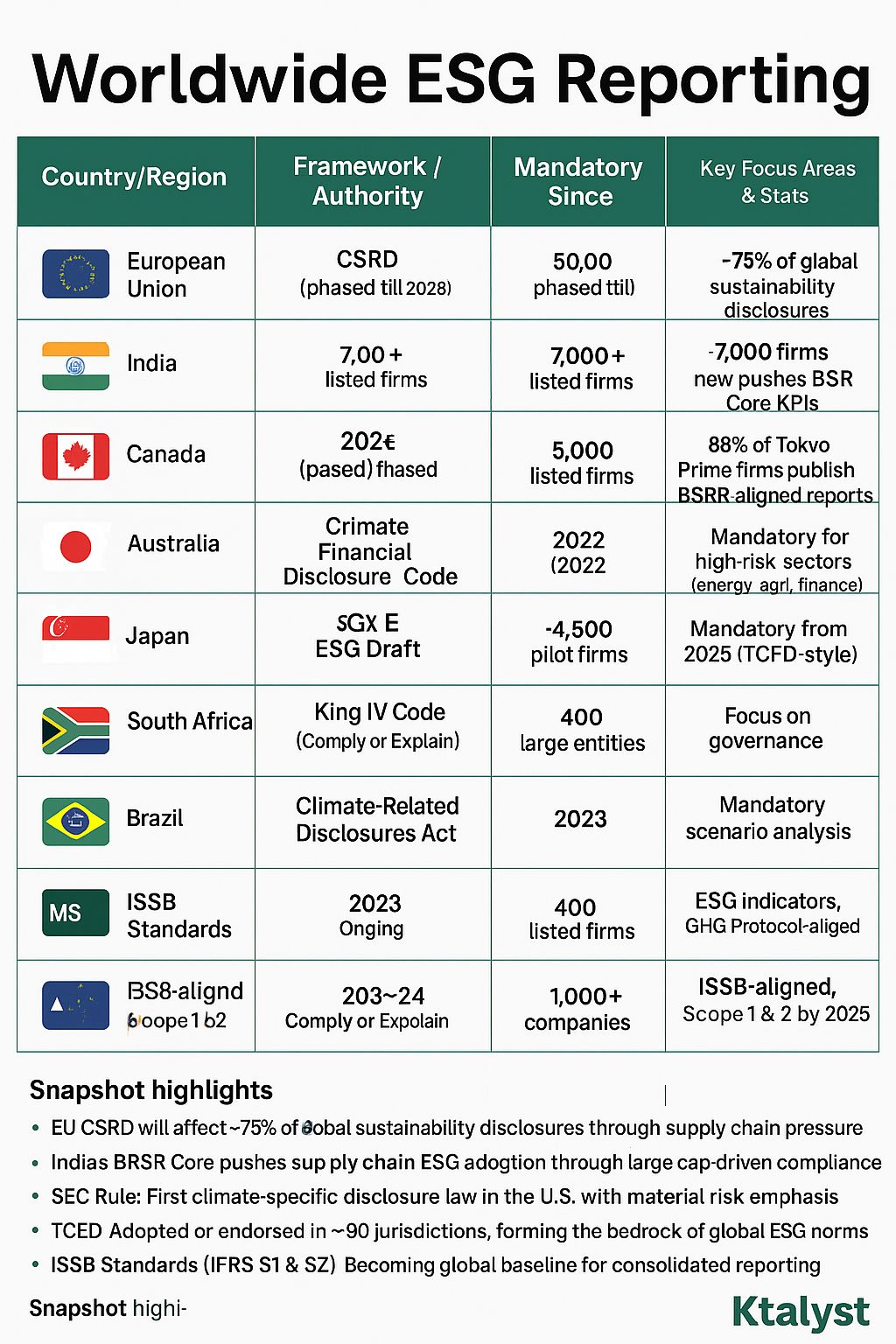
Why ESG Isn’t a Global Roadmap—It’s a Country_by_Country_Compass
ESG Isn’t One-Size-Fits-All—It’s One-Strategy-Fits-Nation
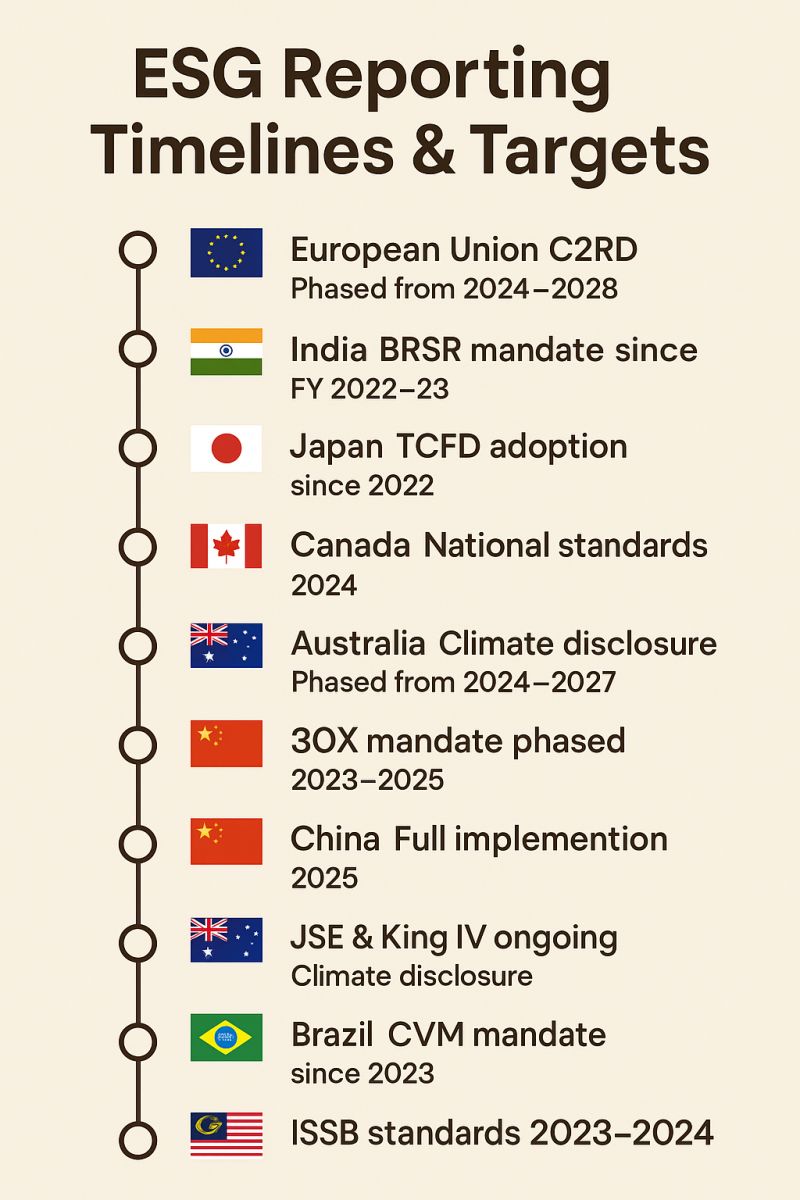
ESG reporting takes different roads because nations prioritize differently—economic maturity, regulatory style, investor pressure, and trade exposure all shape the path. The EU leads with CSRD—affecting 50,000+ firms through double materiality, taxonomy alignment, and mandatory assurance. The US sticks to financial materiality and climate risk, sidestepping Scope 3 and S&G. India’s BRSR ties ESG to development goals, starting with the top 1,000 and easing into assurance. Export-driven China, Malaysia, and Singapore accelerate ESG to meet global buyer expectations and bypass EU CBAM fallout. Japan prefers voluntary codes; South Africa excels in governance (King IV), but lacks integrated data.
Bottom line? ESG mirrors what each country values—growth, governance, global edge, or green capital. It’s not just compliance—it’s strategy, sovereignty, and survival.
🇪🇺 European Union
Timeline: CSRD phased from 2024 to 2028
Mandatory from:
2024: Large public-interest companies
2025: All large companies
2026–28: SMEs (limited scope)
FunFact: Will impact 75%+ of global ESG reporting indirectly via supply chains
🇺🇸 United States
Timeline: SEC Rule effective 2024–2025
Mandatory from:
FY2024: Large Accelerated Filers
FY2025: Accelerated Filers
Scope 3? Only if material (and still debated)
🇮🇳 India
Timeline:
BRSR mandatory since FY 2022–23
BRSR Core with limited assurance from FY 2023–24
Next up: Potential rollout for mid-size unlisted companies by 2026
🇯🇵 Japan
Timeline:
TCFD adoption by Prime listed firms since 2022
No fixed law, but >80% of large firms are already onboard voluntarily
🇨🇦 Canada
Timeline:
CSA rule aligned with TCFD from 2024
Mandated for:
Publicly listed entities, expanding coverage gradually
🇦🇺 Australia
Timeline:
Climate Disclosure Framework phased from July 2024
Rollout:
2024: Large companies
2026–27: Mid and small entities
🇸🇬 Singapore
Timeline:
SGX ESG reporting mandatory since 2023
Sector phased:
Energy, Agri, Finance by 2024
All others by 2025
🇨🇳 China
Timeline:
Draft ESG rules under CSRC in 2024
Target:
Full mandatory rollout by 2025
Pilots ongoing in green finance and energy sectors
🇿🇦 SouthAfrica
Timeline:
JSE & King IV apply ongoing since 2016
Mandate:
Comply or explain” model, no fixed year — but tightening expected by 2025
🇳🇿 NewZealand
Timeline:
Climate-Related Disclosure Act enforced from 2023
Applies to:
Financial institutions & large corporates (>NZ$1B AUM or turnover)
🇧🇷 Brazil
Timeline:
CVM ESG disclosure mandatory since 2023
Focus:
Annual reporting, with increasing pressure for Scope 3 inclusion by 2026
🇲🇾 Malaysia
Timeline:
ISSB-aligned standards adopted in 2023–2024
Mandated by:
Bursa Malaysia, full Scope 1–2 by 2025, Scope 3 optional till 2026


Originally published on LinkedIn on 2025-04-21 21:59:46: https://www.linkedin.com/feed/update/urn%3Ali%3AugcPost%3A7320204627323289601

