TARIFF SHOCKWAVES: INDIA AT THE CROSSROADS OF TRADE & STRATEGY
The 26% blow to Indian exports isn’t just a trade shock—it’s a wake-up call to diversify, digitize, and diplomatically reset our global strategy before the door to developed markets narrows further.
AnjuSharma, MD, KtalystKeystone
What Happened?
📌 10% universal tariff on all U.S. imports announced by President Trump
📌 India hit with 26% tariff on electronics, auto parts, gems, textiles & aluminium
📌 87% of India’s $66B U.S. exports impacted
📌 Estimated annual loss: $6–7 billion
Big 4 Speak Out
💬 PwC: “Tariff retaliation could balloon from $76B to $697B globally
💬 KPMG: “This isn’t trade policy—it’s political performance
💬 EY: “India must restructure global sourcing strategy immediately
💬 Deloitte: “Tariffs will inject stagflation into already strained supply chains
Financial Titans React
💸 Goldman Sachs:
Auto and textile exporters will bleed
Kroger, Valvoline may survive — India’s top B2B exporters will face margin heat
💹 Bloomberg Intelligence:
India risks losing emerging export edge to Vietnam & Mexico
📰 Wall Street Journal:
U.S. tariffs may trigger a regional pivot — India’s FTA urgency just jumped five notches
Market Pulse: Dalal Street Feels the Heat
📉 GIFT Nifty down 350+ pts
📉 Auto, IT, Jewellery, Aluminium stocks see heavy selling
📈 Shift towards domestic FMCG & retail as safe havens
What’s Next for India?
⚙️ Bilateral trade deal in pipeline by Fall 2025
🌍 Explore Middle East, Africa & ASEAN for export realignment
🛠️ Invest in supply chain localization + logistics infrastructure
📜 Fast-track FTA negotiations with EU, UK & Pacific allies
Final Takeaway
🚨 Tariffs aren’t just taxes—they’re tectonic shifts.
India must act with policy agility, strategic diversification, and bold diplomacy to stay ahead in a reshuffled global order.
Total Estimated Exposure
Indian Exports to U.S. Affected: ~$57–60 billion
Percentage of Total Indian Exports to U.S. Affected: ~87%
Estimated Annual Economic Loss: $6–7 billion
Trade Response & Outlook
Commerce Ministry View: “It’s a mixedbag, not a setback
Negotiation Status: Bilateral trade agreement targeted for Fall 2025
Market Impact:
GIFT Nifty: -350 pts (near 23,000)
Auto & IT stocks: Broad selling
Export-heavy stocks (like Titan, Motherson, Hindalco): Underperforming
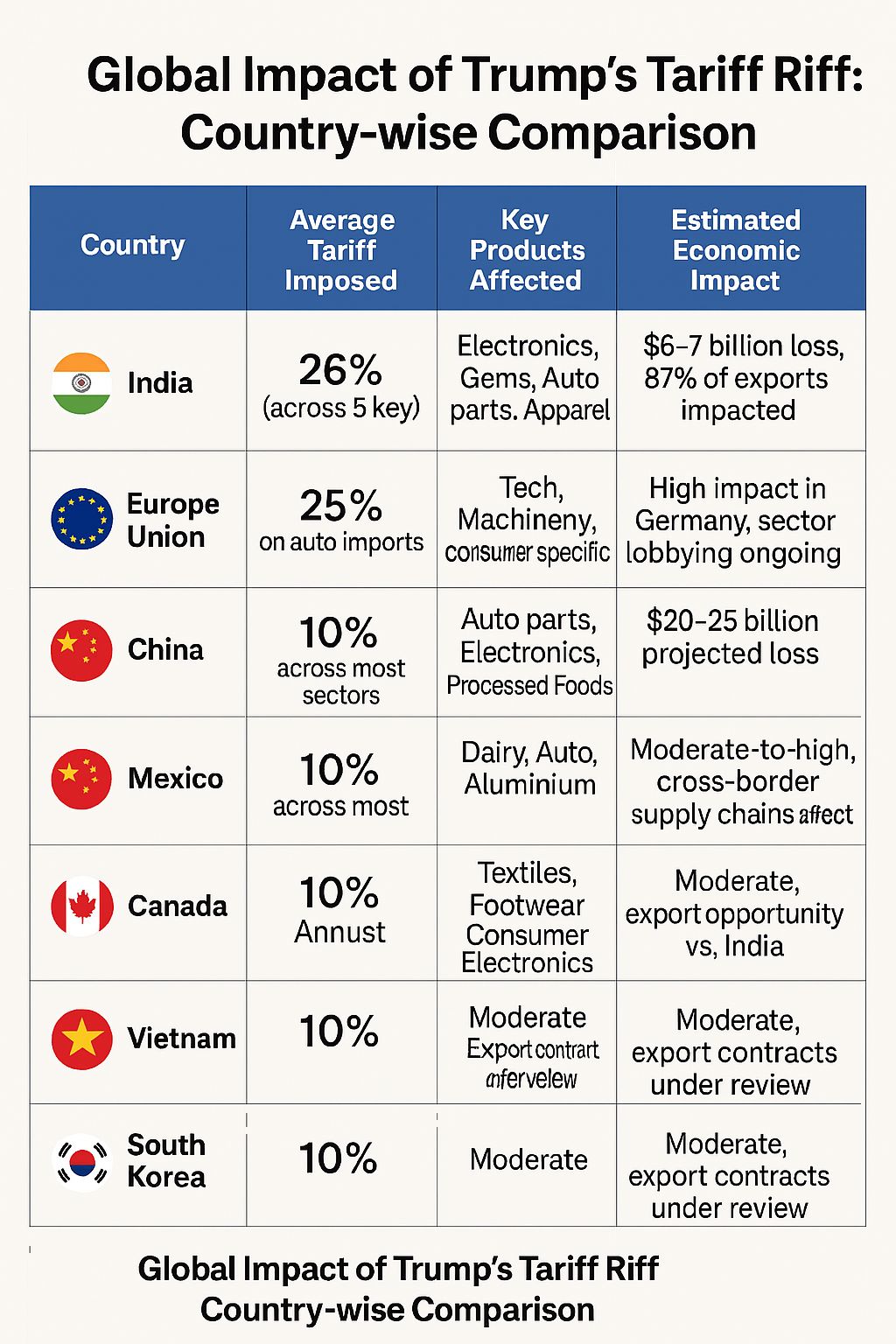
Originally published on LinkedIn on 2025-04-03 04:42:34: https://www.linkedin.com/feed/update/urn%3Ali%3Ashare%3A7313420627510464512
KnowledgeSeries: The Future of CarbonCredits – A USD250B Market by 2050
The carboncredit market is no longer a side conversation—it’s becoming a mainstream financial instrument. With projections hitting #$250B by 2050, businesses and investors must pay attention.
Why? Because companies that integrate NetZero strategies today will gain a competitive edge, while those that don’t will face higher costs, regulatory risks, and shrinking investor confidence.
🌎 The Carbon Credit Boom: Why It’s a Business Imperative
✔️ The voluntary carbon market is set to grow 15X by 2030, reaching #$10B–$40B. (McKinsey)
✔️ Investments in carbon credits hit #$1.7B in 2023, up 50% YoY. (BloombergNEF)
✔️ 6,000+ global companies have set Science-Based Targets (SBTi), driving demand for verified carbon offsets.
✔️ Indonesia, Brazil, and Kenya are integrating carbon markets into their economies, generating revenue from forests, renewable energy, and carbon capture projects.
✔️ Article 6 of the ParisAgreement is enabling international carbon credit trading, boosting market credibility.
🚀 What does this mean for businesses?
✔️ A carbon credit strategy is no longer optional—it’s a business necessity.
✔️ Companies without a decarbonization plan will face higher compliance costs.
✔️ Investors are prioritizing NetZero leaders, making carbon credits a key ESG performance driver.
📊 Who’s Leading the Carbon Credit Race?
✔️ Big Tech & Carbon Capture:
Meta, Microsoft, and Google are securing multi-million-dollar deals in Direct Air Capture (DAC) to future-proof their carbon strategies.
✔️ Financial Institutions Going Green:
BlackRock, JP Morgan, and Goldman Sachs are launching climate-focused funds, treating carbon credits as an emerging asset class.
✔️ Corporate Adoption Soaring:
40%+ of Fortune500 companies are embedding carbon offsets into their business models.
✔️ Government-Led Action:
The EU, Singapore, and Japan are developing regulated carbon exchanges to ensure transparency & standardization.
🌱 What to Expect in 2025 & Beyond?
✔️ Stricter Regulations → Carbon credit verification will be tighter, reducing low-quality offsets & greenwashing risks.
✔️ Rising Prices → As demand outstrips supply, carbon credit prices could triple by 2030, making early adoption a smart financial move.
✔️ Emerging Markets in Play → Africa, Southeast Asia, and Latin America will dominate nature-based carbon solutions (reforestation, soil carbon, etc.).
✔️ Carbon as a Tradable Asset → Institutional investors are pushing for liquid carbon credit markets, making carbon a financialized commodity.
🔍 ComingUpNext: “The Business Case for Carbon Credits – Risks, Rewards & Strategy
Originally published on LinkedIn on 2025-03-08 07:02:05: https://www.linkedin.com/feed/update/urn%3Ali%3AgroupPost%3A82951-7304033651044839424

