KtalystKlues™ PurpleElephant Impact Theory
When everyone can see the impact but nobody can clearly explain what is causing what ie The PurpleElephant. Dr. Anju Sharma
MiddleEast conflict is the visible elephant.
1 | THE ELEPHANT
Middle East conflict
The headline event dominates attention.
2 | THE SHADOW
The conflict changes the economics of moving and making molecules:
Crude ↑ → Gas ↑ → Naphtha/LPG ↑ → Freight ↑ → Insurance ↑ → FX & financing pressure ↑
This is the first-order cost shock.
3 | THE ECHO
Those costs travel through the chemical value chain:
Feedstock → Basic Chemicals → Intermediates → Specialty/Formulation → Manufacturing → End Markets
But transmission is not equal.
A cracker feels the shock differently from a specialty chemical producer.
A polymer converter feels it differently from a fertilizer producer.
And the customer may refuse to absorb the entire increase.
That is where the economics become interesting.
4 | THE MARGIN_TRAP
The key question is not:
How much did the feedstock price rise?
It is:
How much of that increase could actually be passed through?
If:
Cost inflation > Selling-price increase
the difference lands directly in the P&L.
Feedstock ↑
Energy ↑
Freight ↑
Insurance ↑
Financing ↑
while price pass-through remains incomplete.
The result:
Gross Margin ↓ → EBITDA ↓ → Cash Conversion ↓ → ROCE ↓
This is why the central panel moves deliberately from cost to profit, rather than stopping at supply disruption.
5 | THE DISTORTION
Once margins weaken, behaviour changes.
Companies begin to:
delay CAPEX
reduce inventories
change suppliers
substitute feedstocks
renegotiate contracts
cut operating rates
or shut marginal capacity.
Now the response to the shock becomes another economic shock.
6 | THE MACRO_MULTIPLIER
Lower chemical-sector profitability does not stay within the chemical industry.
It moves downstream:
Chemical inflation → Manufacturing cost ↑ → Consumer/industrial prices ↑ → Inflation ↑ → Monetary pressure ↑ → Consumption & CAPEX ↓ → Industrial production ↓ → GDP growth ↓
This is the PurpleElephant.
The conflict is visible.
But the larger board-level risk may be the slow destruction of competitiveness caused by sustained margin compression, lower utilisation and weaker investment.
The PurpleElephant Paradox™
Visibility ≠ Materiality.
The first impact makes the headline.
The second changes the P&L.
The third changes behaviour.
The fourth changes the economy.
So whenever the economic story looks obvious, ask:
What moved?
What did it move?
Who absorbed it?
What could not be passed through?
What behaviour changed?
Where does the impact finally land?
Because the biggest risk is rarely the elephant everyone is pointing at.
It is the chain of consequences behind it.
KtalystKlues™ | Find the Purple Elephant before it finds the balance sheet.
Originally published on LinkedIn on 2026-09-13 14:30:25: https://www.linkedin.com/feed/update/urn%3Ali%3Ashare%3A7504909353414615041
🌍 GeopoliticalFlashFloodIndex (GFFI)3Decade 11Events
Dr. Anju Sharma | MrsSustainability | KtalystInsights
Geopolitical crises no longer move slowly. They behave like flash floods, transmitting through the global economy in a predictable sequence:
Conflict → Energy → Markets → Capital → SupplyChains
🌐 11Largest GeopoliticalShocks (1999–2024)
Ranked by Geopolitical Flash Flood Index (GFFI)
1️⃣ Russia–Ukraine War (2022) | GFFI 2.4
European gas crisis • Oil & LNG spikes • Grain disruption → inflation
2️⃣ COVID Global Shutdown (2020) | GFFI 2.3
Production freeze • Financial crash • Logistics paralysis
3️⃣ 9/11 Terror Attacks (2001) | GFFI 2.0
Market shutdown • Aviation collapse • Security restructuring
4️⃣ Iraq War (2003) | GFFI 1.8
Oil volatility • Middle East instability • Supply chain repricing
5️⃣ Saudi Aramco Abqaiq Attack (2019) | GFFI 1.7
5% global oil supply disrupted overnight
6️⃣ Crimea Annexation (2014) | GFFI 1.6
Sanctions on Russia • Energy market uncertainty
7️⃣ U.S.–China Trade War (2018) | GFFI 1.5
$350B tariffs • Supply chain migration
8️⃣ Red Sea Shipping Crisis (2024) | GFFI 1.5
Suez disruption • Insurance surge • Africa rerouting
9️⃣ Arab Spring Oil Disruptions (2011) | GFFI 1.4
Libyan oil collapse • Brent spike
🔟 Kosovo War (1999) | GFFI 1.3
NATO intervention • European instability
1️⃣1️⃣ Israel–Hamas War (2023) | GFFI 1.3
Middle East risk premium • Energy shipping risks.
📊 What 3DecadeData Reveals
1️⃣ Energy transmits the shock first
~30% global seaborne oil via Hormuz
~12% global trade via Suez
~20% LNG through Middle East routes
Energy shocks rapidly become inflation shocks.
2️⃣ Markets before governments
Markets reprice geopolitical risk within hours. Policy responses follow weeks later.
Financial volatility becomes the first alarm system.
3️⃣ SupplyChains move slowest
Structural adjustments take years, not months:
Europe’s gas diversification after 2022
China+1 manufacturing shift
Red Sea reroutes adding 10–15 days
Resilience competes with efficiency.
Geopolitical crises rarely destroy companies, execution dysfunction does. Resilient organizations practice five strategic habits:
✔ Signal Intelligence – treat energy, freight, insurance spikes as early signals
✔ Scenario Discipline – rehearse geopolitical shocks in advance
✔ Coordinated Execution – align finance, procurement, logistics
✔ Networked Supply Chains – multi-route sourcing and logistics
✔ Margin Strategy – protect pricing power and portfolio resilience
The difference between crisis and opportunity is reaction speed.
GFFI Geopolitical Flash Flood Index
GFFI = 0.30E + 0.25M + 0.20C + 0.20S + 0.05P
E = Energy Shock
M = Market Repricing
C = Capital Rotation
S = Supply Chain Impact
P = Policy Lag
Higher score, faster systemic disruption. ( for Customized versions ping us)
Originally published on LinkedIn on 2026-03-04 06:29:35: https://www.linkedin.com/feed/update/urn%3Ali%3Ashare%3A7434847493542039552
NamasteIndia with HPCL’s H2_PSA: We enter the Global Licensor League
Quiet milestone. Big signal.
Hindustan Petroleum Corporation Limited is now Bharat’s FIRST and the WORLD’s THIRD licensor of HydrogenPSA (Pressure Swing Adsorption) technology.
This is refinery-proven, indigenously engineered hydrogen purification.
What HPCL’s PSA does
✔️ Upgrades refinery off-gases (70–75% H₂)
✔️ Delivers >99.5% pure hydrogen
✔️ Feeds hydrocrackers, hydrotreaters & CCR units
✔️ Commercially running at Vizag Refinery since 2015
With EngineersIndiaLimited as its exclusive commercialization partner, HPCL has moved from user → owner → licensor.
🌍 Global Hydrogen PSA Licensor Landscape (context)
1️⃣ Honeywell UOP (USA)
✔️ Polybed™ PSA benchmark
✔️ 1,000+ refinery-scale installations globally
✔️ Decades of process licensing dominance
2️⃣ Linde (Germany)
✔️ Deep syngas + hydrogen integration
✔️ Strong refinery and gasification linkages
✔️ Engineering-led PSA optimisation
3️⃣ NOW HPCL Hindustan Petroleum Corporation Limited (India)
✔️ Fully indigenous adsorbents + PLC logic
✔️ Designed by a refiner, for refiners
✔️ Scaled for commercialization via EIL
4️⃣ AirProducts (USA)
✔️ High-reliability hydrogen networks
✔️ Industrial hydrogen leadership
✔️ Strong PSA deployment across sectors
5️⃣ AirLiquide (France)
✔️ Tight petrochemical integration
✔️ Hydrogen + gases portfolio strength
✔️ Refinery and chemical complex focus
Why this matters (beyond headlines)
🔹 ~85% of refinery hydrogen purification globally uses PSA
🔹 Hydrogen demand is rising before green hydrogen fully scales
🔹 Import substitution in core refinery tech = energy security
🔹 Brown hydrogen efficiency today enables green hydrogen tomorrow
KtalystInsight:
India didn’t jump straight to green-hydrogen slogans.
It fixed the hydrogen backbone first—purification, reliability, and control.
That’s how real energy transitions are built.
One unit. One license. One system at a time.
Dr. Anju Sharma | MrsSustainability | KtalystInsights™
GreenVrsGreen
DataComa
Originally published on LinkedIn on 2026-02-02 07:08:18: https://www.linkedin.com/feed/update/urn%3Ali%3Ashare%3A7423985599792955392
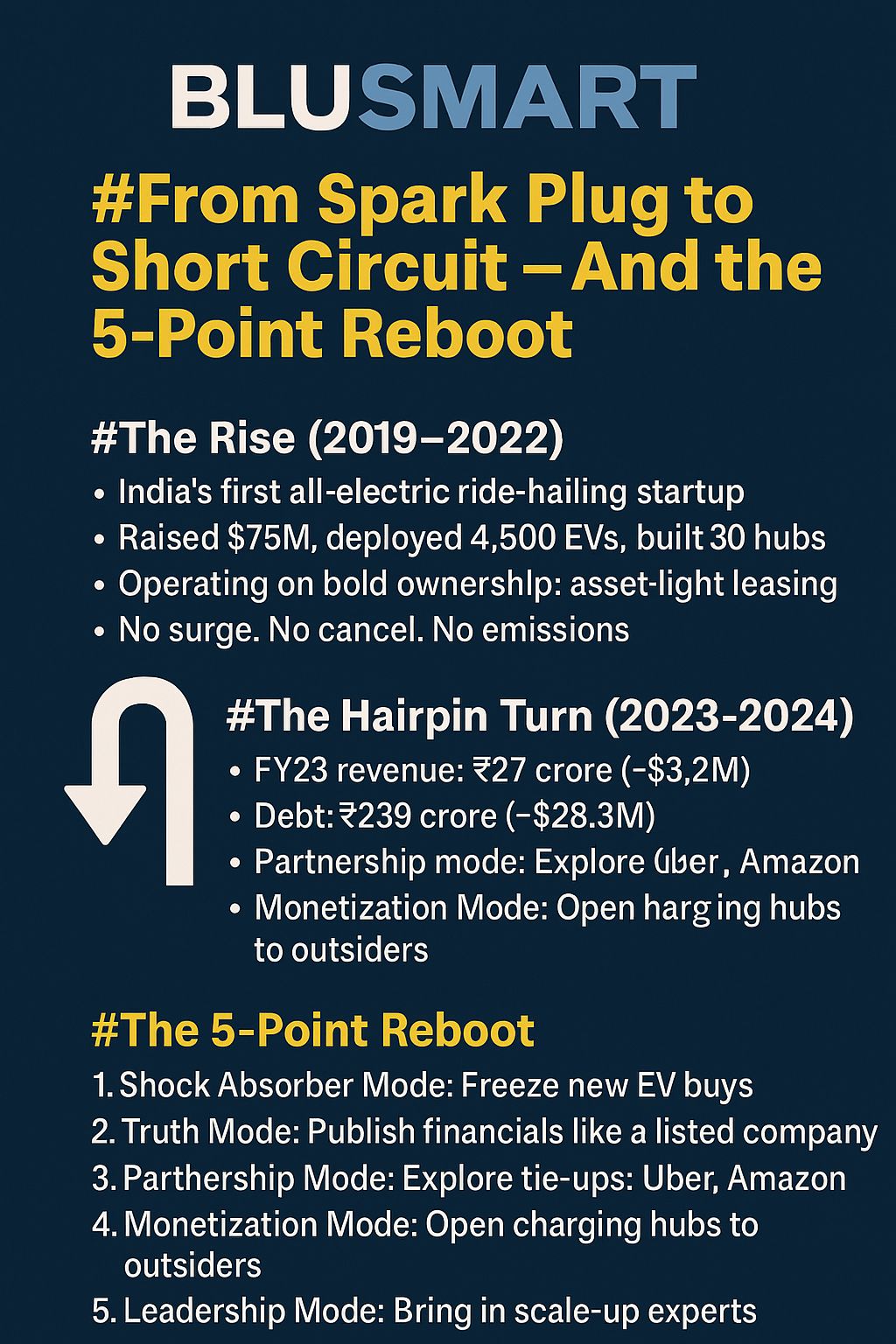
BluSmart: From Spark Plug to Short Circuit – A 5-Point Reboot
Rise, Ride & Reckoning
⚡ 2019–2021 | Launch
India’s first all-electric ride-hailing service. Raised #$75M. Deployed 4,500+ EVs. Built 30+ charging hubs. Bold move: ownership over leasing. Tagline: No surge. No cancel. No emissions.
🌿 2021–2022 | Momentum
Strong ESG branding, high urban trust, and premium experience.
⛔ 2023–2024 | Slump
Revenue: #₹27 crore (~USD 3.2M)
Liabilities: #₹239 crore (~USD 28.3M)
Failed EV asset sale (3,000 units)
Credit rating downgrade
Leadership exits
The 5-Point Comeback Compass
1. 🔧 Debt Restructure
Pause expansion, renegotiate terms, stabilize burn.
Ktalyst: Debt isn’t doom—bad structure is.
2. 🔍 Transparency
Publish quarterly financials and dashboards. Regain investor trust. Ktalyst: Honest numbers outpace hopeful noise.
3. 🤝 Strategic Partners
Explore tie-ups with Uber, Amazon, infra players. Enable co-branded EV ops.
Ktalyst: Survival is a shared drive.
4. 💰 Monetize Infra
Lease fleet, open charging hubs, sell FaaS and analytics.
Ktalyst: Idle assets = silent leaks. Make them earn.
5. 🧠 Leadership Reset
Bring turnaround talent. Form an ESG-savvy board.
Ktalyst: Founders start the fire. Fixers steer the flame.
12_Month Recovery Plan
0–2 Months: Restructure, pause new spends
3–5 Months: Lease EVs, monetize hubs
6–8 Months: Relaunch brand, share impact data
9–11 Months: Raise #$25–30M, secure JV
12 Months: Relaunch BluSmart 2.0 with 60% utilization
Case in Point: Netflix 2011
Lost 800K users after pricing split. Stock fell 77%.
Rebounded via honesty, streaming focus & brand reset.
Ktalyst Parallel: Design, not denial, drives turnarounds.
Final Word:
BluSmart isn’t broken. It’s paused. And ready to be Recharged.


Originally published on LinkedIn on 2025-04-01 19:33:06: https://www.linkedin.com/feed/update/urn%3Ali%3AgroupPost%3A82093-7312919961037934592
BluSmart: From SparkPlug to ShortCircuit – A 5_PointReboot
Rise, Ride & Reckoning
⚡ 2019–2021 | Launch
India’s first all-electric ride-hailing service. Raised #$75M. Deployed 4,500+ EVs. Built 30+ charging hubs. Bold move: ownership over leasing. Tagline: No surge. No cancel. No emissions.
🌿 2021–2022 | Momentum
Strong ESG branding, high urban trust, and premium experience.
⛔ 2023–2024 | Slump
Revenue: #₹27 crore (~USD 3.2M)
Liabilities: #₹239 crore (~USD 28.3M)
Failed EV asset sale (3,000 units)
Credit rating downgrade
Leadership exits
The 5_Point Comeback Compass
1. 🔧 Debt Restructure
Pause expansion, renegotiate terms, stabilize burn.
Ktalyst: Debt isn’t doom—bad structure is.
2. 🔍 Transparency
Publish quarterly financials and dashboards. Regain investor trust. Ktalyst: Honest numbers outpace hopeful noise.
3. 🤝 Strategic Partners
Explore tie-ups with Uber, Amazon, infra players. Enable co-branded EV ops.
Ktalyst: Survival is a shared drive.
4. 💰 Monetize Infra
Lease fleet, open charging hubs, sell FaaS and analytics.
Ktalyst: Idle assets = silent leaks. Make them earn.
5. 🧠 Leadership Reset
Bring turnaround talent. Form an ESG-savvy board.
Ktalyst: Founders start the fire. Fixers steer the flame.
12_Month Recovery Plan
0_2Months: Restructure, pause new spends
3_5Months: Lease EVs, monetize hubs
6_8Months: Relaunch brand, share impact data
9_11Months: Raise #$25–30M, secure JV
12Months: Relaunch BluSmart 2.0 with 60% utilization.
Case in Point: Netflix 2011
Lost 800K users after pricing split. Stock fell 77%.
Rebounded via honesty, streaming focus & brand reset.
Ktalyst Parallel: Design, not denial, drives turnarounds.
Final Word:
BluSmart isn’t broken. It’s paused. And ready to be Recharged.
Originally published on LinkedIn on 2025-04-01 19:29:05: https://www.linkedin.com/feed/update/urn%3Ali%3AgroupPost%3A4023031-7312918948415442944
📚 KnowledgeSeries: Corporate Governance – The Backbone of Sustainable Business 🏛📊
In a world where #$5T+ market value losses are linked to governance failures, Corporate Governance isn’t just a boardroom discussion—it’s a business imperative. Strong governance drives transparency, accountability, and investor confidence.
📊 The Pillars of Corporate Governance
🟢 Accountability → 88% of investors prioritize governance in decision-making. (Source)
🟢 Transparency → 80% of corporate fraud cases stem from weak governance.
🟢 Independence → 47% of global board seats are now occupied by independent directors.
🟢 Ethical Leadership → Companies with strong ethics policies outperform peers by 14% in shareholder returns. (Source)
📅 Latest Corporate Governance Trends (2024-2025)
🟢 ESG Integration: 67% of global firms now link executive compensation to ESG performance.
🟢 Board Diversity: The EU mandates 40% women on boards for large companies by 2026.
🟢 AI & Governance: 52% of corporate risk officers see AI governance as a top priority. (Source)
🔍 High-Profile Governance Shifts
🟢 7-Eleven Japan → Appoints first-ever foreign CEO, marking a boardroom culture shift.
🟢 Julius Baer → Reshuffles leadership amid financial stability concerns.
🟢 BP’s Policy Reversal → Investors call out governance gaps as BP shifts focus back to fossil fuels. (Source)
🔥 The Takeaway: Governance = Growth + Stability
📌 Weak governance costs companies billions—investors are watching.
📌 Diversity & ESG-linked pay are shaping leadership decisions.
📌 AI & corporate ethics are the next frontiers in governance risk.
📢 What governance reforms should companies focus on next? Let’s discuss! 👇

Originally published on LinkedIn on 2025-03-04 08:46:57: https://www.linkedin.com/feed/update/urn%3Ali%3Ashare%3A7302610490927542274
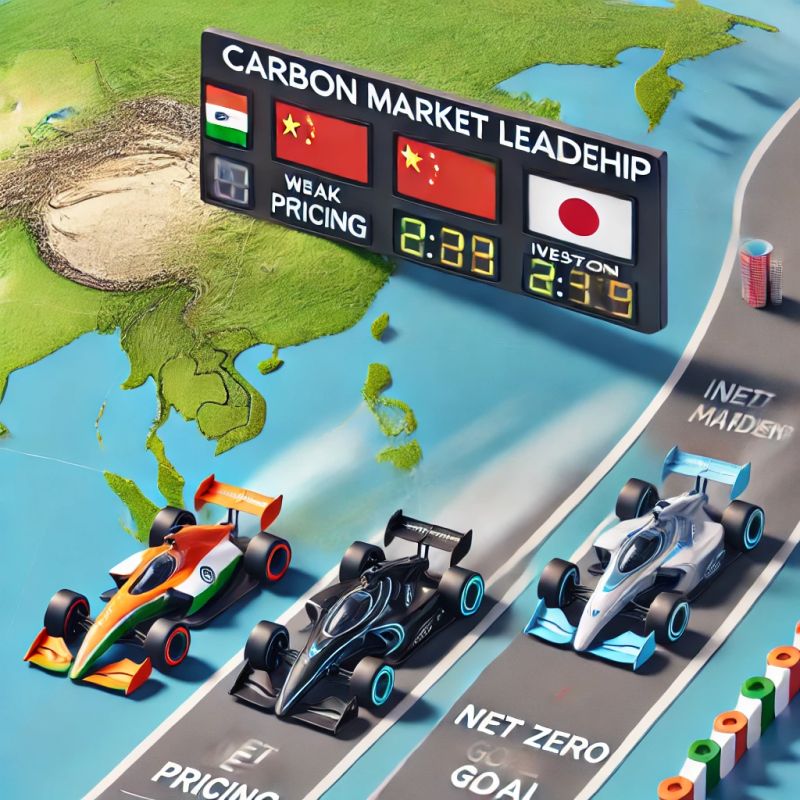
Asia’s Carbon_Market_Race: Who’s Leading and Who’s Lagging?” 🌏💨
Carbon markets are booming across Asia as nations compete to turn emissions into economic opportunities. But with different strategies at play, who’s actually making an impact, and who’s just carbon hustling? Let’s break it down data-first.
🇨🇳 China: The World’s Biggest Carbon Market
✅ Launched in 2021, covering 40% of national emissions.
✅ Expanding to heavy industries like cement & steel.
🚨 Challenge: Weak carbon pricing (~$8/ton) reduces impact. (Source: ICAP, 2024)
🏆 Verdict: Huge scale but weak incentives.
🇮🇳 India: The Emerging Carbon Giant
✅ Legislated in 2022, evolving into a regulated market.
✅ Integrating Renewable & Energy Savings Certificates by 2025.
🚨 Challenge: No firm carbon pricing yet. (Source: Ministry of Power, 2024)
🏆 Verdict: High potential, still in execution mode.
🇸🇬 Singapore: The Smart Carbon Hub
✅ Rising carbon tax from $5/ton (2022) to $50-80/ton by 2030.
✅ Pioneering biodiversity credits for ecosystem conservation.
🚨 Challenge: Small domestic market, reliant on external trading. (Source: Singapore Gov, 2024)
🏆 Verdict: Innovating beyond carbon into full environmental markets.
🇯🇵 Japan: The Tech-Driven Trader
✅ Carbon trading exchange launched in 2023 with investor backing.
✅ Banks investing heavily in climate advisory firms.
🚨 Challenge: Needs stricter corporate compliance. (Source: METI Japan, 2024)
🏆 Verdict: Strong financial backing but low enforcement
🇮🇩 Indonesia: The Controversial Play
✅ First global carbon credit transactions tied to energy projects.
✅ Huge potential from rainforests & nature-based solutions.
🚨 Challenge: Heavy reliance on fossil fuel-linked credits raises greenwashing concerns. (Source: Financial Times, 2024)
🏆 Verdict: Big opportunity, but investor skepticism is rising.
🇲🇾 Malaysia: The Carbon Market Architect
✅ Bursa Carbon Exchange (BCX) launched in 2022, first Shariah-compliant carbon trading platform.
✅ Voluntary Carbon Market (VCM) enabling corporate offsets.
✅ Carbon Tax by 2026 for high-emission industries.
🚨 Challenge: Needs stronger policy enforcement & carbon pricing clarity. (Source: PwC, 2024)
🏆 Verdict: Well-structured but awaiting execution impact.
📊 Who’s Winning the Carbon Market Race?
China = Biggest but Weak Pricing
India = High Potential, Early Stage
Singapore = Smartest Model, Small Scale
Japan = Investment-Driven, Needs Enforcement
Indonesia = High Risk, High Reward
Malaysia = Structuring Well, Needs Execution
🚀 The Future? Asia’s carbon markets must balance financial opportunities with real emission cuts—or risk becoming just another greenwashing tool.
👉 Which country’s approach will set the global standard?
CarbonMarkets AsiaLeadership NetZero Sustainability GreenInvesting ClimateAction

Originally published on LinkedIn on 2025-01-29 07:31:38: https://www.linkedin.com/feed/update/urn%3Ali%3AgroupPost%3A82951-7290270350309756931
NamasteGreenIndia sees “Global Yieldscape:
China’s Bonds Take the Low Road
China 2.8%
India: 7.19%
United_States: 4.28%
United_Kingdom: 4.35%
Australia: 4.42%
France: 3.02%
Germany: 2.20%
Japan: 2.31%
Notably, China’s yield has fallen below Japan’s for the first time, reflecting concerns over potential deflation and economic stagnation reminiscent of Japan’s “Lost Decades.” Factors contributing to China’s low yields include weak consumer demand, adverse demographic trends, and significant debt levels. Despite efforts by Chinese authorities to stimulate the economy through interest rate cuts and fiscal measures, these challenges persist, leading investors to seek the relative safety of long-term government bonds, thereby driving yields lower.
In contrast, higher yields in countries like the U.S. and India indicate robust economic activity, higher inflation expectations, and tighter monetary policies. India’s significantly higher yield reflects the country’s growth trajectory and the higher returns expected in emerging markets. Japan’s slightly higher yield compared to China is influenced by its monetary policies and longstanding economic dynamics.
This divergence underscores varying economic conditions and investor expectations across these economies.
Originally published on LinkedIn on 2024-11-29 10:27:47: https://www.linkedin.com/feed/update/urn%3Ali%3Ashare%3A7268209020363046912
NamasteBioH2India
Project Gensol-Matrix Consortium won the bid for India’s first bio_hydrogen project.
Value: $19.8 million (₹164 crore).
Objective**: Convert 25_tons of bio_waste into 1 ton of hydrogen per day.
Technology: Westinghouse, USA.
Other Green_Hydrogen projects India
1_Reliance Industries GreenH2 Project; $10 billion (75k crore)
2_Indian Oil Corporation Bio_Hydrogen Project: $2.5 billion (₹18,750 crore)
3_Adani Group Green Hydrogen Project: $50 billion (₹375,000 crore)
Originally published on LinkedIn on 2024-09-04 09:08:56: https://www.linkedin.com/feed/update/urn%3Ali%3AgroupPost%3A60128-7237023821675851776
Namaste Indian Railways to launch first Hydrogen train this year, aims for 50 by 2047
Indian Railways plans to launch its first hydrogen train this year, supporting India’s National Hydrogen Mission.
The goal is to introduce about 50 hydrogen trains by 2047.
India’s high-speed rail project (bullet train) is expected to start running by 2027
The Indigenous train protection system, Kavach, is operational over 1,400 kilometers and expanding.
Indian Railways aims to carry 35% of the country’s freight market by 2030-31.
Originally published on LinkedIn on 2024-07-27 13:42:14: https://www.linkedin.com/feed/update/urn%3Ali%3AgroupPost%3A131340-7222959471390543872

