If CarbonCredits are cheap, you should worry?
Low prices rarely signal efficiency.
They usually signal weak scrutiny.
For years, carbon credits were treated as a feel-good add-on
buy, offset, move on.
That phase is ending.
With CBAM tightening in the EU and domestic carbon markets taking shape in India, carbon pricing is no longer about goodwill.
It’s about credibility, trade access, and cost control.
Three shifts are becoming hard to ignore:
1️⃣ Cheap credits now carry risk
Quality screens are tightening around:
additionality
permanence
traceability
Credits that don’t hold up under future audits won’t just disappear —
they will leave behind uncomfortable explanations.
2️⃣ Carbon has entered finance and trade desks
When emissions affect:
export pricing
supplier selection
margin predictability
carbon stops being an ESG topic.
It becomes businessmath.
3️⃣ Low prices may signal future pain
The cheapest carbon credit today
may turn out to be the most expensive line item tomorrow.
The real question companies need to ask now isn’t
How many credits do we buy?
It’s:
Do our credits still make sense when rules tighten?
Curious how this is playing out where you work:
Are carbon credits still handled by ESG teams —
or already showing up in the CFO’s spreadsheet?
By Dr. Anju Sharma | MrsSustainability | KtalystInsights
CarbonCredits ClimateRisk CBAM CarbonMarkets IndiaBusiness
Source / shared link: https://www.reuters.com/sustainability/climate-energy/eu-aluminium-cement-imports-face-higher-emissions-costs-draft-shows-2025-12-12/?utm_source=chatgpt.com
Originally published on LinkedIn on 2025-12-13 03:47:09: https://www.linkedin.com/feed/update/urn%3Ali%3AgroupPost%3A82093-7405453196938166272
⚡ Energy2050Trends: The World Isn’t Transitioning. It’s Re-Architecting Itself.
(By Dr. Anju Sharma | MrsSustainability | KtalystInsights)
The world isn’t entering an energy transition.It’s stepping into an energy redesign that will rewrite competitiveness, geopolitics, & even the meaning of “power.
For the first time in history,
electricity, climate, minerals, cooling, and AI are colliding into a single force field, & the result isn’t evolution.
It’s acceleration.
These aren’t just “trends.
These are early warnings from a future arriving ahead of schedule.
Here is what the new world is quietly preparing for 👇
Trend1️⃣ Electrification becomes the new economic bloodstream
Electricity = 21% of final energy.
But already = 40% of global GDP contribution.
By 2050, electrons not molecules will define national competitiveness.
Nations won’t compete on oil.
They will compete on grid intelligence.
Trend2️⃣ Cooling & AI will shape global demand curves
Cooling adds +330 GW.
Data centres attract USD 580B.
A data centre is now a power plant in disguise. For the first time ever, comfort & computation run on the same fuse.
Trend3️⃣ The GlobalSouth becomes energy’s centre of gravity
80% of new global demand comes from India, ASEAN, Africa, LATAM, Middle East.
Growth follows sunlight, not smokestacks.
TheSunbelt becomes the new SiliconValley.
Trend 4️⃣ FossilFuels enter a managed twilight
Not a dramatic collapse.
A steady, predictable, structural decline.
Oil markets already expect +4 million barrels/day oversupply by the 2030s.
Fossils aren’t ending.They are delegating.
Trend 5️⃣ Adaptation becomes the trillion-dollar economy no one is prepared for
Heat, cooling, membranes, resilient materials. Peak demand up 40%. Adaptation is no longer “environmental.”It is economic survival.
Trend 6️⃣ Digital grids evolve into the national nervous system
Generation capex = USD 1T
Grid capex = USD 400B
We are structurally underwired.
The next revolution won’t be built.
It will be programmed.
Trend 7️⃣ Minerals rewrite global power equations
Lithium = crude.
Copper = oxygen.
Rare earths = leverage.
The next geopolitical tension won’t be over oilfields…It will be over copper belts.
Trend 8️⃣ Finance becomes the real climate divide
Same solar panel.
Same sun.
2.5× higher cost in Africa vs Europe only due to financing risk.
Technology isn’t the barrier.
Capital is.
Trend 9️⃣ CleanEnergy becomes mainstream macroeconomics
Data centres: USD 580B
Oil supply: USD 540B
The inversion is complete.
Energy transition is now economic gravity not ESG branding.
Trend 🔟 India isn’t following the energy future. It is test-running it.
Top driver of oil demand.
One of the fastest-growing clean-energy markets.
A digital governance force.
India doesn’t adapt the future
India prototypes it. And the signal is clear:
The next energy world won’t be discovered.It will be designed.
Originally published on LinkedIn on 2025-11-17 17:06:40: https://www.linkedin.com/feed/update/urn%3Ali%3AgroupPost%3A2474261-7396232320430649344
GreenBondsJustGotSmarter | Introducing the New Gold Standard in Sustainable Finance
Labels don’t build trust. Transparency does.” AnjuSharma,
BreakingNewGround in SustainableFinance
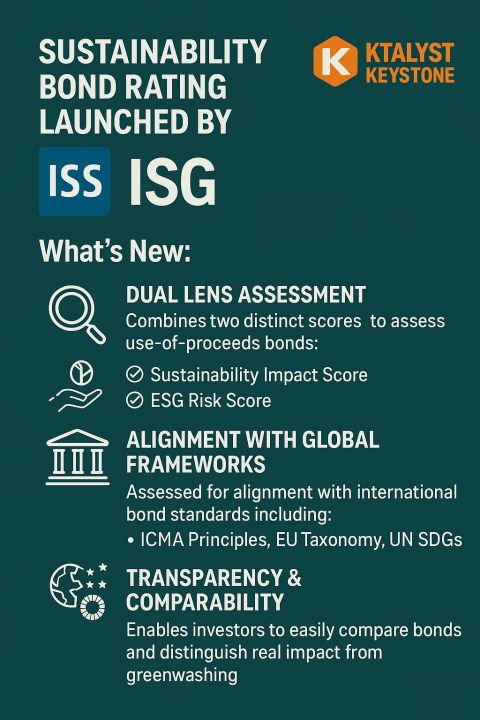
ISS ESG, the sustainability-focused arm of ISS STOXX, just launched something that could change how we look at bonds — introducing the SustainabilityBondRating!
Why should the ESG world take note?
What’sNew:
🔍 DualImpact: Combines Sustainability Impact Score (aligned to SDGs, EU Taxonomy, ICMA) + ESG Risk Score for a fuller picture.
🌍 AllEyesOnGreen: Covers not just corporates but also sovereign issuers of Green, Social, Sustainability & Sustainability-linked bonds (GSSS).
⚖️ GreenOrGreenwashed? A tool that separates true impact from clever spin — vital when $5 trillion+ in GSSS bonds have already flooded the market.
📈 InvestorToolKit: Tailored for the 68% of institutional investors who integrate ESG into their portfolios.
⚙️ GlobalAlignment: Built on globally accepted frameworks — ICMA Principles, EU Taxonomy, and UN SDGs — making it easier to benchmark and trust.
Why it matters:
Because the bond between sustainability and capital markets needs more accountability.
Greenwashing isn’t just noise — it’s a $1.5 trillion challenge.
This new rating is not just a label — it’s a litmustest for integrity in sustainable investing.
👏 Kudos to the ISS ESG team for bringing transparency, clarity, and impact integrity to the GSSS bond universe!
Originally published on LinkedIn on 2025-04-05 13:37:52: https://www.linkedin.com/feed/update/urn%3Ali%3Ashare%3A7314280113766854656
KnowledgeSeries Banks & Climate Pledges: A Retreat or a Realignment? 🌍💰
🚨 Global banks are shifting their net-zero targets! 🚨
💡 What’s Changing?
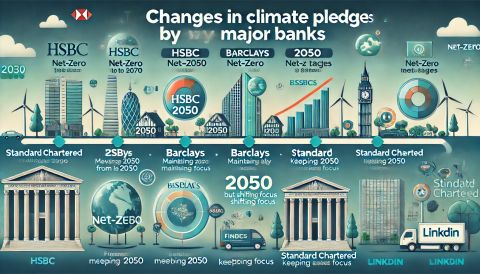
🔄 HSBC: Net-zero delayed from 2050 → 2070, altering financed emissions calculation
🏦 Barclays: Still targeting 2050, but shifting focus to low-carbon transition finance rather than direct emission cuts
📉 StandardChartered: Sticking with 2050, but modifying sector-specific decarbonization pathways
Timeline of Bank Climate Commitments
📌 HSBC
🟢 2020: Pledged net-zero by 2050
🔴 2024: Pushed net-zero to 2070 due to “economic realities
⚠️ Key Shift: Changed how financed emissions are measured, easing short-term compliance
📌 Barclays
🟢 2020: Pledged net-zero by 2050
🟡 2023: No change in target, but transition finance focus increased
⚠️ Key Shift: Redirecting funds to support companies’ gradual shift rather than demanding immediate cuts
📌 StandardChartered
🟢 2021: Pledged net-zero by 2050
🟡 2023-24: Adjusted its decarbonization targets for specific industries
⚠️ Key Shift: Sectors like oil, gas, and heavy industries given more transition time
Why Are Banks Reworking Their Climate Pledges?
📊 Key Drivers Behind the Change:
💰 Economic Pressures: Rising inflation + shareholder push for profits
⚖️ Regulatory Softening: EU reduces mandatory ESG reporting burdens
🏗️ Client Readiness Gap: High-emission sectors not transitioning fast enough
📉 Investor Sentiment: Balancing short-term profitability with long-term sustainability
The Big Question: Greenwashing or a Smarter Strategy?
❓ Are banks backtracking on sustainability due to financial pressure?
❓ Or are they adapting to economic realities for a more realistic transition?
🔥 COP29 will reveal whether these shifts are just delays or genuine strategy recalibrations!
💬 What’s your take? Are banks stepping back or stepping smarter? ⏳💡
Sustainability Finance NetZero ClimatePledges
Originally published on LinkedIn on 2025-03-17 11:21:57: https://www.linkedin.com/feed/update/urn%3Ali%3AgroupPost%3A4385073-7307360540777963520
#️⃣ RegulatoryRadar | SEBI&#CompaniesAct: KeyChangesin2025YouNeedtoKnow 📜⚖
🚀 India’sregulatorylandscapeisevolving—areyouready? SEBI has rolled out major reforms in derivatives,mutualfunds,andinvestmentfunds, while global updates in companylaws are reshaping compliance norms.
📢 KeySEBIReforms(India,2025)
StricterDerivativesMarketRules
📉To enhance market stability, SEBI introduced measures resulting in a 20-30%declineinF&O(Futures&Options)tradingactivity. (Source: Economic Times)
IntroductionofSpecializedInvestmentFunds(SIFs)
💰Starting April 1, 2025, SEBI permits long-shortequityanddebtfunds for high-net-worth individuals, requiring a minimuminvestmentof₹1million. (Source: Reuters)
MandatoryNominationforMutualFunds&DematAccounts
🔹Effective March 1, 2025, investors must provideanomineeorexplicitlyoptout, enhancing financial security. (Source: Business Today)
OptionalSame-DaySettlement(T+0)
🔄From January 31, 2025, SEBI expanded the T+0settlementoptiontothetop500stocksbymarketcapitalization, aiming to improveliquidityandreducesettlementrisks. (Source: Reuters)
CrackdownonMisleadingFinancialInfluencers
🚨SEBI banned six individuals, including Asmita Patel, freezing illegalgainsof₹530million($6.3million), to protect investors from fraudulent schemes. (Source: Financial Times)
🌍 GlobalCompaniesActUpdates
BritishVirginIslands(BVI)Amendments
🌏New filingrequirementsandcomplianceobligations for offshore companies, enhancing transparency. (Source: Lexology)
SouthAfrica’sCompaniesActReforms
📑Simplified sharebuybackandfinancialassistanceprovisions, streamlining corporate actions. (Source: Lexology)
DelawareGeneralCorporationLaw(DGCL)Amendments
🔍Proposed changes aim to clarifydirectorindependencestandards and restrictcontrollingshareholdertransactions, enhancing corporate governance. (Source: Skadden)
💡 WhyThisMatters
📊 EnhancedMarketIntegrity – Stricter regulations aim to reducespeculativetradingandprotectretailinvestors.
📈 DiversifiedInvestmentOpportunities – Introduction of SIFs offers newavenuesforwealthierinvestors, promoting market depth.
🌐 GlobalComplianceAlignment – Updates to company laws reflect a trendtowardgreatertransparencyandaccountability.
🔥 TheBigQuestion:Arethesereformsshapingabettercorporatefuture,oraddingcomplexity?Droopyourthoughtsbelow! 👇


Originally published on LinkedIn on 2025-03-02 15:43:30: https://www.linkedin.com/feed/update/urn%3Ali%3Ashare%3A7301990542890930176
🚀 The Future of Careers: Are You Ready? 💼📊
As AI, automation, and digitalization reshape jobs, the key to survival is choosing the right industry and upskilling. But with employment rates fluctuating, is the job market truly evolving?
📉 Job Market Shifts (Last 5 Years)
🚨 Global employment rate at 56.3% in 2024, still below pre-pandemic levels. (Statista, 2024)
🚨 64.9M young people unemployed worldwide. (ILO, 2024)
🚨 Retail jobs shrinking by 364,800 in the U.S. by 2033 as e-commerce rises. (Statista, 2024)
🚨 Manufacturing jobs rebounding in tech-driven regions, but traditional hubs still struggle. (EIG, 2024)
📌 Reality Check: The real crisis isn’t job loss—it’s the growing skill gap.
📊 Fastest-Growing Career Paths
✅ Tech & AI 💻 – AI engineers, cybersecurity, data scientists. (38% growth by 2030, WEF 2024)
✅ Healthcare & Biotech 🏥 – Telemedicine, bioinformatics. (14% job growth in a decade, BLS 2024)
✅ Sustainability & Green Economy 🌍 – ESG auditors, renewable energy. (Green jobs to outpace fossil fuels 4:1, IEA 2024)
✅ Finance & Fintech 💰 – Blockchain, digital banking. (18% YoY hiring increase, PwC 2024)
✅ Manufacturing & Supply Chain 🏭 – Robotics, AI logistics. (80% of manufacturers lack skilled workers, Deloitte 2024)
🚨 Reality Check: Automation isn’t killing jobs—it’s transforming them.
📉 Careers at Risk
❌ Fossil Fuels – Declining as renewables grow.
❌ Print Media – AI replacing journalism.
❌ Basic Customer Service – AI chatbots taking over.
❌ Traditional Automotive – EVs need fewer parts, reducing jobs.
🚨 Reality Check: Industries aren’t dying—skills are evolving.
🧠 The Skills You Need Now
📌 AI & Data Proficiency – Even non-tech jobs need AI literacy.
📌 Cybersecurity & Digital Skills – The digital economy depends on security.
📌 Sustainability & ESG Knowledge – Businesses need climate-conscious leaders.
📌 Creativity & Adaptability – AI can’t replace problem-solving.
🚨 Reality Check: Lifelong learning isn’t optional—it’s survival.
🏆 KeyTakeaway
Your career could be future-proof with the right skills, should be aligned with growth industries, but would be at risk without adaptation.
👉 Are you ready for the future of work?
FutureOfWork CareerGrowth Upskilling AI GreenJobs Automation


Originally published on LinkedIn on 2025-02-04 13:44:47: https://www.linkedin.com/feed/update/urn%3Ali%3AgroupPost%3A9270968-7292538584681635841
Storm_Over_Net_Zero: Why Financial Titans Are Breaking Away from Climate Alliances
In a pivotal shift, major financial institutions are stepping back from climate alliances like the Net-Zero Banking Alliance (NZBA) and Climate Action 100+, raising questions about the future of collective climate action.
Recent Exits
Goldman Sachs: Left the NZBA in December 2024, citing regulatory complexities but reaffirmed its net-zero goals.
Baillie Gifford: Exited Climate Action 100+ and Net Zero Asset Managers Initiative in November 2024, citing a need to focus on core investments.
JPMorgan Chase Asset Management: Withdrew from Climate Action 100+ in early 2024 to independently pursue climate engagement.
State_Street_Global Advisors: Exited Climate Action 100+ in mid-2024, preferring independent engagement with portfolio companies.
Franklin_Templeton: Also left Climate Action 100+ in 2024 to focus on its strategic priorities.
The Vanguard Precedent
In December 2022, Vanguard ($9.3 trillion AUM) exited the Net Zero Asset Managers Initiative, citing the need for flexibility to represent investor interests.
Sustainability Still a Priority
Despite these exits, investments in clean energy continue to rise, with UK financial institutions tripling clean energy contributions to $2.3 billion in 2023.
Why Are They Leaving?
1. Regulatory Burdens: Growing compliance complexities.
2. Fiduciary Duty: Balancing returns with climate goals.
3. Political Pressures: Climate alliances are increasingly polarizing.
4. Strategic Flexibility: Preference for customized sustainability strategies.
What’s Next?
These exits emphasize the need for adaptive frameworks that balance sustainability with business imperatives. Financial majors aren’t abandoning climate goals—they’re redefining how to achieve them on their own terms.
How can climate alliances evolve to stay relevant? Sustainability Finance NetZero Leadership

Originally published on LinkedIn on 2024-12-15 22:01:20: https://www.linkedin.com/feed/update/urn%3Ali%3AgroupPost%3A2474261-7274181763134836736
NamasteIndia…
Labeling the rumored $200–300 billion climate finance proposal as the “Worst_PJ (Poor Joke) of the Year” might resonate strongly with the frustration of developing nations at COP29.
1. Climate Finance Disparity:
European Union and other developed nations propose $200–300 billion annually.
Developing nations, led by the G77 and China, demand $1.3 trillion annually to address climate challenges effectively.
2. Focus on New Collective Quantified Goal (NCQG):
The NCQG is intended to replace the outdated $100 billion target set in 2009.
Key debates revolve around defining “new and additional” funding sources to ensure credibility.
3. Global Warming Warnings:
Scientists emphasize the need for immediate action to avoid surpassing the 1.5°C threshold by the 2030s.
Urgency is mounting for a fair and ambitious financial framework.
4. Negotiation Bottlenecks:
Lack of consensus on long-term commitments and accountability mechanisms.
Limited clarity on private sector contributions versus public funding.
India’s Perspective:
India, representing the Global South, has consistently stressed climate equity and common but differentiated responsibilities. India believes that developed nations must honor their historical responsibilities and prioritize grants over loans for climate finance.
India’s message resonates globally—climate justice is not just about dollars and targets; it’s about delivering trust and ensuring survival. The real measure of success at COP29 will be the alignment of ambition with accountability, recognizing that the most vulnerable cannot afford empty promises.
Originally published on LinkedIn on 2024-11-22 11:15:53: https://www.linkedin.com/feed/update/urn%3Ali%3Ashare%3A7265684409603772419
NamasteGreenIndia at COP29 GetRid_of_GreenWashing
COP29 is currently underway in Baku, Azerbaijan (November 11-22, 2024), as nearly 200 nations converge to confront the Climate Emergency.
COP29 Key_Actions_Tensions:
USD120 Billion Climate Finance: Multilateral Development Banks pledge $120 billion annually by 2030 to empower low- and middle-income nations for climate resilience.
GlobalCarbonMarkets: A groundbreaking carbon trading framework under Article6.4 of the Paris Agreement, poised to unlock critical financing for developing nations.
Fossil_Fuels in Focus: Azerbaijan’s defense of oil and gas underscores the deep divide between economic dependency on fossil fuels and global climate ambitions.
Skepticism from Argentina: Argentina’s exit from COP29 emphasizes the growing friction between national interests and global climate commitments.
UN’s UrgentPlea: The UN Secretary-General’s stark warning that 2024 is a “masterclass in climate destruction” calls for immediate, intensified action.
India, China, SouthKorea: Leading Voices with Distinct Goals
India: Leading calls for at least $1 trillion in annual climate finance by 2025, India advocates for transparent, fair funding mechanisms and a robust carbon market framework to guide industry-specific emission cuts.
China: Urges developed countries to exceed their $100 billion pledge, seeking $1.3 trillion annually for developing nations. China continues to prioritize large-scale investments in renewables and emphasizes the importance of US-China collaboration on climate issues.
SouthKorea: Sets ambitious 2030 emission reduction targets, expanding investment in green tech, particularly hydrogen and electric vehicles, while fostering regional cooperation to tackle shared environmental challenges.
Originally published on LinkedIn on 2024-11-14 03:21:58: https://www.linkedin.com/feed/update/urn%3Ali%3AgroupPost%3A131340-7262666040386486272
NamasteGreenIndia at COP29 GetRid_of_GreenWashing
COP29 is currently underway in Baku, Azerbaijan (November 11-22, 2024), as nearly 200 nations converge to confront the Climate Emergency.
COP29 Key_Actions_Tensions:
USD120 Billion Climate Finance: Multilateral Development Banks pledge $120 billion annually by 2030 to empower low- and middle-income nations for climate resilience.
GlobalCarbonMarkets: A groundbreaking carbon trading framework under Article6.4 of the Paris Agreement, poised to unlock critical financing for developing nations.
Fossil_Fuels in Focus: Azerbaijan’s defense of oil and gas underscores the deep divide between economic dependency on fossil fuels and global climate ambitions.
Skepticism from Argentina: Argentina’s exit from COP29 emphasizes the growing friction between national interests and global climate commitments.
UN’s UrgentPlea: The UN Secretary-General’s stark warning that 2024 is a “masterclass in climate destruction” calls for immediate, intensified action.
India, China, SouthKorea: Leading Voices with Distinct Goals
India: Leading calls for at least $1 trillion in annual climate finance by 2025, India advocates for transparent, fair funding mechanisms and a robust carbon market framework to guide industry-specific emission cuts.
China: Urges developed countries to exceed their $100 billion pledge, seeking $1.3 trillion annually for developing nations. China continues to prioritize large-scale investments in renewables and emphasizes the importance of US-China collaboration on climate issues.
SouthKorea: Sets ambitious 2030 emission reduction targets, expanding investment in green tech, particularly hydrogen and electric vehicles, while fostering regional cooperation to tackle shared environmental challenges.
As COP29 unfolds, these strategic moves from India, China, and South Korea underline their critical roles in shaping a global path forward. Their approaches reveal the spectrum of solutions needed to mitigate climate risks while balancing growth and sustainability in the face of complex geopolitical, economic, and environmental pressures.
Source / shared link: https://www.indiatoday.in/environment/story/why-are-countries-fighting-over-money-at-cop29-climate-summit-2632757-2024-11-13
Originally published on LinkedIn on 2024-11-14 03:19:55: https://www.linkedin.com/feed/update/urn%3Ali%3Ashare%3A7262665526169010177

