Why ESG Isn’t a Global Roadmap—It’s a Country_by_Country_Compass
ESG Isn’t One-Size-Fits-All—It’s One-Strategy-Fits-Nation
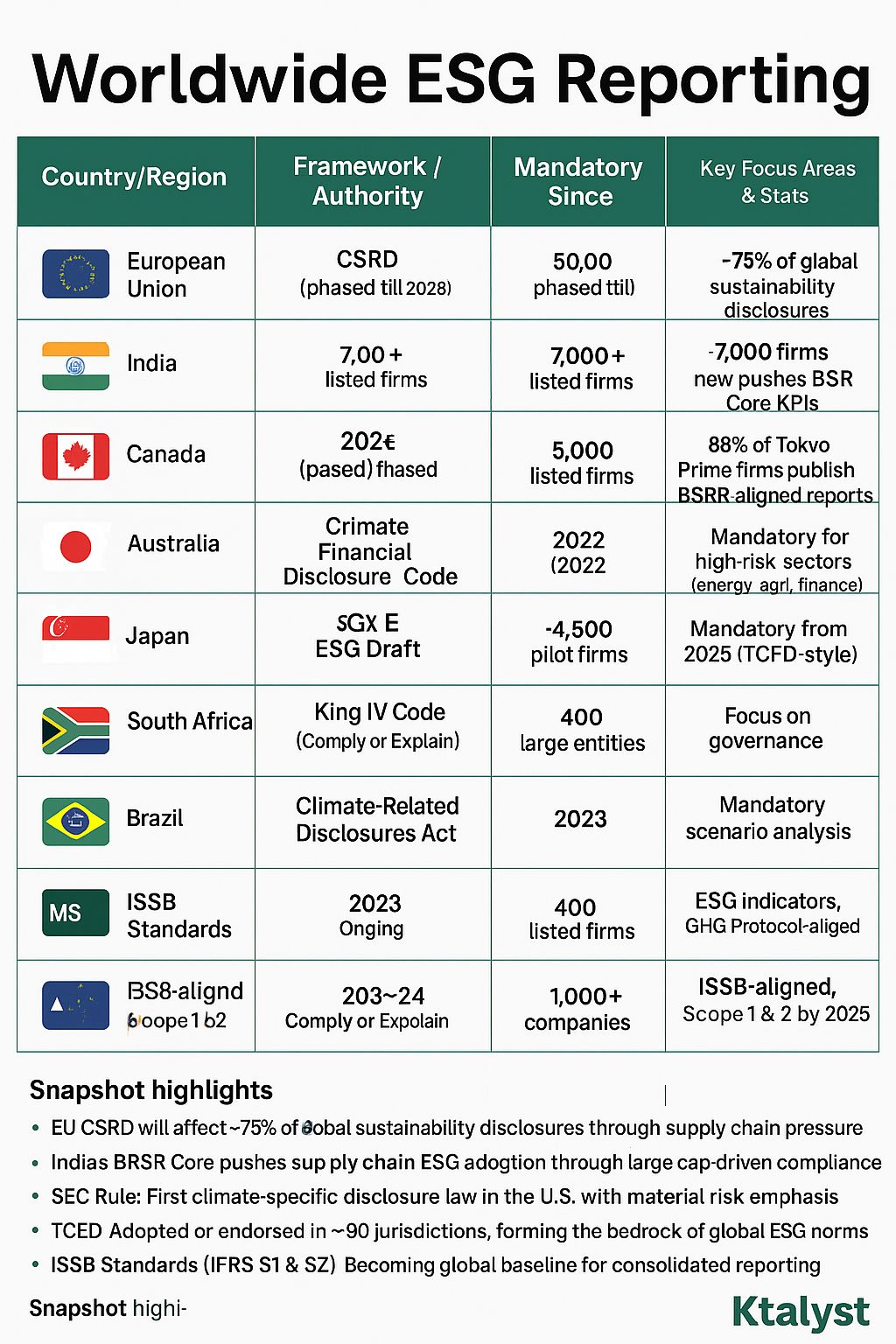
ESG reporting takes different roads because nations prioritize differently—economic maturity, regulatory style, investor pressure, and trade exposure all shape the path. The EU leads with CSRD—affecting 50,000+ firms through double materiality, taxonomy alignment, and mandatory assurance. The US sticks to financial materiality and climate risk, sidestepping Scope 3 and S&G. India’s BRSR ties ESG to development goals, starting with the top 1,000 and easing into assurance. Export-driven China, Malaysia, and Singapore accelerate ESG to meet global buyer expectations and bypass EU CBAM fallout. Japan prefers voluntary codes; South Africa excels in governance (King IV), but lacks integrated data.
Bottom line? ESG mirrors what each country values—growth, governance, global edge, or green capital. It’s not just compliance—it’s strategy, sovereignty, and survival.
🇪🇺 European Union
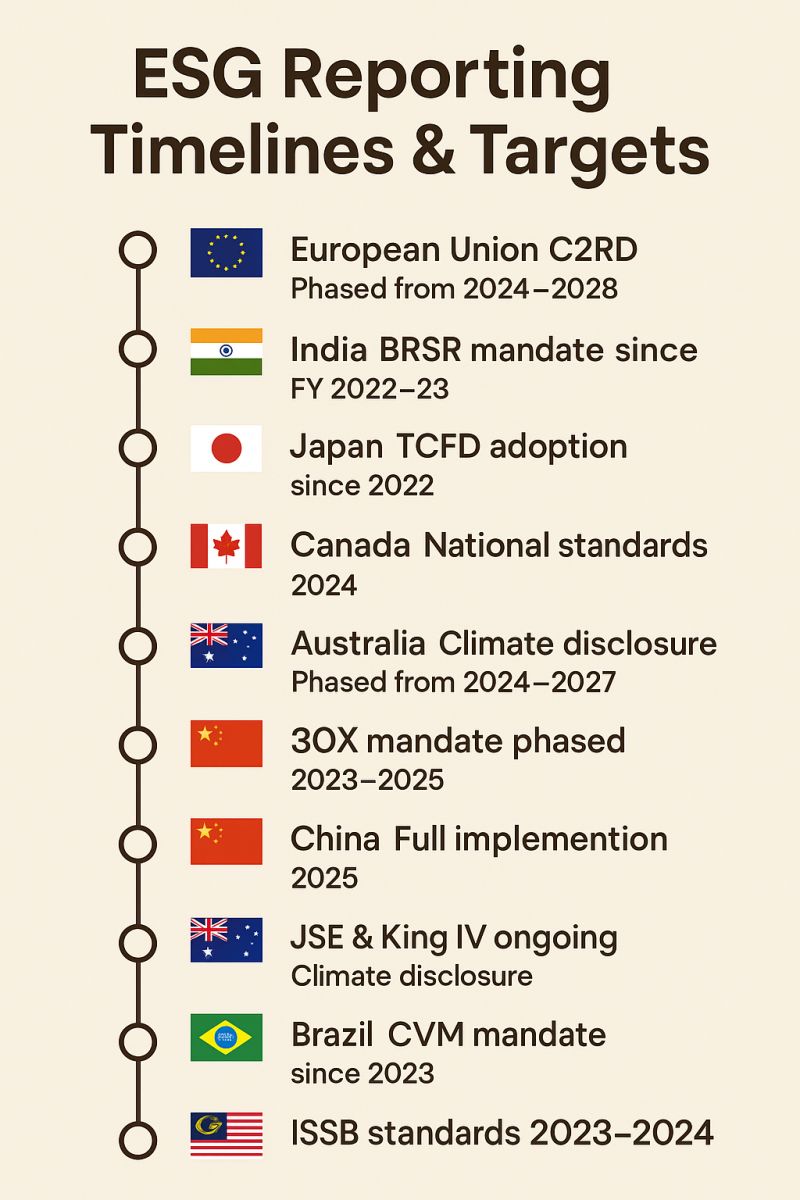
Timeline: CSRD phased from 2024 to 2028
Mandatory from:
2024: Large public-interest companies
2025: All large companies
2026–28: SMEs (limited scope)
FunFact: Will impact 75%+ of global ESG reporting indirectly via supply chains
🇺🇸 United States
Timeline: SEC Rule effective 2024–2025
Mandatory from:
FY2024: Large Accelerated Filers
FY2025: Accelerated Filers
Scope 3? Only if material (and still debated)
🇮🇳 India
Timeline:
BRSR mandatory since FY 2022–23
BRSR Core with limited assurance from FY 2023–24
Next up: Potential rollout for mid-size unlisted companies by 2026
🇯🇵 Japan
Timeline:
TCFD adoption by Prime listed firms since 2022
No fixed law, but >80% of large firms are already onboard voluntarily
🇨🇦 Canada
Timeline:
CSA rule aligned with TCFD from 2024
Mandated for:
Publicly listed entities, expanding coverage gradually
🇦🇺 Australia
Timeline:
Climate Disclosure Framework phased from July 2024
Rollout:
2024: Large companies
2026–27: Mid and small entities
🇸🇬 Singapore
Timeline:
SGX ESG reporting mandatory since 2023
Sector phased:
Energy, Agri, Finance by 2024
All others by 2025
🇨🇳 China
Timeline:
Draft ESG rules under CSRC in 2024
Target:
Full mandatory rollout by 2025
Pilots ongoing in green finance and energy sectors
🇿🇦 SouthAfrica
Timeline:
JSE & King IV apply ongoing since 2016
Mandate:
Comply or explain” model, no fixed year — but tightening expected by 2025
🇳🇿 NewZealand
Timeline:
Climate-Related Disclosure Act enforced from 2023
Applies to:
Financial institutions & large corporates (>NZ$1B AUM or turnover)
🇧🇷 Brazil
Timeline:
CVM ESG disclosure mandatory since 2023
Focus:
Annual reporting, with increasing pressure for Scope 3 inclusion by 2026
🇲🇾 Malaysia
Timeline:
ISSB-aligned standards adopted in 2023–2024
Mandated by:
Bursa Malaysia, full Scope 1–2 by 2025, Scope 3 optional till 2026


Originally published on LinkedIn on 2025-04-21 21:59:46: https://www.linkedin.com/feed/update/urn%3Ali%3AugcPost%3A7320204627323289601
NamasteInnovativeIndia Government of India approves DST’s VigyanDhara via
15th FinanceCommission approves 10.58 billion USD(equivalent to ₹10,579.84 crore).
Objective and Purpose:
Strengthening S&T Ecosystem: The VigyanDhara scheme, launched by the Department of Science and Technology (DST) in India, aims to bolster the country’s Science, Technology, and Innovation (STI) ecosystem.
Capacity Building: It focuses on enhancing research capabilities, fostering innovation, and promoting technology development.
Components and Focus Areas:
S&T Institutional and Human Capacity Building:
This component emphasizes equipping research and development (R&D) labs within academic institutions.
It aims to increase the number of Full-Time Equivalent (FTE) researchers, fostering a robust scientific workforce.
Research and Development (R&D):
Basic Research: Vigyan Dhara supports fundamental research across various domains.
Translational Research: It encourages research with practical applications, addressing critical challenges such as sustainable energy, water management, and healthcare.
International Collaboration: The scheme promotes collaborative research with global partners.
Innovation, Technology Development, and Deployment:
Vigyan Dhara actively engages with educational institutions, industries, and startups to drive innovation.
It facilitates the transition from research outcomes to real-world solutions.
Budget :
The proposed budget for Vigyan Dhara during the 15th Finance Commission period (2021-22 to 2025-26) is approximately 10.58 billion USD(equivalent to ₹10,579.84 crore).
Gender Parity and Inclusivity:
The scheme places emphasis on increasing women’s participation in science and technology.
Collaboration between academia, government agencies, and industries is encouraged.
Originally published on LinkedIn on 2024-08-29 11:53:58: https://www.linkedin.com/feed/update/urn%3Ali%3AgroupPost%3A60128-7234891024651739136
Fighting Nature and winning the battle… what will happen when We lose the War
Despairing for Disappearing Hills in NaviMumbai
For fourteen years, my flat balcony has been my special place—a spot where I could relax and enjoy the lush green leaves against the backdrop of rolling hills. But now, as usual the concrete is taking up this serene area into high-rise buildings.
This change threatens to take away my calming view, which has been my friend for so long. Along with it another natural habitat will die due to greedy hunger of Development. These hills are gradually being surrounded by towering structures, and it feels like nature is losing to human development.
The clash of Titans urbanization and nature happens silently but significantly. Rules favoring development often overpower our connection to the natural world. We stand helpless once again!!! No new governments help in this age old destruction 😔

Originally published on LinkedIn on 2024-08-23 15:12:17: https://www.linkedin.com/feed/update/urn%3Ali%3Ashare%3A7232766605183586304

