Sleepwalking through DataComa?
The costliest risk today isn’t being wrong, it’s being late.” Dr. Anju Sharma
Here’s the uncomfortable question.
What if the global economy isn’t sleepwalking at all?
What if it’s consciously slowing down?
CentralBanks today are not confused, they are boxed in.
They see:
✓ Sticky inflation in services
✓ Slowing growth and weaker jobs
✓ TradeWars fragmenting supply chains
✓ Debt levels limiting bold policy moves
So they do the only thing possible:
move cautiously, communicate carefully, and avoid shocks.
From the outside, this looks like DataComa.
From the inside, it looks like riskcontainment.
Rates are adjusted in small steps.
Liquidity is added without commitment.
Policy language stays flexible.
Because one wrong move now:
✓ Spikes inflation
✓ Crashes currencies
✓ Breaks trust
So yes, hesitation looks rational.
Until it doesn’t.
Where caution quietly turns into DataComa
DataComa doesn’t begin when leaders hesitate. It begins when hesitation becomes the strategy.
That’s when:
✓ Temporary measures become permanent
✓ “Waitingforclarity” replaces decision-making
✓ Economic burden shifts silently to businesses and households
NoCrisis.NoCrash.
Just:
Higher cost of capital
Slower investment
Delayed transitions
Productivity that never quite lifts
This is not stability.
This is slow erosion.
The risk is that everyone waits for someone else to act first.
And while policymakers wait:
✓ Capital becomes defensive
✓ Businesses postpone bets
✓ Transitions cost more than planned
That’s how DataComa spreads.
Not through ignorance.
But through collective delay.
The point (clear and simple)
✓ Caution is sensible
✓ Paralysis is expensive
The world is not asleep.
But it is stuck between prudence and postponement.
And history shows:
✓ Economic burdens don’t come from bad decisions
✓ They come from decisions taken too late
KtalystInsights
DataComa is not a failure of intelligence or policy. It is a failure of timing. The economic burden ahead will not be driven by interest rates or data gaps, but by delayed leadership decisions quietly compounding into higher capital costs, execution drag, and lost momentum. Economies that decide early absorb pain once. Those that wait keep paying interest on hesitation.
Sleepwalking ends when ownership begins.
Source / shared link: https://deloi.tt/4s5gqrZ
Originally published on LinkedIn on 2025-12-20 05:12:22: https://www.linkedin.com/feed/update/urn%3Ali%3Ashare%3A7408011359482720256
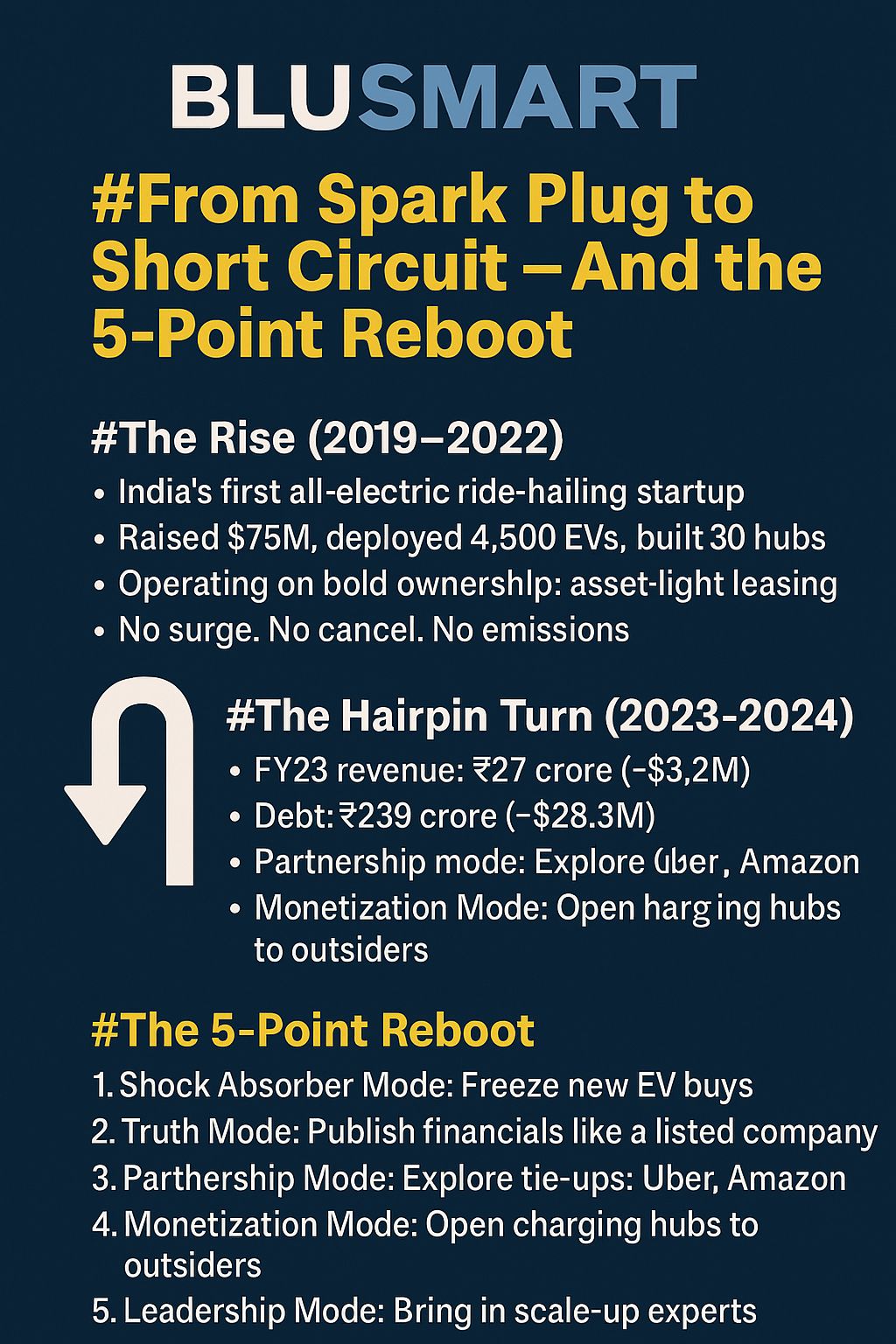
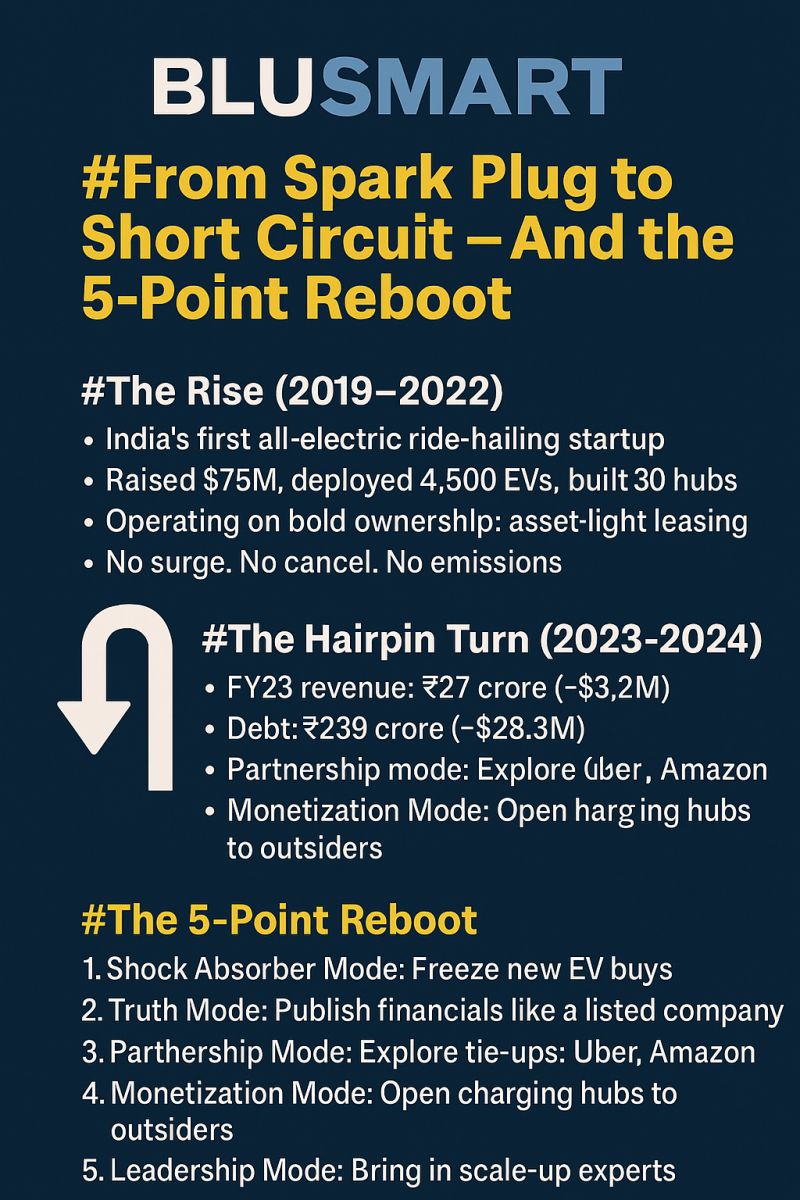
BluSmart: From Spark Plug to Short Circuit – A 5-Point Reboot
Rise, Ride & Reckoning
⚡ 2019–2021 | Launch
India’s first all-electric ride-hailing service. Raised #$75M. Deployed 4,500+ EVs. Built 30+ charging hubs. Bold move: ownership over leasing. Tagline: No surge. No cancel. No emissions.
🌿 2021–2022 | Momentum
Strong ESG branding, high urban trust, and premium experience.
⛔ 2023–2024 | Slump
Revenue: #₹27 crore (~USD 3.2M)
Liabilities: #₹239 crore (~USD 28.3M)
Failed EV asset sale (3,000 units)
Credit rating downgrade
Leadership exits
The 5-Point Comeback Compass
1. 🔧 Debt Restructure
Pause expansion, renegotiate terms, stabilize burn.
Ktalyst: Debt isn’t doom—bad structure is.
2. 🔍 Transparency
Publish quarterly financials and dashboards. Regain investor trust. Ktalyst: Honest numbers outpace hopeful noise.
3. 🤝 Strategic Partners
Explore tie-ups with Uber, Amazon, infra players. Enable co-branded EV ops.
Ktalyst: Survival is a shared drive.
4. 💰 Monetize Infra
Lease fleet, open charging hubs, sell FaaS and analytics.
Ktalyst: Idle assets = silent leaks. Make them earn.
5. 🧠 Leadership Reset
Bring turnaround talent. Form an ESG-savvy board.
Ktalyst: Founders start the fire. Fixers steer the flame.
12_Month Recovery Plan
0–2 Months: Restructure, pause new spends
3–5 Months: Lease EVs, monetize hubs
6–8 Months: Relaunch brand, share impact data
9–11 Months: Raise #$25–30M, secure JV
12 Months: Relaunch BluSmart 2.0 with 60% utilization
Case in Point: Netflix 2011
Lost 800K users after pricing split. Stock fell 77%.
Rebounded via honesty, streaming focus & brand reset.
Ktalyst Parallel: Design, not denial, drives turnarounds.
Final Word:
BluSmart isn’t broken. It’s paused. And ready to be Recharged.


Originally published on LinkedIn on 2025-04-01 19:33:06: https://www.linkedin.com/feed/update/urn%3Ali%3AgroupPost%3A82093-7312919961037934592
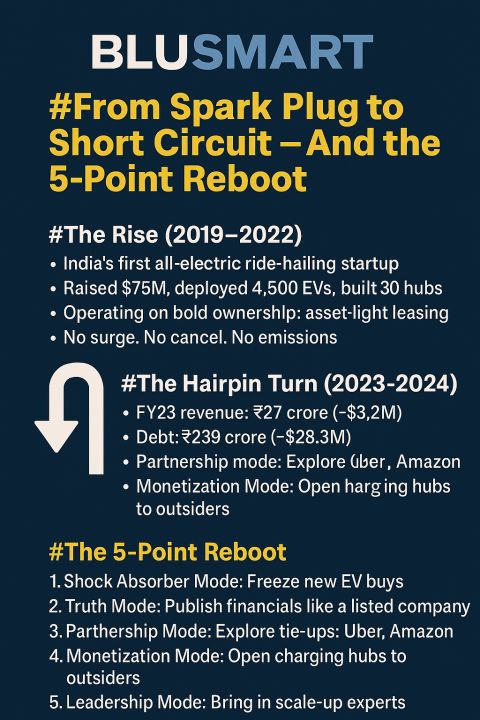
BluSmart: From SparkPlug to ShortCircuit – A 5_PointReboot
Rise, Ride & Reckoning
⚡ 2019–2021 | Launch
India’s first all-electric ride-hailing service. Raised #$75M. Deployed 4,500+ EVs. Built 30+ charging hubs. Bold move: ownership over leasing. Tagline: No surge. No cancel. No emissions.
🌿 2021–2022 | Momentum
Strong ESG branding, high urban trust, and premium experience.
⛔ 2023–2024 | Slump
Revenue: #₹27 crore (~USD 3.2M)
Liabilities: #₹239 crore (~USD 28.3M)
Failed EV asset sale (3,000 units)
Credit rating downgrade
Leadership exits
The 5_Point Comeback Compass
1. 🔧 Debt Restructure
Pause expansion, renegotiate terms, stabilize burn.
Ktalyst: Debt isn’t doom—bad structure is.
2. 🔍 Transparency
Publish quarterly financials and dashboards. Regain investor trust. Ktalyst: Honest numbers outpace hopeful noise.
3. 🤝 Strategic Partners
Explore tie-ups with Uber, Amazon, infra players. Enable co-branded EV ops.
Ktalyst: Survival is a shared drive.
4. 💰 Monetize Infra
Lease fleet, open charging hubs, sell FaaS and analytics.
Ktalyst: Idle assets = silent leaks. Make them earn.
5. 🧠 Leadership Reset
Bring turnaround talent. Form an ESG-savvy board.
Ktalyst: Founders start the fire. Fixers steer the flame.
12_Month Recovery Plan
0_2Months: Restructure, pause new spends
3_5Months: Lease EVs, monetize hubs
6_8Months: Relaunch brand, share impact data
9_11Months: Raise #$25–30M, secure JV
12Months: Relaunch BluSmart 2.0 with 60% utilization.
Case in Point: Netflix 2011
Lost 800K users after pricing split. Stock fell 77%.
Rebounded via honesty, streaming focus & brand reset.
Ktalyst Parallel: Design, not denial, drives turnarounds.
Final Word:
BluSmart isn’t broken. It’s paused. And ready to be Recharged.
Originally published on LinkedIn on 2025-04-01 19:29:05: https://www.linkedin.com/feed/update/urn%3Ali%3AgroupPost%3A4023031-7312918948415442944
🚜🌾 PolicyGovernance & ClimateResilience: Can India Protect Its Farmers from an Uncertain Future? 🌦️🔥💰
A farmer’s success depends on the sky, but survival now depends on policy.
India’s agriculture sector, contributing 18% of GDP & employing 43% of the workforce, is facing climate volatility & policy gaps that threaten both farm incomes & national food security.
🌡️ Climate Impact: Why Farmers Are at Risk?
✔️ Heatwaves & Crop Failures: India saw 273 heatwave days in 2023, reducing wheat yields by 15% in major agricultural belts. (IMD, 2024)
✔️ Monsoon Irregularities: 12 states recorded deficient rainfall in 2023, leading to 20% lower kharif crop production. (MoAFW, 2024)
✔️ Debt Crisis & Migration: Farm loan defaults may rise by 30% by 2030, forcing 7M+ rural workers to migrate annually. (RBI, 2024; World Bank, 2024)
✔️ Insurance Gaps: Only 34% of farmers are insured under PMFBY, leaving millions exposed to climate-related crop losses. (NITI Aayog, 2024)
📌 RealityCheck: Can policy reforms keep pace with climate shocks?
💰 Economic Fallout: Food Prices, Farmer Distress & Rural Unrest
✔️ Food Inflation: Wheat prices surged 24% & onion prices by 60% in 2023 due to supply chain disruptions. (MoAFW, 2024)
✔️ Declining Farm Incomes: The average farmer earns ₹10,218 ($123) per month, while input costs keep rising. (NSO, 2024)
✔️ Rural Finance Gaps: India’s agri-credit disbursement was ₹18 lakh crore ($216B) in 2023, but small farmers struggle to access formal finance. (RBI, 2024)
✔️ Climate-Induced Farmer Suicides: Over 10,800 farmer suicides were reported in 2023, linked to crop failures & mounting debt. (NCRB, 2024)
📌 RealityCheck: Without stronger governance, rural distress will fuel inflation, unemployment & food shortages.
📜 Governance Gaps: Where Policy Needs Urgent Reform
🔹 Ineffective Crop Insurance: Expanding PMFBY coverage to 70% can protect farmers from weather shocks. (NABARD, 2024)
🔹 Delayed Compensation & Relief Funds: Farmers wait 6-12 months for compensation payouts, leading to financial ruin. (CAG Report, 2024)
🔹 Lack of Climate-Adaptive Infrastructure: Only 45% of farms have irrigation coverage, making them overdependent on erratic monsoons. (MoWR, 2024)
🔹 No Long-Term Climate Resilience Strategy: India lacks a national roadmap for climate-proofing agriculture, unlike the EU & US. (WEF, 2024)
📌 RealityCheck: Strong governance must replace temporary relief measures to secure India’s food future.
🏆 KeyTakeaway: India’s Food Security Hinges on Policy & Climate Action
📌 ClimateResilientFarming could be India’s best bet for sustainable agriculture.
📌 PolicyReforms should be designed for long-term farmer protection, not just crisis management.
📌 StrongGovernance would be the game-changer in bridging the gap between food security & farmer welfare.
Originally published on LinkedIn on 2025-02-24 06:32:13: https://www.linkedin.com/feed/update/urn%3Ali%3AgroupPost%3A81198-7299677483526688768
Is Green the New_Global_Superpower? How Climate Policies Are Reshaping the World” 🌍♻️🏛️
Climate policies are no longer just about saving the planet—they’re reshaping global politics, economies, and power dynamics. Welcome to the era of Green Political Global, where sustainability is the new currency of influence.
🌱 1. Is Climate the New_Geopolitical_Weapon?
✅ Carbon Tariffs & Trade Rules: The EU’s Carbon Border Adjustment Mechanism (CBAM) is forcing nations to cut emissions or pay the price.
✅ Green Trade Wars: Countries are using climate policies to favor domestic industries, from EV subsidies to clean energy export bans.
🚨 Who’s Winning? The US, EU, and China lead the green tech race, while developing nations struggle with compliance costs.
💰 2. Is Green Finance Replacing Oil Money?
✅ #$1.5 Trillion in ESG Investments: Global funds are shifting capital toward sustainable projects. (Source: BloombergNEF, 2024)
✅ Debt-for-Nature Swaps: Countries like Ecuador and Belize are cutting debt by committing to climate conservation.
🚨 Who’s Losing? Fossil-fuel-dependent nations risk economic isolation if they don’t transition fast enough.
⚡ 3. Who Controls the Future Energy Chessboard?
✅ China dominates solar & battery production, controlling 80% of global supply chains. (Source: IEA, 2024)
✅ US and EU investing billions in green hydrogen & rare earth mining to reduce dependence on China.
🚨 Who’s at Risk? Countries reliant on coal & oil exports face declining demand, reshaping global alliances.
🚀 4. Is Climate Politics the New Kingmaker?
✅ Green Politics is Winning Elections: Climate-focused leaders are gaining ground in Europe, the US, and Latin America.
✅ Corporate Influence Growing: Tech giants and carbon credit billionaires are shaping global climate policies.
🚨 Who’s Losing? Traditional fossil industries face increasing policy restrictions and legal battles.
🏆 KeyTakeaway
Climate policy is no longer just science—it’s global strategy. Nations that control green tech, finance, and trade rules will dominate the next economic era.
👉 Is your country leading the Green Power Shift, or falling behind?
ClimatePower Geopolitics GreenEconomy NetZero Sustainability FutureOfEnergy

Originally published on LinkedIn on 2025-01-30 11:06:32: https://www.linkedin.com/feed/update/urn%3Ali%3AgroupPost%3A2635374-7290686820978233345
NamasteIndia Debt
IMF Warns Global Debt to Exceed $100 Trillion by 2024, Urging Stricter Fiscal Policies
Debt_Surge: Global public debt is expected to surpass $100 trillion by YR2024 due to increased government spending since COVID-19.
IMF’s Warning: The IMF highlights that high debt levels, particularly in the U.S. and China, require stricter fiscal policies to avoid long-term instability.
Fiscal Risks: Without disciplined debt management, countries face limited fiscal flexibility, higher interest costs, and reduced capacity to handle future economic challenges.
Analysis
1. Debt_to_GDP Ratios (2024):
India: 81.6%, China: 90.1%, U.S.: 121%, EU: 82.7%
Global_Impact: Rising global debt levels could increase borrowing costs and strain fiscal resilience, with the IMF stressing that economies with high debt, like the U.S. and China, need more disciplined policies.
Risk_Assessment by Region:
India
Risks: High debt, inflation, and oil dependency.
Outlook: India’s young population and focus on tech and infrastructure drive growth but require fiscal caution to avoid excess debt.
Global Impact: India’s stable growth supports global supply chains and regional economic stability.
China
Risks: Rising local debt, slowing growth, trade tensions.
Outlook: China’s shift to consumer-led growth could reshape global trade but needs balanced debt control.
Global Impact: China’s domestic focus could diversify trade; however, IMF warns that unchecked debt poses broader risks.
UnitedStates
Risks: High national debt, potential rate hikes, inflation.
Outlook: Balancing debt with the dollar’s global role is critical for stability.
Global Impact: U.S. fiscal stability is essential for global markets; disciplined spending is needed to mitigate financial ripple effects.
European Union
Risks: Varied debt across member states, energy dependencies.
Outlook: EU growth depends on fiscal cohesion, green investments, and reducing economic disparities.
Global Impact: Europe’s green initiatives can lead global sustainability efforts, though internal debt disparities may challenge stability.
3. Additional Insights:
Trends: COVID-19 spending has driven U.S. and EU debt, while China and India focus on infrastructure and development.
Investor Impact: Rising debt and interest rates impact bond yields, currency stability, and sector investments.
Geopolitical Dynamics: Trade tensions and alliances affect fiscal priorities, especially in tech and defense.
Conclusion
Not an easy path toward a bright YR2030 lies ahead, as high debt levels and complex fiscal challenges call for coordinated global strategies. With debt expected to exceed $100 trillion, the IMF’s call for disciplined fiscal policies is crucial to support economic resilience, sustainable trade, and global stability.
Originally published on LinkedIn on 2024-11-09 14:51:57: https://www.linkedin.com/feed/update/urn%3Ali%3Ashare%3A7261027742547148800

