EnergyGradeSolvents?
AIHeat meets oil volatility & cooling turns geopolitical.
Dr. Anju Sharma |MrsSustainability
Capital flows into Gigafactories | AIClusters | HyperscaleDataCenters | GreenH2
But the next constraint isn’t silicon.
It’s 🔥AIHeat
Cooling is no longer HVAC engineering. It’s specialtysolvent strategy.
The molecules enabling AI-scale:
GTL synthetic dielectric hydrocarbons
PAO engineered fluids
Silicone-based thermal fluids
Synthetic esters (low volatility)
Dielectric chemistries
This is performance chemistry under 24/7 80–120 kW rack densities.
1️⃣ MarketSignal: Structural Shift
✔ 2025 immersion cooling: ~USD 0.6–1.0B
✔ 2030–35: USD 2.5–4B+
✔ CAGR: ~18–23%
✔ 30–40% lower cooling energy vs air
✔ 10–20% total DC power reduction
✔ Single-phase fluids: >55% share
❌ Air cooling struggles beyond 30–40 kW
❌ AI/HPC crossing 80–120 kW
❌ PUE <1.3 becoming benchmark
This is thermal architecture redesign — not incremental efficiency.
2️⃣ Regional Acceleration
✔ North America ~40% share
✔ China: state-backed AI + green DC
✔ EU: ESG + energy cost pressure
✔ India: ~18–25% CAGR (fastest emerging)
NamasteIndia:
✔ 1+ GW DC pipeline
✔ Bengaluru, Hyderabad, Mumbai scaling
Yet:
❌ Immersion fluids imported
❌ Limited domestic dielectric IP
❌ Weak regeneration ecosystem
Growth without chemistry sovereignty = margin leakage.
3️⃣ NotCommodityFluid
Immersion solvents require:
✔ True dielectric insulation
✔ <10 mm²/s viscosity @40°C
✔ High flash point & oxidation stability
✔ PCB/elastomer compatibility
✔ Long life under AI loads
❌ Commodity hydrocarbons degrade
❌ High-GWP fluorinated fluids face ESG risk
❌ Poor formulation = corrosion + failure
This is advanced formulation science not bulk oil.
4️⃣ IncumbentsAreMoving
Shell – GTL immersion fluids
Castrol (BP) – ON Immersion
ExxonMobil – dielectric DC fluids
Dow – silicone immersion chemistries
When oil majors pivot, that’s margin migration. India’s specialty chemical ecosystem remains largely absent.
Cooling fluids are strategic infrastructure not consumables.
5️⃣ CapitalAllocation (India Lens)
✔ Synthetic dielectric manufacturing
✔ Ultra-refined hydrocarbon streams
✔ Silicone high-stability fluids
✔ Low-GWP alternatives
✔ Recycling & regeneration
Avoid:
❌ DC builds without thermal integration
❌ Treating cooling as OPEX
❌ Ignoring lifecycle carbon intensity
Compute density accelerates.
Heat scales with compute.
Solvents become infrastructure.
6️⃣ Sovereignty Question
NamasteIndia builds:
✔ AI capacity
✔ Semiconductor ambition
✔ Data center scale
But are we building:
✔ Energy-grade solvent capability?
✔ Immersion IP?
✔ Circular cooling platforms?
Energy transition isn’t just electrons.
It’s removing heat efficiently — and profitably.
KtalystInsights
Cooling is shifting:
OperationalUtility → StrategicChemicalAsset
New investments must build not just DataCenters
but the molecules that keep them alive.
DataComa ImmersionCooling 5Ps 5Es
Originally published on LinkedIn on 2026-03-02 03:42:54: https://www.linkedin.com/feed/update/urn%3Ali%3Ashare%3A7434080769842532352
GreenGreed & CleanGrids 🍃
Dr. Anju Sharma | MrsSustainability | KtalystInsights
I was reading an engaging Bloomberg piece & hit like a plot twist: coal_based grid consumption in China & NamasteIndia is on a downward pivot. Not because coal suddenly became unpopular but because the grid is getting new muscles: more renewables, better dispatch, and harder economics.
Plot twist: “Green” has two meanings.
🟢 PlanetGreen = clean electrons
💵 DollarGreen = who pays + who profits
And the grid? TheGrid only respects24/7 electricity.
1) CoalGoal = “No Blackouts” Goal 🪨⚡
Coal isn’t the dream. Coal is the backup friend when solarghosts you at 7pm.
✓ Night-time demand + evening ramp
✓ Heatwaves + peak load panic
✓ Factory spikes + weekday surges
✓ Gas prices acting spicy
✗ Coal doesn’t “win” because it’s loved
✗ Coal wins when storage + transmission are late
2) Is fossil fuel getting retired?
Not fully. But the old privilege is.
✓ “Operate” now needs a plan: emissions + affordability + security
✓ Financing is harder for high-emission, high-cost assets
✗ The era of “Burn first, explain later” is fading
✗ Fossil is no longer default — it’s case-by-case
3) The uncomfortable globalmath 🌍
Coal is still mostly an Asia story.
✓ China + India ≈ ~70% of global coal use
✓ So global coal decline = Asia’s grid upgrade story
✗ Speeches don’t bend coal curves
✗ Only systems do: transmission, storage, flexible markets
4) YR2025 → YR2030: AIEeeks
Demand rises anyway (AC + EVs + industry). AI adds the “always-on” layer.
✓ Data centres = electricity gyms (always training, always hungry)
✓ Forecast: data-centre power use could ~double by 2030 (~945 TWh)
✗ This isn’t just “more electricity
✗ It’s more 24/7 electricity (firm power becomes valuable)
5) The real battle: Clean vs Chaos ⚡
Not green vs coal. It’s grid-ready vs grid-wishful.
✓ Renewables (cheap energy)
✓ Storage (night + peaks)
✓ Smart grids (less waste)
✓ Transmission (move power where needed)
✓ Some firm power (until storage scales)
✗ A “clean” grid that can’t survive 7pm
✗ A transition built on vibes, not infrastructure
If your ‘green’ can’t survive 7pm, it’s not a transition, it’s a mood.” Dr. Anju Sharma
Originally published on LinkedIn on 2026-01-29 11:05:47: https://www.linkedin.com/feed/update/urn%3Ali%3AugcPost%3A7422595814646251520
KnowledgeKtalyst
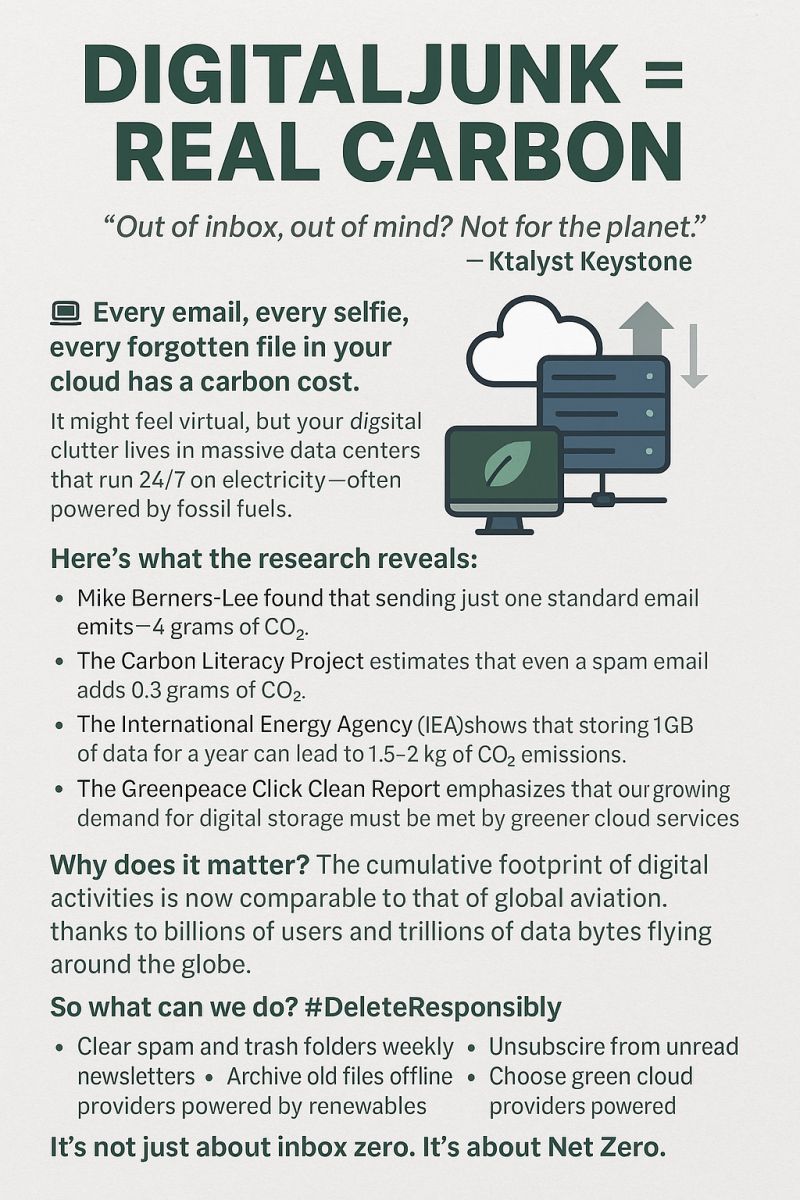
DigitalJunk = RealCarbon
Out of inbox, out of mind? Not for the planet.” — KtalystKeystone
🖥️ Every email, every selfie, every forgotten file in your cloud has a carbon cost.
It might feel virtual, but your digital clutter lives in massive dataCenters that run 24/7 on electricity—often powered by fossil fuels.
Here’s what the research reveals:
According to MikeBerners-Lee, author of “How Bad Are Bananas?”, sending just one standard email emits ~4 grams of CO₂, while a photo-heavy or attachment-filled email can go up to 50 grams.
The CarbonLiteracyProject estimates that even a single spam email—read or unread—adds 0.3 grams of CO₂ to the atmosphere.
Analysis from the International Energy Agency (IEA) shows that storing just 1GB of data for a year can lead to 1.5–2 kg of CO₂ emissions, depending on the data center’s energy mix.
The GreenpeaceClickClean Report also emphasizes that our growing demand for digital storage must be met by greener cloud services, or risk making the internet a major carbon culprit.
Why does it matter?
The cumulative footprint of digital activities is now comparable to that of global aviation, thanks to billions of users and trillions of data bytes flying around the globe.
So what can we do?
DeleteResponsibly
Clear spam and trash folders weekly
Unsubscribe from unread newsletters
Archive old files offline
Choose green cloud providers powered by renewables
It’s not just about inbox zero. It’s about NetZero.
Let’s clean up our digital lives—one file, one click, one byte at a time.
SustainabilityStartsWithYou | GreenTech | CarbonFootprint | DigitalDetox | KtalystKeystone
Originally published on LinkedIn on 2025-04-11 11:55:37: https://www.linkedin.com/feed/update/urn%3Ali%3Ashare%3A7316428711644348416

