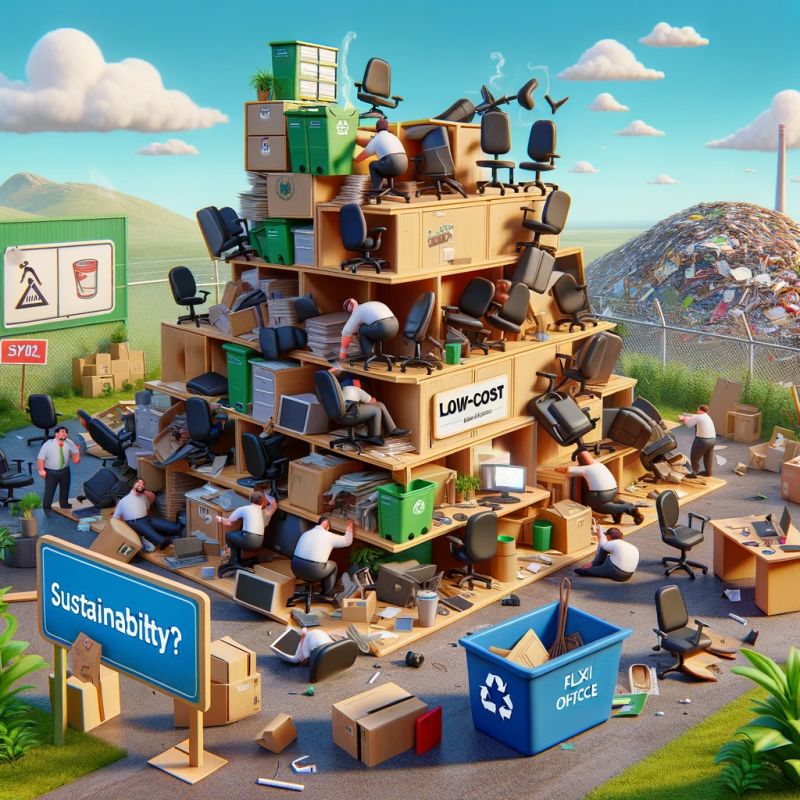
Knowledge Series: “Flexi Offices & Low_Cost Furniture – The Hidden Sustainability Crisis
You wouldn’t throw away your office every year—so why do we treat office furniture as disposable?
As FlexiOffices and coworking spaces boom, so does the demand for low-cost, fast furniture. While these setups are great for cost-cutting, they come with a massive environmental price tag—landfill waste, deforestation, and rising carbon emissions.
📊 The Hidden Environmental Cost of Flexi Office Trends
🔹 Furniture Waste Explosion
✔️ Over 12 million tons of furniture end up in landfills yearly in the US alone. (EPA, 2024)
✔️ 90% of discarded office furniture is non-recyclable due to toxic glues and laminates. (Circular Economy Report, 2024)
✔️ RealityCheck: The average lifespan of cheap office furniture? Just 5 years.
🔹 Deforestation & Resource Drain
✔️ The furniture industry drives 60% of illegal logging globally. (WWF, 2024)
✔️ One desk = One tree (50+ years to grow), yet most desks are discarded within 3-5 years. (FAO, 2024)
✔️ RealityCheck: The “cost-effective” furniture trend is accelerating deforestation and biodiversity loss.
🔹 Carbon Footprint & Toxic Chemicals
✔️ Many budget office setups rely on MDF and particleboard, releasing formaldehyde, a known carcinogen. (Environmental Health Report, 2024)
✔️ The furniture industry contributes 5% of global carbon emissions. (Carbon Trust, 2024)
✔️ RealityCheck: That “affordable” office setup could be an environmental nightmare.
🛠️ What Needs to Change?
✅ CircularEconomy Approach – Promote furniture leasing, second-hand markets, and repair initiatives.
✅ SustainableMaterials – Choose solid wood, bamboo, or recycled materials over disposable MDF.
✅ DesignForLongevity – Furniture should be modular, durable, and repairable—not landfill-bound.
🏆 KeyTakeaway
🌍 FlexiOffices could be both cost-efficient and sustainable with better material choices.
📉 They should be designed for reuse, not rapid disposal.
🚨 But they would be an environmental crisis if businesses prioritize cheap over green.
👉 Would you pay more for sustainable office furniture? Let’s discuss! 👇
Originally published on LinkedIn on 2025-02-21 14:47:52: https://www.linkedin.com/feed/update/urn%3Ali%3AgroupPost%3A2474261-7298715054588239872
🚨 CorporateGovernance The Lodha Brothers’ Brand Dispute: A Case of Legacy, Law, and Leadership
🔍 Overview
The high-profile legal battle between Abhishek Lodha (Macrotech Developers Ltd.) and Abhinandan Lodha (House of Abhinandan Lodha) over the “Lodha” brand is more than a family feud—it’s a masterclass in governance, brand strategy, and crisis management.
With over ₹1,700 crore invested in marketing and ₹91,000 crore in revenues attributed to the “Lodha” brand (FY14–FY24), the stakes are sky-high. At the heart of the dispute lies a YR2017 family settlement and differing interpretations of rights to the iconic name.
⚡ Why It Matters
Brand Equity: A four-decade legacy risks dilution.
Reputation: Public disputes among business leaders erode stakeholder confidence.
Financial Impact: Rebranding, legal costs, and operational distractions loom large.
📈 Key Lessons
1️⃣ Brand Governance: Clear ownership rights and robust agreements are non-negotiable.
2️⃣ Conflict Resolution: Mediation, not litigation, protects legacy and relationships.
3️⃣ Crisis Communication: Transparent messaging is essential to maintain trust.
4️⃣ Future-Proof Agreements: Regular reviews of family/business settlements can prevent ambiguity.
🎯 What’s Next?
The Bombay High Court will hear the case on January 21, 2025. The decision could reshape how family businesses approach brand governance and conflict management.
💡 Takeaway
For leaders and boards, this dispute serves as a wake-up call: protecting legacy requires more than just great business acumen—it demands foresight, clarity, and a proactive approach to governance.
What’s your perspective on managing brand rights in family businesses? Share your thoughts below!
https://lnkd.in/diXWty7C
Originally published on LinkedIn on 2025-01-21 13:13:50: https://www.linkedin.com/feed/update/urn%3Ali%3AgroupPost%3A2153908-7287457364532695040
🚨 CorporateGovernance The Lodha Brothers’ Brand Dispute: A Case of Legacy, Law, and Leadership
🔍 Overview
The high-profile legal battle between Abhishek Lodha (Macrotech Developers Ltd.) and Abhinandan Lodha (House of Abhinandan Lodha) over the “Lodha” brand is more than a family feud—it’s a masterclass in governance, brand strategy, and crisis management.
With over ₹1,700 crore invested in marketing and ₹91,000 crore in revenues attributed to the “Lodha” brand (FY14–FY24), the stakes are sky-high. At the heart of the dispute lies a YR2017 family settlement and differing interpretations of rights to the iconic name.
⚡ Why It Matters
Brand Equity: A four-decade legacy risks dilution.
Reputation: Public disputes among business leaders erode stakeholder confidence.
Financial Impact: Rebranding, legal costs, and operational distractions loom large.
📈 Key Lessons
1️⃣ Brand Governance: Clear ownership rights and robust agreements are non-negotiable.
2️⃣ Conflict Resolution: Mediation, not litigation, protects legacy and relationships.
3️⃣ Crisis Communication: Transparent messaging is essential to maintain trust.
4️⃣ Future-Proof Agreements: Regular reviews of family/business settlements can prevent ambiguity.
🎯 What’s Next?
The Bombay High Court will hear the case on January 21, 2025. The decision could reshape how family businesses approach brand governance and conflict management.
💡 Takeaway
For leaders and boards, this dispute serves as a wake-up call: protecting legacy requires more than just great business acumen—it demands foresight, clarity, and a proactive approach to governance.
What’s your perspective on managing brand rights in family businesses? Share your thoughts below! 👇
Originally published on LinkedIn on 2025-01-21 13:13:22: https://www.linkedin.com/feed/update/urn%3Ali%3AgroupPost%3A2205762-7287457247146733569
Tarnishing Hill Queen’s Crown: An Environmental Crisis
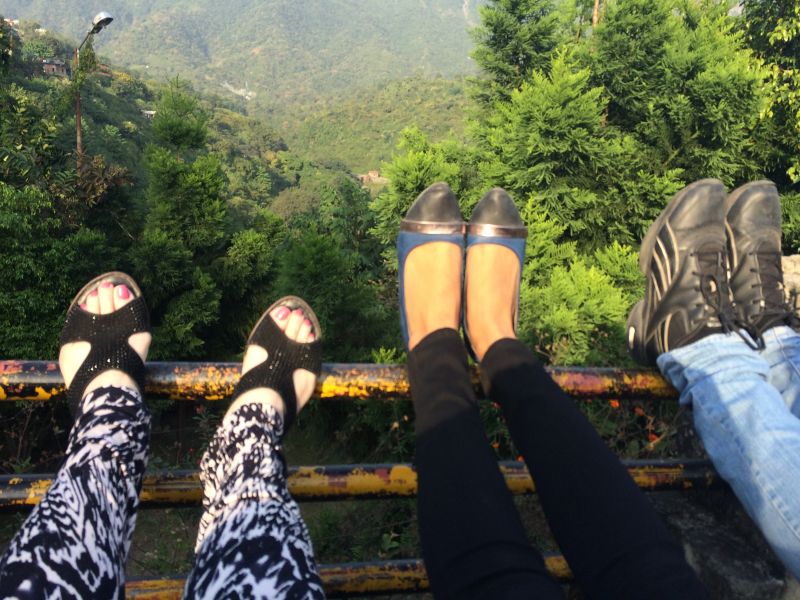
Mussoorie so many memories of family and friends tracking up and down the hills.
Incident: Road between Mussoorie and Dehradun washed away
Location: Galogi area
Heavy rainfall leading to landslides
Impact: Major disruptions, one-way traffic, restriction on heavy vehicles.
Underlying Environmental Issues:
Deforestation: Rampant cutting of trees weakening soil structure
Landscape Distortion: Construction activities disrupting natural water flow
Soil Erosion: Increased susceptibility due to deforestation and landscape changes
Infrastructure development without nature prioritisation
Lack of proper waste management leading to pollution
The road between Mussoorie and Dehradun is more than just a means of transportation; it is a symbol of the delicate balance between human activity and nature. The recent damage is a wake-up call to address the underlying environmental issues that have been ignored for too long. By taking proactive steps towards sustainable development and environmental conservation, we can ensure that the “Queen of the Hills” retains her crown for generations to come.
Originally published on LinkedIn on 2024-08-07 15:11:40: https://www.linkedin.com/feed/update/urn%3Ali%3Ashare%3A7226968244551577600

