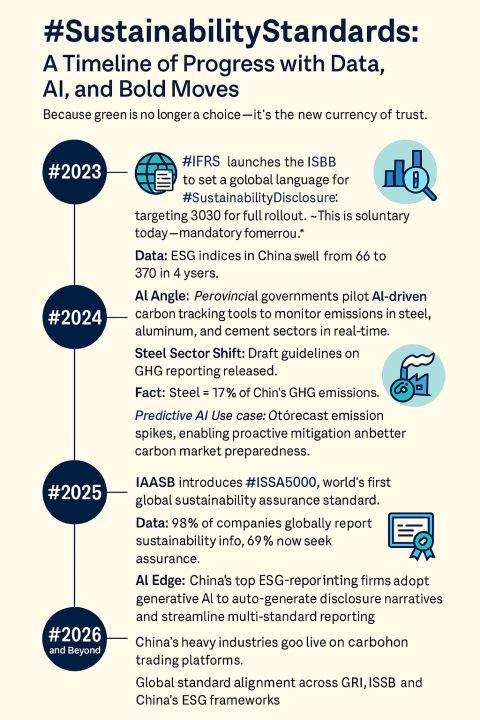
SustainabilityStandards China New initiative: A Timeline of Progress with Data, AI, and Bold Moves
Because green is no longer a choice—it’s the new currency of trust.
2023
IFRS launches the ISSB (International Sustainability Standards Board) to set a global language for SustainabilityDisclosure.
China accelerates its push for ESG alignment.
Data: China’s ESG investment hits ¥33.06 trillion ($4.56T), up 34.4% YoY.
AI Angle: ESG-focused funds and asset managers in China begin using AI models to identify high-performing sustainable sectors and detect greenwashing patterns.
YR2024
December: China rolls out Basic Standards for Corporate Sustainability Disclosure, targeting 2030 for full rollout.
This is voluntary today—mandatory tomorrow.
Data: ESG indices in China swell from 66 to 370 in 4 years.
AI Angle: Provincial governments pilot AI-driven carbon tracking tools to monitor emissions in steel, aluminum, and cement sectors in real time.
Steel Sector Shift: Draft guidelines on GHG reporting released.
Fact: Steel = 17% of China’s GHG emissions.
AI Use Case: Predictive AI used to forecast emission spikes, enabling proactive mitigation and better carbon market preparedness.
YR2025
IAASB introduces ISSA5000, the world’s first global sustainability assurance standard.
Data: 98% of companies globally report sustainability info; 69% now seek assurance.
AI Edge: China’s top ESG-reporting firms adopt generative AI to auto-generate disclosure narratives and streamline multi-standard reporting.
YR2026 and Beyond
China’s heavy industries go live on carbon trading platforms.
Global standard alignment across GRI, ISSB, and China’s ESG frameworks.
AI-powered ESG dashboards become boardroom staples—driving smarter decisions with real-time metrics.
Takeaway:
The future of sustainability reporting isn’t just green—it’s smart. AI is fast becoming the invisible enabler behind China’s massive push for environmental accountability and ESG transparency.


Originally published on LinkedIn on 2025-03-30 05:22:03: https://www.linkedin.com/feed/update/urn%3Ali%3AgroupPost%3A4281795-7311981011091791872
CustomerInfluence is Driving CorporateSustainability—Are Businesses Ready? 🇮🇳🌍🛍️
What if every dollar (or rupee!) you spent was a vote for the future you wanted?
Consumers are no longer just buying products—they’re reshaping industries. In India, 85% of urban shoppers now prefer eco-friendly brands (Nielsen, 2024), pushing businesses to align with sustainability or risk losing relevance.
📢 WhichIndustries Are Most Affected by Customer Demand for Sustainability?
🚗 Automobile & Mobility
✔️ India’s EV market grew 48% YoY as consumers shift to greener transport (SIAM, 2024).
✔️ Tata Motors leads India’s EV sector with a 74% market share, while global automakers scramble to meet demand (Economic Times, 2024).
✔️ Uber & Ola face pressure to electrify fleets, with government mandates accelerating the shift.
🛍️ Retail & Fashion
✔️ Fast fashion faces a reckoning: 73% of Gen Z in India prefer sustainable brands (Deloitte, 2024).
✔️ H&M & Zara under fire for greenwashing, while local sustainable brands like FabIndia & B Label are thriving.
✔️ Shein & Flipkart Fashion have faced sustainability backlash, yet mass-market appeal keeps them afloat.
🥤 Food & Beverage
✔️ 70% of Indian consumers prefer eco-friendly packaging, pushing brands to reduce plastic use (Mint, 2024).
✔️ Nestlé & PepsiCo face bans on single-use plastics, while Amul & Mother Dairy work on sustainable dairy farming.
✔️ Plant-based meat & dairy alternatives are gaining ground, with a 32% YoY growth in demand (FICCI, 2024).
🏡 RealEstate & Construction
✔️ Green buildings account for 7% of new constructions in India, but demand for sustainable housing is rising (JLL India, 2024).
✔️ Godrej Properties & Mahindra Lifespaces are leading in green-certified real estate.
✔️ Builders failing on sustainability face regulatory & buyer scrutiny, pushing firms toward solar power & eco-friendly materials.
💄 Beauty & Personal Care
✔️ India’s natural beauty segment is growing 35% YoY, driven by demand for chemical-free, cruelty-free products (Statista, 2024).
✔️ Forest Essentials & Kama Ayurveda thrive, while L’Oréal & Unilever struggle with green claims scrutiny.
📊 KeyTakeaway: Consumers Hold the Power
📌 Customers could be the biggest force in driving corporate climate action.
📌 Brands should be transparent & proactive—greenwashing is no longer an option.
📌 The future would be shaped by companies prioritizing real impact over marketing.
👉 Do you factor sustainability into your purchasing decisions? Let’s discuss below! 👇

Originally published on LinkedIn on 2025-02-26 05:06:26: https://www.linkedin.com/feed/update/urn%3Ali%3AgroupPost%3A95089-7300380670919426049

