KtalystInsights | The RedThreads of the GreenJourney: Glasgow to Belém in the New Energy World
Climate talks aren’t photo-ops; they’re cliffhangers. Each COP leaves loose ends — promises half-stitched, credibility half-earned. From Glasgow in 2021 to Belém in 2025, the story is threaded with ambition, finance, urgency, and doubt.
And beyond the COP corridors, a New Energy World is charging up. Watts rival currencies. Trillions flow to clean tech. But greenwashing often trips the circuit.
1. COP26 – Glasgow (2021): Ambition Pledged
i. Pact: “phase down coal,” keep 1.5°C alive
ii. $100B finance re-promised
iii. Global Methane Pledge & GFANZ launched
iv. Flop: Adaptation vague; trust deficit widened
2. COP27 – Sharm el-Sheikh (2022): Loss & Damage Recognized
i. Branded “Implementation COP,” little new ambition
ii. Loss & Damage Fund created
iii. Adaptation lagged
iv. Flop: North–South divides deepened
3. COP28 – Dubai (2023): Fossil Transition Admitted
i. Global Stocktake: world off track
ii. Text: “transitioning away from fossil fuels
iii. $100B finance “met,” mostly loans
iv. Flop: Renewables & efficiency behind
4. COP29 – Baku (2024): Finance Roadmap Launched
i. $300B/yr goal by 2035
ii. $1.3T/yr mobilization roadmap
iii. Progress on carbon markets & adaptation
iv. Flop: Fossil text diluted; finance thin
5. COP30 – Belém (2025): The Amazon Test
i. Will $300B/yr move from paper to pipelines?
ii. Forests, biodiversity, Indigenous rights center stage
iii. Just Transition: link jobs & equity
iv. Midpoint check: 1.5°C survival on the line
6. Threads Pulled Tight
i. 2021 Glasgow → Ambition pledged
ii. 2022 Sharm → Loss & Damage recognized
iii. 2023 Dubai → Fossil transition admitted
iv. 2024 Baku → Finance roadmap launched
v. 2025 Belém → Credibility test
7. Flowing vs. Flopping
Flowing:
i. Loss & Damage recognized
ii. Fossil transition in texts
iii. Finance roadmap trillion-scale
iv. 585 GW renewables added in 2024 (+15.1%, total 4,448 GW)
v. Solar PV: 452 GW; renewables = 92.5% of new capacity
Flopping:
i. Finance gap: loans > grants
ii. Adaptation < $200–300B/yr need
iii. Fossil subsidies $1.2T (2022), $620B (2023)
iv. Pledges track to ~2.4°C warming
👉 The paradox: the watt economy is booming, but credibility is still on load-shedding.
8. Looking Ahead: COP30 → 2030
i. Flows to accelerate: finance, renewables, efficiency
ii. Flops to fix: subsidies, adaptation, accountability
iii. COP30 judged by: finance flows, forests stand, fossil use declines
iv. By 2030, history will ask: Did urgency weave a green future — or just patch together greenwashing?
KtalystKeystone | MrsSustainability | NamasteIndia | COP30 | EnergyTransition | NetZero
Are we spinning a New Energy World on real wattage — or just running it on the backup generator of greenwashing?” Dr. Anju Sharma
Originally published on LinkedIn on 2025-09-19 20:19:06: https://www.linkedin.com/feed/update/urn%3Ali%3AgroupPost%3A2474261-7374899862095446016
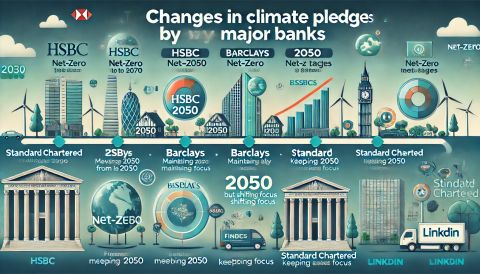
KnowledgeSeries Banks & Climate Pledges: A Retreat or a Realignment? 🌍💰
🚨 Global banks are shifting their net-zero targets! 🚨
💡 What’s Changing?
🔄 HSBC: Net-zero delayed from 2050 → 2070, altering financed emissions calculation
🏦 Barclays: Still targeting 2050, but shifting focus to low-carbon transition finance rather than direct emission cuts
📉 StandardChartered: Sticking with 2050, but modifying sector-specific decarbonization pathways
Timeline of Bank Climate Commitments
📌 HSBC
🟢 2020: Pledged net-zero by 2050
🔴 2024: Pushed net-zero to 2070 due to “economic realities
⚠️ Key Shift: Changed how financed emissions are measured, easing short-term compliance
📌 Barclays
🟢 2020: Pledged net-zero by 2050
🟡 2023: No change in target, but transition finance focus increased
⚠️ Key Shift: Redirecting funds to support companies’ gradual shift rather than demanding immediate cuts
📌 StandardChartered
🟢 2021: Pledged net-zero by 2050
🟡 2023-24: Adjusted its decarbonization targets for specific industries
⚠️ Key Shift: Sectors like oil, gas, and heavy industries given more transition time
Why Are Banks Reworking Their Climate Pledges?
📊 Key Drivers Behind the Change:
💰 Economic Pressures: Rising inflation + shareholder push for profits
⚖️ Regulatory Softening: EU reduces mandatory ESG reporting burdens
🏗️ Client Readiness Gap: High-emission sectors not transitioning fast enough
📉 Investor Sentiment: Balancing short-term profitability with long-term sustainability
The Big Question: Greenwashing or a Smarter Strategy?
❓ Are banks backtracking on sustainability due to financial pressure?
❓ Or are they adapting to economic realities for a more realistic transition?
🔥 COP29 will reveal whether these shifts are just delays or genuine strategy recalibrations!
💬 What’s your take? Are banks stepping back or stepping smarter? ⏳💡
Sustainability Finance NetZero ClimatePledges
Originally published on LinkedIn on 2025-03-17 11:21:57: https://www.linkedin.com/feed/update/urn%3Ali%3AgroupPost%3A4385073-7307360540777963520
NamasteGreenIndia Advances Climate Action: Setting Up Carbon Trading and Green Bond Regulator
Key Developments:
1. Establishment of a Regulatory Body:
India plans to set up a dedicated regulator for carbon trading and green bonds.
The body will oversee activities related to domestic carbon markets and sustainable financing.
2. Legislative Framework:
The Energy Conservation (Amendment) Bill 2022 laid the foundation for a regulated carbon market.
Carbon_Credit_Trading_Scheme 2023 has been approved, which involves forming a National Steering Committee for market governance.
3. Integration with Global Frameworks:
Aligns with the global carbon market rules finalized under Article 6.4 of the Paris_Agreement at COP29 in Baku, Azerbaijan.
Focused on achieving India’s commitment to reducing greenhouse gas emissions by 2030.
4. Securities Market Expansion:
The Securities and Exchange Board of India (SEBI) proposed including green securitization and sustainable debt instruments under its sustainable finance framework.
Key Actions to be Taken:
1. Formation of the Regulatory Body:
Establish an agency similar to NAFED to regulate carbon trading and green bonds.
2. Operationalizing Carbon Trading:
Develop clear rules for carbon credit issuance, trading, and compliance.
Ensure alignment with international standards for credibility and market participation.
3. Promoting Green Bonds:
Create incentives for businesses to issue and invest in green bonds.
Strengthen frameworks for transparency and accountability in green bond utilization.
4. Stakeholder Engagement:
Collaborate with industries, investors, and global climate bodies to ensure successful implementation.
Promote public and private sector participation in carbon markets and sustainable finance.
5. Monitoring and Reporting Mechanisms:
Implement robust systems for tracking carbon emissions reductions and reporting.
Enhance capacity-building efforts to ensure compliance with regulatory norms.
6. Market Integration:
Foster a domestic carbon market and facilitate integration with international carbon trading systems.
Leverage global best practices to establish India as a leader in green finance and carbon trading.
Strategic Objectives:
Drive India’s transition to a low-carbon economy.
Mobilize green investments to meet climate goals.
Achieve a balance between economic growth and environmental sustainability.
This initiative positions India as a key player in global climate action, aligning national economic policies with environmental priorities.
Originally published on LinkedIn on 2024-12-02 16:46:50: https://www.linkedin.com/feed/update/urn%3Ali%3AgroupPost%3A60128-7269391576076800000
NamasteIndia “Optical Illusions”: COP29 Climate Finance Controversy
Developed nations pledged $300 billion annually by 2035, significantly short of the $1.3 trillion deemed necessary by experts and developing nations.
Criticism from the Global South
Insufficient Funding:
The pledged amount of $300 billion falls far below the required $1.3 trillion annually.
Experts and vulnerable nations argue this level of financing will not address urgent climate challenges.
Disproportionate Impacts:
Developing nations are the most affected by climate change despite contributing the least to global emissions.
Countries like India and Nigeria criticized the agreement for not recognizing their immediate needs.
Strong Reactions:
Chandni Raina, India’s negotiator, described the agreement as an “optical illusion.
Representatives of the Global South feel abandoned and betrayed by the Global North.
Challenges in Negotiations
Tensions Between North and South:
Prolonged discussions highlighted the deep divide in climate priorities.
Developing nations demanded more robust financial support to address historical inequities in emissions.
Reluctance from Developed Nations:
Wealthy countries hesitated to commit to higher amounts due to economic concerns and competing domestic priorities.
Implications of the COP29 Agreement
Impact on Climate Cooperation:
The perceived inadequacy of commitments undermines trust between the Global North and South.
Future collaboration under the Paris Agreement goals may be at risk.
Barriers to Mitigation and Adaptation:
Insufficient financial resources could delay critical initiatives in vulnerable regions.
Progress on combating climate change globally could be hindered.
Bridging the Gap:
Acknowledging the disparity between the pledged amount and actual needs is crucial.
Developed nations must reassess their commitments to foster global trust and equity.
Ensuring Accountability:
Mechanisms to monitor and enforce financial pledges should be strengthened.
Focus on transparent and equitable distribution of climate funds.
The “optical illusion” of climate finance at COP29 emphasizes the need for tangible, equitable solutions to address the climate crisis and build trust across global communities.
The Great Escape from Baku: Global North abandons South, denies adequate climate finance at COP29 https://lnkd.in/dp_H8ry9
Originally published on LinkedIn on 2024-11-25 08:44:07: https://www.linkedin.com/feed/update/urn%3Ali%3Ashare%3A7266733380271046657
NamasteIndia just ahead of the COP29 Global GHG Emissions by Sector and Key Countries (2023)
Sector Breakdown
1. Power (26%, 15 Gt)
China (27%), US (11%), India (7%): Coal dominates emissions.
Focus: Transition to renewables and improve grid efficiency.
2. Transport (15%, 9 Gt)
US, China, EU: High emissions from vehicles and freight.
Focus: Expand EV adoption and public transport.
3. Industry (11%, 6 Gt)
China, India, US: Cement, steel, and chemical production.
Focus: Decarbonize processes with clean technology.
4. Fuel Production (10%, 6 Gt)
Russia, Middle East, US: Fossil fuel extraction.
Focus: Reduce methane leaks and shift to alternatives.
5. Agriculture (11%, 6 Gt)
Brazil, India, US: Methane from livestock, rice cultivation, and fertilizer.
Focus: Promote regenerative farming and reduce food waste.
6. Land Use & Forestry (7%, 4 Gt)
Brazil, Indonesia, Africa: Deforestation and land conversion.
Focus: Reforestation and sustainable land management.
7. Buildings (6%, 3 Gt)
US, China, EU: Energy use for heating and construction.
Focus: Energy-efficient buildings and renewable energy.
8. Waste (4%, 2 Gt)
India, China, US: Methane from landfills and wastewater.
Focus: Modernize waste management and capture methane.
Top Emitters
China (~30%): Coal, cement, and steel dominate.
US (~14%): Transport and energy-intensive sectors.
India (~7%): Power and agriculture emissions.
EU (~8%): Heavy industries and aging systems.
Brazil & Indonesia: Deforestation hotspots.
Global Priorities:
Energy: Expand renewables and phase out coal.
Transport: Scale up EVs and public transit.
Industry: Invest in clean production technologies.
Forestry: Halt deforestation and restore ecosystems.
Impact: Tailored, sector-specific strategies can drive significant reductions in global GHG emissions.
Source / shared link: https://www.visualcapitalist.com/charted-global-ghg-emissions-by-sector/
Originally published on LinkedIn on 2024-11-19 03:28:20: https://www.linkedin.com/feed/update/urn%3Ali%3AgroupPost%3A59930-7264479581858861056
NamasteGreenIndia at COP29 GetRid_of_GreenWashing
COP29 is currently underway in Baku, Azerbaijan (November 11-22, 2024), as nearly 200 nations converge to confront the Climate Emergency.
COP29 Key_Actions_Tensions:
USD120 Billion Climate Finance: Multilateral Development Banks pledge $120 billion annually by 2030 to empower low- and middle-income nations for climate resilience.
GlobalCarbonMarkets: A groundbreaking carbon trading framework under Article6.4 of the Paris Agreement, poised to unlock critical financing for developing nations.
Fossil_Fuels in Focus: Azerbaijan’s defense of oil and gas underscores the deep divide between economic dependency on fossil fuels and global climate ambitions.
Skepticism from Argentina: Argentina’s exit from COP29 emphasizes the growing friction between national interests and global climate commitments.
UN’s UrgentPlea: The UN Secretary-General’s stark warning that 2024 is a “masterclass in climate destruction” calls for immediate, intensified action.
India, China, SouthKorea: Leading Voices with Distinct Goals
India: Leading calls for at least $1 trillion in annual climate finance by 2025, India advocates for transparent, fair funding mechanisms and a robust carbon market framework to guide industry-specific emission cuts.
China: Urges developed countries to exceed their $100 billion pledge, seeking $1.3 trillion annually for developing nations. China continues to prioritize large-scale investments in renewables and emphasizes the importance of US-China collaboration on climate issues.
SouthKorea: Sets ambitious 2030 emission reduction targets, expanding investment in green tech, particularly hydrogen and electric vehicles, while fostering regional cooperation to tackle shared environmental challenges.
Originally published on LinkedIn on 2024-11-14 03:21:58: https://www.linkedin.com/feed/update/urn%3Ali%3AgroupPost%3A131340-7262666040386486272
NamasteGreenIndia at COP29 GetRid_of_GreenWashing
COP29 is currently underway in Baku, Azerbaijan (November 11-22, 2024), as nearly 200 nations converge to confront the Climate Emergency.
COP29 Key_Actions_Tensions:
USD120 Billion Climate Finance: Multilateral Development Banks pledge $120 billion annually by 2030 to empower low- and middle-income nations for climate resilience.
GlobalCarbonMarkets: A groundbreaking carbon trading framework under Article6.4 of the Paris Agreement, poised to unlock critical financing for developing nations.
Fossil_Fuels in Focus: Azerbaijan’s defense of oil and gas underscores the deep divide between economic dependency on fossil fuels and global climate ambitions.
Skepticism from Argentina: Argentina’s exit from COP29 emphasizes the growing friction between national interests and global climate commitments.
UN’s UrgentPlea: The UN Secretary-General’s stark warning that 2024 is a “masterclass in climate destruction” calls for immediate, intensified action.
India, China, SouthKorea: Leading Voices with Distinct Goals
India: Leading calls for at least $1 trillion in annual climate finance by 2025, India advocates for transparent, fair funding mechanisms and a robust carbon market framework to guide industry-specific emission cuts.
China: Urges developed countries to exceed their $100 billion pledge, seeking $1.3 trillion annually for developing nations. China continues to prioritize large-scale investments in renewables and emphasizes the importance of US-China collaboration on climate issues.
SouthKorea: Sets ambitious 2030 emission reduction targets, expanding investment in green tech, particularly hydrogen and electric vehicles, while fostering regional cooperation to tackle shared environmental challenges.
As COP29 unfolds, these strategic moves from India, China, and South Korea underline their critical roles in shaping a global path forward. Their approaches reveal the spectrum of solutions needed to mitigate climate risks while balancing growth and sustainability in the face of complex geopolitical, economic, and environmental pressures.
Source / shared link: https://www.indiatoday.in/environment/story/why-are-countries-fighting-over-money-at-cop29-climate-summit-2632757-2024-11-13
Originally published on LinkedIn on 2024-11-14 03:19:55: https://www.linkedin.com/feed/update/urn%3Ali%3Ashare%3A7262665526169010177

