📌 LinkedInKnowledgeSeries: Sustainability & Competitive Advantage of Offshore CDMOs
WhyOffshoreCDMOs?
In today’s globalized world, offshore Contract Development and Manufacturing Organizations (CDMOs) play a crucial role in pharmaceutical, biotech, and specialty chemical industries. But beyond cost efficiencies, their sustainability impact and strategic advantages are shaping industry decisions.
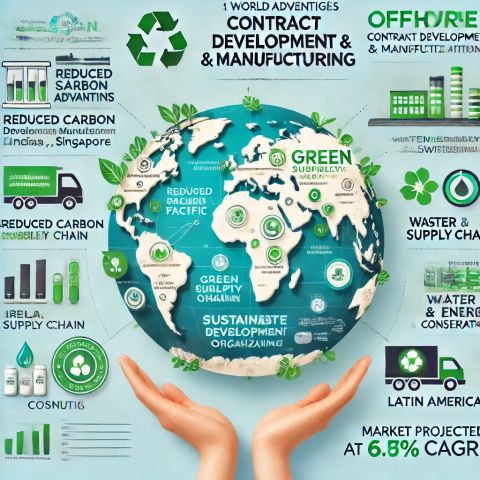
🌎 SustainabilityAdvantage of Offshore CDMOs
🟢 LowerCarbonFootprint
✔️ Energy-efficient large-scale production
✔️ Green chemistry & solvent recovery
🟢 WasteReduction & CircularEconomy
✔️ Optimized byproduct utilization
✔️ Compliance with strict environmental laws (ISO 14001, ESG standards)
🟢 Water & Energy Conservation
✔️ Smart water recycling systems
✔️ Low-carbon energy usage in manufacturing hubs
🟢 SustainableSourcing & GreenSupplyChain
✔️ Proximity to raw materials reduces transportation emissions
✔️ Near-market facilities cut global shipping footprints
🟢 Regulatory Compliance & ESG Commitment
✔️ Many offshore CDMOs align with Science-Based Targets Initiative (SBTi)
✔️ Integration of renewable energy and sustainability reporting
📍 GeographicalAdvantages of Offshore CDMOs
🌏 AsiaPacific (China, India, Singapore)
📌 Cost-effective & scalable operations
📌 Skilled workforce & advanced manufacturing hubs
📌 Strong pharma & biotech presence
🌍 Europe (Ireland, Germany, Switzerland)
📌 High-quality standards & regulatory compliance
📌 Proximity to major global markets
📌 Strong biologics & specialty chemical R&D
🌎 LatinAmerica (Brazil, Mexico, Argentina)
📌 Emerging CDMO hub with growing market access
📌 Favorable trade agreements for pharma exports
📌 Increasing investment in biotech & generics
📊 IndustryTrends: Who’s Outsourcing to Offshore CDMOs?
💊 Pharmaceuticals (70% of top pharma companies outsource)
🧬 Biotechnology (45% of biologics rely on CDMOs)
🧴 Cosmetics & Personal Care (35% of premium brands partner with CDMOs)
🔹 The CDMO market is projected to grow at 6.9% CAGR, driven by sustainability mandates and cost optimization strategies.
✅ Takeaway
Companies leveraging offshore CDMOs not only gain cost & operational efficiency but also enhance ESG compliance and reduce carbon footprints—a winning formula for long-term sustainability and profitability.
👉 WouldYouOutsource? Tell us in the comments! What are your thoughts on offshore CDMOs as a sustainability advantage?
Originally published on LinkedIn on 2025-03-20 08:10:19: https://www.linkedin.com/feed/update/urn%3Ali%3AgroupPost%3A82951-7308399477562753025
KnowledgeSeries: The Future of CarbonCredits – A USD250B Market by 2050
The carboncredit market is no longer a side conversation—it’s becoming a mainstream financial instrument. With projections hitting #$250B by 2050, businesses and investors must pay attention.
Why? Because companies that integrate NetZero strategies today will gain a competitive edge, while those that don’t will face higher costs, regulatory risks, and shrinking investor confidence.
🌎 The Carbon Credit Boom: Why It’s a Business Imperative
✔️ The voluntary carbon market is set to grow 15X by 2030, reaching #$10B–$40B. (McKinsey)
✔️ Investments in carbon credits hit #$1.7B in 2023, up 50% YoY. (BloombergNEF)
✔️ 6,000+ global companies have set Science-Based Targets (SBTi), driving demand for verified carbon offsets.
✔️ Indonesia, Brazil, and Kenya are integrating carbon markets into their economies, generating revenue from forests, renewable energy, and carbon capture projects.
✔️ Article 6 of the ParisAgreement is enabling international carbon credit trading, boosting market credibility.
🚀 What does this mean for businesses?
✔️ A carbon credit strategy is no longer optional—it’s a business necessity.
✔️ Companies without a decarbonization plan will face higher compliance costs.
✔️ Investors are prioritizing NetZero leaders, making carbon credits a key ESG performance driver.
📊 Who’s Leading the Carbon Credit Race?
✔️ Big Tech & Carbon Capture:
Meta, Microsoft, and Google are securing multi-million-dollar deals in Direct Air Capture (DAC) to future-proof their carbon strategies.
✔️ Financial Institutions Going Green:
BlackRock, JP Morgan, and Goldman Sachs are launching climate-focused funds, treating carbon credits as an emerging asset class.
✔️ Corporate Adoption Soaring:
40%+ of Fortune500 companies are embedding carbon offsets into their business models.
✔️ Government-Led Action:
The EU, Singapore, and Japan are developing regulated carbon exchanges to ensure transparency & standardization.
🌱 What to Expect in 2025 & Beyond?
✔️ Stricter Regulations → Carbon credit verification will be tighter, reducing low-quality offsets & greenwashing risks.
✔️ Rising Prices → As demand outstrips supply, carbon credit prices could triple by 2030, making early adoption a smart financial move.
✔️ Emerging Markets in Play → Africa, Southeast Asia, and Latin America will dominate nature-based carbon solutions (reforestation, soil carbon, etc.).
✔️ Carbon as a Tradable Asset → Institutional investors are pushing for liquid carbon credit markets, making carbon a financialized commodity.
🔍 ComingUpNext: “The Business Case for Carbon Credits – Risks, Rewards & Strategy
Originally published on LinkedIn on 2025-03-08 07:02:05: https://www.linkedin.com/feed/update/urn%3Ali%3AgroupPost%3A82951-7304033651044839424
🚨 India’s Emission Intensity Targets: A Game_Changer for Industries & Carbon#Markets?
India is set to release EmissionIntensityTargets for nine industrial sectors by the end of February 2025—marking a major milestone in its NetZero commitment. With industries given one year to comply, CarbonCreditTrading is expected to follow, reshaping how businesses approach Decarbonization and Sustainability.
📊 What’s Changing?
🔹 Industries Impacted: Steel, Cement, Petrochemicals, Fertilizers, Textiles, Pulp & Paper, Power, and more.
🔹 Compliance Window: Companies get one year to implement emission-cutting measures.
🔹 Carbon Markets Activation: After compliance, CapAndTrade kicks in—firms exceeding targets can sell credits, while high emitters must buy them.
🔹 India’s Net Zero Push: Aims to cut GHG emissions intensity by 45% by 2030 (vs. 2005 levels). (MoEFCC, 2025)
💡 What’s the Opportunity?
✔️ Green Investment Boom: Expect a surge in Renewables, CCUS (Carbon Capture), and EnergyEfficiency projects.
✔️ Competitive Advantage: Early adopters of clean tech & low-carbon solutions will benefit from carbon credits.
✔️ Global Alignment: Brings India closer to EU CBAM, US IRA, & China’s ETS—making exports competitive.
⚠️ The Challenges Ahead
🚨 Cost of Compliance: Industries must invest in LowCarbonTech, Electrification, and AlternativeFuels.
🚨 Regulatory Uncertainty: Clarity on CarbonPricing, OffsetRules, and international trading needed.
🚨 SMEs at Risk: Large firms may comply, but MSMEs could struggle due to financial constraints.
🏆 KeyTakeaway: Green Mandates & Market Forces Converging
📌 India could be a global leader in carbon markets & industrial sustainability.
📌 India should be providing clear policy incentives & transition funds.
📌 India would be missing out if compliance turns into just another Greenwashing exercise.
👉 Will India’s emission trading system be a breakthrough or just another regulatory hurdle? Let’s discuss! 👇
Originally published on LinkedIn on 2025-02-25 17:55:58: https://www.linkedin.com/feed/update/urn%3Ali%3Ashare%3A7300211941875052544
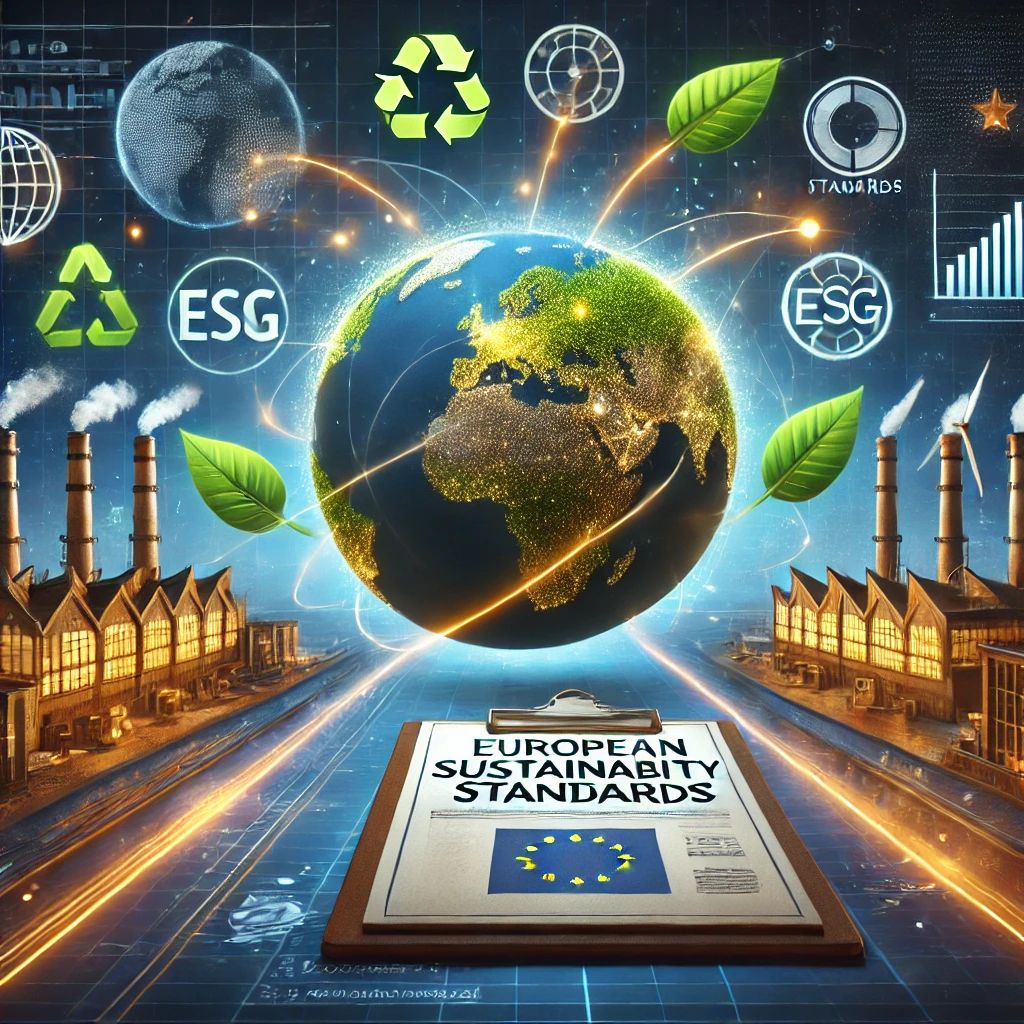
NamasteIndia ESRS_Ripple_Effect:Europe’s Global_Disruptor_Rules Reshape Indian Businesses” 🇮🇳
With the EU’s European Sustainability Reporting Standards (ESRS) coming into effect, Indian businesses are set to feel the heat. Here’s a data-driven breakdown of how these standards will impact India:
🔵 Indian Exporters Face Compliance Pressure
Fact: India exported goods worth #€65 billion to the EU in 2022, making the EU one of India’s largest trading partners. (Source: Eurostat)
Impact: Exporters must now meet ESRS-aligned requirements like carbon reporting, labor conditions, and water usage transparency.
Example: 45% of Indian textile exports go to the EU, which requires ESG disclosures from supply chains.
🟢 Subsidiaries of EU Companies Must Adapt
Fact: Over 4,000 EU-based companies have subsidiaries in India, spanning sectors like IT, pharmaceuticals, and manufacturing. (Source: EU Delegation to India)
Impact: Indian branches will face stricter ESG reporting as EU headquarters comply with ESRS.
Example: Indian operations of EU automotive giants must disclose scope 1, 2, and 3 emissions to support parent company reports.
🟡 Supply Chain Scrutiny to Intensify
Fact: 70% of EU companies rely on global supply chains, with India being a critical link. (Source: EFRAG)
Impact: Indian suppliers must provide accurate sustainability data or risk losing contracts.
Example: EU pharma imports from India, valued at #€8 billion annually, will require ESG-aligned disclosures like energy use and labor practices.
🟠 Regulatory Convergence in India
Fact: India’s BRSR framework, introduced in 2021, already mandates ESG reporting for the top 1,000 listed companies. (Source: SEBI)
Impact: ESRS accelerates India’s regulatory momentum, pushing companies to adopt global ESG benchmarks.
🟣 Opportunities in Green Tech and Consulting
Fact: The ESG consulting market in India is projected to grow at a CAGR of 35%, reaching #$1.2 billion by 2030. (Source: PwC India)
Impact: Indian firms offering ESG solutions—like software platforms for tracking emissions—stand to gain as EU firms outsource compliance support.
🔴 Competitive Advantage for ESG Leaders
Fact: 83% of EU investors prefer companies with strong ESG credentials. (Source: EY)
Impact: Indian companies with advanced sustainability practices will become preferred partners for EU buyers.
Example: Tata Steel’s carbon-neutral initiatives make it a strong supplier for ESG-conscious European firms.
Key Stats That Matter
#€85 billion: Total trade between India and the EU in 2022. (Source: Eurostat)
4,000+: EU-based companies with operations in India. (Source: EU Delegation to India)
35% CAGR: Growth of India’s ESG consulting market by 2030. (Source: PwC)
👉 Are Indian companies ready to navigate the ESG revolution and seize the opportunity?
SustainabilityLeadership ESRSImpact IndiaAndEU ESGCompliance GreenEconomy
Originally published on LinkedIn on 2025-01-27 11:33:17: https://www.linkedin.com/feed/update/urn%3Ali%3AgroupPost%3A3880479-7289606387402207232
Question “Turning Methane Green for Hydrogen: A Sustainable Revolution or an Overhyped Gamble?
The Hydrogen Spectrum: Gray, Blue, and Green
🟦 Gray Hydrogen:
Makes up 80% of global hydrogen production, emitting 9-12 kg CO₂/kg of hydrogen.
Inexpensive at $1-2/kg, but environmentally costly.
🔵 Blue Hydrogen:
Cuts emissions by up to 90% using carbon capture.
Costs $1.5-3/kg, but CCS scalability is a challenge.
💚 Green Hydrogen:
Zero emissions but expensive at $3-8/kg.
Projected to reach $1-2/kg by 2030, with renewable energy advancements (IEA, 2024).
🌱 Biogas: Methane’s Green Revolution or Gamble?
1️⃣ The Green Potential
Waste Reduction: Converts 20% of global methane emissions from decomposing waste, cutting greenhouse gas emissions equivalent to 500 million tons of CO₂ annually (IEA, 2023).
Methane Mitigation: Captures a gas 25x more potent than CO₂, turning it into energy.
2️⃣ A Renewable Pathway
Biomethane Production: Purifies biogas into biomethane, a substitute for natural gas or feedstock for green hydrogen.
Future Potential: Biomethane could meet 20% of global natural gas demand by 2040 (World Biogas Association, 2023).
3️⃣ Practical Challenges
High Costs: Initial investment in anaerobic digesters and upgrading facilities is substantial.
Slow Adoption: Only 2% of global methane demand is currently fulfilled by biomethane.
💡 Hydrogen from Biogas: A Green Transition
🔗 Biomethane-to-Hydrogen: Biomethane enables a blue-to-green hydrogen bridge, reducing emissions by 95% when paired with carbon capture.
💰 Economic Feasibility: Producing hydrogen from biomethane costs $2-4/kg, making it a competitive interim solution.
🌍 Key Impact Potential
🌱 Emission_Reduction: Combating up to 1 gigaton of CO₂-equivalent emissions annually by scaling biogas and biomethane.
♻️ Circular_Economy: Converts 300 million tons of organic waste into energy annually.
🔒 Energy_Security: Biogas can fulfill 10% of global energy demand by 2050.
Conclusion: Revolution or Gamble?
Biogas and biomethane present a game-changing opportunity to turn methane green and bridge the gap to green hydrogen. However, costs, infrastructure, and slow adoption spark skepticism. The path forward requires bold policy action, strategic investment, and technological breakthroughs to turn this gamble into a sustainable revolution.
Originally published on LinkedIn on 2024-12-27 04:21:11: https://www.linkedin.com/feed/update/urn%3Ali%3AgroupPost%3A60128-7278263621023903744

