🧼 Greenwashing Gets Washed Out! 🌍
IndiaAndBeyond | June 2025
🔍 KtalystInsight: “Don’t rinse your image—clean your impact.
From buzzwords to busts, the world’s calling out fake green. Here’s your rinse cycle of reality:
🚨India
SEBI & CCPA are done with ESG fluff. Misleading ads? Tree-planting tall tales? Get ready for fines and fact-checks.
🇪🇺 EU
The much-hyped Green Claims Directive? Spun out. Politics > Planet, for now.
🇨🇦 Canada
New rules = no more eco-fairy tales. Truth in ads or face public & legal backlash.
🇨🇱 Chile
Writing greenwashing laws with teeth—and claws. Think fines, bans, and reversed burden of proof!
⚖️ France
TotalEnergies stands trial. A net-zero pledge doesn’t wash away fossil fuel facts.
🧾 Verdict?
🌱 Green is good. Greenwashed isn’t.
📊 Data > Drama. Truth > Trend.
Originally published on LinkedIn on 2025-06-26 01:17:45: https://www.linkedin.com/feed/update/urn%3Ali%3Ashare%3A7343809665182355459
SustainabilityNow | Numbers That Shaped the Week 📊
In a world obsessed with noise 📢, we focus on what truly matters:
Data 📈. Direction 🧭. Decisions 🤝.
Here’s your 60_second ESG intel — through the sharp lens of KtalystKeystone 🔍:
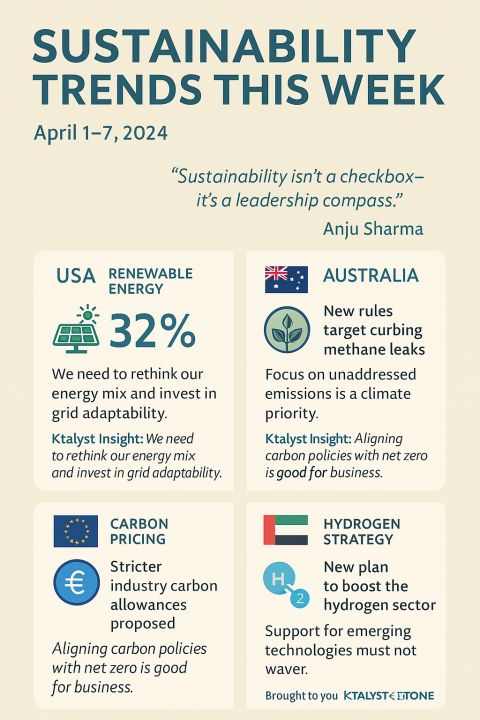
⚡ Ard32% of Global Electricity Now Comes from Renewables (2024)
Driven by EVs, AI data centers & heatwaves
Ktalyst Insight:
Clean power without smart integration causes volatility.
We help businesses future-proof with resilient energy models that balance renewable input and grid flexibility.
🏭 8.5 Million Tonnes of CO₂ to Be Injected in Texas
EPA greenlights Occidental’s carbon storage wells
Ktalyst Insight:
Carbon capture isn’t a trophy — it’s a tool.
We guide leaders on carbon ROI, policy risk, and long-term decarbonization impact.
🇪🇺 EU Considers Global Carbon Credits to Meet 2040 Targets
Offsetting from forests in Brazil & Africa on the table
Ktalyst Insight:
You can’t outsource accountability or ethics.
We enable traceable, measurable, community-aligned offset strategies — beyond green optics.
🌍 Africa’s Climate Voice: “No Reverse Gear on Commitments
Push for finance equity, clean energy, just transitions
Ktalyst Insight:
Africa isn’t a follower — it’s a forerunner.
We help firms tap into clean-tech zones with local partnerships and impact-driven models.
🌡️ March 2025: Warmest Ever — 1.6°C Above Pre-Industrial Avg
20 of last 21 months breached 1.5°C threshold
Ktalyst Insight:
Resilience is the new insurance.
We embed climate forecasting into supply chains, infrastructure, and operations.
⛏️ Chile’s Lithium 2Push Faces Indigenous Pushback
Communities demand shared governance in Atacama
Ktalyst Insight:
True sustainability includes those who live on the land.
We co-design ethical sourcing policies with consent-led governance and justice principles.
💸 €25M Greenwashing Fine for Deutsche’s DWS
After $25M U.S. settlement for ESG misstatements
Ktalyst Insight:
If ESG is a checkbox — the penalty is a checkmate.
We help brands build audit-ready, data-backed ESG narratives with global compliance alignment.
💼 MUFG Appoints First EMEA Sustainability Chief
Strategic move after UNNZBA exit
Ktalyst Insight:
A title isn’t a transformation — implementation is.
We drive ESG ownership across teams with board-level playbooks, measurable KPIs, and incentive alignment.
KtalystQuoteOfTheWeek 💬
Sustainability isn’t a finish line — it’s the fuel line for future-ready growth.
Anju Sharma, Ktalyst Keystone

Originally published on LinkedIn on 2025-04-08 07:02:18: https://www.linkedin.com/feed/update/urn%3Ali%3AgroupPost%3A2474261-7315267732160110594
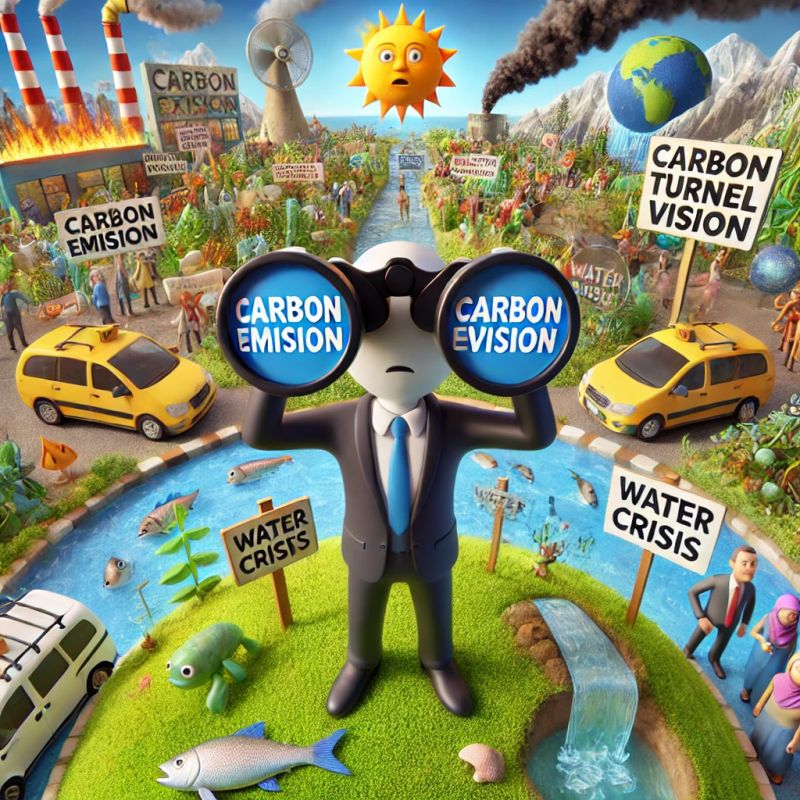
CarbonTunnelVision Gigantic_Mistake: Are We Missing the Big Picture? 🌍🌱
What is Carbon Tunnel Vision?
Focusing solely on carbon emissions while ignoring other sustainability factors like biodiversity, water, pollution, and equity.
KeyStats:
🟢 Afforestation_Gone_Wrong
Fact: Non-native tree plantations in Chile increased carbon storage but reduced local biodiversity by 60%. (Source: UNEP, 2023)
🔵 Water_Trade-Offs in Agriculture
Fact: Low-carbon crops like almonds require 1.1 gallons of water per almond, worsening droughts in water-scarce regions. (Source: WWF, 2023)
🟣 Biodiversity_Loss
Fact: Solar farms in India save 1.2M tons of CO₂ annually, but displace endangered wildlife habitats. (Source: WRI, 2023)
🟠 Pollution Ignored
Fact: Factories cutting carbon emissions often increase water and soil pollution by 30-40%. (Source: IPCC, 2023)
🔴 Social Impact Overlooked
Fact: Renewable energy projects displaced 42 million people globally between 2000 and 2022. (Source: Oxfam, 2023)
Takeaway
Carbon_Tunnel_Vision limits true sustainability. To create a balanced future, we must go BeyondCarbon and adopt HolisticStrategies that protect ecosystems, water, and communities. 🌱
👉 Are your sustainability goals stuck in the tunnel? Time to zoom out!
Sustainability ClimateAction ESG Leadership
Originally published on LinkedIn on 2025-01-25 06:05:01: https://www.linkedin.com/feed/update/urn%3Ali%3AgroupPost%3A3880479-7288799002844667904
NamasteGreenIndia
Copper Crunch: A Looming Threat to India’s Renewable Energy Ambitions
India’s aggressive push to achieve 500 GW of non_fossil fuel capacity by 2030 hinges on a critical resource: copper. Widely regarded as the “metal of electrification,” copper is vital for renewable energy systems like solar panels, wind turbines, and grid expansion, which require up to five times more copper than traditional power generation methods. However, a domestic supply deficit and growing dependence on imports threaten to derail these plans.
Rising_Demand, Modest_Supply
India is both a significant consumer and a modest producer of copper. Ranked 7th globally in refined copper consumption, India’s demand continues to surge due to its renewable energy and infrastructure ambitions. However, the country ranks 17th in global copper production, contributing a mere 0.2% of the global output. This stark mismatch between consumption and production has led to a heavy reliance on imports, primarily from top copper-producing countries like:
1. Chile – The largest global producer, 28% of the world’s output.
2. Peru – The second-largest producer with 12% of global output.
3. China – A major producer with significant smelting capacity.
4. Democratic Republic of Congo (DRC) – Known for high-grade copper reserves.
5. United States – A leading producer with advanced mining infrastructure.
India’s refined copper imports increased by 30% in FY2023 and by 180% in the first half of FY2024, highlighting its growing dependence on foreign supplies.
Strategic Interventions
To address the copper crunch, India is exploring several strategies:
1. Boosting Domestic Production: The Adani Group’s upcoming smelter with a 0.5 million metric ton capacity is expected to partially bridge the supply gap by FY2025.
2. Promoting Recycling: Copper’s recyclability offers a sustainable solution, but high GST rates on scrap hinder recycling efforts.
3. Exploring Deep-Sea Mining: India plans to explore polymetallic nodules in the Pacific Ocean to secure essential minerals, including copper.
Copper_intensive renewable projects like solar and wind energy are central to India’s climate goals. Solar power installations require 4-5 tons of copper per megawatt, while wind turbines demand 2-3 tons per megawatt. Without a steady copper supply, renewable energy projects could face significant cost escalations and delays, jeopardizing India’s ability to meet its 2030 targets.
With global copper demand projected to double by YR2040, competition for resources is expected to intensify, making a robust and diversified strategy critical for India.
Originally published on LinkedIn on 2024-12-04 14:46:38: https://www.linkedin.com/feed/update/urn%3Ali%3Ashare%3A7270086103792013312
Li-ion to Na-ion: A Periodic Table Power Shift!
Lithium-ion Batteries: Current Dominance and Challenges: Lithium-ion (Li-ion) batteries have long been the preferred choice for electric vehicles (EVs) and renewable energy storage. However, the rapid expansion of these markets is leading to potential supply shortages of lithium within the next five to ten years.
Key Challenges:
1. Increased Demand: The demand for lithium has tripled since 2017 and is expected to grow tenfold by 2050.
2. Geographical Concentration: Lithium production is concentrated in a few countries, primarily Australia, Chile, and China.
3. Supply Chain Complexities: The supply chain involves multiple stages, any of which can face disruptions.
Sodium-ion Batteries: A Promising Alternative
Sodium-ion (Na-ion) batteries offer several advantages that make them a viable alternative to Li-ion batteries, particularly for India.
Advantages:
1. Cost-Effectiveness: Sodium is more abundant and cheaper than lithium.
2. Wide Availability: Sodium is not concentrated in a few countries, reducing supply chain risks.
3. Safety: Na-ion batteries are less prone to thermal runaway and fire hazards.
4. Environmental Impact: Sodium mining and processing have a lower environmental impact.
5. Longer Lifespan: These batteries tend to have a longer lifespan.
How Sodium-ion Batteries Can Benefit India
1. Energy Storage for Renewable Sources: Na-ion batteries can stabilize the grid and store energy from renewable sources like solar and wind.
2. Electric Vehicles (EVs): Their cost-effectiveness and safety can make EVs more affordable and safer, accelerating electric mobility adoption.
3. Telecom and Remote Areas: Ideal for telecom towers and remote or off-grid areas, providing stable and safe energy storage.
4. Reducing Import Dependence: Developing and adopting Na-ion battery technology can reduce India’s dependence on imported lithium, enhancing energy security.
Originally published on LinkedIn on 2024-09-29 18:28:44: https://www.linkedin.com/feed/update/urn%3Ali%3Ashare%3A7246224394694381568
China is going all in for GreenHydrogen production:
640MW Green Hydrogen Project in Songyuan, Jilin Province
Operator: China Energy Engineering Corporation (CEEC)
Capacity: 640MW
Significance: Largest green hydrogen project in China
Other Major Green Hydrogen Plants in China
1. Sinopec’s Kuqa Plant
Location: Kuqa, Xinjiang
Capacity: 20,000 tons of green hydrogen annually
2. Baofeng Energy’s Ningxia Plant
Location: Ningxia
Capacity: 160MW
Integrates solar power for hydrogen production
3. China Huaneng’s Qinghai Plant
Location: Qinghai
Capacity: 100MW
4. SPIC’s Inner Mongolia Plant
Location: Inner Mongolia
Capacity: 200MW
5. China Datang’s Hebei Plant
Location: Hebei
Capacity: 150MW
Significance: Supports local green energy goals and industrial decarbonization
China’s Investments in Hydrogen Projects Outside of China
1. Saudi Arabia’s NEOM Project
2. Australia’s Asian Renewable Energy Hub
3. Norway’s Green Hydrogen Projects
4. Chile’s Green Hydrogen Initiatives
5. UnitedArab Emirates’ Hydrogen Project
The European Union is taking steps to limit the involvement of Chinese firms in its hydrogen project subsidies.
https://lnkd.in/dhhXCXx4
Originally published on LinkedIn on 2024-09-03 20:25:57: https://www.linkedin.com/feed/update/urn%3Ali%3AgroupPost%3A60128-7236831808686829569

