ProfitSinkhole: The Global E-Waste
Every gadget we discard carries gold, copper, rare earths & a ticking time bomb.
The world generated 62 million tonnes of e-waste in 2022. Formal recycling? Barely 22%. By 2030, that share could slip below 20% unless policy muscle and smarter tech step in. Asia already produces half the world’s e-waste. Europe collects the most (~40%), Africa the least (~1%). The gap is obvious & so are the business opportunities.
Who’s Doing What (and Why It Matters)
US – 25 states run e-waste laws, mostly EPR-funded. No federal mandate, patchwork policy. State-by-state siting game for recyclers chasing steady PCB & plastics feed.
EU– WEEE Directive & RoHS compliance make it the most certification-heavy market. Think: pay premium for chemical recycling that strips BFRs and recovers Au, Cu, Pd with documented purity.
UK – New WEEE reforms (2025–26) aim to boost formal take-back. A short window for pilots that prove BFR-free plastics and high-yield metals recovery.
China – After the National Sword import ban, the focus is all domestic. Huge feedstock, strict compliance, WEEE treatment funds, and new subsidies = local partnerships only, global investors welcome… if they play by Beijing’s book.
SouthKorea – High EPR discipline, tech adoption, and strict RoHS application. This is a premium market for high-purity outputs — plated metals, BFR-clean ABS/PC plastics.
ASEAN – Singapore leads with a national EPR system. Rest of ASEAN varies. The real play? Singapore as a certification hub, with cross-border pre-processing flows (Basel rules in check).
NamasteIndia – E-Waste Rules brought in strong CPCB-led EPR tracking. Formal processors are scaling fast (e.g., Telangana). But the informal sector still dominates → the winning formula is integration + auditable chain-of-custody.
What Investors & Operators Must Learn
GoHybrid: Mechanical pre-sort + hydromet/electrochemical for PCBs + solvent dissolution for BFR plastics. Design for 95–98% solvent recovery and closed loops.
ChasePolicy-backed feed: EU/UK targets, US state EPR programs, China funds, India’s CPCB portal, Singapore EPR → these stabilize supply & de-risk offtake.
Localize to compliance: Don’t fight the rulebook, site selection should follow it.
ProvePurity: EU/UK OEMs demand RoHS/WEEE-compliant recyclate. Build in labs, XRF/GC-MS, and third-party audits.
KtalystLensCheck
In e-waste, winners aren’t the ones who collect the most junk.
They’re the ones who turn the Green Hustle into real compliance, traceable purity, and de-risked supply.
MrsSustainability KtalystInsights CircularEconomy ChemicalRecycling
Abbreviations
PCB: Printed Circuit Board
WEEE: Waste Electrical and Electronic Equipment
RoHS: Restriction of Hazardous Substances Directive
BFR: Brominated Flame Retardant
ABS/PC: Acrylonitrile Butadiene Styrene / Polycarbonate
CPCB – Central Pollution Control Board
XRF – X-ray Fluorescence
GC-MS – Gas Chromatography/Mass Spectrometry
Originally published on LinkedIn on 2025-09-30 09:10:30: https://www.linkedin.com/feed/update/urn%3Ali%3AgroupPost%3A82951-7378717868206673920
♻️ PlasticRecycling: TheSilentBillionDollarRevolution
isn’t just saving waste — it’s reshaping economies.
Discover the real market movers with KtalystInsights.
#♻️ “Recycling isn’t just renewal; it’s reinvention. Every plastic reimagined is a future reclaimed.” — KtalystKeystone
GlobalLandscape
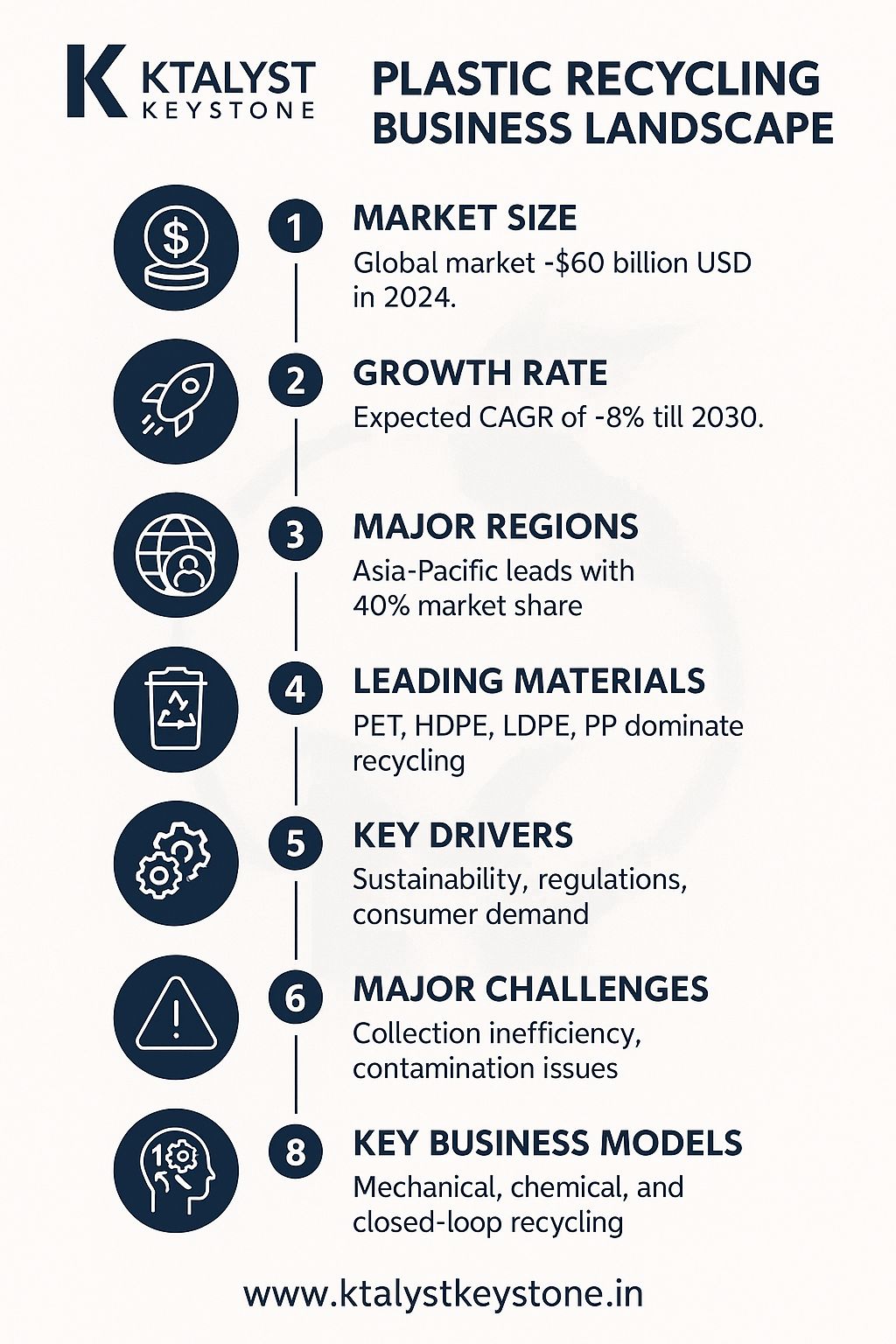
🌎 MarketSize (2024): ~$60 billion USD
📈 ExpectedCAGR (2024–2030): ~8%
🗺️ TopRegions:
AsiaPacific (~40% share)
Europe (~25%)
NorthAmerica (~20%)
KtalystInsight:
Asia’s dominance is fueled by aggressive policyshifts (China’s Green Fence, India’s EPR regulations) — local recycling startups and global joint ventures are booming.
KtalystRecyclingRating
⭐ AsiaPacific: 8.5/10 — Rapid growth, moderate tech.
⭐ Europe: 9.2/10 — High regulation, tech leadership.
⭐ NorthAmerica: 8.0/10 — Innovation-led recycling but slower mass adoption.
⭐ LATAM & Africa: 5.5/10 — Emerging opportunity zones with infra gaps.
KtalystInsight:
Europe sets the goldstandard with circulareconomy laws, while Asia leads in volume but needs advanced tech and traceability upgrades.
5KeyApplications
🛍️ Packaging – Bottles, containers, films (PET, HDPE).
👕 Textiles – Recycled polyester for apparel and furnishings.
🚗 Automotive – Lightweight components from recycled PP and composites.
🏗️ Construction – Pipes, panels, roofing from recycled plastics.
🎮 ConsumerGoods – Toys, gadgets, daily-use products.
KtalystInsight:
Packaging & Textiles together consume over 60% of all recycled plastics — brands chasing ESG targets are pivoting toward 100% recycled content.
FuturePotential
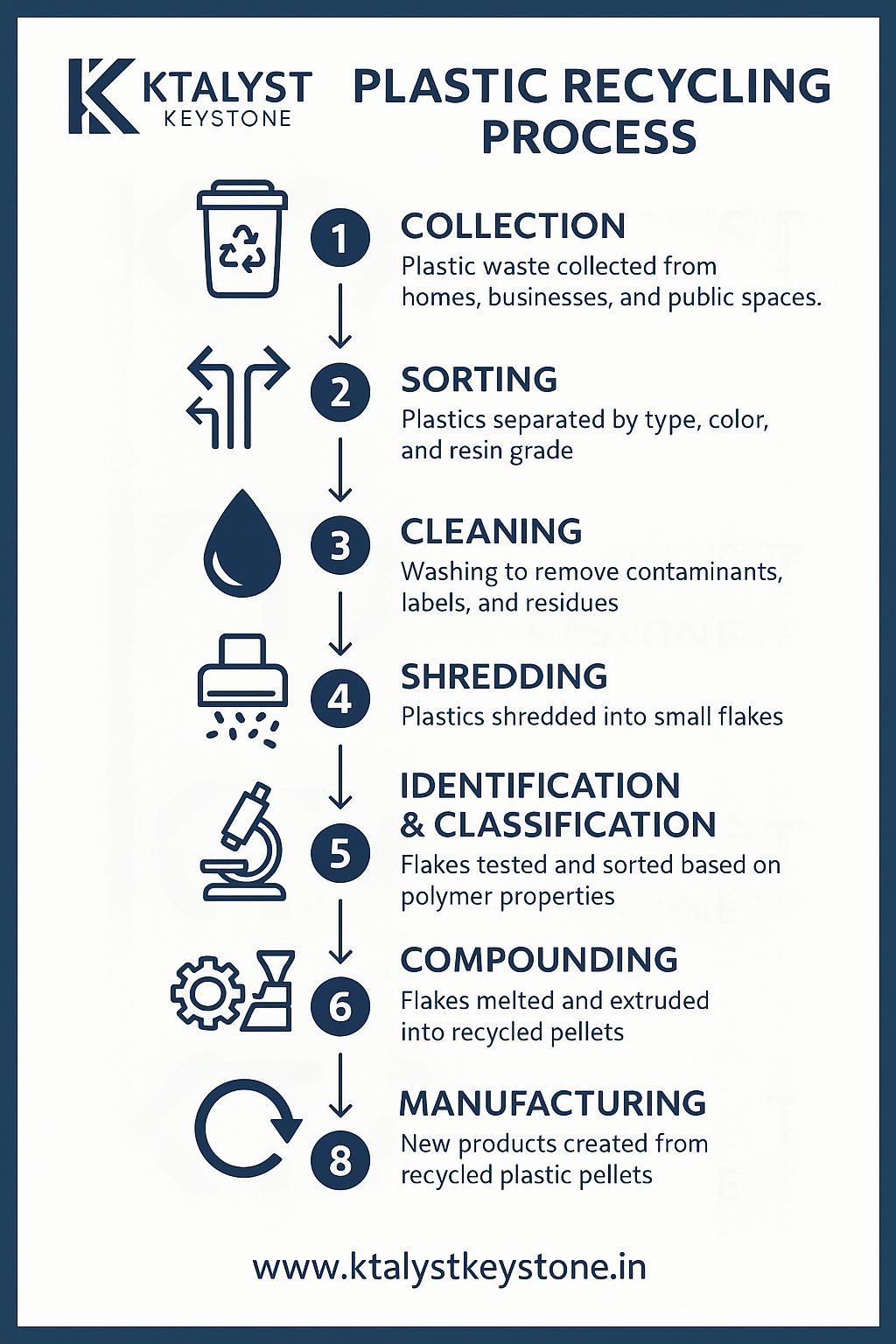
⚙️ AdvancedRecyclingTech (ChemicalRecycling): Unlocking hard-to-recycle plastics.
🤖 AIandRobotics: Smart sorting tech increasing plant yields by 25–30%.
🌿 BioplasticsHybridization: Next-gen materials mixing recycled polymers with bio-based resins.
KtalystInsight:
MechanicalRecycling dominates today, but ChemicalRecycling will be the investmentmagnet for the next decade, especially in Asia and the US, driven by stricter EPR mandates.
FinalThought
The PlasticRecycling economy is no longer a side act.
It’s the next trilliondollaropportunity, the ESGcredibility anchor, and a critical climatestrategy.
At KtalystKeystone, we believe recycling is no longer optional; it’s industrialevolution.
Originally published on LinkedIn on 2025-04-27 11:21:36: https://www.linkedin.com/feed/update/urn%3Ali%3AugcPost%3A7322218357754081280

