EVChariotsToBatteryBays: The Battery Is Becoming a Chemical Power Club
Dr. Anju Sharma MrsSustainability
The EV story is familiar.
The chemical story inside the battery is just getting interesting.
Global EV battery deployment reached around 1.2 TWh in 2025 and is expected to approach 3 TWh by 2030. By 2035, it could reach 4–5 TWh depending on the scenario.
Yet the power is concentrated.
In January 2026, the top five EV battery makers held roughly 75% of global installations:
✓ CATL: 45.2%
✓ BYD: 13.8%
✓ LG Energy Solution: 6.6%
✓ CALB: 5.3%
✓ Panasonic: 4.3%
That means OEMs are not just buying cells.
They are buying into a chemistry-led dependency system.
The old auto chain was:
OEM → Tier 1 → Component Supplier
The EV chain now looks like:
OEM → Cell Maker → Specialty Chemical Platform → Mineral / Refining Base → Recycler
This is where specialty chemicals become strategic.
Lithium gets the headline.
Chemistry decides the behaviour.
✓ Electrolyte additives: fast charging + cell stability
✓ Binders: electrode durability
✓ Conductive additives: power movement
✓ Separator coatings: thermal safety
✓ Cathode coatings + dopants: cycle life
✓ Silicon-anode enablers: higher energy density
✓ Thermal interface materials: heat control
✓ Flame retardants: pack credibility
✓ Adhesives + sealants: structural reliability
✓ Coolants + dielectric fluids: temperature discipline
The OEM problem is no longer only:
Can I source batteries?
It is:
✓ Who controls my charging curve?
✓ Who controls my degradation risk?
✓ Who controls my warranty exposure?
✓ Who controls my carbon footprint?
✓ Who controls my recycling loop?
✓ Who controls my cost of ownership?
S&P Global Mobility has flagged range, charging time and cost as key EV technology pain points for automakers.
That is exactly why the battery conversation is moving from cell capacity to chemical performance.
Commodity chemicals support scale.
Niche specialty chemicals create differentiation.
EV Competitiveness = Battery Chemistry × Charging Confidence × Carbon Credibility ÷ Cost of Ownership
The carbon math is also not automatic.
Better chemistry can mean longer life, fewer replacements, safer fast charging and improved recycling economics.
Poor chemistry can mean oversized packs, faster degradation, higher embedded carbon, fossil-heavy charging dependency and end-of-life waste.
The EV may sell from the showroom.
The strategy sits inside the battery.
Lithium may power the battery. Specialty chemistry decides whether that power becomes performance, profit or problem.
Dr. Anju Sharma
Originally published on LinkedIn on 2026-05-26 16:41:42: https://www.linkedin.com/feed/update/urn%3Ali%3Ashare%3A7465079729059151872
Sodium_Ion “Third Lane”: Why Range Is a Lazy Metric
Dr. Anju Sharma | MrsSustainability | KtalystKlues™
The EV industry is still flexing range, but range is a showroom metric.
DiggingDeeper:
Chemistry → Heat → Charging → Degradation → Lifecycle Carbon
Sodium-ion is not here to “kill” lithium.
It is here to build the Third Lane:
not premium range,
not lowest-cost compromise, thermal-carbon discipline for high-cycle, hot-climate mobility.
1. MineralMath: The Mine Comes Before the Mile
A battery’s carbon story starts before the vehicle moves.
✓ LFP / NMC: lithium, nickel, cobalt, graphite dependency
✓ Sodium-ion: abundant sodium, hard-carbon anodes, aluminium current collectors
✓CATL’s Naxtra sodium-ion platform has reported 170–175 Wh/kg energy density.
That means Na-ion is no longer a “low-density side quest.
It is becoming an LFP-adjacent contender.
Cross to watch:
✗ lower energy density than premium lithium chemistries
✓ stronger supply-chain optionality
✓ lower mineral-intensity logic
2. ThermalStack: Heat Is Silent Depreciation
India, Southeast Asia, and the Middle East do not test EVs gently.
They test them in heat.
Cooling is not free.
It adds:
✗ weight
✗ cost
✗ power draw
✗ pack complexity
✗ carbon load
Na-ion signal: reported operating window around -40°C to 70°C.
A cooler, more stable pack is not only safer.
It is better system economics:
✓ less cooling stress
✓ lower degradation risk
✓ longer battery life
✓ lower replacement carbon
3. 10KCycleQuestion: Fast Charging Has a Cost
Fast charging is not just convenience.
It can be a degradation event.
For fleets, the money is not in one heroic range claim.
It is in pack behaviour after:
1,000 cycles. 3,000 cycles. 5,000 cycles. Real roads. Real heat. Real charging abuse.
CATL claims Naxtra can deliver 10,000 cycles, if proven, this shifts the EV metric from:
✗ cost per kWh
to
✓ carbon per useful kilometre
4. 60GWhSignal: BESS Proves, Mobility Scales
Sodium-ion is no longer just a lab story. CATL has signed a 60 GWh, three-year sodium-ion supply deal with Beijing HyperStrong.
Why it matters:
✓ storage validates safety
✓ storage tests cycle life
✓ storage builds manufacturing confidence
✓ storage improves bankability
✓ mobility then scales the learning
BESS proves the system.
EVs monetise the chemistry.
TheThirdLane Equation
Sustainable EV = Lower Mineral Intensity × Thermal Stability ÷ Replacement Probability
Where Na-ion could win first:
✓ 2W / 3W
✓ city EVs
✓ last-mile logistics
✓ depot-charged fleets
✓ hot-climate mobility
✓ EV + charging + storage ecosystems
High-sweat. High-cycle. High-carbon-impact.
KtalystKlue
Lithium gave EVs range.
LFP gave EVs cost discipline.
Sodium-ion may give EVs thermal-carbon discipline. A smarter system.
KtalystEVSlates™ KtalystInsights™ KtalystKeystone KtalystKlues™ KtalystGreenLove SodiumIon EVBattery ThermalManagement CarbonFootprint SustainableMobility EnergyTransition CleanMobility
Originally published on LinkedIn on 2026-05-02 01:38:47: https://www.linkedin.com/feed/update/urn%3Ali%3Ashare%3A7456155194465243136
6thToe of the CarbonFootprint: GreenCreditability
Dr. Anju Sharma MrsSustainability
The chemical industry was built to make molecules.
YR2035 chemical industry will be judged by how intelligently it brings them back.
For decades, carbon footprinting walked on five familiar toes:
Energy. Emissions. Water. Waste. Compliance.
But the new chemical world needs a 6thToe:
GreenCreditability
Not green credit as a certificate.
Not circularity as a slogan.
Not “recyclable” as a perfume for greenwashing.
Green Creditability is the ability of a molecule, material, or process to return measurable green value after first use.
Global energy-related CO₂ emissions are near 38 Gt. Plastic circularity is still stuck around 9% recycled. That is not waste. That is stranded carbon, stranded chemistry, and stranded margin.
So the new footprint will not only ask:
What did you emit?
It will ask:
What did you recover, prove, reuse, and monetise?
The 5 Green Creditability Tests
1. ReturnTest
Can the molecule come back?
✓ Collection route
✓ Reverse logistics
✓ Customer take-back
2. RecoveryTest
Can useful value be extracted?
✓ Solvent recovery
✓ By-product valorisation
✓ Monomer recovery
3. ReEntryTest
Can yesterday’s output become tomorrow’s input?
✓ Circular feedstock
✓ Certified recycled content
✓ Industrial symbiosis
4. ProofTest
Can the loop be verified?
✓ Chain of custody
✓ End-of-life traceability
✓ Real recovery, not slide recovery
5. MarginTest
Can recovery protect profit?
✓ Lower disposal cost
✓ Lower virgin feedstock dependence
✓ Lower carbon exposure
✓ New circular revenue
The old footprint measured the cost of making.
The 6thToe measures the credit of bringing back.
Carbon footprint tells us what the molecule cost the planet.
Green Creditability tells us what value it can return to the economy.
That is the shift from Molecule Maker to Material-Value Manager.
KtalystKlue
The future of Green Chemistry is not just a cleaner molecule.
It is a smarter return journey.
Originally published on LinkedIn on 2026-04-26 13:23:55: https://www.linkedin.com/feed/update/urn%3Ali%3Ashare%3A7454158318761213952
Not all GreenMolecules are innocent:CarbonFootprint delivers the verdict. for the GreytoGreenTriangle Biomethane (CH₄) | GreenHydrogen (H₂) | GreenAmmonia (NH₃)
Dr. Anju Sharma KtalystInsights | MrsSustainability
The world loves binaries.
CoalvsSolar. Oilvs EVs, but YR2025 refuses to rehearse that tired script.
The coming decade isn’t an energy race anymore…it’s a courtroom drama.
Imagine 3GreenMolecules walk in
each claiming to be the hero of the transition and they must defend themselves before the toughest judge on Earth: CarbonFootprint.
A judge unmoved by hype.
Unimpressed by ambition.
Allergic to glossy decks.
Carbon Footprint accepts only one form of testimony: data.
🟢 Biomethane :The Street-Smart Lawyer
Final Score: 8.7 / 10
✓ Data that wins
✓ Feedstock availability: 9.5/10
✓ Critical minerals needed: 0 (10/10)
✓ Fits existing pipelines: 10/10
✓ Commissioning: 12–24 months
✓ EU: €25B, 950 plants
✓ India: 500 CBG plants
✓ Brazil: 9 bagasse biomethane projects
✓ A humble truth
✓ Biomethane isn’t perfect — but its barriers are manageable & immediate.
CarbonFootprint:
🟢 “You cut carbon and clean waste. Approved.
🔵 GreenHydrogen: The Brilliant, High-Maintenance Advocate
Final Score: 4.9 / 10
✓ Data that drags
✓ Energy intensity: 2/10
✓ Storage complexity: 2.5/10
✓ Pipeline friction: 3.5/10
✓ Electrolyser supply chain: 66–80% China-dependent
✓ Global FID rate: <8%
✓ Cost: 2–3× grey hydrogen
✓ Where it actually matters
✓ Steel, fertilisers, methanol, aviation, shipping → no substitute
CarbonFootprint:
🔵 “Potential noted. Discipline required.
🟣 GreenAmmonia: The Diplomat
Final Score: 7.1 / 10
✓ Data that travels
✓ Shipping & storage: 9/10
✓ Haber–Bosch maturity: 8/10
✓ Best hydrogen carrier: 10/10
✓ Japan–Korea co-firing: 20–50%
✓ Global pipeline: 40+ NH₃ projects
✓ 80% of H₂ exports planned as ammonia
✓ Emerging green ammonia futures markets → first pricing signal
Carbon Footprint:
🟣 “Port-ready. Global-ready. Proceed.
⭐ FinalVerdict
✓ Biomethane → Wins the Now
✓ GreenAmmonia → Wins the Trade
✓ GreenHydrogen → Wins the Hard Industries
Three molecules.
Three verdicts.
One transition.
KtalystInsights:
Decarbonisation isn’t a beauty parade it’s a carbon audit.
The molecule that wins is the one that lightens the planet’s burden with the least drama and the most honesty.” Dr. Anju Sharma
Originally published on LinkedIn on 2025-11-29 19:39:36: https://www.linkedin.com/feed/update/urn%3Ali%3Ashare%3A7400619461319307264
KnowledgeKtalyst
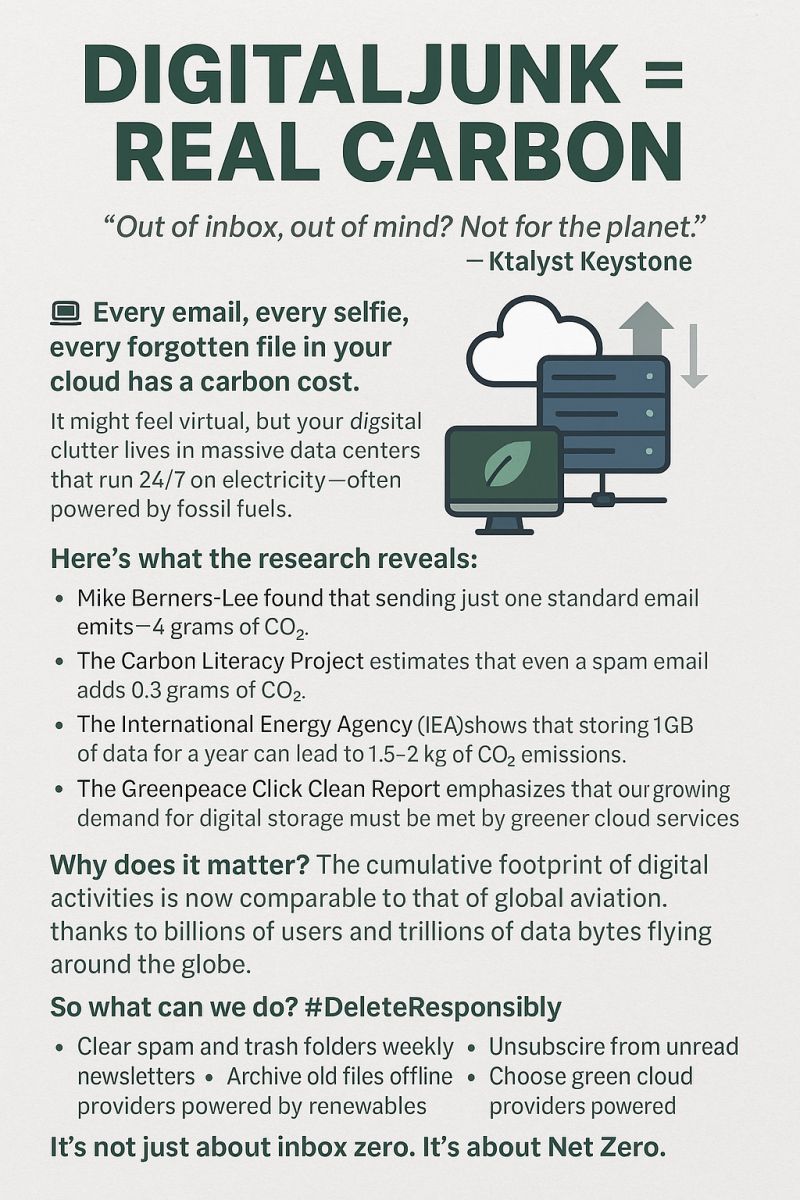
DigitalJunk = RealCarbon
Out of inbox, out of mind? Not for the planet.” — KtalystKeystone
🖥️ Every email, every selfie, every forgotten file in your cloud has a carbon cost.
It might feel virtual, but your digital clutter lives in massive dataCenters that run 24/7 on electricity—often powered by fossil fuels.
Here’s what the research reveals:
According to MikeBerners-Lee, author of “How Bad Are Bananas?”, sending just one standard email emits ~4 grams of CO₂, while a photo-heavy or attachment-filled email can go up to 50 grams.
The CarbonLiteracyProject estimates that even a single spam email—read or unread—adds 0.3 grams of CO₂ to the atmosphere.
Analysis from the International Energy Agency (IEA) shows that storing just 1GB of data for a year can lead to 1.5–2 kg of CO₂ emissions, depending on the data center’s energy mix.
The GreenpeaceClickClean Report also emphasizes that our growing demand for digital storage must be met by greener cloud services, or risk making the internet a major carbon culprit.
Why does it matter?
The cumulative footprint of digital activities is now comparable to that of global aviation, thanks to billions of users and trillions of data bytes flying around the globe.
So what can we do?
DeleteResponsibly
Clear spam and trash folders weekly
Unsubscribe from unread newsletters
Archive old files offline
Choose green cloud providers powered by renewables
It’s not just about inbox zero. It’s about NetZero.
Let’s clean up our digital lives—one file, one click, one byte at a time.
SustainabilityStartsWithYou | GreenTech | CarbonFootprint | DigitalDetox | KtalystKeystone
Originally published on LinkedIn on 2025-04-11 11:55:37: https://www.linkedin.com/feed/update/urn%3Ali%3Ashare%3A7316428711644348416
📚 KnowledgeSeries: The Hidden_Cost_of_Digital_Pollution – Is the Internet Killing the Planet? 🌍💻
While we focus on EVs, renewables, & plastic waste, digital pollution remains an invisible climate threat. From emails to AI, the internet’s carbon footprint is bigger than expected.
📊 Digital Pollution: The Data Behind the Screens
🟢 Data Centers = 2% of Global Electricity Use → That’s more than Germany’s entire energy consumption. (Source)
🟢 One Email = 4g CO₂ → With attachments, it’s 50g CO₂. 306B emails/day = 15M tons of CO₂ annually.
🟢 Video Streaming = 1% of Global CO₂ → One hour of Netflix in HD = 36g CO₂ → Watching at lower resolution cuts emissions by 40%.
🟢 Google Searches Emit 500 Tons CO₂/Day → Each search = 0.2g CO₂. 8.5B searches daily = annual emissions of 1.3M cars.
🟢 AI & Cloud Computing Are Carbon Guzzlers → Training one AI model emits 125,000 lbs CO₂, equal to five cars’ lifetime emissions.
🛑 How to Reduce Digital Pollution?
🟢 Delete Unnecessary Emails → Reducing 100 unneeded emails = saving 30kg CO₂ annually.
🟢 Declutter Cloud Storage → 1GB of deleted cloud data = 7kg CO₂ saved per year.
🟢 Use Green Hosting → Only 30% of websites are on carbon-neutral servers.
🟢 Limit AI Queries → Reducing unnecessary AI prompts & computations cuts energy waste.
🔥 The Takeaway: Is Digital the New Plastic?
🟢 If the internet were a country, it would be the 6th largest polluter in the world.
🟢 Digital sustainability is the next frontier—will businesses take action?
🟢 Every click, search, and email has a carbon cost—time to rethink digital habits.
📢 How can we build a cleaner, low-carbon internet? Let’s discuss! 👇

Originally published on LinkedIn on 2025-03-03 14:43:53: https://www.linkedin.com/feed/update/urn%3Ali%3AgroupPost%3A82951-7302337927789879296
📢 KnowledgeSeries: “Sustainable Resolutions—Are You Making Real Impact?” 🌍📉
Not all green choices are equal. Are you focusing on what truly matters?
As we commit to SustainableResolutions for 2025, it’s crucial to distinguish between low-impact actions vs. game-changing decisions that can truly reduce our carbon footprint.
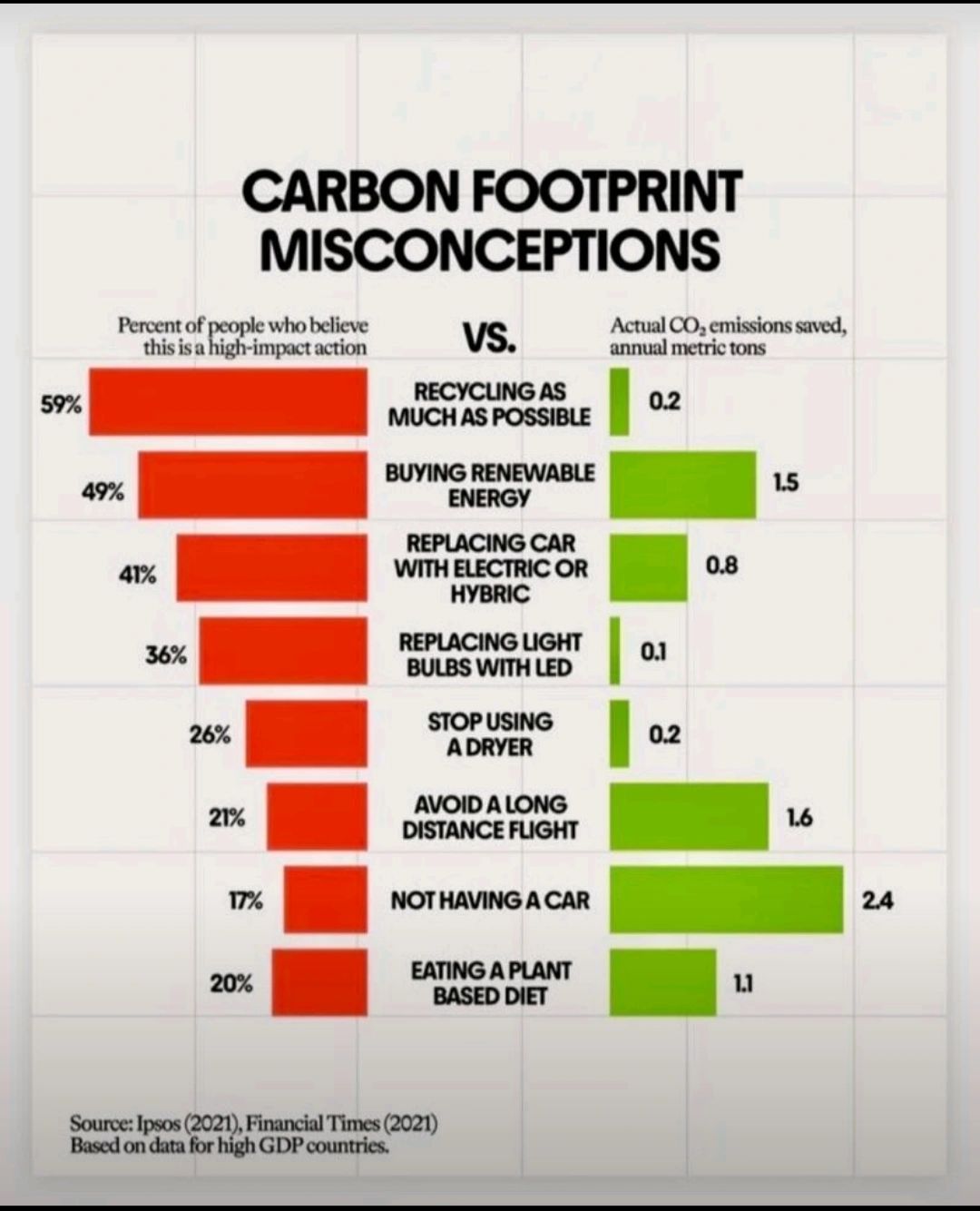
📊 CarbonMisconceptions vs. RealImpact: Where Should You Focus?
🔴 The Green Illusions We Fall For:
🚨 Recycling – 59% of people believe it’s a major climate solution, yet it only saves 0.2 metric tons of CO₂ annually per person. (Ipsos, 2021)
🚨 LED Bulbs – Swapping old bulbs for LED reduces emissions by just 0.1 metric tons annually. (Financial Times, 2021)
🚨 EV Swaps – Switching to an electric vehicle cuts 0.8 metric tons of CO₂, but only if powered by clean electricity. (IEA, 2024)
🚨 Avoiding Dryers – Only saves 0.2 metric tons per year—far less than other choices. (EPA, 2023)
🚨 Short-Term Offsets – Many carbon offset programs focus on short-term tree planting, which takes decades to absorb emissions but provides immediate corporate greenwashing benefits. (UNEP, 2024)
✅ Resolutions That Actually Move the Needle:
🌍 Not owning a car – The single biggest change, saving 2.4 metric tons annually in emissions. (IEA, 2024)
✈️ Skipping a long-haul flight – Avoiding just one international flight saves 1.6 metric tons of CO₂. (UNEP, 2023)
⚡ Switching to renewable energy – A household using renewables can cut emissions by 1.5 metric tons per year. (IPCC, 2024)
🥗 Adopting a plant-based diet – Reduces CO₂ impact by 1.1 metric tons annually. (Nature Food, 2024)
🏠 Energy-efficient homes – Retrofitting homes with insulation, heat pumps, and solar panels can cut energy-related emissions by 40%. (IEA, 2025)
🚀 Your 2025 Sustainable Resolutions: Choose Wisely!
🌱 Could be minor eco-friendly habits—important, but not enough alone.
🌎 Should be actions that target major carbon sources—transport, energy, and food choices.
🔥 Would be transformational if individuals + businesses prioritize high-impact change.
📌 RealityCheck: Corporate sustainability efforts alone won’t fix the crisis—real impact comes from systemic choices.
👉 What’s your sustainability resolution for 2025? Drop your thoughts below! 👇
Originally published on LinkedIn on 2025-02-20 16:00:26: https://www.linkedin.com/feed/update/urn%3Ali%3Ashare%3A7298370925727494144

