ESGMagician: Beyond_NetZero or BeyondBelief?
Dr. Anju Sharma MrsSustainability
The market is full of ESG magicians.
They arrive with one deck of slides and promise:
✓“Net zero?” Done.
✓“Beyond net zero?” Also done.
✓“Circularity?” Of course.
✓“Carbon credits?” Raining.
✓“Green claims?” Sparkling.
Wonderful.
Now get me that ticket to the bullet train $$
Because the real journey is not from the claim to the certificate. It’s from certificate to transformation.
Carbon credits can support transition.
But they cannot replace:
process change
cleaner chemistry
renewable energy
credible measurement
verified custody
capital discipline
hard operational proof
**“Do what you do.
Produce. Sell. Profit. Grow.
But do not pretend the muck disappears because the report looks clean.
ESG is not about magicmarkers.
It is about taking responsibility for what your business leaves behind every day.” Dr. Anju Sharma
The problem is not carbon markets.
The problem is using carbon credits as theatre when the factory, fleet, feedstock and fuel system have not moved.
NetZero is not a magic trick.
It is not an illusion created by accounting smoke, offset mirrors and glossy sustainability language.
It is an industrial journey.
And right now, too many companies are selling first-class tickets to “beyond net zero” without building the track.
Verdict:
If ESG feels like magic, check the mechanism.
If carbon credits are raining, ask who owns the umbrella.
And if someone promises beyond net zero, ask where the bullet train actually starts.
Dr. Anju Sharma
MrsSustainability KtalystKlues ESG CarbonCredits NetZero
Originally published on LinkedIn on 2026-06-24 07:36:30: https://www.linkedin.com/feed/update/urn%3Ali%3AgroupPost%3A1910576-7475451776633204736
ESGMagician: Beyond_NetZero or BeyondBelief?
Dr. Anju Sharma MrsSustainability
The market is full of ESG magicians.
They arrive with one deck of slides and promise:
✓“Net zero?” Done.
✓“Beyond net zero?” Also done.
✓“Circularity?” Of course.
✓“Carbon credits?” Raining.
✓“Green claims?” Sparkling.
Wonderful.
Now get me that ticket to the bullet train $$
Because the real journey is not from the claim to the certificate. It’s from certificate to transformation.
Carbon credits can support transition.
But they cannot replace:
process change
cleaner chemistry
renewable energy
credible measurement
verified custody
capital discipline
hard operational proof
**“Do what you do.
Produce. Sell. Profit. Grow.
But do not pretend the muck disappears because the report looks clean.
ESG is not about magicmarkers.
It is about taking responsibility for what your business leaves behind every day.” Dr. Anju Sharma
The problem is not carbon markets.
The problem is using carbon credits as theatre when the factory, fleet, feedstock and fuel system have not moved.
NetZero is not a magic trick.
It is not an illusion created by accounting smoke, offset mirrors and glossy sustainability language.
It is an industrial journey.
And right now, too many companies are selling first-class tickets to “beyond net zero” without building the track.
Verdict:
If ESG feels like magic, check the mechanism.
If carbon credits are raining, ask who owns the umbrella.
And if someone promises beyond net zero, ask where the bullet train actually starts.
Dr. Anju Sharma
MrsSustainability KtalystKlues ESG CarbonCredits NetZero
Originally published on LinkedIn on 2026-06-23 11:13:21: https://www.linkedin.com/feed/update/urn%3Ali%3Ashare%3A7475143956104929281
NurtureOverNature: The UN Carbon-Credit Paradox
Dr. Anju Sharma | MrsSustainability | KtalystGreenLove™
Carbon credits were born from Nature.
Their survival depends on Nurture.
Inside the UN’s Article 6.4 mechanism sits the paradox of the next carbon market.
The world is moving from the “Wild West” of voluntary offsets to regulated global climate-finance infrastructure.
The tension ! brutal:
Every layer of integrity adds a layer of friction.
TheDataSpine: A Market in Mutation
The 2024–2026 numbers show a clear flight to quality.
Not a trend.
A survival mandate.
1. The LiquidityCrunch
In 2024, the voluntary carbon market reported transaction value of around US$535 million, down 29% from 2023.
Transaction volume declined 25%, while average price fell only 5.5%.
Translation?
Buyers did not simply exit.
They became more selective.
2. The QualityPremium
The price spread is now clinical.
High-durability technical removals can command US$170–500+/tCO₂e.
Lower-quality or legacy avoidance credits can struggle below US$5/tCO₂e.
Buyers are not only buying carbon.
They are buying reputational insurance.
3. The Article 6.4 Milestone
In February 2026, the UN approved the first Article 6.4 credits under the Paris Agreement carbon market, linked to a clean-cooking project in Myanmar.
Not just a pilot.
This is the operating blueprint for how climate finance may move across countries, registries, corporates and project developers.
TheDiagnostic: Too Much Friction = No Market
The market needed discipline.
✓ stronger additionality
✓ better verification
✓ cleaner registries
✓ no double counting
✓ stronger safeguards
Long overdue.
Yet “Nurture” has a price tag.
✓ more monitoring
✓ more documentation
✓ more validation
✓ more audits
✓ more legal risk
✓ slower issuance
Here sits the paradox:
Too less regulation= greenwashing.
Too much friction = noMarket.
A perfect carbon market that nobody can afford to use is not a climate solution.
It is a compliance museum.
TheKtalystFormula
Market Success = Trust × Supply × Simplicity
2026CarbonLandscape for the “purest” credit designsystems that are:
1. Financeable — Capital-ready
2. Scalable — Built to grow
3. Accessible — Open to all
4. Equitable — Fair by design
5. Defensible — Audit-proof
KtalystCarbonCode™ a guideline:
DeployCapital — fund identify projects for long run
DesignForFlow — reduce compliance drag
KeepItUsable — integrity without friction
OpenAccess — developer-first entry
ProtectPeople — community-first safeguards
BuildLiquidity — deepen market depth
ScaleTrust — audit-ready systems
LetItBreathe — speed with discipline
NatureCreates | NurtureScales
PriceBridge — close the US$5 → US$200+ gap
Originally published on LinkedIn on 2026-05-04 04:51:12: https://www.linkedin.com/feed/update/urn%3Ali%3AgroupPost%3A1910576-7456928393993838592
CarbonCredits are not a “Gift.
Dr. Anju Sharma•MrsSustainability
Carbon credits is a Performance Audit. 🛑📉
Most businesses are chasing “growth” while sitting in a profound DataComa. They track vanity metrics while their energy architecture hemorrhages margin.
They ask: “Can carbon credits boost my margins?
KtalystKash ask: “Is your operation even worthy of the boost?
The BrutalTruth:
Carbon credits don’t reward the loudest companies.
They don’t reward “commitments” or “net-zero” press releases.
They reward discipline. If your factory blinks when the grid fails, you aren’t resilient.
If your diesel bill rises with every peak-hour spike, you aren’t optimized.
You are just a “utility-taker” waiting for the next outside shock.
The ChinamaxxBenchmark ($100/kWh):
The global winners aren’t “going green” for the planet. They are doing it for Strategic Arbitrage.
BatteryBackupMax isn’t a backup—it’s a Margin-Shield.
SolarEnergyMax isn’t a panel—it’s Energy Sovereignty.
When LFP storage hits $60/kWh, and you’re still paying peak-hour panic prices? That’s not a market issue. That’s a leadership failure.
The Ktalyst5Ps of the New Economic Architecture: We don’t just install tech. We re-engineer the BusinessCharacter:
✓Profit: Turning a utility “tax” into an internal lever.
✓Planet: Real molecules, not just “offsets.
✓Policy: Treating the CarbonCreditBoost as a hard-earned refund on your CAPEX.
✓People: Providing stability in a volatile world.
✓Purpose: Moving from Fragile to Fortified.
The KtalystKlues: From Tracking to Transforming
Stop measuring the decline.
✓Start documenting the Evidence.
The market only trusts the Exchange of old volatility for new Excellence.
”If you can’t operationalize your sustainability, you can’t monetize your intelligence.” Dr. Anju Sharma
KtalystInsights
The next margin lever isn’t in your sales deck.
It’s on your roof. It’s in your battery room. It’s in the load curve you’re too “busy” to manage.
Are you building a fortress, or are you just waiting for the grid to eat your profit? 🏗️⚡
MrsSustainability DataComa Ktalyst5Ps Ktalyst5Es BusinessExcellence CarbonCreditBoost SolarEnergyMax BatteryBackupMax ManufacturingStrategy EnergyTransition KtalystInsights KtalystKeystone KtalystKash GreenLove$
Originally published on LinkedIn on 2026-04-07 08:09:28: https://www.linkedin.com/feed/update/urn%3Ali%3Ashare%3A7447193815200866304
If CarbonCredits are cheap, you should worry?
Low prices rarely signal efficiency.
They usually signal weak scrutiny.
For years, carbon credits were treated as a feel-good add-on
buy, offset, move on.
That phase is ending.
With CBAM tightening in the EU and domestic carbon markets taking shape in India, carbon pricing is no longer about goodwill.
It’s about credibility, trade access, and cost control.
Three shifts are becoming hard to ignore:
1️⃣ Cheap credits now carry risk
Quality screens are tightening around:
additionality
permanence
traceability
Credits that don’t hold up under future audits won’t just disappear —
they will leave behind uncomfortable explanations.
2️⃣ Carbon has entered finance and trade desks
When emissions affect:
export pricing
supplier selection
margin predictability
carbon stops being an ESG topic.
It becomes businessmath.
3️⃣ Low prices may signal future pain
The cheapest carbon credit today
may turn out to be the most expensive line item tomorrow.
The real question companies need to ask now isn’t
How many credits do we buy?
It’s:
Do our credits still make sense when rules tighten?
Curious how this is playing out where you work:
Are carbon credits still handled by ESG teams —
or already showing up in the CFO’s spreadsheet?
By Dr. Anju Sharma | MrsSustainability | KtalystInsights
CarbonCredits ClimateRisk CBAM CarbonMarkets IndiaBusiness
Source / shared link: https://www.reuters.com/sustainability/climate-energy/eu-aluminium-cement-imports-face-higher-emissions-costs-draft-shows-2025-12-12/?utm_source=chatgpt.com
Originally published on LinkedIn on 2025-12-13 03:47:09: https://www.linkedin.com/feed/update/urn%3Ali%3AgroupPost%3A82093-7405453196938166272
🌳KtalystInsights | Rooting CarbonCredits
❝ Carbon credits aren’t just traded—they’re rooted in Policy, People, & Proof. A plantation today is a portfolio tomorrow. ❞
Dr. Anju Sharma
📊 Global Carbon Credit Forestry: At a Glance
🌍 ~30% of the global Voluntary Carbon Market (VCM) is nature-based
💰 Credit Prices:
🇹🇭 Thailand T-VER: $45–55/ton (🌏 highest)
🇮🇳 NamasteIndia: ₹10,000 upfront + survival-linked credits
🇯🇵 Japan: 100 MtCO₂ JCM goal by 2030
🔁 Payouts based on tree survival + GPS = measurable trust
🌴 ASEAN: Trees are even used as loan collateral
☕ Japan’s credits now include tea fields. Seriously!
🧭 KtalystInsights Quick Scan
🌏 Country 💼 Payment Model 🧪 Verification 📌 Unique Feature
🇮🇳 NamasteGreenIndia’s Green Credit Programme (GCP) KtalystUttarPradesh is leading by example, offering ₹10,000 (~$120) upfront + 30-year annuity-linked credits. From plantation to prosperity—this is policy with purpose.
🇺🇸 USA Market-driven, no direct cash Verra, CAR, staged audits Urban aggregation, voluntary VCM
🇨🇳 ChinaSale to CDM/CCER buyers AI + satellite + local reporting 3,000 ha projects, cash-crop forestry
🇹🇭 ASEAN Annual baht/rai + credit sales Registry + audits by TGO Tree Bank, mangroves, rubber credits
🇰🇷 Korea Public + private co-funded CDM + biochar MRV Coffee waste → carbon offsets
🇯🇵 Japan J_Credit + JCM (ASEAN) Digital MRV + Article 6 alignment Tea, forest, and overseas projects
📥 DM KtalystKeystone for: • ✅
📊 Agro-credit models linked to survival tracking
📁 Voluntary Carbon Market (VCM) entry toolkit for MSMEs
Originally published on LinkedIn on 2025-07-21 08:38:54: https://www.linkedin.com/feed/update/urn%3Ali%3AgroupPost%3A2153908-7352980378069938176
KtalystIsights“When the West recycles its conscience, the East receives the garbage.
Dr. Anju Sharma, Founder, Ktalyst Keystone
🌍 It’s not just plastic.
The GlobalSouth — especially India — is choking under imported waste, exported emissions, and outsourced guilt.
📦 95% of textile waste from Europe and the US is “shipped for recycling”… to the East.
⚗️ Carboncredits? Mostly traded to delay real change in the West, while Asia becomes a dumping ground for “offset” plantations.
📈 ESG frameworks? Written in boardrooms in London, pushed onto factories in Ludhiana
🛑 This isn’t sustainability.
It’s climate colonialism dressed in recycled jargon.
🇮🇳 India doesn’t need imported guilt. It needs sovereign solutions
✅ Decentralized bio-CNG, not carbon token fads
✅ Native composting, not imported plastic incinerators
✅ Indigenous ESG, rooted in Dharma, local supply chains, and intergenerational wisdom
Originally published on LinkedIn on 2025-07-12 20:39:27: https://www.linkedin.com/feed/update/urn%3Ali%3AgroupPost%3A2474261-7349900221809676289
KnowledgeKtalyst TrashTalk: What’s Really Filling Landfills in the US, EU, India & China?
Every landfill is a business ledger in disguise. What you trash today could have been your margin tomorrow.
Anju Sharma
UnitedStates
LandfillWhat?
[Food Waste] 24Percent
[Plastics] 18Percent
[Paper/Cardboard] 12Percent
[Textiles & Rubber] 11Percent
[Metals] 9Percent
[Wood] 8Percent
[Glass] 5Percent
[Other] 13Percent
50Percent of all MSW still goes to landfill!
ManagingItHow?
32Percent recycled or composted
12Percent through energy recovery
Rest? Buried beneath profit margins.
EuropeanUnion
LandfillWhat?
[Organic Waste] – Big share, varies by country
[Paper/Cardboard] – Still a chunk
[Plastics, Glass, Metals] – Widespread
ManagingItHow?
24Percent landfilled
48Percent recycled/composted
28Percent incinerated with energy gain
EU = Policy Muscle + Producer Pressure = Less Waste
India
LandfillWhat?
[Organic Waste] – 50Percent
[Plastics] – 8Percent
[Paper] – 7Percent
[Rest] – Metals, glass, biomedical mix
ManagingItHow?
Mostly OpenDumping
InformalRecycling = backbone
Composting + WTE = Emerging, not scaled
India = Waste goldmine, but needs formal systems
China
LandfillWhat?
[Food Waste] – Top chunk
[Plastics & Paper] – Considerable
[Textiles, Metals, Others] – Add-on clutter
ManagingItHow?
Historically high landfilling
Big leap in Recycling and WTE
Smart cities with AI-sorting + NoWaste policies
China = From pile-up to policy playbook
KtalystTakeaways
LandfillAddiction: US & India still digging deep
OrganicWaste: Common culprit, compost it!
PlasticAttack: Needs cross-border innovation
EUPlaybook: Regulation works, so do taxes
NextMove?: Monetize waste + tie it to CarbonCredits

Originally published on LinkedIn on 2025-04-10 19:09:07: https://www.linkedin.com/feed/update/urn%3Ali%3AgroupPost%3A100646-7316175417202163713
KnowledgeSeries: The Future of CarbonCredits – A USD250B Market by 2050
The carboncredit market is no longer a side conversation—it’s becoming a mainstream financial instrument. With projections hitting #$250B by 2050, businesses and investors must pay attention.
Why? Because companies that integrate NetZero strategies today will gain a competitive edge, while those that don’t will face higher costs, regulatory risks, and shrinking investor confidence.
🌎 The Carbon Credit Boom: Why It’s a Business Imperative
✔️ The voluntary carbon market is set to grow 15X by 2030, reaching #$10B–$40B. (McKinsey)
✔️ Investments in carbon credits hit #$1.7B in 2023, up 50% YoY. (BloombergNEF)
✔️ 6,000+ global companies have set Science-Based Targets (SBTi), driving demand for verified carbon offsets.
✔️ Indonesia, Brazil, and Kenya are integrating carbon markets into their economies, generating revenue from forests, renewable energy, and carbon capture projects.
✔️ Article 6 of the ParisAgreement is enabling international carbon credit trading, boosting market credibility.
🚀 What does this mean for businesses?
✔️ A carbon credit strategy is no longer optional—it’s a business necessity.
✔️ Companies without a decarbonization plan will face higher compliance costs.
✔️ Investors are prioritizing NetZero leaders, making carbon credits a key ESG performance driver.
📊 Who’s Leading the Carbon Credit Race?
✔️ Big Tech & Carbon Capture:
Meta, Microsoft, and Google are securing multi-million-dollar deals in Direct Air Capture (DAC) to future-proof their carbon strategies.
✔️ Financial Institutions Going Green:
BlackRock, JP Morgan, and Goldman Sachs are launching climate-focused funds, treating carbon credits as an emerging asset class.
✔️ Corporate Adoption Soaring:
40%+ of Fortune500 companies are embedding carbon offsets into their business models.
✔️ Government-Led Action:
The EU, Singapore, and Japan are developing regulated carbon exchanges to ensure transparency & standardization.
🌱 What to Expect in 2025 & Beyond?
✔️ Stricter Regulations → Carbon credit verification will be tighter, reducing low-quality offsets & greenwashing risks.
✔️ Rising Prices → As demand outstrips supply, carbon credit prices could triple by 2030, making early adoption a smart financial move.
✔️ Emerging Markets in Play → Africa, Southeast Asia, and Latin America will dominate nature-based carbon solutions (reforestation, soil carbon, etc.).
✔️ Carbon as a Tradable Asset → Institutional investors are pushing for liquid carbon credit markets, making carbon a financialized commodity.
🔍 ComingUpNext: “The Business Case for Carbon Credits – Risks, Rewards & Strategy
Originally published on LinkedIn on 2025-03-08 07:02:05: https://www.linkedin.com/feed/update/urn%3Ali%3AgroupPost%3A82951-7304033651044839424
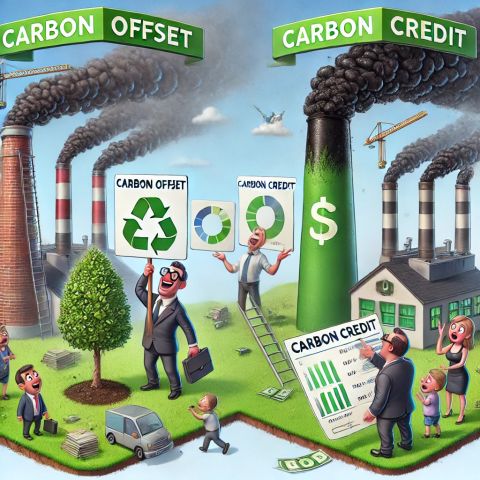
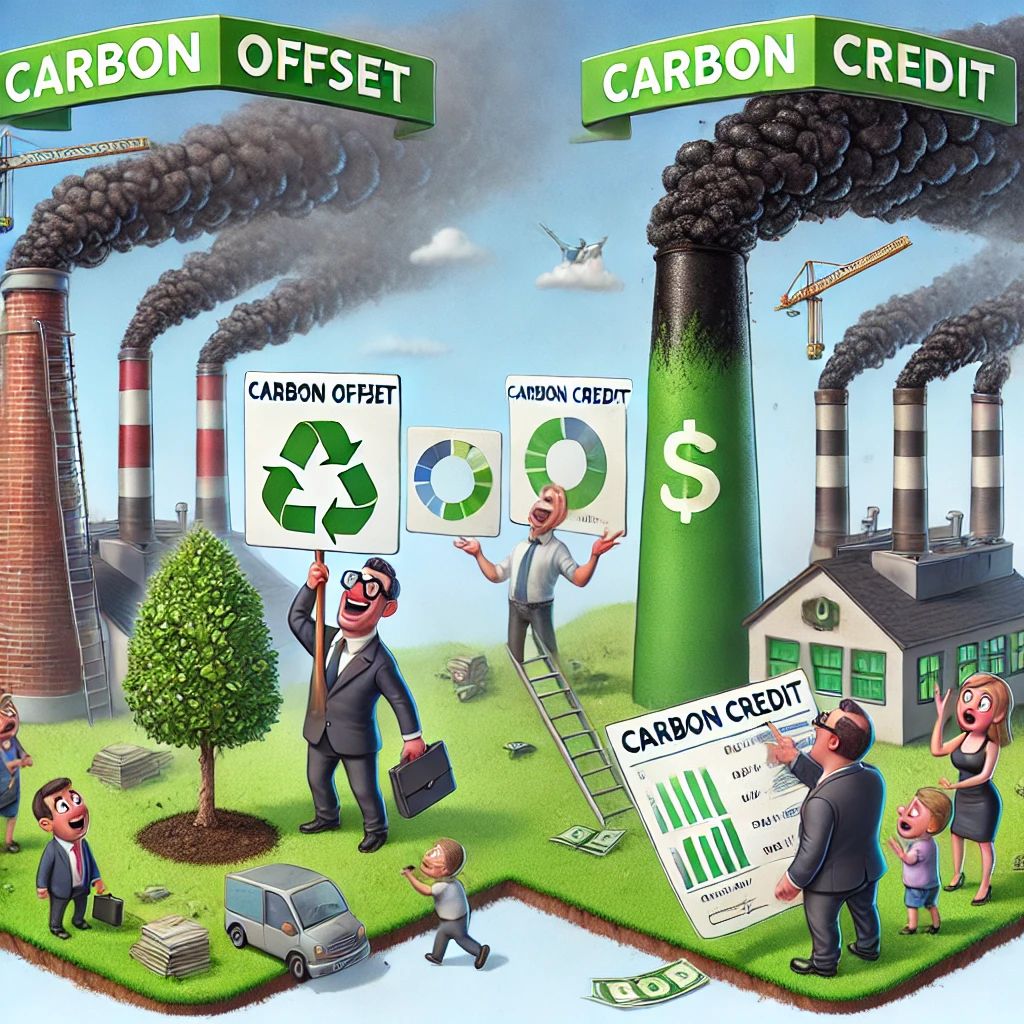
🚨 “Carbon_Offsets vs. Carbon_Credits: TheGreenwashingLoophole?” 💰♻️
With corporations pledging net-zero goals, carbon markets are booming—but do we really understand carbon offsets vs. carbon credits? Or is this just a billion-dollar greenwashing loophole?
📊 CarbonOffsets vs. CarbonCredits: What’s the Difference?
🔹 CarbonOffset = A company/individual voluntarily compensates for emissions by investing in green projects (e.g., tree planting, renewable energy).
🔹 CarbonCredit = A tradable permit issued by governments or markets, allowing companies to emit 1 metric ton of CO₂—can be sold, bought, or banked.
📌 RealityCheck: Offsets are voluntary; credits are part of regulated carbon markets.
📉 TheMarketBoom: Who’s Buying?
🚨 Global carbon market value hit $950B in 2024, up 30% YoY. (World Bank, 2025)
🚨 Corporate demand for carbon offsets surged 47%, led by tech, finance & oil giants. (Carbon Market Watch, 2025)
🚨 Top buyers:
✅ Microsoft: 1.5M tons in forest-based offsets.
✅ Shell: Spent $450M on credits—but still expands fossil fuel ops.
✅ Amazon: Invested in nature-based offsets but emissions grew 40% since 2020.
📌 RealityCheck: Many companies buy offsets while continuing high-carbon activities.
⚠️ TheGreenwashingProblem: Offsets ≠ Real Reductions
🔻 95% of carbon offsets fail to deliver actual emission cuts. (ProPublica, 2025)
🔻 Only 6% of forest-based carbon credits are verifiable. (Guardian, 2025)
🔻 Oil giants buy millions in offsets but expand fossil fuel extraction. (IEA, 2025)
📌 RealityCheck: Carbon credits allow polluters to delay real decarbonization.
🏆 Who’s Doing It Right?
✅ Sweden 🇸🇪 – 100% transparent carbon pricing & strict offset validation.
✅ Singapore 🇸🇬 – First global carbon exchange (CIX) for verifiable credits.
✅ EU 🇪🇺 – Carbon Border Tax enforces real cuts, not just offsets.
📌 RealityCheck: Strong policies + transparency = real impact.
🏆 KeyTakeaway
Carbon markets could be a powerful tool for climate action, should be strictly regulated, but would be a loophole for greenwashing if companies keep using them to avoid real emission cuts.
👉 Are carbon offsets a real solution or just a climate smokescreen? Drop your thoughts below! 👇
Originally published on LinkedIn on 2025-02-13 20:46:18: https://www.linkedin.com/feed/update/urn%3Ali%3AgroupPost%3A82093-7295906154327498752

