TARIFF SHOCKWAVES: INDIA AT THE CROSSROADS OF TRADE & STRATEGY
The 26% blow to Indian exports isn’t just a trade shock—it’s a wake-up call to diversify, digitize, and diplomatically reset our global strategy before the door to developed markets narrows further.
AnjuSharma, MD, KtalystKeystone
What Happened?
📌 10% universal tariff on all U.S. imports announced by President Trump
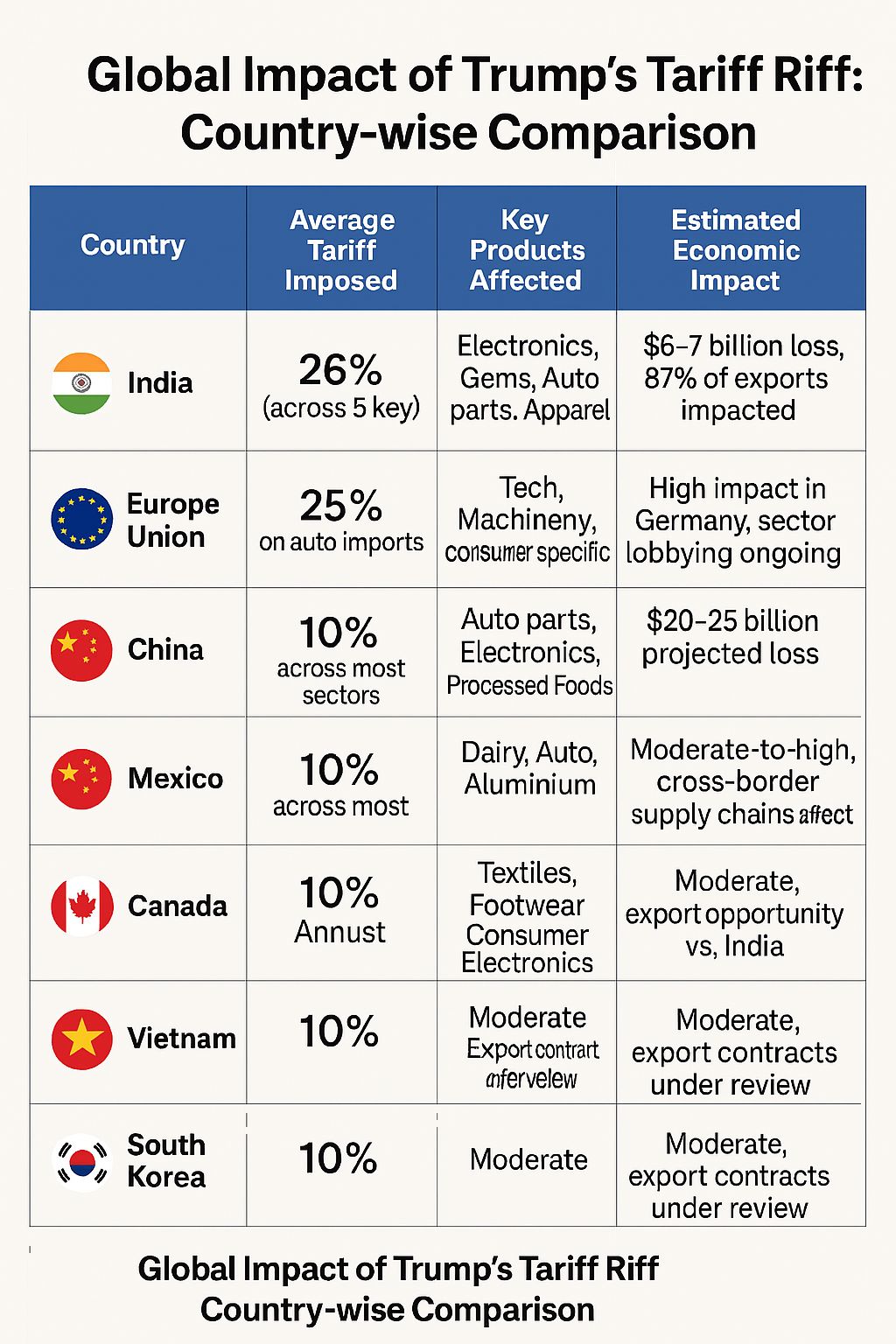
📌 India hit with 26% tariff on electronics, auto parts, gems, textiles & aluminium
📌 87% of India’s $66B U.S. exports impacted
📌 Estimated annual loss: $6–7 billion
Big 4 Speak Out
💬 PwC: “Tariff retaliation could balloon from $76B to $697B globally
💬 KPMG: “This isn’t trade policy—it’s political performance
💬 EY: “India must restructure global sourcing strategy immediately
💬 Deloitte: “Tariffs will inject stagflation into already strained supply chains
Financial Titans React
💸 Goldman Sachs:
Auto and textile exporters will bleed
Kroger, Valvoline may survive — India’s top B2B exporters will face margin heat
💹 Bloomberg Intelligence:
India risks losing emerging export edge to Vietnam & Mexico
📰 Wall Street Journal:
U.S. tariffs may trigger a regional pivot — India’s FTA urgency just jumped five notches
Market Pulse: Dalal Street Feels the Heat
📉 GIFT Nifty down 350+ pts
📉 Auto, IT, Jewellery, Aluminium stocks see heavy selling
📈 Shift towards domestic FMCG & retail as safe havens
What’s Next for India?
⚙️ Bilateral trade deal in pipeline by Fall 2025
🌍 Explore Middle East, Africa & ASEAN for export realignment
🛠️ Invest in supply chain localization + logistics infrastructure
📜 Fast-track FTA negotiations with EU, UK & Pacific allies
Final Takeaway
🚨 Tariffs aren’t just taxes—they’re tectonic shifts.
India must act with policy agility, strategic diversification, and bold diplomacy to stay ahead in a reshuffled global order.
Total Estimated Exposure
Indian Exports to U.S. Affected: ~$57–60 billion
Percentage of Total Indian Exports to U.S. Affected: ~87%
Estimated Annual Economic Loss: $6–7 billion
Trade Response & Outlook
Commerce Ministry View: “It’s a mixedbag, not a setback
Negotiation Status: Bilateral trade agreement targeted for Fall 2025
Market Impact:
GIFT Nifty: -350 pts (near 23,000)
Auto & IT stocks: Broad selling
Export-heavy stocks (like Titan, Motherson, Hindalco): Underperforming
Originally published on LinkedIn on 2025-04-03 04:42:34: https://www.linkedin.com/feed/update/urn%3Ali%3Ashare%3A7313420627510464512
GreenIsTheNewGrit
India’s Sustainability Shift in Fast-Forward
From bold emission norms to ESG disclosures, India’s journey toward sustainability is accelerating — on paper.
But as we move from intent to impact, it’s clear that what’s green in policy must also grow on the ground.
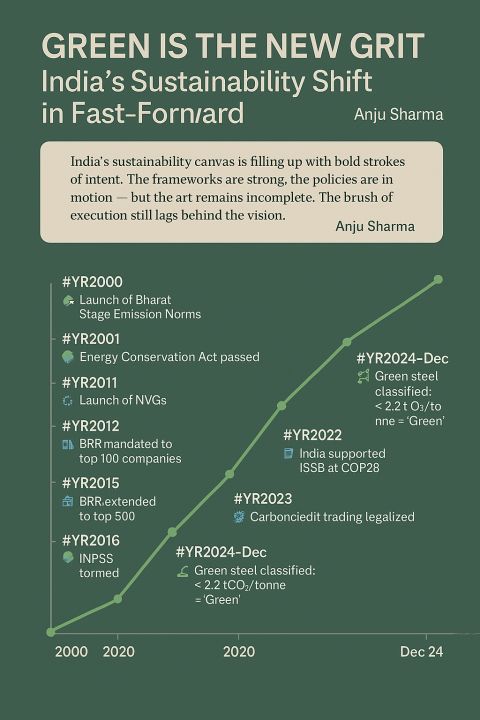
#”India’s sustainability canvas is filling up with bold strokes of intent. The frameworks are strong, the policies are in motion — but the art remains incomplete. The brush of execution still lags behind the vision.
Anju Sharma
Here’s a quick snapshot of India’s evolving sustainability framework:
YR2000 [🚗] Bharat Stage Emission Norms introduced – India begins regulating vehicle pollution.
YR2001 [⚡] Energy Conservation Act passed – BEE is born.
YR2011 [♻️] ESG enters boardrooms with National Voluntary Guidelines (NVGs).
YR2012 [📊] Top 100 listed firms mandated to report sustainability via BRR.
YR2015 [🏢] BRR expanded to top 500 companies.
YR2016 [🌐] INPPSS launched with UN support.
YR2020 [🌬️] BS-VI norms enforced nationwide — leapfrogging clean air policies.
YR2021 [📃] India backs ISSB — for global ESG alignment.
YR2022 [💱] Carbon Credit Trading legalized.
YR2023 [🛢️] E20 ethanol-blended fuel launched.
[🧾] BRSR Core ESG reporting begins with top 150 companies.
YR2024-Dec
[🏗️] Green Steel classified: <2.2 tCO₂/tonne = Green
[✅] Eco-Mark expanded to 17 product categories
[☀️] Solar PV mandate issued – only Made-in-India cells allowed from June 2026.
What’s Next?
Time to match pace on execution. The clock is green. The momentum must be too.

Originally published on LinkedIn on 2025-03-30 05:39:36: https://www.linkedin.com/feed/update/urn%3Ali%3AgroupPost%3A1967292-7311985426058088448
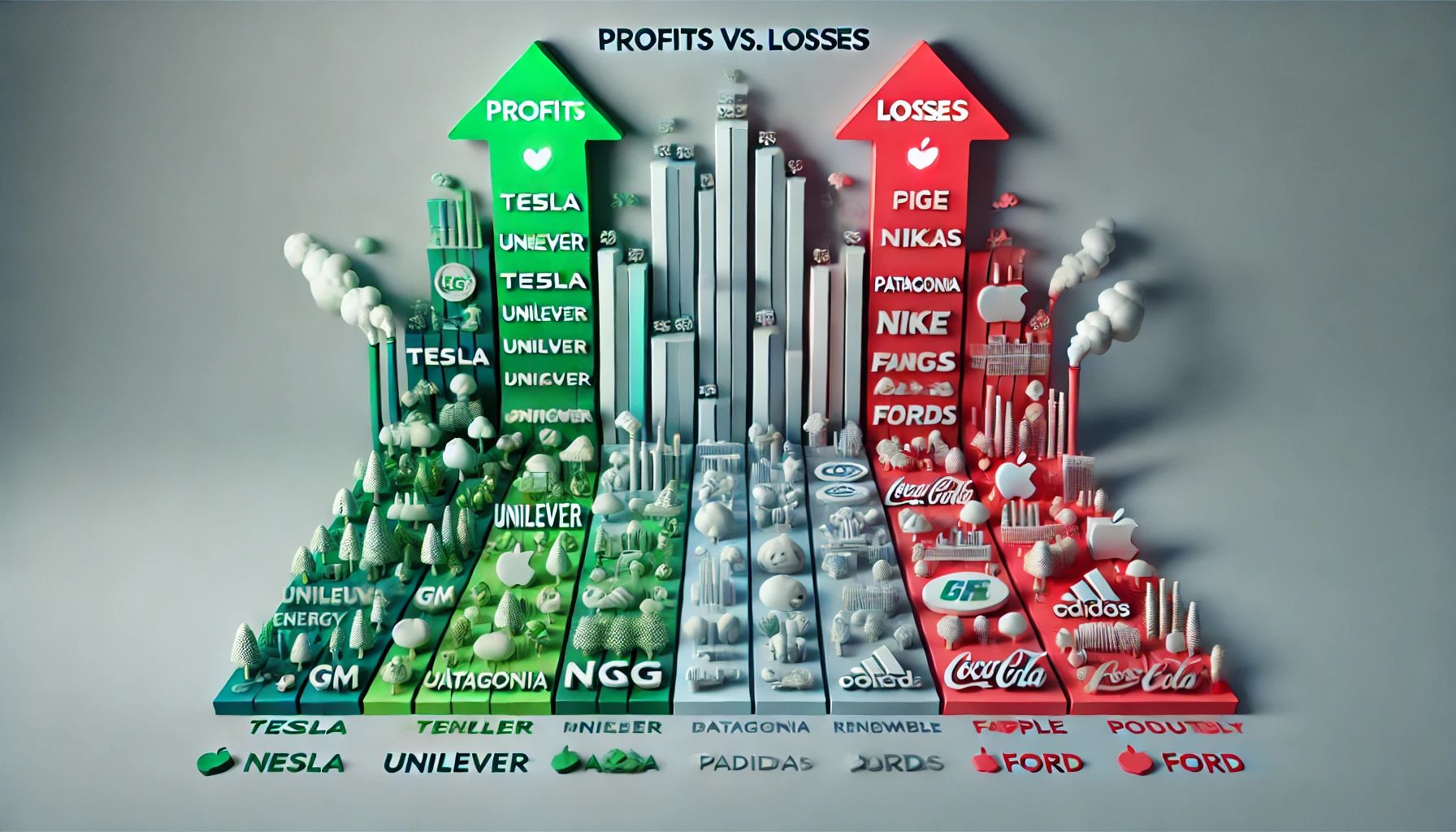
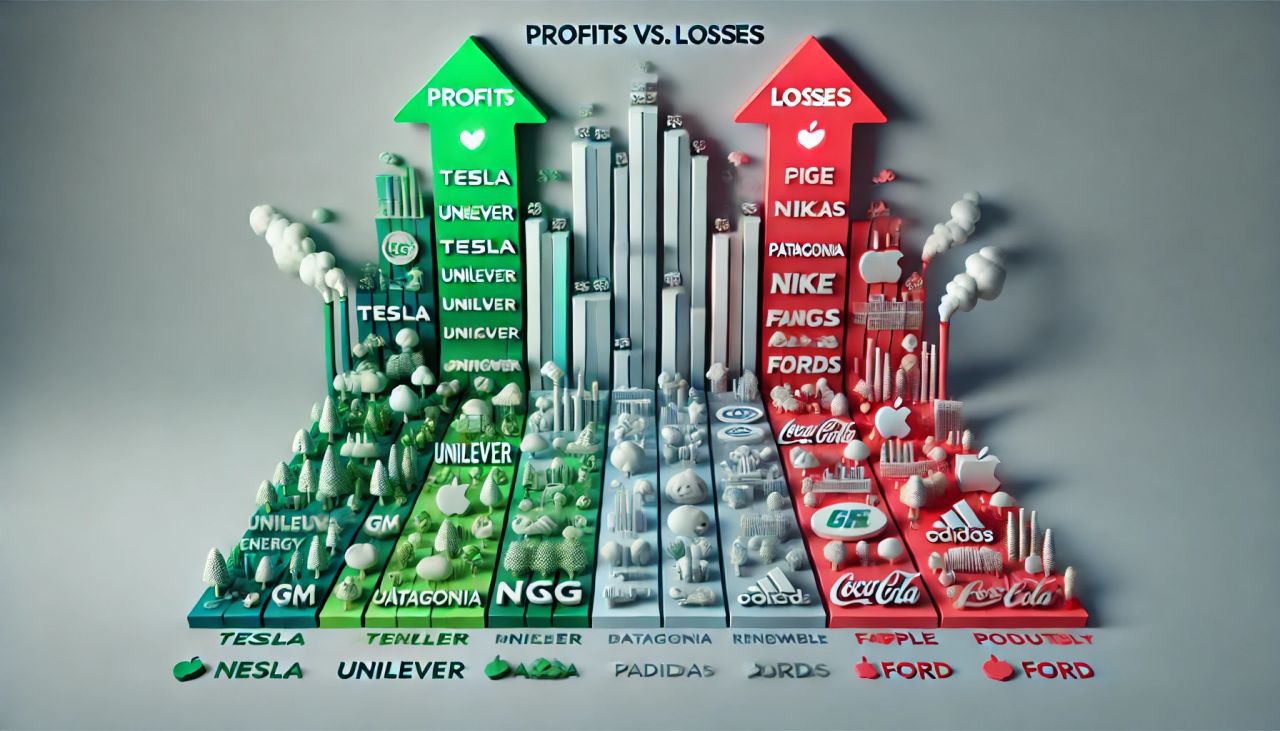
Sustainability Wars: Profits of the Bold, Losses of the Blind
Sustainability isn’t just a buzzword—it’s the defining strategy for profitability in modern business. These 10 examples showcase how companies that embraced sustainability secured financial success, while competitors who hesitated faced staggering losses and shrinking market share.
📊 1. Unilever vs. Procter & Gamble (P&G)
Unilever: Sustainable brands grew 69% faster, saving #€1 billion by 2020.
P&G: Lost #$8 billion in 2023, struggling to appeal to eco-conscious consumers in Europe.
📊 2. Tesla vs. General Motors (GM)
Tesla: EV dominance earned #$12.6 billion net income (2022) and an 800% valuation increase in 5 years.
GM: EVs accounted for just 2% of revenue (2022), causing a 25% market share drop in China.
📊 3. IKEA vs. Wayfair
IKEA: Renewable energy and circular practices saved #€2 billion and grew customer loyalty by 25%.
Wayfair: Suffered #$1.5 billion losses (2022) due to unsustainable operations.
📊 4. Patagonia vs. Columbia Sportswear
Patagonia: Eco-friendly initiatives helped achieve #$1 billion annual revenue and build brand trust.
Columbia: Lost 15% market share between 2020-2023 to Patagonia due to lack of sustainability focus.
📊 5. Walmart vs. Target
Walmart: Energy efficiency saved #$1 billion annually, cutting operational costs significantly.
Target: Reported a #$2 billion profit dip (2022) due to slower sustainability adoption.
📊 6. Nike vs. Adidas
Nike: Flyknit technology saved 60% material costs, generating #$3.5 billion in savings.
Adidas: Faced a #€500 million revenue loss (2023) from delayed sustainable innovations.
📊 7. Apple vs. Samsung
Apple: 100% renewable energy adoption fueled record #$394 billion revenue (2022) and 40% brand equity growth.
Samsung: Lost 15% EU market share, criticized for lagging in renewable energy initiatives.
📊 8. Microsoft vs. Oracle
Microsoft: Sustainability efforts drove 27% Azure growth (2023), securing eco-conscious enterprise clients.
Oracle: Missed #$1.2 billion in contracts, trailing in cloud services for sustainability-focused industries.
📊 9. PepsiCo vs. Coca-Cola
PepsiCo: Water-saving initiatives saved #$80 million annually, stabilizing global supply chains.
Coca-Cola: Lost #$2 billion (2022) due to water mismanagement protests and plant shutdowns in India.
📊 10. Toyota vs. Ford
Toyota: Sold 16 million hybrid vehicles, generating #$70 billion in cumulative profits.
Ford: Lost 10% market share (2020-2023) due to delayed EV and hybrid innovations.
The Bottom Line
Companies that lead with sustainability strategies not only maximize profits but also future-proof their business. Those that delay or ignore the shift face crippling losses in revenue, market share, and reputation.
SustainabilityWins GreenGrowth ProfitWithPurpose CorporateLeadership
Originally published on LinkedIn on 2025-01-24 05:11:11: https://www.linkedin.com/feed/update/urn%3Ali%3AgroupPost%3A82951-7288423065552609280
NamasteGreenIndia🌟 India’s Clean Energy Edge
📊 Key Statistics
$200B investment needed to achieve India’s renewable energy target of 500 GW by YR2030.
Solar capacity projected to rise from 70 GW to 280 GW by 2030.
Green hydrogen market in India expected to reach $44B by 2030, driven by projects from RIL, Adani, and ReNew Power.
India’s EV market forecasted to grow to $47B by 2030, requiring 4M EV chargers nationwide.
🔋 RIL’s Bold Vision for Green Energy
💰 $6B+ Invested in Clean Energy
Already deployed over half of its $10B budget to build a renewable energy ecosystem.
☀️ Solar at Scale
The 20 GW solar Giga factory in Jamnagar will commence production in phases starting March 2024 and reach full capacity by 2026.
🔋 BatteryPowerhouse
Developing a battery Giga factory for advanced storage and recycling solutions by 2026, addressing India’s growing energy storage needs (projected to hit 27 GW by YR2030).
💧 Green Hydrogen Revolution
Establishing a fully automated electrolyzer Giga factory, powering India’s green hydrogen production targets of 5 MTPA by YR2030.
⚡ Fuel Cell Innovation
Pioneering fuel cell technology, transforming hydrogen into power for commercial and industrial use, aligning with India’s commitment to net-zero by YR2070.
🤝 Strategic Acquisitions
Acquired REC Solar ($771M) and a 40% stake in Sterling & Wilson Renewable Energy ($240M) to strengthen its renewable portfolio.
📈 Profitability Meets Sustainability
Chairman Mukesh Ambani envisions the New Energy business matching the profitability of RIL’s oil-to-chemicals segment (which generated $35B in revenue in 2023) within 5-7 years.
🌏 Other Key Players Driving India’s Renewable Energy Revolution
🔹 TataPower
Committed to investing $9 billion to expand renewable capacity to 20 GW by YR2027.
Recently launched a 4.3 GW solar cell and module manufacturing plant in TamilNadu.
Partnering with the Tamil Nadu government to develop 10 GW renewable energy projects, with an estimated investment of $8.4 billion.
Operating 1.1 GW rooftop solar capacity and expanding EV infrastructure to install 50,000 charging points by 2030.
🔹 AdaniGreenEnergy
Operating 8 GW of renewable capacity and targeting 45 GW by YR2030.
Announced a $50B investment in green hydrogen, solar manufacturing, and wind projects over the next decade.
🔹 ReNew Power
Managing 13 GW operational capacity, targeting 25 GW by 2025.
Partnered with L&T and Indian Oil for green hydrogen projects, contributing to India’s $44B hydrogen market by 2030.
🔹 NTPC Limited
Targeting 60 GW renewable capacity by 2032, with large solar and wind projects in Rajasthan and Gujarat.
🔹 JSW Energy
Transitioning its portfolio to renewables, aiming for 20 GW capacity by 2030, up from its current 4.8 GW.
Originally published on LinkedIn on 2024-12-12 07:06:10: https://www.linkedin.com/feed/update/urn%3Ali%3AgroupPost%3A2635374-7272869323998679040
NamasteInvestIndia: Turning Challenges into Champions of Growth!
InvestIndia, the country’s premier investment promotion agency, has emerged as a symbol of resilience and transformation, especially in the face of global uncertainties in YR2023 and YR2024. Through bold strategies, innovative leadership, and a focus on sustainability, Invest India not only rebounded strongly but also positioned the nation as a global investment powerhouse.
1. Foreign Direct Investment (FDI):
Despite global headwinds, Invest India achieved an impressive rebound, securing a 22% weighting in the MSCI Emerging Markets Index, surpassing China’s 19%, signaling renewed global confidence in India’s market.
2. Ease of Doing Business:
Reforms were accelerated, reducing 41,000 compliances, decriminalizing 3,600 laws, and facilitating 255,000 approvals through the National Single Window System, making it easier than ever to do business in India.
3. Infrastructure Development:
With the ambitious PM GatiShakti Plan, the agency drove projects worth $743 billion, integrating 35 logistics systems to enhance connectivity, efficiency, and supply chain resilience.
4. Startup Ecosystem:
Scaling up significantly, Invest India recognized 114,000 startups, created 1.2 million jobs, and secured $2.08 billion in funding for 915 startups, showcasing adaptability and innovation amid economic challenges.
5. Production-Linked Incentive (PLI) Scheme:
Attracted $17 billion in investments, producing $131.6 billion in output, and creating nearly 1 million jobs, ensuring stability in manufacturing and boosting industrial growth.
6. Renewable Energy:
Leading in sustainability, Invest India set ambitious 500 GW by 2030 targets and drove $385 billion in green investments, making India a global leader in renewable energy during critical times of climate urgency.
Conclusion
The remarkable resilience of Invest India in 2023 and 2024 exemplifies the power of focused leadership and bold decision-making in uncertain times. While Phase 1 laid the groundwork during a period of stability, Phase 2 turned challenges into opportunities, fostering innovation, sustainability, and global competitiveness.
As India strides toward becoming a self-reliant, globally dominant economic powerhouse, Invest India stands as a testament to the nation’s ability to adapt and thrive. Together, these transformative years highlight a journey of resilience, innovation, and enduring progress, setting the stage for India’s growth in the next decade.
Originally published on LinkedIn on 2024-12-05 12:23:32: https://www.linkedin.com/feed/update/urn%3Ali%3Ashare%3A7270412478365265921
NamasteAmazon’s sustainability Chief: ‘We have to act now’ on climate
Climate Pledge: Amazon aims to eliminate carbon emissions by 2040 through its Climate Pledge initiative.
Bold Steps: Companies committing to the Climate Pledge must take significant actions to make their operations more sustainable.
Amazon’s Initiatives:
Incorporating electric vehicles in delivery fleets.
Supporting clean technologies in sectors like air and sea transport, steel, and cement manufacturing.
Let’s keep pushing for a greener future!
Download Economic Times App to stay updated with Business News – https://lnkd.in/gvCUBh-r
Originally published on LinkedIn on 2024-07-23 15:04:21: https://www.linkedin.com/feed/update/urn%3Ali%3Ashare%3A7221530584777416704

