🚨 NamasteIndia BioGasPolicyUpdate| 🇮🇳 July2025: India Mandates Biogas Blending SustainableAlternativeTowardsAffordableTransportation
🛢️ SATAT | GOBARdhan | EnergySecurity | NetZero2070
💡 KtalystInsights:
> Biogas isn’t just rural. It’s national security in methane’s mask.
🟢 What’s New?
India has mandated phased blending of Compressed Biogas (CBG) into CNG and PNG networks starting FY 2025–26.
📅 Blending Timeline:
FY2025–26 → 1%
FY2026–27 → 3%
FY2027–28 → 4%
FY2028–29 → 5% (and stable)
💰 Producers Rejoice:
New price: ₹1,478/MMBtu (~₹77.4/kg)
Compression support + transport incentives
750+ new CBG units to be commissioned
₹37,500 crore+ investment push incoming
📈 Strategic Goals:
Cut LNG imports
Boost rural incomes (₹1–2/kg dung)
Recognize fermented slurry as FOM (under FCO 2023)
Create a circular economy rooted in Indian villages
> “From waste to wealth, and from bio-gas to bio-glory — India’s green fuel vision just got real.
Originally published on LinkedIn on 2025-07-01 04:34:41: https://www.linkedin.com/feed/update/urn%3Ali%3Ashare%3A7345671164616175617
From SolarSurges to BiofuelBreakthroughs: What May 2025 Taught Us About Sustainability
The sun’s still shining, but so is the scrutiny.
In May2025, sustainability wasn’t just a checkbox—it was a headline. From GlobalPacts to LocalClimateWins, here’s what moved the needle:
Top 5 Signals from May 2025
1. G20 Goes Bold on Renewables
⚡ Commitment to TripleCapacity of Solar and Wind by 2035
⚡ Execution is the new challenge. Ambition is no longer the problem.
Source: WINs Solutions
2. WHO’s Pandemic Pact = Health + Equity
🌍 Global agreement on PandemicPreparedness with Sustainability at its core
🌍 Focus on ResilientSystems and EquitableAccess to resources
Source: WHO
3. Karnataka’s Biofuel Playbook Goes Global
🌱 Partnership with GermanUniversities to boost innovation
🌱 Focus on Biogas, EthanolVehicles, and ProducerIncentives
Source: Times of India
4. Europe Doubles Down on ESG—US Hesitates
♻️ EU pension funds tightening ESG demands
♻️ US investors show MixedIntent—some pulling back
Source: Financial Times
5. Tokyo E-Prix Walks the Talk
⚙️ Event PoweredByRenewables and spotlighting CleanTechCareers
⚙️ Speed, Sustainability, and SocialImpact on the same track
Source: Times of India
KtalystTakeaway
Sustainability in 2025 is about Tradeoffs, Transitions, and Timelines.
If you’re in the business of Circularity, Decarbonization, or ESGBackedGrowth, now is the time to ShowNotJustSay.
Let’s connect on CleanGrowth, ClimateAction, and the GreenTransition ahead.
Originally published on LinkedIn on 2025-05-22 04:13:40: https://www.linkedin.com/feed/update/urn%3Ali%3Ashare%3A7331170355719389184
KnowledgeKtalyst:
AgriWaste = Business:
Sustainability doesn’t grow in labs alone—it sprouts from the fields, from what we left behind.
KtalystKeystone
SweetResidue, StrongFuture: The Sustainability of Sugarcane
India generates over 120 million tons of sugarcane bagasse annually.
Bioethanol market in India projected to hit USD 10 billion by 2028, largely driven by bagasse-based 2G ethanol
Furfural demand in Asia-Pacific growing at CAGR 5.8%, fueled by green solvents
MCC (microcrystalline cellulose) global market expected to reach USD 1.6 billion by 2030
PLA bioplastics: India’s packaging sector pushing demand at >13% CAGR
Kernel to Kilowatt: The Potential of CornWaste
India produces 30–35 million tons of corn stover annually—mostly underutilized.
Cellulosic ethanol from corn projected to cross USD 4.5 billion globally by 2030
Corn-based PLA holds 40%+ of global bioplastics market, growing at CAGR 12%
Corn cob-derived furfural used in pharma & resins is growing fast in EU & China
Biogas from corn waste contributes to India’s SATAT target of 15 MMT gas/year
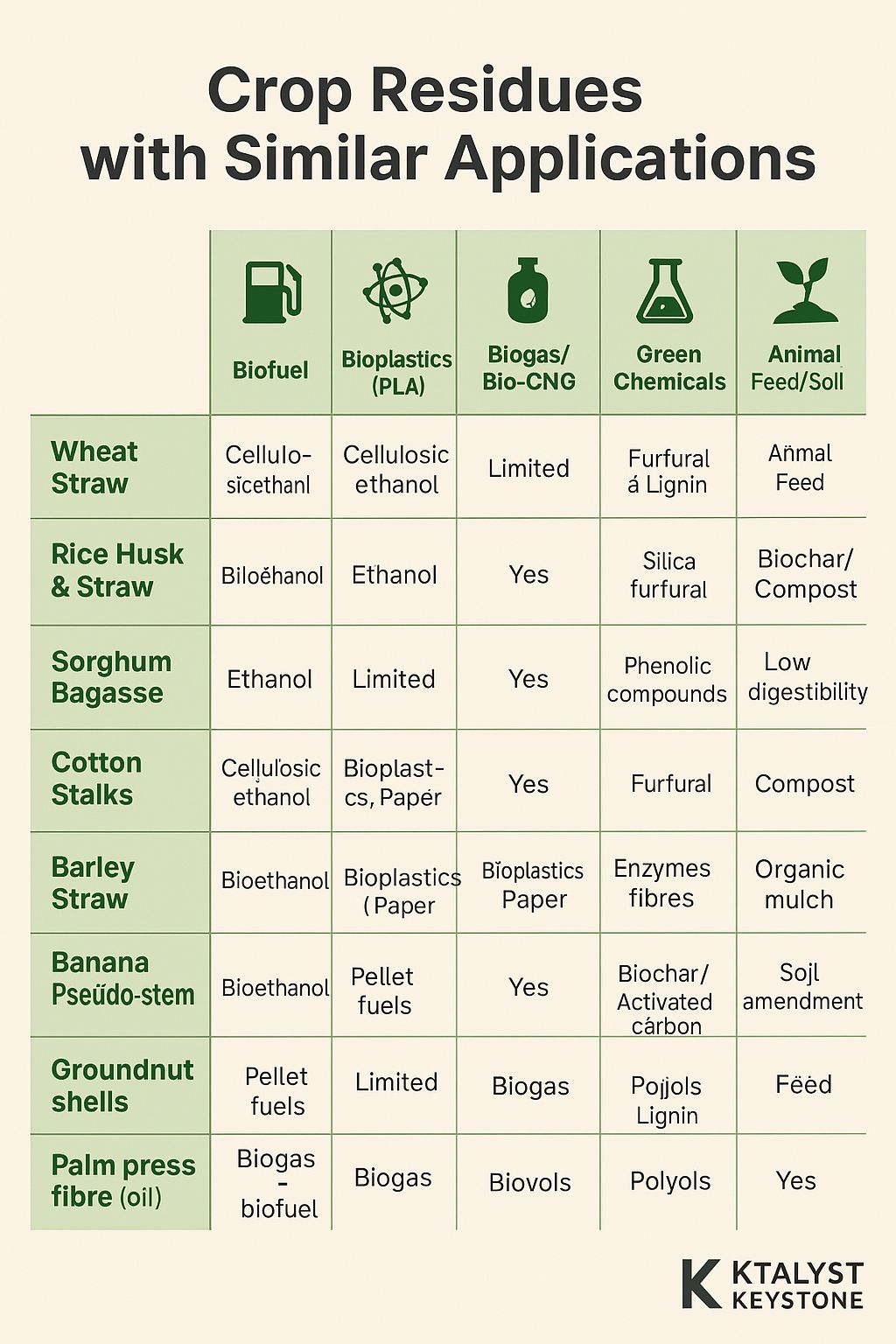
Crop Residues:
Hidden Bio_Assets
Together, India generates over 500 million tons of crop residues annually.
Wheat & rice straw alone contribute ~60% of India’s agricultural residue
Bio_CNG plants using rice straw receive capital subsidies up to 35% under GOBARdhan
Banana stem fibre exports expected to double by 2026 due to paper & fabric demand
Groundnut shells & cotton stalks tapped for biochar and activated carbon—growing global market worth USD 6.5 billion
Palm press fibre reuse supports sustainable palm certification programs in Southeast Asia
Ktalyst Viewpoint
In my opinion, India sits on a biomass treasure chest. The future lies in converting kilotons of agri-waste into megawatts of revenue—through smart policy, public-private pilots, and next-gen processing tech.
This is not just circular. It’s strategically spiral—turning residue into resilience.
Originally published on LinkedIn on 2025-04-11 18:06:08: https://www.linkedin.com/feed/update/urn%3Ali%3AgroupPost%3A2153908-7316521955061383169
Question “Turning Methane Green for Hydrogen: A Sustainable Revolution or an Overhyped Gamble?
The Hydrogen Spectrum: Gray, Blue, and Green
🟦 Gray Hydrogen:
Makes up 80% of global hydrogen production, emitting 9-12 kg CO₂/kg of hydrogen.
Inexpensive at $1-2/kg, but environmentally costly.
🔵 Blue Hydrogen:
Cuts emissions by up to 90% using carbon capture.
Costs $1.5-3/kg, but CCS scalability is a challenge.
💚 Green Hydrogen:
Zero emissions but expensive at $3-8/kg.
Projected to reach $1-2/kg by 2030, with renewable energy advancements (IEA, 2024).
🌱 Biogas: Methane’s Green Revolution or Gamble?
1️⃣ The Green Potential
Waste Reduction: Converts 20% of global methane emissions from decomposing waste, cutting greenhouse gas emissions equivalent to 500 million tons of CO₂ annually (IEA, 2023).
Methane Mitigation: Captures a gas 25x more potent than CO₂, turning it into energy.
2️⃣ A Renewable Pathway
Biomethane Production: Purifies biogas into biomethane, a substitute for natural gas or feedstock for green hydrogen.
Future Potential: Biomethane could meet 20% of global natural gas demand by 2040 (World Biogas Association, 2023).
3️⃣ Practical Challenges
High Costs: Initial investment in anaerobic digesters and upgrading facilities is substantial.
Slow Adoption: Only 2% of global methane demand is currently fulfilled by biomethane.
💡 Hydrogen from Biogas: A Green Transition
🔗 Biomethane-to-Hydrogen: Biomethane enables a blue-to-green hydrogen bridge, reducing emissions by 95% when paired with carbon capture.
💰 Economic Feasibility: Producing hydrogen from biomethane costs $2-4/kg, making it a competitive interim solution.
🌍 Key Impact Potential
🌱 Emission_Reduction: Combating up to 1 gigaton of CO₂-equivalent emissions annually by scaling biogas and biomethane.
♻️ Circular_Economy: Converts 300 million tons of organic waste into energy annually.
🔒 Energy_Security: Biogas can fulfill 10% of global energy demand by 2050.
Conclusion: Revolution or Gamble?
Biogas and biomethane present a game-changing opportunity to turn methane green and bridge the gap to green hydrogen. However, costs, infrastructure, and slow adoption spark skepticism. The path forward requires bold policy action, strategic investment, and technological breakthroughs to turn this gamble into a sustainable revolution.
Originally published on LinkedIn on 2024-12-27 04:21:11: https://www.linkedin.com/feed/update/urn%3Ali%3AgroupPost%3A60128-7278263621023903744
YR2024_India’s Bioenergy Capacity Hits New Milestone
India has reached a significant milestone in its clean energy efforts, with bioenergy playing a key role in the renewable energy mix. As of 13th November_2024, bioenergy contributes significantly to India’s renewable portfolio, supporting the country’s transition toward net-zero emissions by 2070.
With advancements in biogas, bioethanol, bio_CNG, and biomass power, India is accelerating its clean energy goals:
Bioenergy (~6%) now forms a critical part of the 46.3% renewable energy share in the total installed power capacity.
The sector supports decarbonization in transportation, industry, and aviation through initiatives like bioethanol blending and Sustainable Aviation Fuel (SAF).
India’s bioenergy growth reflects its focus on reducing fossil fuel dependency while strengthening its $20 billion bioeconomy, creating a sustainable and greener energy future.
India’s Bioenergy Partnerships in 2024
✅ TruAlt Bioenergy & Sumitomo Corporation
Focus: Biogas, Bioethanol, SAF
Target: Cutting fossil fuel dependency by 50%.
✅ ISMA, TERI & Praj Industries
Focus: SAF, Green Hydrogen
Target: 12 billion liters SAF annually by 2030.
✅ India_Brazil SAF Collaboration
Focus: SAF Supply Chain Optimization
✅ BPCL ($170M Investment)
Focus: SAF Production
Target: 5% SAF blending by 2030.
✅ IOC & LanzaJet
Focus: Waste-to-Ethanol SAF
Output: 80,000 metric tons annually.
✅ GPS Renewables & SAF One
Focus: Aviation Emission Reduction (8% GHG emissions).
✅ Adani Total Gas & Greenko Group
Focus: Biogas, Green Hydrogen
Impact: 10% reduction in industrial emissions by 2035.
✅ Reliance & Air Products
Focus: Bioethanol, SAF
Strengthening the $20 billion bioeconomy.
✅ Tata Power & Shell India
Focus: Bio-CNG, Biogas
Target: 5M metric tons annually by 2030.
✅ NTPC & Honeywell International
Focus: Green Methanol, SAF
Emissions Reduction: 20% by 2035.
✅ Vedanta & EcoEnergy Europe
Focus: Waste-to-Bioethanol
Target: 20% ethanol blending by 2025.
✅ L&T & Siemens Energy
Focus: Biohydrogen
Target: 1M metric tons annually by 2030.
Why This Matters
India’s bioenergy partnerships are driving innovation, emissions reduction, and economic growth.
📊 Key Stats:
50% fossil fuel dependency reduction by 2030.
12B liters SAF production annually by 2030.
20% ethanol blending by 2025.
5M metric tons of biogas production annually.
1M metric tons of biohydrogen by 2030.
India is laying the foundation for a sustainable and net-zero tomorrow, proving that collaboration is key to progress.
Source / shared link: https://pib.gov.in/PressReleaseIframePage.aspx?PRID=2073038
Originally published on LinkedIn on 2024-12-17 15:02:29: https://www.linkedin.com/feed/update/urn%3Ali%3AgroupPost%3A3880479-7274801133875822593
1. Carbon Markets and Biogas in India:
Carbon markets can fund biogas projects in India.
Record revenues in 2023: $104 billion globally.
Coverage: 24% of global emissions.
Sectors: Power, industry, aviation, shipping, and waste.
EU’s Carbon Border Adjustment Mechanism (CBAM) encourages pricing.
Voluntary carbon markets attract finance.
2. Steps for Indian Companies:
Assess emissions (Scope 1, 2, and 3).
Set science-based reduction targets.
Implement internal measures (energy efficiency, renewables).
Develop a carbon pricing strategy.
Engage in carbon markets (offsets, credits).
Invest in renewable energy.
Collaborate and advocate for climate policies.
Remember, each company’s path varies, but these guidelines promote a greener future!
Originally published on LinkedIn on 2024-07-30 13:59:13: https://www.linkedin.com/feed/update/urn%3Ali%3AgroupPost%3A131340-7224050911122190336
1. Carbon Markets and Biogas in India:
Carbon markets can fund biogas projects in India.
Record revenues in 2023: $104 billion globally.
Coverage: 24% of global emissions.
Sectors: Power, industry, aviation, shipping, and waste.
EU’s Carbon Border Adjustment Mechanism (CBAM) encourages pricing.
Voluntary carbon markets attract finance.
2. Steps for Indian Companies:
Assess emissions (Scope 1, 2, and 3).
Set science-based reduction targets.
Implement internal measures (energy efficiency, renewables).
Develop a carbon pricing strategy.
Engage in carbon markets (offsets, credits).
Invest in renewable energy.
Collaborate and advocate for climate policies.
Remember, each company’s path varies, but these guidelines promote a greener future!
Originally published on LinkedIn on 2024-07-30 13:59:07: https://www.linkedin.com/feed/update/urn%3Ali%3Ashare%3A7224050885381767169
NamesteIndia Biogas a “Future Fuel !!!
India’s Biogas Revolution:
In a stunning to know, we actually have been using Biogas in India since more than a Century
1859: The first anaerobic digestion plant in Bombay (now Mumbai) lit up the streets with biogas. Forget Edison; this was the original light bulb moment!
1970s: India rolled out family biogas plants like a boss. Cattle manure became the new gold standard.
1980s: Decentralized biogas models sprouted faster than weeds after monsoon rains. Urban, industrial, and agricultural wastes joined the party.
2015: The Advanced High Rate (AGR) digester design emerged, turning solid waste into energy. It’s like Hogwarts for garbage!
Certainly! Here’s a concise overview of India’s biogas developments from 2020 to 2024:
2020: India continued to promote biogas as a sustainable energy source. Research focused on improving digester efficiency and exploring new feedstocks beyond cattle manure.
2021: The government launched the National Biogas Mission, aiming to increase biogas production and utilization across the country. Incentives were provided for setting up biogas plants in rural and urban areas.
2022: India witnessed a surge in communitybased biogas projects. These projects involved collaboration between local communities, NGOs, and private entities to establish decentralized biogas facilities.
2023: Researchers discovered innovative ways to enhance biogas yield through codigestion. By mixing organic waste streams (such as food waste, agricultural residues, and sewage sludge), biogas production became more efficient.
2024: The Indian biogas sector expanded its focus beyond electricity generation. Biogas was increasingly used for cooking, heating, and as a clean fuel alternative in transportation.
Overall, India’s commitment to biogas as a renewable energy solution remained steadfast during this period, with efforts spanning research, policy, and practical implementation.
Originally published on LinkedIn on 2024-07-19 18:03:17: https://www.linkedin.com/feed/update/urn%3Ali%3AgroupPost%3A59930-7220126065124421632
NamesteIndia Biogas a “Future Fuel !!!
India’s Biogas Revolution:
In a stunning to know, we actually have been using Biogas in India since more than a Century
1859: The first anaerobic digestion plant in Bombay (now Mumbai) lit up the streets with biogas. Forget Edison; this was the original light bulb moment!
1970s: India rolled out family biogas plants like a boss. Cattle manure became the new gold standard.
1980s: Decentralized biogas models sprouted faster than weeds after monsoon rains. Urban, industrial, and agricultural wastes joined the party.
2015: The Advanced High Rate (AGR) digester design emerged, turning solid waste into energy. It’s like Hogwarts for garbage!
Certainly! Here’s a concise overview of India’s biogas developments from 2020 to 2024:
2020: India continued to promote biogas as a sustainable energy source. Research focused on improving digester efficiency and exploring new feedstocks beyond cattle manure.
2021: The government launched the National Biogas Mission, aiming to increase biogas production and utilization across the country. Incentives were provided for setting up biogas plants in rural and urban areas.
2022: India witnessed a surge in communitybased biogas projects. These projects involved collaboration between local communities, NGOs, and private entities to establish decentralized biogas facilities.
2023: Researchers discovered innovative ways to enhance biogas yield through codigestion. By mixing organic waste streams (such as food waste, agricultural residues, and sewage sludge), biogas production became more efficient.
2024: The Indian biogas sector expanded its focus beyond electricity generation. Biogas was increasingly used for cooking, heating, and as a clean fuel alternative in transportation.
Overall, India’s commitment to biogas as a renewable energy solution remained steadfast during this period, with efforts spanning research, policy, and practical implementation.
Originally published on LinkedIn on 2024-07-19 18:03:04: https://www.linkedin.com/feed/update/urn%3Ali%3Ashare%3A7220126007599489026
Biogas: The ‘Re-leaf’ India Needs for a Greener Tomorrow!” NamsteIndia
India’s stride towards biogas plants is a multifaceted leap into sustainability.
These plants are not just about producing energy; they’re a catalyst for environmental stewardship, reducing greenhouse emissions, and managing waste with finesse. They’re a boon for the socio-economic landscape, offering jobs and combating poverty.
Energy-wise, they diversify the portfolio, ensuring a steadier, greener grid. For farmers, the by-product doubles as a natural fertilizer, enriching the soil without chemical intervention. And on a global scale, these initiatives resonate with the Sustainable Development Goals, tackling sanitation and ecosystem conservation. In essence, biogas plants are a holistic approach to nurturing a greener India.
Originally published on LinkedIn on 2024-06-01 18:45:02: https://www.linkedin.com/feed/update/urn%3Ali%3AgroupPost%3A131340-7202741954860822528

