TurningTrashToTreasure | Bagasse Booms as Billion-Dollar Biowaste Bets Rise
From millwaste to molecule wealth—bagasse is India’s stealth greengold.
KtalystInsight
✔️ Bioethanol & BioCNG – India Takes the Lead
→ INR 6,000 Cr+ ($720M) invested in 10+ CBG units by PrajIndustries & IOCL under SATAT and E20 mandates
→ Bagasse is now powering India’s fuelblending and energysecurity
✔️ GreenPower & Cogeneration – Brazil’s Grid Gets Greener
→ Raízen has invested $500M+ to expand 2G ethanol and bagasse-based captive plants
→ Over 200 sugar mills feed excess power to Brazil’s grid
✔️ Furfural, Xylitol & Biochemicals – Molecules from Molasses Waste
→ Lenzing (Austria): $400M+ for xylitol and pulp from agro-residue
→ GodavariBiorefineries (India): Capital raise for furfural and bioacetates using bagasse
✔️ SustainablePackaging Surge – Compostable Goes Commercial
→ 15+ plants in India, Vietnam, China built since 2021
→ Huhtamaki, YashPakka, BioPak: Joint investments $350M+ into molded fiber & tableware
→ India emerging as a greenexporthub
✔️ KtalystTakeaway
Bagasse is no longer a byproduct—it’s a platform.
This agro-waste is turning into the greenfeedstock of the future—fuels, fibers, and fine chemicals fueling India’s bioeconomy.
Originally published on LinkedIn on 2025-05-10 14:32:16: https://www.linkedin.com/feed/update/urn%3Ali%3AgroupPost%3A4385073-7326977380613337089
KnowledgeKtalyst:
AgriWaste = Business:
Sustainability doesn’t grow in labs alone—it sprouts from the fields, from what we left behind.
KtalystKeystone
SweetResidue, StrongFuture: The Sustainability of Sugarcane
India generates over 120 million tons of sugarcane bagasse annually.
Bioethanol market in India projected to hit USD 10 billion by 2028, largely driven by bagasse-based 2G ethanol
Furfural demand in Asia-Pacific growing at CAGR 5.8%, fueled by green solvents
MCC (microcrystalline cellulose) global market expected to reach USD 1.6 billion by 2030
PLA bioplastics: India’s packaging sector pushing demand at >13% CAGR
Kernel to Kilowatt: The Potential of CornWaste
India produces 30–35 million tons of corn stover annually—mostly underutilized.
Cellulosic ethanol from corn projected to cross USD 4.5 billion globally by 2030
Corn-based PLA holds 40%+ of global bioplastics market, growing at CAGR 12%
Corn cob-derived furfural used in pharma & resins is growing fast in EU & China
Biogas from corn waste contributes to India’s SATAT target of 15 MMT gas/year
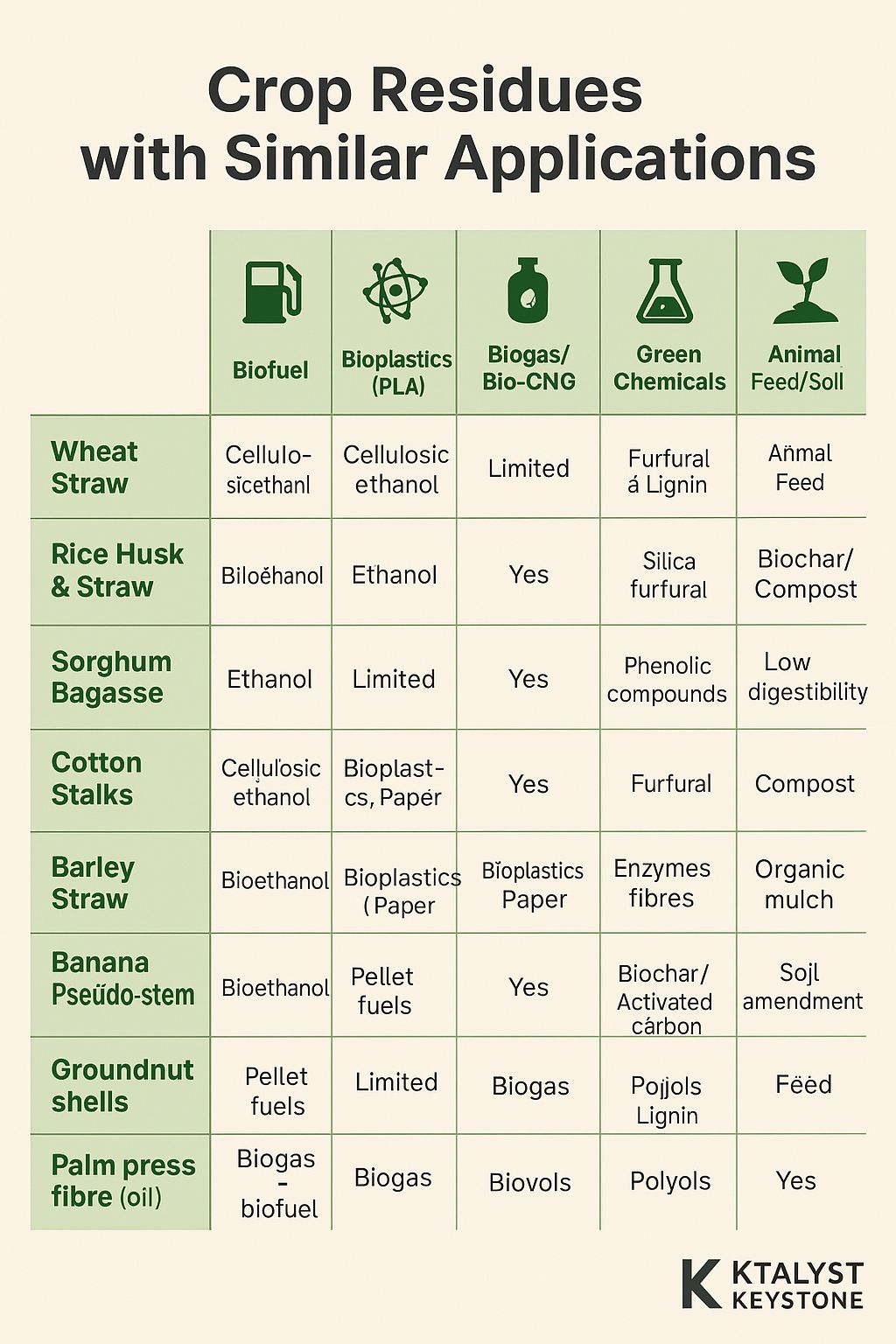
Crop Residues:
Hidden Bio_Assets
Together, India generates over 500 million tons of crop residues annually.
Wheat & rice straw alone contribute ~60% of India’s agricultural residue
Bio_CNG plants using rice straw receive capital subsidies up to 35% under GOBARdhan
Banana stem fibre exports expected to double by 2026 due to paper & fabric demand
Groundnut shells & cotton stalks tapped for biochar and activated carbon—growing global market worth USD 6.5 billion
Palm press fibre reuse supports sustainable palm certification programs in Southeast Asia
Ktalyst Viewpoint
In my opinion, India sits on a biomass treasure chest. The future lies in converting kilotons of agri-waste into megawatts of revenue—through smart policy, public-private pilots, and next-gen processing tech.
This is not just circular. It’s strategically spiral—turning residue into resilience.
Originally published on LinkedIn on 2025-04-11 18:06:08: https://www.linkedin.com/feed/update/urn%3Ali%3AgroupPost%3A2153908-7316521955061383169
YR2024_India’s Bioenergy Capacity Hits New Milestone
India has reached a significant milestone in its clean energy efforts, with bioenergy playing a key role in the renewable energy mix. As of 13th November_2024, bioenergy contributes significantly to India’s renewable portfolio, supporting the country’s transition toward net-zero emissions by 2070.
With advancements in biogas, bioethanol, bio_CNG, and biomass power, India is accelerating its clean energy goals:
Bioenergy (~6%) now forms a critical part of the 46.3% renewable energy share in the total installed power capacity.
The sector supports decarbonization in transportation, industry, and aviation through initiatives like bioethanol blending and Sustainable Aviation Fuel (SAF).
India’s bioenergy growth reflects its focus on reducing fossil fuel dependency while strengthening its $20 billion bioeconomy, creating a sustainable and greener energy future.
India’s Bioenergy Partnerships in 2024
✅ TruAlt Bioenergy & Sumitomo Corporation
Focus: Biogas, Bioethanol, SAF
Target: Cutting fossil fuel dependency by 50%.
✅ ISMA, TERI & Praj Industries
Focus: SAF, Green Hydrogen
Target: 12 billion liters SAF annually by 2030.
✅ India_Brazil SAF Collaboration
Focus: SAF Supply Chain Optimization
✅ BPCL ($170M Investment)
Focus: SAF Production
Target: 5% SAF blending by 2030.
✅ IOC & LanzaJet
Focus: Waste-to-Ethanol SAF
Output: 80,000 metric tons annually.
✅ GPS Renewables & SAF One
Focus: Aviation Emission Reduction (8% GHG emissions).
✅ Adani Total Gas & Greenko Group
Focus: Biogas, Green Hydrogen
Impact: 10% reduction in industrial emissions by 2035.
✅ Reliance & Air Products
Focus: Bioethanol, SAF
Strengthening the $20 billion bioeconomy.
✅ Tata Power & Shell India
Focus: Bio-CNG, Biogas
Target: 5M metric tons annually by 2030.
✅ NTPC & Honeywell International
Focus: Green Methanol, SAF
Emissions Reduction: 20% by 2035.
✅ Vedanta & EcoEnergy Europe
Focus: Waste-to-Bioethanol
Target: 20% ethanol blending by 2025.
✅ L&T & Siemens Energy
Focus: Biohydrogen
Target: 1M metric tons annually by 2030.
Why This Matters
India’s bioenergy partnerships are driving innovation, emissions reduction, and economic growth.
📊 Key Stats:
50% fossil fuel dependency reduction by 2030.
12B liters SAF production annually by 2030.
20% ethanol blending by 2025.
5M metric tons of biogas production annually.
1M metric tons of biohydrogen by 2030.
India is laying the foundation for a sustainable and net-zero tomorrow, proving that collaboration is key to progress.
Source / shared link: https://pib.gov.in/PressReleaseIframePage.aspx?PRID=2073038
Originally published on LinkedIn on 2024-12-17 15:02:29: https://www.linkedin.com/feed/update/urn%3Ali%3AgroupPost%3A3880479-7274801133875822593
NamasteInvestIndia
JV for bio-ethylene plant:
Partnership: GAIL (India) Limited and US-based PetronScientech Inc. have signed a non-binding Memorandum of Understanding (MoU).
Objective: They aim to explore the establishment of a 500 Kilo Tons per Annum (KTA) bio-ethylene plant in India.
BioEthanol Basis: The plant will be based on bioethanol produced within the project.
JointVenture: The project will be undertaken as a 50:50 joint venture between the two companies.
Feasibility Studies: GAIL and Petron will collaborate on feasibility studies to assess technical viability and financial prospects.
Sustainable Development: This initiative contributes to India’s bio-economy and sustainable development.
This joint effort represents a significant step toward enhancing sustainable practices and advancing the bio-economy in India.
https://lnkd.in/eHpXWJAg
Originally published on LinkedIn on 2024-08-23 16:14:02: https://www.linkedin.com/feed/update/urn%3Ali%3Ashare%3A7232782146145320960

