IndiaAtCOP26: Are We Walking the Talk — or Just Talking the Talk?
You cannot greenwash a deadline. Climate targets don’t wait, and neither should leadership.
Anju Sharma
In 2021, India made a powerful promise to the planet.
By 2025, the applause has faded. It’s time for accountability — not just ambition.
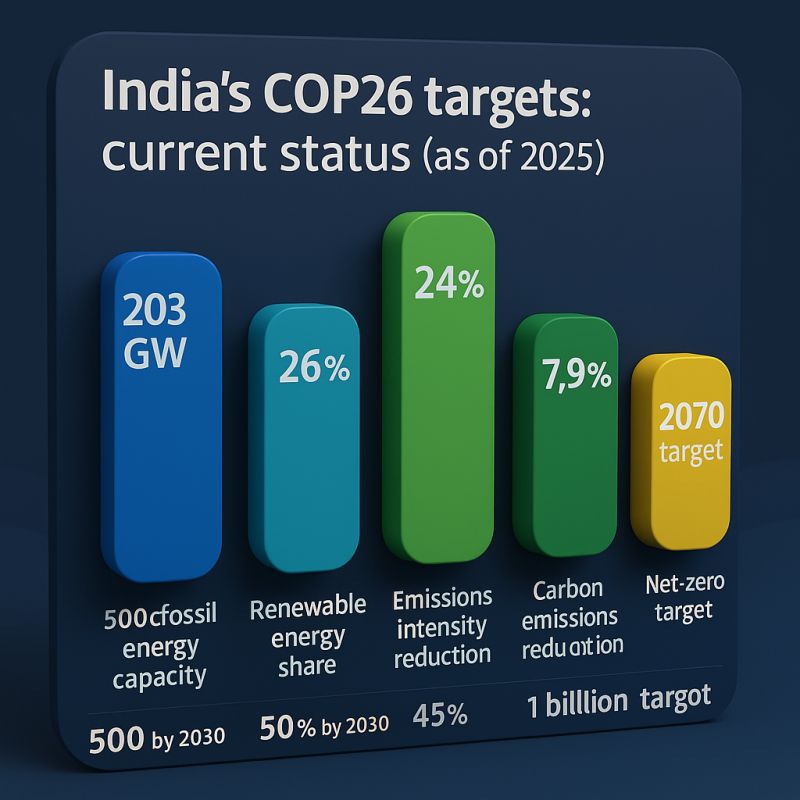
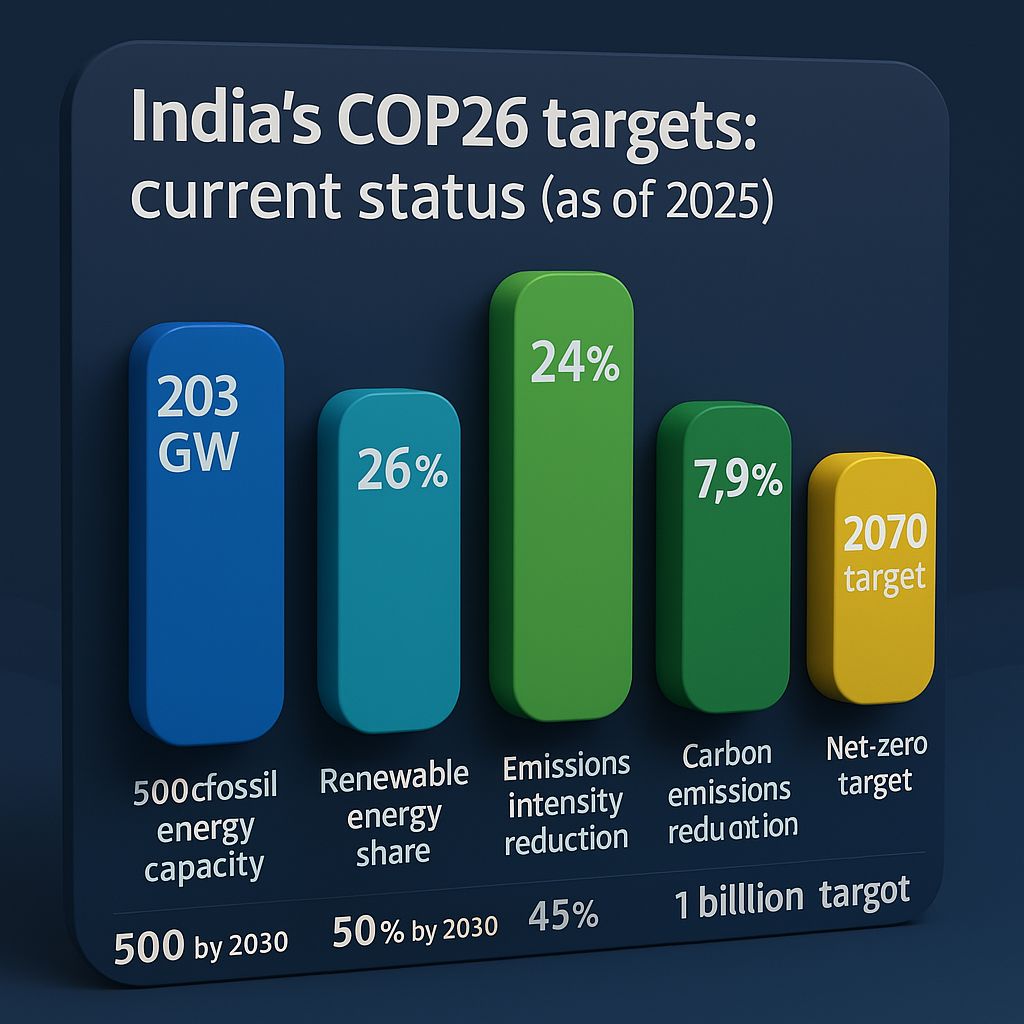
The 5Targets. The 5Year Reality Check:
🔋 500 GW Non-Fossil Energy by 2030
✅ 203.18 GW achieved (as of Oct 2024)
⚠️ Slowing pace. Grid and land hurdles choking large projects.
⚡ 50% Power from Renewables
✅ 26% YoY growth in clean energy (Jan 2025)
⚠️ Rooftop solar under 15% of target. State policies? All over the place.
📉 45% Emission Intensity Cut by 2030
✅ 33% achieved
⚠️ Driven by GDP growth — not aggressive emissions management.
🌫️ 1 Billion Tonnes CO₂ Reduction by 2030
✅ 7.9% drop in 2020
⚠️ But coal production surged 9% in 2024. Net gains? Neutralized.
🕰️ Net-Zero by 2070
✅ Roadmap submitted.
⚠️ No sectoral mandates. No accountability. No serious momentum.
Where’s the Leadership?
🚫 Ministries in silos
🚫 Power sector still fossil-heavy
🚫 EV infra crawling
🚫 Agriculture untouched
Are we really driving the transition — or just riding a global narrative?
And the Money?
💰 India has raised billions — Green Bonds, FDI, PLI schemes…
But…
❌ Utilization = uneven
❌ Outcome tracking = missing
❌ Impact per rupee = unclear
The climate rupee has wings — but no flight path.
The Fix — And Fast
✅ Appoint sector-wise climate champions with KPIs
✅ Launch public climate spend dashboards (Geo-tagged)
✅ Train bureaucrats in ESG, climate finance & tech
✅ Incentivize state-wise performance on climate goals
At_This_Pace, Where_Will_We_Land?
⏳ 3/5 targets may be missed
⏳ Investor confidence may fade
⏳ India’s brand as a climate leader may turn into a paper tiger
India doesn’t lack ambition.
It lacks the fire to deliver.
Time to shift gears.
From policy promises to powerful performance.
Originally published on LinkedIn on 2025-03-30 11:31:32: https://www.linkedin.com/feed/update/urn%3Ali%3AgroupPost%3A4385073-7312073993270784000
#️⃣ HarvestingtheSunTwice: TheAgrivoltaicsRevolution🌞🌾
🌍 Agrivoltaics—farmingandsolarpowercombined—isreshapinglanduseefficiency. This innovation boosts cropyields,waterconservation,andincreasescleanenergyoutput.
📈 MarketGrowth 🟢 #$4.59BMarket(2024),Projectedto$23.84Bby2034 – CAGR of 16.76%, driven by rising solar adoption. (marketresearchfuture.com) 🟢 14GWInstalledGlobally – Germany alone has a potential 1,700GW, showing massive scalability. (sens-energy.com)
🌾 AdvantagesofAgrivoltaics 🟢 70%IncreaseinLandEfficiency – Dual land use maximizes productivity. (vectorenewables.com) 🟢 200%HigherTomatoYield,300%forPeppers – Shaded crops thrive under controlled conditions. (mbtenergy.com) 🟢 47%LessWaterNeeded – Solar panels reduce evaporation, benefiting drought-prone regions. (mbtenergy.com)
🌍 GlobalAdoptionTrends 🌱 USA: 500+AgrivoltaicSites generating 9GW of solar power. (en.wikipedia.org) 🌱 Europe: Germany and France leading R&D and implementation. (en.wikipedia.org) 🌱 Asia: Japan and China scaling agrivoltaics in rural solar programs. (en.wikipedia.org)
⚠️ ChallengesAhead 🔴 HighInitialInvestment – Cost barriers slow adoption. (mdpi.com) 🔴 ComplexDesignIntegration – Requires precision in panel spacing and crop selection. (mdpi.com) 🔴 CropCompatibilityIssues – Not all plants benefit from shading. (mdpi.com)
🐑 InnovativeApplications 💡 SolarGrazing: 3,000Sheep maintain vegetation under solar farms in Texas. (apnews.com) 💡 PollinatorSolarFarms: Solar arrays double as bee-friendly habitats. (newyorker.com)
🚀 TheFutureIsBright – Agrivoltaics mergesfoodsecurityandcleanenergy, but scaling requires policy support, innovation, and global collaboration.
💡 Wouldyousupportagrivoltaicsinyourregion?Dropyourthoughtsbelow!👇
Originally published on LinkedIn on 2025-03-03 07:26:27: https://www.linkedin.com/feed/update/urn%3Ali%3AgroupPost%3A82951-7302227847153160192
🚜🌾 PolicyGovernance & ClimateResilience: Can India Protect Its Farmers from an Uncertain Future? 🌦️🔥💰
A farmer’s success depends on the sky, but survival now depends on policy.
India’s agriculture sector, contributing 18% of GDP & employing 43% of the workforce, is facing climate volatility & policy gaps that threaten both farm incomes & national food security.
🌡️ Climate Impact: Why Farmers Are at Risk?
✔️ Heatwaves & Crop Failures: India saw 273 heatwave days in 2023, reducing wheat yields by 15% in major agricultural belts. (IMD, 2024)
✔️ Monsoon Irregularities: 12 states recorded deficient rainfall in 2023, leading to 20% lower kharif crop production. (MoAFW, 2024)
✔️ Debt Crisis & Migration: Farm loan defaults may rise by 30% by 2030, forcing 7M+ rural workers to migrate annually. (RBI, 2024; World Bank, 2024)
✔️ Insurance Gaps: Only 34% of farmers are insured under PMFBY, leaving millions exposed to climate-related crop losses. (NITI Aayog, 2024)
📌 RealityCheck: Can policy reforms keep pace with climate shocks?
💰 Economic Fallout: Food Prices, Farmer Distress & Rural Unrest
✔️ Food Inflation: Wheat prices surged 24% & onion prices by 60% in 2023 due to supply chain disruptions. (MoAFW, 2024)
✔️ Declining Farm Incomes: The average farmer earns ₹10,218 ($123) per month, while input costs keep rising. (NSO, 2024)
✔️ Rural Finance Gaps: India’s agri-credit disbursement was ₹18 lakh crore ($216B) in 2023, but small farmers struggle to access formal finance. (RBI, 2024)
✔️ Climate-Induced Farmer Suicides: Over 10,800 farmer suicides were reported in 2023, linked to crop failures & mounting debt. (NCRB, 2024)
📌 RealityCheck: Without stronger governance, rural distress will fuel inflation, unemployment & food shortages.
📜 Governance Gaps: Where Policy Needs Urgent Reform
🔹 Ineffective Crop Insurance: Expanding PMFBY coverage to 70% can protect farmers from weather shocks. (NABARD, 2024)
🔹 Delayed Compensation & Relief Funds: Farmers wait 6-12 months for compensation payouts, leading to financial ruin. (CAG Report, 2024)
🔹 Lack of Climate-Adaptive Infrastructure: Only 45% of farms have irrigation coverage, making them overdependent on erratic monsoons. (MoWR, 2024)
🔹 No Long-Term Climate Resilience Strategy: India lacks a national roadmap for climate-proofing agriculture, unlike the EU & US. (WEF, 2024)
📌 RealityCheck: Strong governance must replace temporary relief measures to secure India’s food future.
🏆 KeyTakeaway: India’s Food Security Hinges on Policy & Climate Action
📌 ClimateResilientFarming could be India’s best bet for sustainable agriculture.
📌 PolicyReforms should be designed for long-term farmer protection, not just crisis management.
📌 StrongGovernance would be the game-changer in bridging the gap between food security & farmer welfare.
Originally published on LinkedIn on 2025-02-24 06:32:13: https://www.linkedin.com/feed/update/urn%3Ali%3AgroupPost%3A81198-7299677483526688768
🌍 Agriculture & Deforestation: The_Silent_Climate_Bomb
💡 NetZero is impossible without fixing Food & Land Use.
🔥 AFOLU (Agriculture, Forestry & Land Use) fuels 18-20% of global emissions—outpacing global transport, steel, and cement.
🚨 Yet, it’s under_discussed. The world’s biggest climate culprit is on your plate.
🌲 Deforestation – 10% of Global CO₂ Emissions
🟢 Tropical forests store 7.6B metric tons of CO₂ annually.
🔴 Clearing them releases 1.5B metric tons/year—more than Japan’s total emissions.
⚠️ 80% of Amazon deforestation is for cattle grazing & soy farming.
🐄 Livestock Methane – 6% of Global Emissions
🐂 1.5B cows = 100M metric tons of methane annually—more than all planes, cars & ships combined.
🔥 Methane is 28x stronger than CO₂ and rising fast.
🚨 Beef production alone is responsible for 41% of all livestock-related emissions.
🌾 Fertilizers & Soil_Emissions – 2-4% of Global GHGs
💥 N₂O is 265x worse than CO₂. It lingers for over 100 years.
🌎 China & India = 30% of global N₂O emissions—driven by excessive synthetic fertilizers.
💧 Runoff pollutes rivers, destroys soil, and creates oceanic dead zones.
✅ Climate Solutions with Real Impact
🌱 Reforestation & Agroforestry → Could offset 10-15% of global CO₂ annually.
🐄 Seaweed Feed for Cows → Reduces methane by 30-80%.
🌾 Precision Farming & Organic Alternatives → Cuts fertilizer emissions by 50%.
🍽️ DietShift (10% Less_Meat Globally) → Slashes methane by 60M metric tons.
📢 The food system is broken. The solution isn’t just electric cars—it’s on your plate.
🚀 Policy, investment & consumer choices must change—NOW.

Originally published on LinkedIn on 2025-02-12 14:43:03: https://www.linkedin.com/feed/update/urn%3Ali%3Ashare%3A7295452348695388160
🚀 NamasteIndiaBudget YR2025: India’s Green Energy Push, Tax Reforms & Economic Resilience 🚀
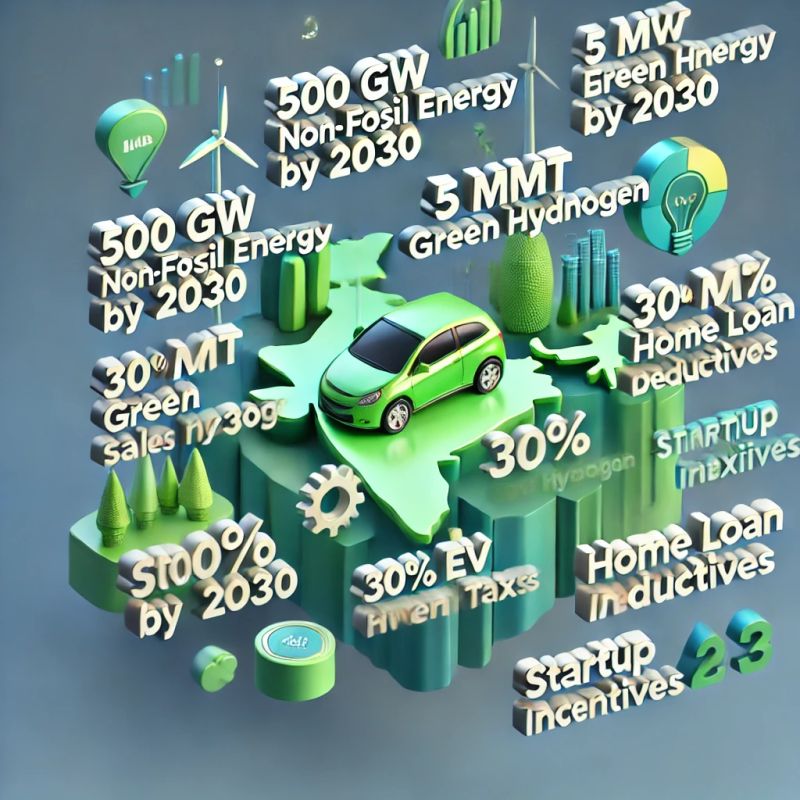
🌟 Super Important: India Targets 500 GW Non-Fossil Capacity by 2030 🌟
🌍 GreenEnergy Highlights
India’s Budget 2025 champions sustainability and green growth. Key priorities include:
🔆 RenewableEnergy:
Target: 500GW Non-Fossil Capacity by 2030.
Major focus on solar, wind, and hydropower.
💚 GreenHydrogen:
Goal: 5MMT Annual Production by 2030.
Incentives for electrolyser manufacturing and green ammonia.
🔋 BatteryStorage & EVs:
Gigafactories for advanced batteries.
Driving 30Percent EV Sales by 2030, with FAME subsidies and charging infrastructure.
🌿 CarbonMarkets & GreenBonds:
Carbon credit trading systems and increased Sovereign Green Bonds to fund renewable energy projects.
📈 EconomicGrowth & FiscalGoals
Balancing fiscal discipline with growth:
📊 GDPGrowth: Nominal growth forecast at 10.5Percent (FY25).
📉 FiscalDeficit: Targeted at 4.7Percent of GDP in FY25, under 4.5Percent by FY26.
🏦 Disinvestment: Reduced to ₹300 billion (from ₹500 billion).
💰 TaxReforms & Relief
SimplifiedTaxation: Capital gains tax rationalization and streamlined tax structures.
IndividualTaxRelief:
Higher home loan interest deduction limit to ₹5 lakh (from ₹2 lakh).
Expanded standard deduction and updated tax slabs to boost disposable income.
CorporateTaxation: Incentives for R&D in clean energy and emerging tech.
StartupSupport: Tax breaks for green startups, space tech, and AI initiatives.
HealthcareRelief: Exemptions on life-saving drugs and reduced GST on medical equipment.
🚀 SectoralSpotlight
Fostering innovation and inclusivity:
🩺 Healthcare: Tax exemptions on critical medicines and medical imports.
🏘️ RealEstate: Incentives for affordable housing and infrastructure status.
🛰️ SpaceTech & AI: Tax cuts and investments in 5G & 6G Infrastructure.
🌾 Agriculture: Subsidies for SolarPowered Irrigation and biofuel production.
🏆 KeyTakeaway
Budget 2025 boldly addresses Sustainability, EconomicGrowth, and TaxRelief, setting India on a path to innovation, fiscal resilience, and green energy leadership.
✨ How do you see these tax reforms shaping India’s future? Let’s connect and discuss! ✨

Originally published on LinkedIn on 2025-01-21 14:17:06: https://www.linkedin.com/feed/update/urn%3Ali%3AgroupPost%3A10334500-7287473288216240128
NamasteGreen_AI_India
India is not only embracing technology but is also leveraging it to ensure a greener and sustainable future for generations to come.” – Narendra Modi
AI_Driving_Sustainability in India: A Data-Driven Revolution
India is emerging as a global leader in AI-driven sustainability, leveraging technology to address critical challenges like climate change, resource management, and pollution. A recent report highlights that 60% of Asia_Pacific organizations, led by Indian innovators, expect tangible benefits from AI within 2-5 years.
Key Applications Transforming India’s Sustainability Landscape
🟢 Renewable Energy
15% efficiency gains through AI-powered forecasting and predictive maintenance.
ReNew Power and Tata Power leverage AI to optimize solar and wind energy, ensuring grid stability and reliability.
🟢 Water Management
Up to 30% reduction in urban water loss using AI-based monitoring.
Startups like Fluid Robotics and WEGoT Utility Solutions detect leaks and optimize water distribution in real time.
🟢 Agriculture
20% increase in crop yields and reduced input costs through AI-powered precision farming.
Leaders like CropIn and Fasal empower over 7 million farmers with actionable insights for smarter resource use.
🟢 Pollution Control
20% improvement in air quality management using real-time AI models.
Companies like Ambee and Bosch India deploy AI for air quality monitoring and smart traffic management.
🟢 Climate Risk Mitigation
30% faster disaster response through AI-driven predictive analytics.
SatSure and Blue Sky Analytics combine satellite data and AI to manage climate vulnerabilities and deforestation.
Why_India_is_Leading
Visionary Goals: Net-zero emissions by YR2070 and alignment with UN SDGs.
Innovation Ecosystem: Startups and industry giants are at the forefront of AI adoption.
Government Push: Policies like AI for All and Digital India are driving scalability.
The_Road_Ahead
India’s AI-driven sustainability initiatives are more than solutions—they are shaping a blueprint for the world. With continued innovation, investments, and collaborations, AI will power India toward a greener, resilient, and sustainable future.
The future is sustainable, and AI is the engine driving India’s progress.
Originally published on LinkedIn on 2024-12-17 12:12:56: https://www.linkedin.com/feed/update/urn%3Ali%3AgroupPost%3A2474261-7274758463560318976
NamasteIndia just ahead of the COP29 Global GHG Emissions by Sector and Key Countries (2023)
Sector Breakdown
1. Power (26%, 15 Gt)
China (27%), US (11%), India (7%): Coal dominates emissions.
Focus: Transition to renewables and improve grid efficiency.
2. Transport (15%, 9 Gt)
US, China, EU: High emissions from vehicles and freight.
Focus: Expand EV adoption and public transport.
3. Industry (11%, 6 Gt)
China, India, US: Cement, steel, and chemical production.
Focus: Decarbonize processes with clean technology.
4. Fuel Production (10%, 6 Gt)
Russia, Middle East, US: Fossil fuel extraction.
Focus: Reduce methane leaks and shift to alternatives.
5. Agriculture (11%, 6 Gt)
Brazil, India, US: Methane from livestock, rice cultivation, and fertilizer.
Focus: Promote regenerative farming and reduce food waste.
6. Land Use & Forestry (7%, 4 Gt)
Brazil, Indonesia, Africa: Deforestation and land conversion.
Focus: Reforestation and sustainable land management.
7. Buildings (6%, 3 Gt)
US, China, EU: Energy use for heating and construction.
Focus: Energy-efficient buildings and renewable energy.
8. Waste (4%, 2 Gt)
India, China, US: Methane from landfills and wastewater.
Focus: Modernize waste management and capture methane.
Top Emitters
China (~30%): Coal, cement, and steel dominate.
US (~14%): Transport and energy-intensive sectors.
India (~7%): Power and agriculture emissions.
EU (~8%): Heavy industries and aging systems.
Brazil & Indonesia: Deforestation hotspots.
Global Priorities:
Energy: Expand renewables and phase out coal.
Transport: Scale up EVs and public transit.
Industry: Invest in clean production technologies.
Forestry: Halt deforestation and restore ecosystems.
Impact: Tailored, sector-specific strategies can drive significant reductions in global GHG emissions.
Source / shared link: https://www.visualcapitalist.com/charted-global-ghg-emissions-by-sector/
Originally published on LinkedIn on 2024-11-19 03:28:20: https://www.linkedin.com/feed/update/urn%3Ali%3AgroupPost%3A59930-7264479581858861056

